Gold price sees little movement following Powell’s outlook on U.S. labor market Kitco NEWS
Month: February 2021
Silver will outshine gold as demand hits 8-year high in 2021 – Silver Institute Kitco NEWS
Categories
Short the Fed, Buy Gold

Source: Peter Krauth for Streetwise Reports 02/09/2021
Peter Krauth, editor of Gold Resource Investor, explains why corporate America is beginning to see gold as a necessary reserve asset.
Yellen is Treasury Secretary. Powell is Fed Chair. And Sanders is head of the Senate Budget Committee.
Most of the time, it’s impossible to tell the future. But there are exceptions. Right now, there’s no room left to read between the lines. The goals, and outcome, are obvious.
America, along with the rest of the world, is going to try and spend its way out of the pandemic crisis.
This crystal ball is perfectly clear, and Wall Street’s been peering into it. That’s why stocks are near all-time highs. It’s why, increasingly, the savviest managers from corporate America are also catching on, and acting.
It’s why Tesla just moved $1.5 billion of its cash into bitcoin. Naturally, that’s big news. But what didn’t make the Tesla headlines may surprise you.
It’s time to manage your cash, with gold.
The Dollar Is Fizzling
Here’s what Tesla’s latest 10k filing said:
“In January 2021, we updated our investment policy to provide us with more flexibility to further diversify and maximize returns on our cash that is not required to maintain adequate operating liquidity…we may invest a portion of such cash in certain alternative reserve assets including digital assets, gold bullion, gold exchange-traded funds and other assets as specified in the future.” (emphasis mine)
Alternative reserve assets? Gold bullion? Gold exchange-traded funds?
Folks, the writing is now all over the wall. Corporate America is cluing in, but the vast majority of individual investors haven’t…yet. It’s why gold, silver, and pretty much all commodities have started to run higher.
The dollar is toast.
Look, the dollar’s been the undisputed reserve currency for nearly a century. But that’s the average life span of a reserve currency going back over 500 years.
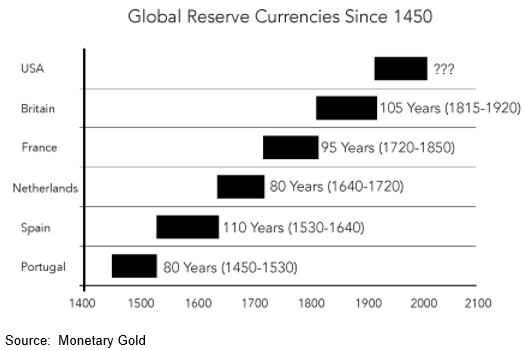
The dollar enjoyed a short reprieve over the last decade or so, but central bank and government reaction worldwide to the Covid-19 crisis was the final straw. The camel’s back is now broken.
Even bond king Jeffrey Gundlach’s firm, DoubleLine Capital, via Bill Campbell, recently said:
“…a series of equal and opposite reactions are occurring as nations move to remove the role of the U.S. dollar at the center of global trade and finance. This will have long-lasting structural impact in ending the dominance of the dollar as the world’s reserve currency.”
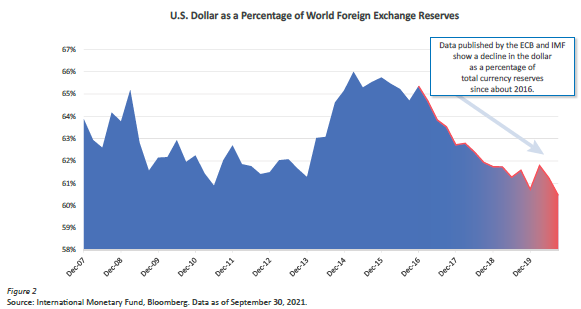
The action in the US dollar index over the past few years tells a similar story.
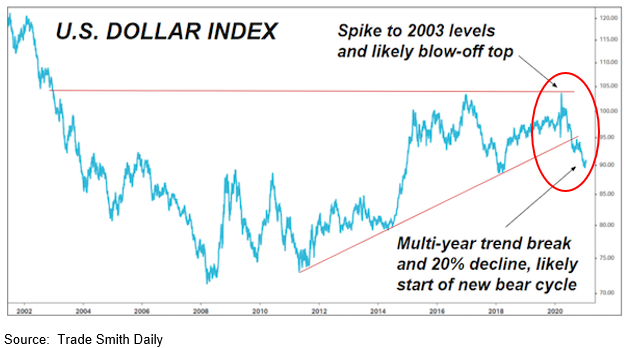
The dollar has clearly broken down below a rising trend line after peaking near 105 last March. Today, it’s trading near 90. By all accounts, it appears the dollar has resumed its long-term downtrend.
Stanley Druckenmiller, once chief portfolio manager at George Soros’ Quantum fund, recently said in a Goldman Sachs interview,
“It’s possible, in fact probable, that all this stimulus is still going to be in place and frankly increasing just when we release the biggest increase in pent up demand globally that we’ve had maybe since the 1920s, which could make the world look extremely different than today…I would say that my overriding theme is inflation relative to what the policy makers think.”
That makes gold a go-to option not only to preserve, but to grow your cash.
The Future is Golden
2020 was challenging for everyone, including gold miners.
Annual gold mine production actually dropped about 3% last year, from 3,300 tonnes to 3,200 tonnes, as miners were forced to temporarily shut down their facilities.
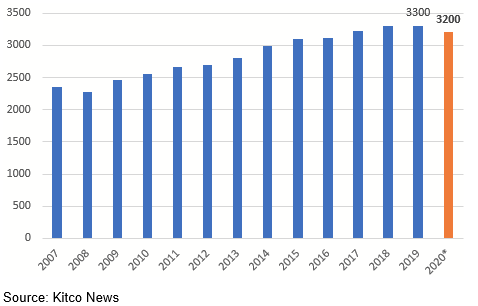
Still, most analysts expect gold output to grow over the next decade. A report by Fitch Solutions forecasts about 2.5% annual gold production growth between 2020 and 2029, led by Russia which would overtake China as the largest producer by then. But it’s worth noting Russia’s drive to grow its gold output is in order to increase its central bank holdings as a buffer against ongoing U.S. sanctions and risks of Russian banks being excluded from dealing in dollar-denominated assets. So a lot of Russia’s production may never reach market. (Source: The Northern Miner, Sept. 1, 2020)
Going all the way back to the mid-1970s, gold has not only kept pace, but surpassed global M2 money supply growth.
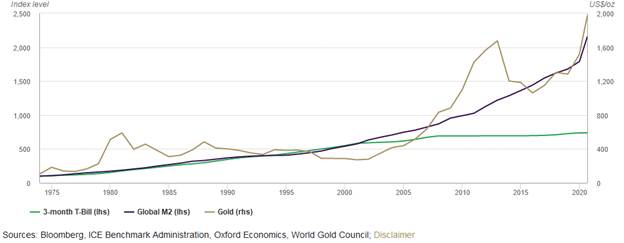
Overall, I expect demand drivers to hold up. According to the World Gold Council, central banks are set to remain net buyers again this year. In my view, financial and geopolitical uncertainty, near-zero or negative rates, historic levels of fiscal and monetary stimulus, and massive pent-up demand as pandemic effects subside mean gold is primed to outperform.
Here’s the big takeaway.
The dollar has resumed its long-term downtrend, as investors are beginning to realize it’s about to be printed into oblivion. You need to take steps now that will help you protect your cash and purchasing power. And that means prioritizing precious metals and commodities.
In the Gold Resource Investor newsletter, I provide my outlook on which gold stocks offer the best prospects as this bull market progresses. I recently added two companies to the portfolio, which I believe have exceptional potential to double or better in the next 12 months.
In the end, it’s not just me saying gold’s a necessary reserve asset.
Now even Elon Musk likes gold.
–Peter Krauth
Peter Krauth is a former portfolio adviser and a 20-year veteran of the resource market, with special expertise in precious metals, mining and energy stocks. He is editor of two newsletters to help investors profit from metal market opportunities: Silver Stock Investor, www.silverstockinvestor.com and Gold Resource Investor, www.goldresourceinvestor.com. In those letters Peter writes about what he is buying and selling; he takes no pay from companies for coverage. Peter has contributed numerous articles to Kitco.com, BNN Bloomberg, the Financial Post, Seeking Alpha, Streetwise Reports, Investing.com, TalkMarkets and Barchart, and he holds a Master of Business Administration from McGill University.
Sign up for our FREE newsletter at: www.streetwisereports.com/get-news
Disclosure:
1) Statements and opinions expressed are the opinions of the author and not of Streetwise Reports or its officers. The author is wholly responsible for the validity of the statements. Streetwise Reports was not involved in any aspect of the article preparation. The author was not paid by Streetwise Reports LLC for this article. Streetwise Reports was not paid by the author to publish or syndicate this article.
2) This article does not constitute investment advice. Each reader is encouraged to consult with his or her individual financial professional and any action a reader takes as a result of information presented here is his or her own responsibility. By opening this page, each reader accepts and agrees to Streetwise Reports’ terms of use and full legal disclaimer. This article is not a solicitation for investment. Streetwise Reports does not render general or specific investment advice and the information on Streetwise Reports should not be considered a recommendation to buy or sell any security. Streetwise Reports does not endorse or recommend the business, products, services or securities of any company mentioned on Streetwise Reports.
3) From time to time, Streetwise Reports LLC and its directors, officers, employees or members of their families, as well as persons interviewed for articles and interviews on the site, may have a long or short position in securities mentioned. Directors, officers, employees or members of their immediate families are prohibited from making purchases and/or sales of those securities in the open market or otherwise from the time of the decision to publish an article until three business days after the publication of the article. The foregoing prohibition does not apply to articles that in substance only restate previously published company releases.


Source: Peter Epstein for Streetwise Reports 02/09/2021
Peter Epstein of Epstein Research discusses this newly listed company with “two 100%-owned, potentially world-class copper porphyry projects in Peru.”
There’s been a tremendous amount of attention on gold juniors over the past year, and rightfully so. Gold at $1,846/oz is up +27% from 2020’s March low (down from an all-time high of $2,070/oz. last summer).
Silver is up even more. However, I bet few readers know that copper (“Cu”) at $3.72/lb (near an 8-year nominal price high) has soared +87% from its 52-week low. In the midst of a global pandemic, Cu has been one of the best performing commodities.
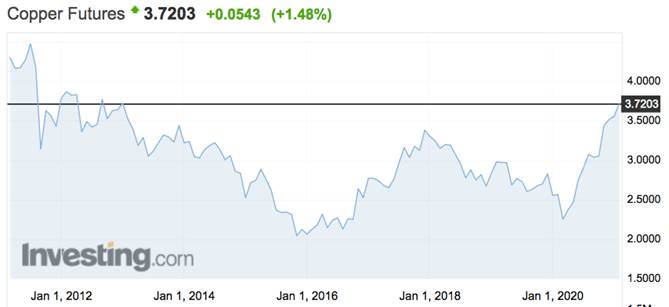
Copper fundamentals are strong, not just for this year and next, but for a long time to come. Goldman Sachs believes the world is entering a multi-year commodities super-cycle.
A renewed push for global decarbonization (with the U.S. back in the game and climate change increasingly undeniable) is one of several key factors pointing towards a new super-cycle thesis.
Copper fundamentals are strong for decades to come….
The 2020s will be remembered for massive deficit spending/debt issuance, which is bullish for precious metals—but also for base metals. Tens of trillions of dollars will be spent on giant Cu-intensive infrastructure and green energy projects. Renewable energy projects require 5x the Cu of fossil fuel plants.
The paradigm shift to vehicle electrification will boost Cu demand as well. EVs require 4x the Cu of internal combustion engine cars. Not to mention that Cu soon to be needed for 18-wheelers, delivery vans, construction, mining, military vehicles and equipment, ocean-crossing container ships, etc. Prodigious quantities of Cu will be required to build a vast battery charging infrastructure to make it all work.
Strong Cu demand is all but assured, but global supply is increasingly precarious. Many of the largest Cu mines are also the oldest and deepest—some date back to the 1800s.
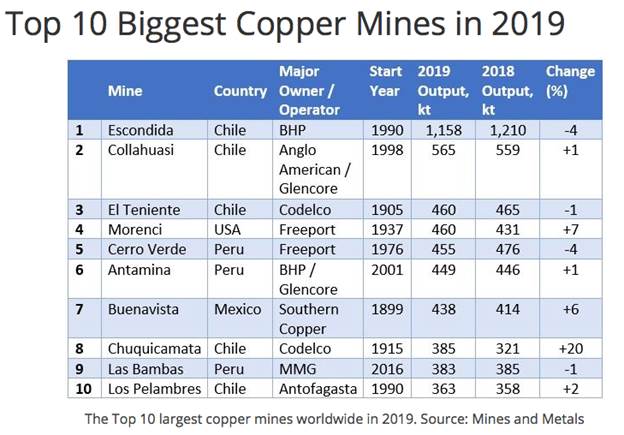
Mined Cu grades have been in decline for decades, as has the number of new, blockbuster Cu discoveries. Several well-known open-pit mines are now operating at grades at or below 0.25% Cu. That’s US$19/tonne rock.
….but copper supply is increasingly uncertain
Everything I’ve written points to one critical takeaway. Higher Cu prices are necessary to incentivize mining companies to invest billions of dollars, over 10–20 year periods, to develop reserves—and then plan, permit, fund and build mines, processing plants and tailings facilities.
Adjusted for inflation, the all-time high Cu price breached $6/lb in the mid-1970s. In 2011 it was >$5/lb. The 2020s will likely see a new record high price. That’s great news for up-and-coming Cu juniors with (prospective) mines opening this decade—not so good for old, high-cost, low-grade mines nearing end of life.
Chile is by far the leader in Cu production, accounting for 28% of the world’s mined copper in 2020. But, cost inflation and lower grades are taking a toll. Obtaining water to operate the mines, many of which are at elevations above 3,500 meters, is tremendously challenging, costly and time consuming.
Peru is the second largest Cu producing country, it delivered 12% of last year’s mined copper. It too has mines at high and very high! elevations (>4,000 meters). Northern Peru is widely considered to be more difficult for companies to do business in due to opposition to mining in some areas.
However, in the central and southern parts of the country, which in many cases have less population density, mine operations are better tolerated and permitting is easier to achieve.
In the most recent Fraser Institute Mining Survey, Peru ranked higher than 7 of 12 Canadian provinces and (also) 7 of 12 U.S. states. Overall it ranked near the top of the second quartile.
Chile and Peru (a combined 40% of 2020 mined Cu) have been great jurisdictions to work in. Looking forward, both countries will likely remain Cu powerhouses, but fresh new mines will lead the way as aging, depleted mines shut down.
A newly listed company that’s well positioned with two 100% owned, potentially world-class copper porphyry projects in Peru is Element 29 Resources Inc. (ECU:TSX.V). Both projects are at 4,000 meters.
Element 29 Resources; advancing two promising Cu projects in Peru
Unlike for a growing number of properties in Chile, water is not expected to be an issue for Element 29. In fact, one of the two projects is close to a river. Both are outside of northern Peru, in the more mining friendly southern and central parts of the country. And, both are
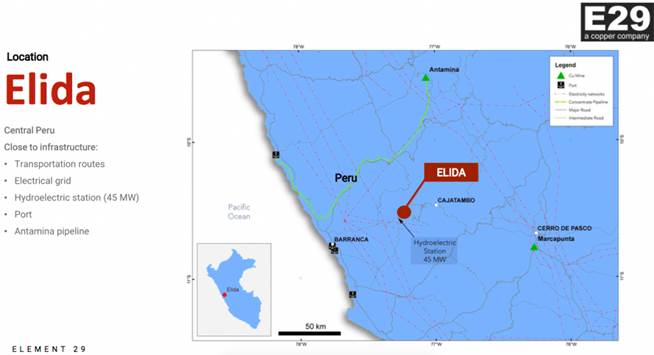
The Elida property hosts a recently discovered (2013), untested copper-moly (Cu-Mo) porphyry cluster located ~170 km northwest of Lima, and ~85 km from the coast. Elida sits in a highly prospective porphyry belt in central Peru.
The property consists of 28 mining concessions totaling 19,210 hectares. It’s a cluster of at least four porphyry centers, with only the central target drilled.
The initial focus at Elida is on a sizable 750 meter by 600 meter central porphyry target. Management is pursuing a conceptual exploration target of 200 to 500M tonnes, grading between 0.35% to 0.45% Cu plus 0.03% to 0.05% Mo plus 3.5 to 4.5 g/t Ag.
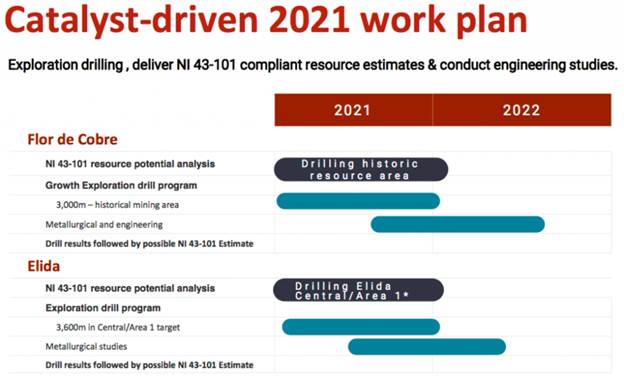
This is no pie-in-the-sky three-year goal. Element 29 is funded to deliver a NI 43-101 resource that could be >200M tonnes by Q1 2022. Management already has 18 holes, nearly 10,000 meters of historical drilling. The team needs to tighten up the spacing. A 3,600 meter infill drill program is expected to start in April.
In 2014–15, Lundin Mining completed a modern 18-hole / 9,880 meter drill program that intersected a robust porphyry system. All holes hit Cu-Mo-Ag mineralization. Most holes ended in mineralization, (some holes in moderately high-grade mineralization) meaning that the system remains open at depth.
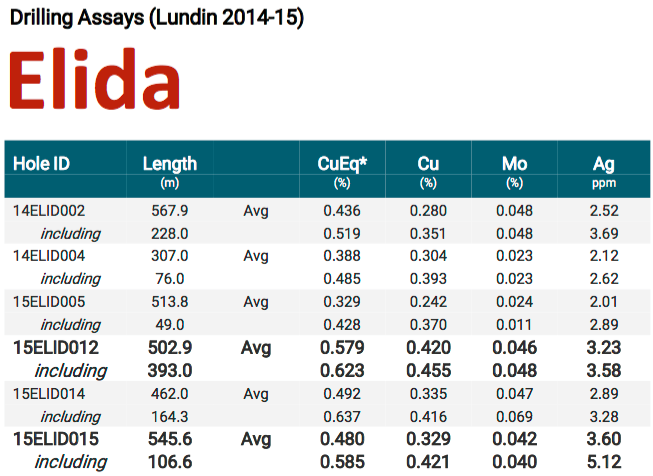
Note: Drilling and sampling was carried out by Lundin Mining Peru SAC (2014-2015). ALS-Global Laboratories in Lima, Peru, analyzed the half-core by ME-ICP41, which includes 35 elements using an Aqua Regia digestion ICP-AES analysis and gold fire assay with an AA finish (Au-AA23). The over limits underwent ME-OG46 for ore grade elements using an Aqua Regia digestion. Reported widths are drill core lengths; true widths are unknown at this time. Assay values are uncut. The calculated Copper Equivalent (CuEq. (%)) grade was used to determine the significant intervals (>0.20% CuEq. and >30 m core length, with higher grade intervals using a >0.40% CuEq. and >15m core length). *CuEq. = Cu(%) + Mo(%) x 2.667 +Au (ppm) x 0.6320 +Ag (ppm) x 0.0097 (no metallurgy has been completed at Elida, therefore no metallurgical recovery was applied in the copper equivalent formula). Cu Price= $3.00 USD/lb, Mo Price = $8.00 USD/lb, Au Price=$1,300.00 USD/oz, Ag Price=$20.00 USD/oz. The numbers correspond to Table 4 in the Elida Technical Report (refer to www.sedar.com for the full report).
The best assay at Elida was from hole DDH-15ELID012, which hit a wide intercept of 503 m of 0.42% Cu plus 0.046% Mo plus 3.2 g/t Ag = 0.58% Cu Eq., including 393 m of 0.455% Cu plus 0.048% Mo plus 3.6 g/t Ag = 0.62% Cu Eq.
Drilling confirmed very significant areas of potential mineralization. Management believes there is excellent exploration upside. And, preliminary metallurgical studies are planned with existing core taken from prior drilling done by Lundin. In my view, this is a top-quartile global Cu exploration project.
From Element 29’s NI 43-101 technical report on Elida:
“Elida is a Cu-Mo-Ag mineralized porphyry complex that is part of a cluster of porphyry centres exposed over ~2.0 by 2.5 km. Elida is the first Eocene-aged porphyry system identified in Peru. This suggests a re-appearance of the Eocene magmatic arc present much further south in northern Chile. The world-renowned Chuquicamata and Escondida porphyry copper deposits reside in the Eocene belt of northern Chile.”
The property and surrounding areas are mostly uninhabited. Land in the immediate region is not being used. Engagement with locals has been ongoing for years. A community agreement that was set to expire in 2020 was successfully renewed until 2025. Management anticipates few, if any, difficulties in obtaining surface and water rights.
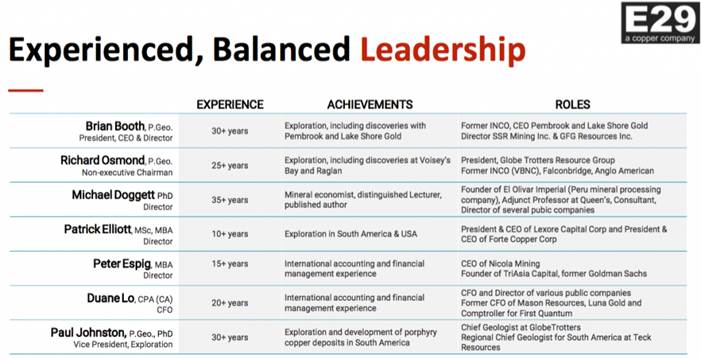
I’m placing a great deal of faith in this leadership team. The chairman, Richard Osmond; CEO, Brian Booth; and VP of Exploration, Paul Johnston have worked extensively in Peru and have considerable large and small mining company experience. The team includes notable experts in copper as well, like Director Peter Espig.
President and CEO Brian Booth (P.Geo) is very impressive; he has over 20 years with mining giant INCO and has held CEO and director positions at other junior miners and is currently a director at SSR Mining and GFG Resources.
Flor de Cobre, a second potential company-making asset
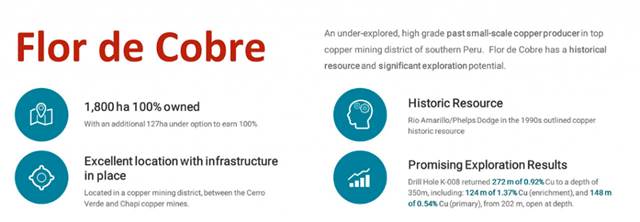
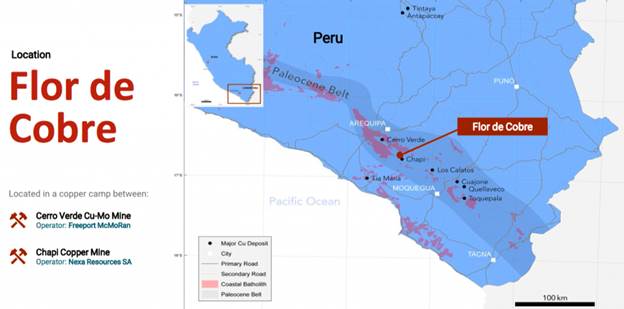
Second, but not last, Flor de Cobre (“Flor”) is an 1,800 hectare property (+127 ha under option) in the Southern Peru Copper Belt. It hosts an under-explored, higher-grade, small past-producing copper mine in southwestern Peru.
The project sits 45 km southeast of the country’s second largest city (Arequipa). It’s 30 km southeast of the fifth largest copper mine in the world, Freeport’s Cerro Verde, and just 7 km northwest of the Nexa Resources’ Chapi mine. Flor is wide open at depth and along strike to the northeast.
In addition to Cerro Verde and Chapi, multiple operating mines and deposits of >10 Mt of contained Cu are in the belt, including Cuajone and Toquepala (Southern Copper) and Quellaveco (Anglo/Mitsubishi).
The Flor area hosts a porphyry copper-molybdenum (Cu-Mo) system called the “Candelaria Porphyry,” with characteristics similar to other porphyry deposits in the belt.
One or more Cu enrichment zones support high-grade potential
The Candelaria zone was outlined by two drill campaigns in the 1990s and includes an enriched Cu zone with pockets of >1% Cu. The dimensions are 850 m x 1,000 m. Rio Amarillo later produced an initial resource estimate based on drilling that covered ~488 ha, and was based on 40 diamond drill holes. {See page 10 of Corporate Presentation}.
In another area, there’s evidence to suggest that the Atravezado target could be a second Cu-Mo porphyry system, bigger than Candelaria at roughly 1.2 x 1.0 km. A geophysical resistivity signature at 400 m depth is similar to other porphyries in the belt, making it a compelling target for testing.
In 1994, there were 60 drill holes completed at Flor, totaling 5,960 meters. The best hole, K-008, returned 124 m at 1.37% Cu (from an enriched Cu zone). Preliminary metallurgical test work was completed to investigate recovery by leaching and flotation. The reported Cu recovery was 89.5%.
Phelps Dodge followed that year’s program with 36 holes totaling 5,882 meters. Drill hole CD-128 returned the best intercept, with 40 m at 1.0% Cu.
Well funded to advance two top-quartile Cu exploration projects
Flor has higher-grade potential, but if Elida demonstrates 200M+ tonnes at a Cu Eq. grade of 0.40%-0.45%, then Element 29 Resources (TSX-V: ECU) could be sitting on two 100%-owned, top-quartile, (global) Cu exploration projects.
Both projects are funded through most of the year. New resource estimates, then third-party Preliminary Economic Assessments (“PEA”) in 2022 could re-rate this exciting new story, especially if the Cu price moves north of $4/lb. Readers take note, the current price of $3.72/lb is just 7% away from that important $4/lb threshold.
Peter Epstein is the founder of Epstein Research. His background is in company and financial analysis. He holds an MBA degree in financial analysis from New York University’s Stern School of Business.
Sign up for our FREE newsletter at: www.streetwisereports.com/get-news
Disclosures / Disclaimers: The content of this article is for information only. Readers fully understand and agree that nothing contained herein, written by Peter Epstein of Epstein Research [ER], (together, [ER]) about Element 29 Resources., including but not limited to, commentary, opinions, views, assumptions, reported facts, calculations, etc. is not to be considered implicit or explicit investment advice. Nothing contained herein is a recommendation or solicitation to buy or sell any security. [ER] is not responsible under any circumstances for investment actions taken by the reader. [ER] has never been, and is not currently, a registered or licensed financial advisor or broker/dealer, investment advisor, stockbroker, trader, money manager, compliance or legal officer, and does not perform market making activities. [ER] is not directly employed by any company, group, organization, party or person. The shares of Element 29 Resources are highly speculative, not suitable for all investors. Readers understand and agree that investments in small cap stocks can result in a 100% loss of invested funds. It is assumed and agreed upon by readers that they will consult with their own licensed or registered financial advisors before making any investment decisions.
At the time this article was posted, Element 29 Resources was an advertiser on [ER].
Readers understand and agree that they must conduct their own due diligence above and beyond reading this article. While the author believes he’s diligent in screening out companies that, for any reasons whatsoever, are unattractive investment opportunities, he cannot guarantee that his efforts will (or have been) successful. [ER] is not responsible for any perceived, or actual, errors including, but not limited to, commentary, opinions, views, assumptions, reported facts and financial calculations, or for the completeness of this article or future content. [ER] is not expected or required to subsequently follow or cover events and news, or write about any particular company or topic. [ER] is not an expert in any company, industry sector or investment topic.
Streetwise Reports Disclosure:
1) Peter Epstein’s disclosures are listed above.
2) The following companies mentioned in the article are billboard sponsors of Streetwise Reports: None. Click here for important disclosures about sponsor fees. The information provided above is for informational purposes only and is not a recommendation to buy or sell any security.
3) Statements and opinions expressed are the opinions of the author and not of Streetwise Reports or its officers. The author is wholly responsible for the validity of the statements. The author was not paid by Streetwise Reports for this article. Streetwise Reports was not paid by the author to publish or syndicate this article. Streetwise Reports requires contributing authors to disclose any shareholdings in, or economic relationships with, companies that they write about. Streetwise Reports relies upon the authors to accurately provide this information and Streetwise Reports has no means of verifying its accuracy.
4) The article does not constitute investment advice. Each reader is encouraged to consult with his or her individual financial professional and any action a reader takes as a result of information presented here is his or her own responsibility. By opening this page, each reader accepts and agrees to Streetwise Reports’ terms of use and full legal disclaimer. This article is not a solicitation for investment. Streetwise Reports does not render general or specific investment advice and the information on Streetwise Reports should not be considered a recommendation to buy or sell any security. Streetwise Reports does not endorse or recommend the business, products, services or securities of any company mentioned on Streetwise Reports.
5) From time to time, Streetwise Reports LLC and its directors, officers, employees or members of their families, as well as persons interviewed for articles and interviews on the site, may have a long or short position in securities mentioned. Directors, officers, employees or members of their immediate families are prohibited from making purchases and/or sales of those securities in the open market or otherwise from the time of the decision to publish an article until three business days after the publication of the article. The foregoing prohibition does not apply to articles that in substance only restate previously published company releases.

( Companies Mentioned: ECU:TSX.V,
)
Categories
EMX Royalty Options 5 Battery Metal Projects

Source: Maurice Jackson for Streetwise Reports 02/09/2021
Maurice Jackson of Proven and Probable sits down with Dr. Eric Jensen, CEO of prospect generator EMX Royalty, to discuss the company’s new option agreements on five battery metal projects in Scandinavia, as well as its other projects.
Maurice Jackson: Joining us for a conversation is Dr. Eric Jensen, the general manager of exploration for EMX Royalty Corp. (EMX:TSX.V; EMX:NYSE.American), the royalty generator.
Dr. Jensen, welcome to the show, sir.
Dr. Eric Jensen: Great to speak with you again, Maurice.
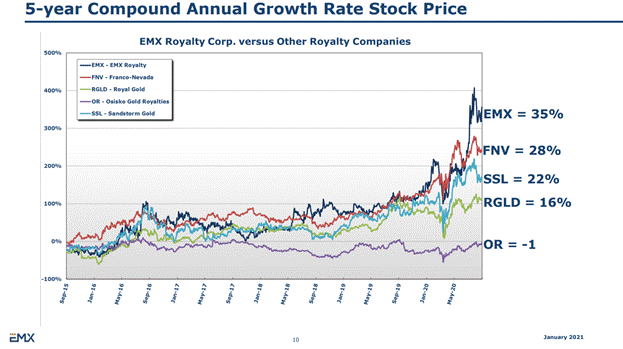
Maurice Jackson: Last time we spoke, if I’m not mistaken, it was 2017 and that was at the Sprott Natural Resource Symposium. And by the way, EMX at that time, sir, was trading around 90 cents on the New York Stock Exchange. EMX has come a long way since then. Sir, would you please share with us, what is the current price for EMX Royalty on the New York Stock Exchange?
Dr. Eric Jensen: We’ve been doing very well. EMX is now trading in the US $3.50 range. I believe we closed at $3.67 today in New York. The company has had a good trend. And I think the last time you and I spoke, that was a time when the sector was just emerging from that slump that we went through between 2011 and 2016. And I remember that conversation distinctly because we were sitting there, as you stated, we were hovering in the 90 cent range, and the people inside the company, we could see how much value we’ve created and we felt we were very tremendously undervalued at that time. And in the subsequent years since we’ve spoken, EMX Royalty has continued to create a lot of value, grow the portfolio. And yeah, the market’s now recognizing that. And I think that we will certainly continue to leverage the strengths of our business approach and business model.
Maurice Jackson: We have full confidence that value proposition of EMX Royalty will continue to reward shareholders. I’m on record. I plan to match my bullion purchases, and anyone that knows me I love my precious metals, for the third year in a row in shares in EMX Royalty. Dr. Jensen, for someone new to EMX Royalty, please introduce the company.
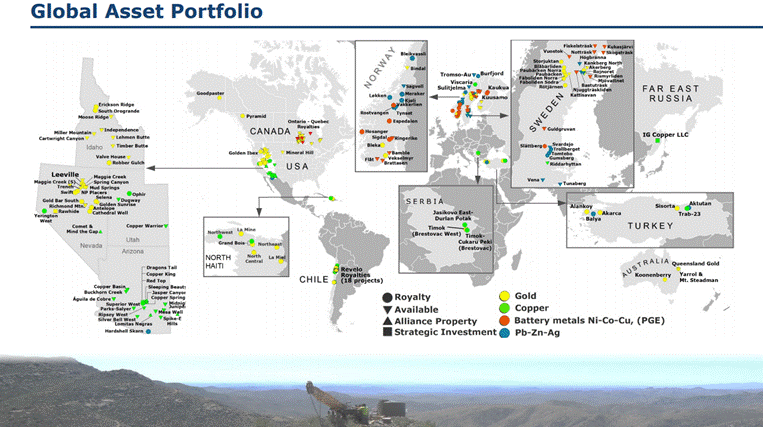
Dr. Eric Jensen: EMX Royalty is a royalty generator. We believe in the long-term value of mineral rights and mineral real estate, and EMX maintains a diverse portfolio of mineral project interests around the world. We now have over 200 project interests. This spans many jurisdictions, commodities, industry partnerships, or commercial frameworks. And with that, we offer our investors exposure to discovery upside, and the optionality, you hear that word a lot now in our sector, of the optionality inherent to the mineral rights. Our project portfolio will continue to grow in value through time as the world economies continue to grow, expand, so we see development in the developing nations. So we are active in obtaining more mineral real estate, mineral rights, as we believe they will become more valuable, and our share price performance certainly reflects that we have been correct.
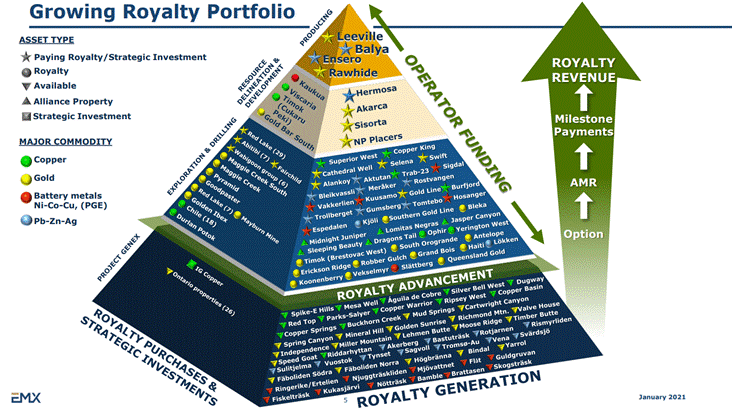
Regarding royalties, EMX is a bit different than other companies in our sector in that a lot of our exposure, the value that we create in our company, is via the royalty generation model. And this gives exposure to our shareholders to cashflow some royalties without the liability exposures or the capital risk exposures that come with the development and the operational side of the business. It’s just a great way to leverage the long-term value of mineral resource production and the value of mineral rights in a global sense.
Maurice Jackson: I couldn’t have said it better and that’s exactly why I continue to match my purchases in precious metals with the shares in EMX. Dr. Jensen, EMX Royalty just consummated another accretive transaction on five projects located Scandinavia involving nickel, copper, cobalt and platinum group elements. Investors are curious to find out why EMX Royalty has taken a strategic position in these metals. But before we get into the details of the transaction, provide us with some context on these metals from a production and consumption outlook, respectively, beginning with cobalt. What is the opportunity here?
Dr. Eric Jensen: I’ll address both nickel and cobalt together because they’re part and parcel of the same commercial phenomenon. But now EMX is particularly bullish about nickel and in particular nickel sulfide deposits because those types of deposits are primary sources of both nickel and cobalt. So they occur together in these deposits, but also there’s typically a fair amount of copper and by-product PGEs, platinum group elements, which I know is something you’re also quite interested in, and also gold. And we just love the optionality of that metal suite that is found in those types of deposits. And so you get all those things together. And as we know, the electrification of vehicle fleets is now a worldwide phenomenon that’s not going away.
The batteries that are in these vehicles and the motors will consume quite an amount of nickel and copper. And so that the world’s going to continue to consume a tremendous amount of these materials in future years. There’s no question about that. Everyone’s aware of that. But one of the interesting things is between the years of 2011 and 2018, there was very little to, in some cases, arguably no exploration for nickel sulfide deposits, these kinds of deposits where you get these elements altogether and EMX, during that time, we took a contrarian view. We saw this surge in demand that was inevitable, especially with, again, the electrification of vehicle fleets and some of the new technologies that were being introduced in particular with batteries.
We began to acquire these assets in 2016, 2017, and we built a nice portfolio, especially in northern Europe, of these types of assets at a time when other companies simply were disinterested. And that has now changed. Suddenly everyone is interested in and they should be. We’re going to need a lot more of these metals as we go forward.
Maurice Jackson: And speaking of those jurisdictions, are those favorable mining jurisdictions?
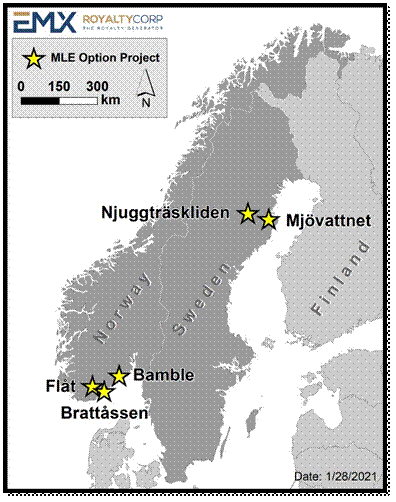
Dr. Eric Jensen: We love working there. There are challenges around the world on the social side, the environmental side, that’s growing, that’s true for every jurisdiction. But what I love about Scandinavia is not only is the geology fantastic, they’ve been mining for 1,000 years up there. They have deposits scattered all over these countries. Norway was the world’s leading nickel producer in the 1800s and people have forgotten about that. There are lots of opportunities there. And in a country like Norway, which switched the focus to petroleum products with the discoveries in the North Sea in the 1960s, as they should have, speculators have kind of forgotten about the mining heritage of Sweden and Norway, for hundreds of years coming out of the Middle Ages and through the Industrial Revolution, they powered the world by provision of copper in particular, and also nickel.
A lot of people have forgotten that. EMX is hoping to revive a lot of that history. Sweden doesn’t need to be revived. They’ve been doing it slowly for 1,000 years, but we’re bullish on both jurisdictions. And on the permitting side, I do hear people say, “Well, aren’t those tough jurisdictions to permit?” I say, “Absolutely not.” What they have is a transparent framework with a very well-defined series of criteria that are applied. You know where you can explore and where you can’t explore, shouldn’t explore. And places where there are restricted environmental covenants, we simply stay out of those places. We work where we can work. I can permit a drill program in six to eight weeks in these countries, whereas elsewhere in the world, sometimes it takes months or even years. So yeah, there’s a big advantage there.
Equally important, they have fantastic fiscal regimes. We’re talking about corporate income tax rates in the low 20s, no state royalties, very progressive commercial structures. The power is very inexpensive, which is a third of the operating cost in mining as power consumption. And then when you can buy electricity for 4.5 euro cents per kilowatt-hour versus 20, 30, 40 elsewhere in the world, that’s a huge advantage. Therefore, we see some of the lowest cut-off grades in the world, most of those mining operations that are active in the Nordic countries. It’s a great place to work.
Maurice Jackson: Speaking of nickel, before we leave there, you have a surging price in nickel. It’s starting to get a lot of attention from speculators, but to have the vision in advance to start making those accretive transactions and then also realizing that there’s a potential supply deficit in front of us, it’s just great business acumen. How about copper?
Dr. Eric Jensen: People sometimes forget about copper in this discussion. After steel, the number one metal component that goes into electric vehicles is copper, by far. It’s much greater than nickel and certainly a lot greater than cobalt. So let’s not sleep on that one. And again so the electrification of vehicle fleets is one thing, but just the advents of economies in developing nations. As people continue to strive for first-world standards of living around the world, the consumption patterns for copper are very clear and that’s reflected in the current price support, and look what the pandemic couldn’t do. It couldn’t beat the prices down of nickel and copper as we come out of the pandemic, looking very strong as they should be because we need them for this development.
Maurice Jackson: Speaking of copper, the world is going to consume more copper in the next 25 years than in all of recorded history. And here you have a company (EMX) that’s exploring for it and discovering it and or creating royalties from it.
Dr. Eric Jensen: I have a slide presentation that I put up and I have a slide that shows exactly what you just said. It shows you a symbol for the amount of copper that’s been discovered, produced and consumed in world history, and then the same volume for the next 25 years. That’s a very good point. Copper is not going away. We have continued to explore for both nickel and copper during the recent downturn and slump in the industry so EMX shareholders are ahead of the curve and we are well poised.
Maurice Jackson: How about my favorite from a precious metals investment standpoint? That’s the platinum group elements. What is the outlook on the production and consumption of these metals?
Dr. Eric Jensen: Oh, that’s another good element! In fact, the Platinum Group Elements (PGEs) are really an interesting group. The PGEs’ fundamental value is seen as a precious metal, but these also have tremendous industry applications, and the platinum group elements, in particular, have this strange geochemical behavior. These components are very resistant to corrosion and attack by chemical reagents, but yet they’re able to catalyze chemical reactions in a phenomenal capacity. And so they have a broad application in industry. This goes from things like aircraft turbines, electronics; they’re used extensively in the petrochemical industry, medical field. There’s a lot of new medical advances that are using these types of components. But of course, the big one is the catalytic converters in vehicles. Now we talked about the electrification of vehicle fleets, but realistically, if you look at much of the developing world, internal combustion engines are not going away.
Neither are cities. And when those two things are combined, you have smog, you have all the issues with emissions of vehicles, and these elements are critical in the supply of catalytic converter components to help us clean the air and have better emissions from these vehicles. That demand is not going anywhere. And these are critical components for that.
Maurice Jackson: And Dr. Jensen, correct me if I’m wrong, but the demand will also be there for electrification of vehicles because you’ve got to have them for the fuel cells in regards to platinum.
Dr. Eric Jensen: I’m glad you brought that up. People are pointing to the PGEs as a critical component for fuel cells. As we convert to that new technology, that’s also going to drive demand on those metals, but, with their unusual chemical characteristics, there’s such a broad use for those. As technology continues to advance, we see new ideas and new technological advancements will continue to identify new applications for those as well.
Maurice Jackson: Germane to platinum, 78% of the world’s platinum comes from a very unstable region of the world, and that is South Africa. So that’s something that is something that one should consider. Also, platinum is 30 times more rare than gold. And I, if I’m not mistaken but I believe South Africa’s cost to extract platinum is the spot price in essence, and thus, again, no profits are coming in.
Dr. Eric Jensen: Those are old mines and older deposits that have been producing for so long, you reach a point where you have diminishing returns to time. And again, we just haven’t done enough exploration for these types of deposits. And so it’s something that we’ve been keenly aware of for several years. EMX sees a great opportunity in the metals as the world moves to clean air through the catalytic converters and electric vehicles.
Maurice Jackson: How is EMX positioning shareholders to take advantage of the value proposition before us in all of these said metals?
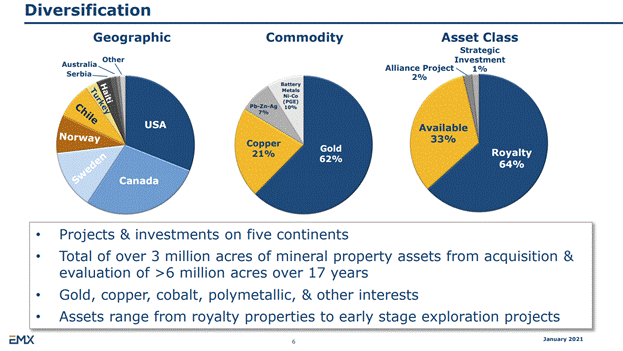
Dr. Eric Jensen: For several years, EMX has been making, not the primary focus, but a key focus of our exploration efforts globally and our business development efforts to procure projects and royalties for these metals. We have now built a substantial, growing portfolio of royalties on nickel sulfide projects that include, again, exposure to nickel, copper, cobalt and PGEs. Last year we consummated an interesting transaction; we bought a royalty in Palladium One’s Kaukua project in Finland, which is a big PGE project that had somewhere just over a million contained ounces of PGEs and the resources, and they’re having a lot of exploration success. And that’s undoubtedly going to grow.
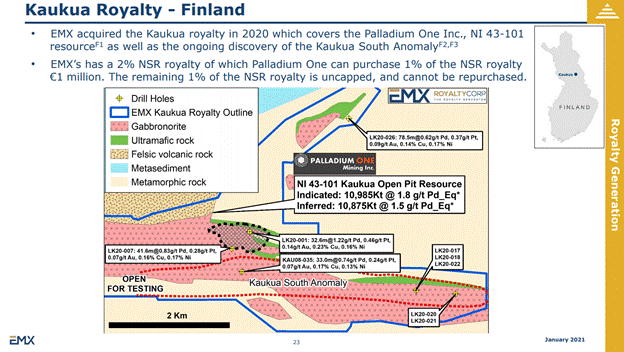
That looks like a big discovery now, but we’ve also been active in exploration for battery metal projects, which these projects we have in our exploration side will be converted steadily to royalty interests through time as for our business model. And in fact, I just picked up an interesting nickel-copper-PGE project last week. I can’t talk about it yet because they’re still putting the land together, but we found another one of these things that were probably forgotten about. We found it in a database of historical information. And so, yeah, we now have several battery metal partnerships established and a growing number of projects that are available for partnership. And we’re looking to do more business along those lines. And so, yeah, I expect the heightened interest in this particular metal scooping to continue and to be significant in the coming years.
Maurice Jackson: By the way, that’s a 2% NSR with Palladium One. Is that correct?
Dr. Eric Jensen: That’s correct. One part of that can be bought down, but that’s a solid royalty. We’re excited about that one.
Maurice Jackson: Oh, there’s nothing wrong with getting some cash upfront either.
Dr. Eric Jensen: Not all (laughing), bonus payment.
Maurice Jackson: Let’s discuss the proof of concept in the strategy by getting details on this week’s press release, “EMX Royalty executes option agreement for five battery metal projects in Scandinavia.” Take us to Scandinavia and let’s visit Sweden first and then Norway and provide us with an overview of the commercial terms between EMX Royalty and Martin Laboratories EMG Limited.
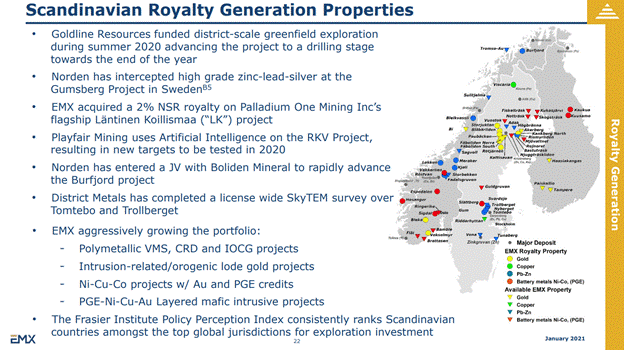
Dr. Eric Jensen: This is an interesting one, actually this press release received a good market reaction. This is a neat opportunity. And so this again grew out of just the current interest from the investing sector in these battery metal projects. And so Ellis Martin is someone we’ve worked with and had a relationship with for many years. He’s been a long ardent supporter of EMX. And he has a group of supporters that are looking to back a battery metals exploration company. He came right to us and said, “Look, I know that you guys generate high-quality mineral projects and exploration projects. And we’ve got a group that wants to back up a spinoff type a company,” and we’ve done this several times in recent years. So we’ve taken this a commercial approach with a really good result for EMX shareholders. We will obtain an equity block in exchange for a portfolio of assets and also a royalty interest on the assets.
In this particular case, it’s going to start on the private side, but I know that Ellis is intending to obtain a public listing rather quickly with this. The support that’s behind this, it’s going to be a well-capitalized vehicle that allows us to do exactly what we do best and that’s to pursue discoveries on multiple assets. And so we put together this portfolio of battery metal assets, both in Norway and Sweden, and this group of assets is interesting. We’ve been collecting, been putting this together since 2017 this particular group. And these were projects that were originally discovered by Falconbridge in the case of the Norwegian assets and state-run enterprises in the case of the Swedish assets.
The original work was done back starting back in the 1970s in the Swedish assets, but none since the global financial crisis. And so you may recall that Falconbridge was purchased by Xstrata around 2006. And Falconbridge had conducted a lot of regional exploration in the Nordics because they had a presence there, but when they were bought by Xstrata, those programs, the funding for the regional exploration was cut and they abandoned those projects, and they’ve just been sitting there. And so we were able to come in and pick up a bunch of projects that have seen significant historical work. And so we got a huge head start on these. There are drills to find mineralization. There are resources and several of these properties are a good starting point.
Maurice Jackson: Sir, I know you have intimate knowledge of these projects. Can you provide us with an overview of the Swedish projects first?
Dr. Eric Jensen: So these were projects that were picked up in what’s called the nickel line. And so this is an area in which the Swedish government had focused quite a bit of attention back in the 1970s and 1980s. And in that era, all the exploration in Sweden was done by state-run enterprises. And so their modus operandi is they’d come in and look for outcropping discoveries or places where mineralization was exposed to the surface, they’d drill a pincushion of shallow drill holes, and then move on to the next project. And so they left behind a whole series of these probably drilled out, probably explored resources that were never drilled the depth. And they indicate that on their notes. And you read the exploration histories and you look at the records and you can see, yeah, sometimes you just see the tops of these systems.
We have no idea how they projected depth, or even in some cases what happens along strike. It’s a really interesting series of opportunities there. And we see all kinds of other indicators of other bodies of mineralization being present in these licenses that have just never been explored fundamentally. So really neat opportunities.
Maurice Jackson: How about an overview of the Norwegian projects?
Dr. Eric Jensen: These projects also go back to the Falconbridge programs. And so this was a group that came into Norway in the 1920s. There’s a big refining and processing nickel refinery in southern Norway called Nikkelverk A/S. And that was purchased by Falconbridge back in the 1920s. We have to remember, this was one of the worlds, again, it was probably, I think the world’s largest producer of those commodities back in the 1800s. And then Falconbridge owned that for many, many decades. And then they started doing quite a bit of rigorous exploration in the early 2000s before they were purchased by Xstrata. And they assembled a whole series of projects. We conducted geophysics as well as some scout drilling, and a lot of surface work that defined a whole series of opportunities. And then 2006 hit. They pulled up their stakes.
The projects got transferred to a JV partner who never recovered from the subsequent global financial crisis. You may recall it was just right before the wheels came off the global financial system. And yeah, those products have been idle ever since then. And 2012, 2013, 2014, no one cared about a nickel. These products were just sitting there. So EMX began collecting these, going out, and acquiring these mineral rights in 2016, 2017, and as recently as last year.
Maurice Jackson: What are the exploration plans for 2021 on these projects?
Dr. Eric Jensen: We’re going to be pretty aggressive. There’s financing that’s taking place, be taking place now and the coming weeks and then, yeah, we’ll put these, so we’ll put these exploration dollars to work. There’s a lot we can do just picking up where the other teams had left off back in the 1980s or 2000 era exploration programs. We have a bunch of surface work to do, and we’re going to refine drill targets. Several of the products have walk-up drill targets. And we’re hoping to commence drilling probably in the summer months of 2021, if things go well, and then a whole series of just logical steps that we’ll apply that the types of methodologies other companies have used in that region with great success to make other discoveries. And so the nice thing about these is that a lot of the discovery has already been made. We just got to continue to explore them. So that’s a great place to start, and there’s plenty of plenty to do this year, starting with the surface work.
Maurice Jackson: So we’re going to start the surface work. How about assay results? Have there been any delays from that region?
Dr. Eric Jensen: The labs are actually in pretty good shape. Now, we’re dealing with the travel restrictions that are in place with the pandemic, but now with the proliferation of vaccines, believe that the travel restrictions that are in place will be hopefully lifted mid part of this year, maybe later this year. So we’ll be able to move around freely again in the Nordic countries shortly. So that is a concern right now because things are a little bit delayed. It’s hard to go between the countries right now, but the labs seem to be in pretty good shape. And so we’ve been able to get assays turned around rather quickly on the current products that we’re exploring. And so we’re excited about this new partnership. We’ll get this underway. There’s still snow cover on most of these properties, but we’ll see that abate in the next couple of months, and then we’ll get to work on the surface.
Maurice Jackson: Dr. Jensen, I’m smiling from ear to ear. All of the aforementioned are just great use of optionality and yet another perfect demonstration of the vision, patience, and deployment of the royalty generation business model by EMX Royalty. Before we close, Dr. Jensen, please provide us with the capital structure for EMX Royalty.
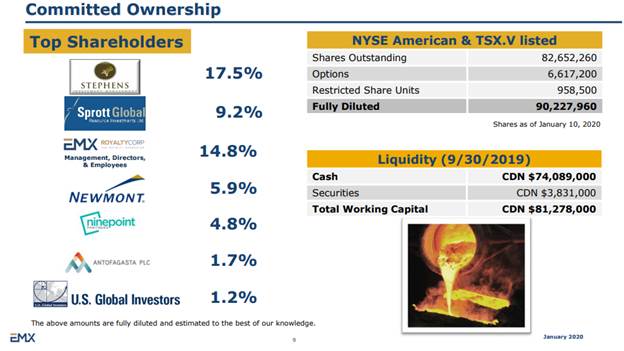
Dr. Eric Jensen: EMX Royalty has 84 million shares issued and outstanding at this point, 92 million on a fully diluted basis. But the key point for EMX, Maurice, as you’re aware, we’re well capitalized. We have plenty of cash and so shareholders like myself, I’m a key shareholder in the company, we don’t have to worry about EMX running out of money and taking a dilute of financing, which happens in the sector at times. We did small financing back in 2017 for a very specific purpose. And I believe that’s the only financing we’ve done since Q1 2011. So it’s been a decade since we’ve had to take down financing. The merits and stewardship provide shareholders with a tight share structure, well capitalized, strong treasury, good revenue streams from multiple sources of funding, and our existing project portfolio. EMX is well positioned.
Maurice Jackson: Now. I’d be remiss if I didn’t ask this, you don’t have to give me a timeframe. I just wonder if there’s a discussion, only a discussion, but any discussions regarding dividends.
Dr. Eric Jensen: Yeah. We get that question a lot.
Maurice Jackson: I’m sure you do.
Dr. Eric Jensen: As we company we are focused right now and just the clever and prudent ways to deploy our capital that we have in the treasury, because our goal, it’s no secret that we are all looking for again, good, clever prudent ways to deploy our treasury to secure additional cash flow for the company. That’s our primary focus. And so just a side thing, if anyone company with royalties or cash flowing assets should not hesitate to contact us, but yeah, we’re on a good path to positive and increasing cash flow within the company. We have several royalty assets that are now reaching the production stage. Again, the core of our business is the organic generation of royalties, and a lot of the projects that we’ve been working on for years now are now reaching that production stage. So we’re seeing that in several cases.
And we expect that those production royalty revenue streams will be a catalyst to reprice our stock in the future. But yeah, we are eager to find additional sources of those types of revenues. And certainly, a dividend is part of the discussion right now. A lot of people have been asking us about that, but our first objective is to make sure that this company is on a really solid financial footing as it has been, but we want to secure that future for our shareholders as well.
Maurice Jackson: Now, you alluded to it there with a future cash flow generating here shortly. Can you tell us anything about the events going on right now in Serbia?
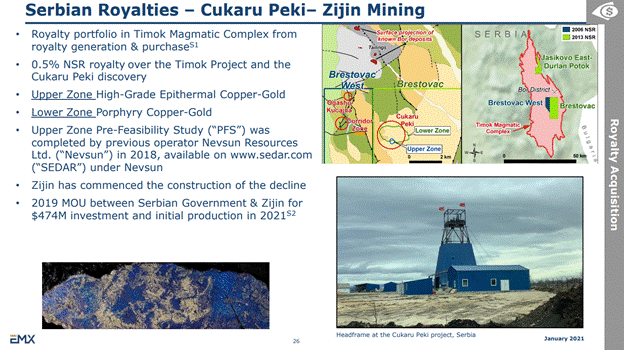
Dr. Eric Jensen: I guess the best thing I can do at this point is to direct the listeners to Zijin Mining website, which is the big Chinese multinational company that’s advancing that project in which we have, you’re referring to the Timok Magmatic Complex where we have a royalty on the Cukaru Peki discovery, which is one of the world’s biggest or ongoing, I should say, discoveries of copper and gold in the past decade. It was a great discovery that’s now being advanced by Zijin, a rapidly growing international player in the mining sector. They’ve put up some news recently in terms of their production schedule. Zijin has been telling the market that they’ll be producing from Cukaru Peki in Q2 2021. And that’s the latest indications on the website that they’re on pace to do that, so pretty exciting news coming out of there, but that’s going to be a great royalty for our company for years to come.
Maurice Jackson: Folks, this is a behemoth. I know Dr. Jensen kind of said that little conservatively, I don’t know which one excites me more the success EMX has on the Malmyzh Copper project in Russia, which loaded the treasury with Brinks Truck delivering nearly $70M CAD or the opportunity before in Cukaru Peki. They’re both just fantastic assets for the company and shareholders.
Dr. Eric Jensen: If you could just build a copper and gold deposit, you’d build it like Cukaru Peki. It’s got a real high grade, it’s like a big animal with a hat and that hat is a high-grade copper and gold system. As Zijin mines downward they’re going to start in this ultra-high-grade material, which they’ve got some announcements in their website about that, and then there’s a big porphyry copper-gold system below it that the bottom of which they’ve not finished drilling out, it’s still expanding. So it’s a great system. It’s got this full high-grade value driver on top, where they’re going to start mining. Then we get this big porphyry system that underlies that. So it’s a fantastic discovery, a great story, and we are delighted to have that royalty in portfolio.
Maurice Jackson: And again, a recurring theme, a surge in the copper price, increased demand, and again, a company that’s going to be profiting from that. And that’s going to be EMX Royalty and their shareholders. This transaction alone has the potential to make to the stock melt up! In closing, multilayered question here, what is the next unanswered question for EMX Royalty? When can we expect a response and what determines success?
Dr. Eric Jensen: I’d come right back to the question of cash flow. Again, we’re looking for cash flow, we’re looking to augment the value creation, the value drivers for the company. And so that’s something that a lot of us are focused on right now. And one thing I want to point out that may not be all that obvious to the market is that we have assembled a very elite team of advanced project evaluators at EMX because we’re looking at these royalty interests. We’re looking at advanced projects. We’ve developed a team of eight players with a wealth of development and operational experience. And I would put this team up against any other due diligence team in the world in terms of their ability to quickly decipher value and to see red flags on operations and investment opportunities that other companies may not see.
And so I think a lot of interesting decisions are being made by royalty companies out there right now in terms of buying assets, but we’re not going to make any big mistakes. We’ve got a great technical team. We are keen stewards of shareholder value, and we have our eye on the long run. And so this is a company that’s based to, we call it the get rich slow scheme. I call it a crescendo of value creation and that we’re on that path and we intend to stay there.
Maurice Jackson: Sir, what keeps you up at night that we don’t know about?
Dr. Eric Jensen: I’m a terrible sleeper as it is, but what keeps me up at night is just quite simply, it’s the thought of missing an opportunity or missing a royalty opportunity, the opportunity to pick up a great project or a royalty. There are times I’ll sit up at two in the morning and just think, “Hey, we looked at this project 10 years ago. Maybe that came open and maybe the claims were dropped,” and you run to the computer and you get your GIS database, you start flipping through land status and seeing if there’s an opportunity there. I hate getting beat to new opportunities. We’ve got a great dynamic, nimble team that’s out there around the world looking for a new value for the company. And so I don’t like getting beat to stuff. That keeps me up.
Maurice Jackson: Last question and that is, what did I forget to ask?
Dr. Eric Jensen: I come back again to that technical team. Again, it’s what value drivers within EMX are not visible to the market. And I think that this great team of eight players we’ve put together to assess advanced project opportunities, strategic investments and royalties, people may not be able to see that from the outside, but this is a great value driver for our company. I’m very confident in this team’s ability and the willingness of the team also to think entrepreneurially and creatively about where value may lie that other companies can’t see. We’ve had a history of doing that. We’ve gone to some unusual jurisdictions. You referred to the Malmyzh project in the far east of Russia, and we’ve capitalized opportunities in ways that other companies have not been able to, and that’s a credit to the people we have on this team. It’s a fantastic group to work with. We love what we do. We have a lot of fun. It’s a great group, a great group of people, and yeah, we’re going to continue to deliver value and hopefully in a real big way.
Maurice Jackson: EMX Royalty is just the perfect combination of the tangibles and the intangibles. And again, I’m on record. This is my third year. I plan to match my precious metal purchases with shares in EMX Royalty. Dr. Jensen, for someone listening that wants to get more information about EMX Royalty, please share the website address.
Dr. Eric Jensen: Please visit us at www.emxroyalty.com.
Maurice Jackson: Dr. Jensen, it’s been a pleasure speaking with you. Wishing you and EMX Royalty the absolute best, sir.
Before you make your next precious metals purchase (Platinum) make sure you contact me. I’m a licensed representative to buy and sell physical precious metals through Miles Franklin Precious Metals Investments where we have several options to expand your precious metals portfolio from physical delivery of gold, silver, platinum, palladium, and rhodium directly to your home or office, to offshore depositories and precious metal IRAs. Call me directly at 855.505.1900 or email maurice@milesfranklin.com. Finally, please subscribe to Proven and Probable, where we provide Mining Insights and Bullion Sales. Subscription is free.
Maurice Jackson is the founder of Proven and Probable, a site that aims to enrich its subscribers through education in precious metals and junior mining companies that will enrich the world.
Sign up for our FREE newsletter at: www.streetwisereports.com/get-news
Disclosure:
1) Maurice Jackson: I, or members of my immediate household or family, own shares of the following companies mentioned in this article: EMX Royalty. I personally am, or members of my immediate household or family are, paid by the following companies mentioned in this article: None. My company has a financial relationship with the following companies mentioned in this article: EMX Royalty is a sponsor of Proven and Probable. Proven and Probable disclosures are listed below.
2) The following companies mentioned in this article are billboard sponsors of Streetwise Reports: None. Click here for important disclosures about sponsor fees.
3) Statements and opinions expressed are the opinions of the author and not of Streetwise Reports or its officers. The author is wholly responsible for the validity of the statements. The author was not paid by Streetwise Reports for this article. Streetwise Reports was not paid by the author to publish or syndicate this article. The information provided above is for informational purposes only and is not a recommendation to buy or sell any security. Streetwise Reports requires contributing authors to disclose any shareholdings in, or economic relationships with, companies that they write about. Streetwise Reports relies upon the authors to accurately provide this information and Streetwise Reports has no means of verifying its accuracy.
4) This article does not constitute investment advice. Each reader is encouraged to consult with his or her individual financial professional and any action a reader takes as a result of information presented here is his or her own responsibility. By opening this page, each reader accepts and agrees to Streetwise Reports’ terms of use and full legal disclaimer. This article is not a solicitation for investment. Streetwise Reports does not render general or specific investment advice and the information on Streetwise Reports should not be considered a recommendation to buy or sell any security. Streetwise Reports does not endorse or recommend the business, products, services or securities of any company mentioned on Streetwise Reports.
5) From time to time, Streetwise Reports LLC and its directors, officers, employees or members of their families, as well as persons interviewed for articles and interviews on the site, may have a long or short position in securities mentioned. Directors, officers, employees or members of their immediate families are prohibited from making purchases and/or sales of those securities in the open market or otherwise from the time of the decision to publish an article until three business days after the publication of the article. The foregoing prohibition does not apply to articles that in substance only restate previously published company releases. As of the date of this article, officers and/or employees of Streetwise Reports LLC (including members of their household) own shares of EMX Royalty, a company mentioned in this article.
Disclosures for Proven and Probable: Proven and Probable LLC receives financial compensation from its sponsors. The compensation is used is to fund both sponsor-specific activities and general report activities, website, and general and administrative costs. Sponsor-specific activities may include aggregating content and publishing that content on the Proven and Probable website, creating and maintaining company landing pages, interviewing key management, posting a banner/billboard, and/or issuing press releases. The fees also cover the costs for Proven and Probable to publish sector-specific information on our site, and also to create content by interviewing experts in the sector. Monthly sponsorship fees range from $1,000 to $4,000 per month. Proven and Probable LLC does accept stock for payment of sponsorship fees. Sponsor pages may be considered advertising for the purposes of 18 U.S.C. 1734.
The Information presented in Proven and Probable is provided for educational and informational purposes only, without any express or implied warranty of any kind, including warranties of accuracy, completeness, or fitness for any particular purpose. The Information contained in or provided from or through this forum is not intended to be and does not constitute financial advice, investment advice, trading advice or any other advice. The Information on this forum and provided from or through this forum is general in nature and is not specific to you the User or anyone else. You should not make any decision, financial, investments, trading or otherwise, based on any of the information presented on this forum without undertaking independent due diligence and consultation with a professional broker or competent financial advisor. You understand that you are using any and all Information available on or through this forum at your own risk.
Images provided by the author.

( Companies Mentioned: EMX:TSX.V; EMX:NYSE.American,
)
Categories
Silver Demand Projected to Rise 11% in 2021
Silver got a brief boost when the Reddit Raiders turned their attention to the white metal. The online investors weren’t able to pull off a short-squeeze in the silver market, but we’ve said all along that there are fundamental reasons to be bullish on silver, the attention of Reddit Raiders notwithstanding. New demand projections for […]
The post Blog first appeared on SchiffGold.
So, what’s wrong with stimulus, money printing, trade deficits, and the minimum wage? Peter Schiff appeared on Meet Kevin to tackle these questions and more. If price declines are normal, why not run the printing presses and hand out those stimulus checks? Simply put, it stops prices from falling and that represents a tax. Now […]
The post Blog first appeared on SchiffGold.
If you are looking for a reason why silver was capped at $30 and declined… The latest from Ted Butler, via Silver Seek In the latest Commitment of Traders report […]
It’s been 10 years since we’ve seen this kind of enthusiasm and drive… By Matt from Silver Fortune via Silver Fortune It’s been 10 years since we’ve seen this kind […]
Categories
Debt and the Demise of the Middle Class
Unfortunately for those at the top who’ve benefited immensely from speculative bubbles, speculative bubbles don’t create a vibrant middle class, they… by Charles Hugh Smith via Of Two Minds Unfortunately […]