Gold and Crypto: There’s Room in Your Portfolio For Both ETF Trends
Month: March 2021
LatAm gold miners’ cash flows surge 150% BNamericas English
Is Another Gold Mega-Merger Brewing? Motley Fool
- Gold ends more than 2% higher as yields pull back, dollar softens MarketWatch
- Pause in Bond Market Sell-Off Sees Gold Price Rebound with Silver, Platinum | Gold News BullionVault
- Gold rebounds as dollar, U.S. yields pull back CNBC
- Gold jumps over 2% on retreating U.S. yields, dollar Yahoo Finance
- Gold price slides to 10-month low, may fall further – MINING.COM MINING.com
- View Full Coverage on Google News
Gold, silver rebound amid retreats in USDX, bond yields Kitco NEWS
Gold still looks good, but copper and oil look better – USBWM Kitco NEWS
Gold, silver rebound as bond yields, USDX retreat Kitco NEWS
Gold, silver and platinum rally, can it hold? Kitco NEWS

During the 1970’s, the U.S. experienced a decade of below-trend economic growth combined with rising interest rates – and eventually – massively higher gold and silver prices.
Some sectors boomed while others lagged, and then as now, the majority of the population struggled with rising home and commodity prices, bookmarked by lofty interest rates.
This stilted and challenging environment, which came to be called stagflation, eventually drove the more perceptive people into gold and silver.
The result?
Gold, having been freed from its long-term tether of $35, first rose to $200, then dropped to $100 before rocketing to an all-time nominal high of $850.
As per usual on a percentage basis, silver rose even more, topping out at $50 the ounce.
For years now, (officially-stated) inflation has been annualizing at one or two percent per year. Most people, including the current generation of market participants, have little or no memory of the relatively high inflation, interest rates and metal’s prices of the late ’70’s.
They may be about to get a shock…
Plata o Plomo?
Mexican bandits, when attempting to relieve victims of their money, might ask them “Plata o Plomo?” – Silver or lead (bullets)?
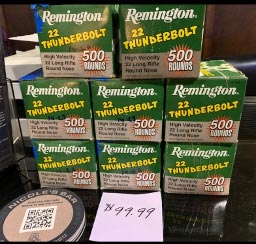
.22 rounds for sale at a local gun range.
Given that demand and the rising cost of components have now priced ammunition several times higher in all calibers than last year, perhaps those who stack both silver and ammo should change this phrase to “Plata y Plomo”… Silver and Lead.
The picture nearby from a local gun range shows something well beyond the Fed’s sub-2% inflation target.
But then they also said it would be acceptable to let inflation “run hot.” Last year a box of .22 rounds could be had for less than $25. Is the Fed getting what they asked for?
Inflation? Deflation? Both?
This debate has gone on for several years as governments continue to ramp up spending. Oversimplified, if they let our debts default, the result is deflation.
If the printing press and spending spigot remain unchecked, then inflation is more likely. Excessive demand, loss of confidence, and increased money velocity (turnover) leads reliably to the inflationary door.
A few asset classes like the stock market and most real estate sectors initially keep up but later on lag severely, as purchasing power declines precipitously.
But gold and silver catch a wave, and wealth preservation for the lucky relative few, historically topping out at 2.5 – 3% of the population’s assets, is largely assured, enabling a small minority to seriously blunt the inflationary impacts on their material wealth.
Since August 2020, it hasn’t been a bed of roses for metals/mining share holders.
However, as Lobo Tiggre states, “No price goes up forever without taking a break. That’s why they call it a correction…In short, I see any near-term correction as a buying opportunity for commodities – even more so for gold and silver, which are monetary metals as well – notice that silver falls into both categories.”
Prices UP? More buying of gold and silver. Prices Down? Same Story.
What’s becoming increasingly apparent is that when gold and silver prices rise, public buying increases. And when prices drop… public buying increases! The mints I’ve spoken to all report sustained sales of everything gold and silver.
Take Australia’s Perth Mint.
Perth Mint minted product sales for both gold and silver soared during February, with more than 124,000 troy ounces of gold, and more than 1.8 million troy ounces of silver sold during the month. Relative to February 2020, sales increased by more than 400% for gold and 200% for silver, as investors took advantage of lower precious metal prices.
The Federal Reserve has only three ways to “deal with” debt: make significant cuts in deficit spending; substantially raise taxes; or let inflation drive economic policy, with the end result that government debts are paid off in increasingly worth-less paper.
Agriculture Prices Have Broken a 10-Year Downtrend
Given the way politicians and the currency creators have historically dealt with this, I’d cast a strong vote for the inflationary “solution.”
What indications do we have right now that not only is inflation higher in disparate sectors of the economy considerably than the government’s highly- manipulated statistics tell us, but even more important, that the rate of increase is moving at a worrisome (to us) speed.
- In Indonesia, tofu costs 30% more than it did in December.
- In Brazil, the staple, turtle beans, have risen 50% in the past month.
- In Russia, consumers are paying 60% more for sugar over the last year.
- Cereal inflation is now running at a 20% annualized rate.
- Locust swarms are devouring food supplies in East Africa and Saudi Arabia.
- Michael Snyder writes that The Head of the UN Food Program has stated there will be “famines of biblical proportions in 2021.”
- And demonstrating that, thanks in no small part to the recent Wall Street Bets – Reddit successful (if initially short-lived) foray into buying silver miners and physical metal, the case that we’re moving into the public recognition phase for our thesis has been greatly strengthened.
Note a new subreddit, Wall Street Silver, already has over 30,000 subscribers.
Few people are aware that, even as the Feds tout the validity of the CPI in tracking inflation – both current and expected – they openly admit food prices are the most accurate predictor of inflation!
Start keeping track of your grocery tab!
No less an establishment thinker than former U.S. Treasury Secretary, Lawrence Summers, opines, “I think there’s a real possibility that within the year, we’re going to be dealing with the most serious incipient inflation problem we have faced in the last forty years.”
Consider that – starting right now – elevated inflation, concomitant with uneven economic growth and massive deficit spending via guaranteed income and the likely build out of MMT – is going to duplicate the deleterious stagflationary effects of the ’70’s… on steroids!
Got silver? Got lead?


Categories
The Fedcoin Is Coming

Before we talk about Fedcoins, let’s look at the old school non-digital, non-blockchain, coin. Gold. And silver.
Since January 4, the price has dropped about $244. And the price of silver has fallen about $4. Are these buying opportunities? Or the end of the brief gold bull market of 2020 (i.e. Covid)?
It helps to return to the idea that gold is the unit of measure of value. Not as a rhetorical device to sell gold, but because it gives a clearer picture.
If one thinks in dollars, one thinks that bitcoin is rising, stocks are rising (though not this week), oil is rising, other currencies are rising, etc. And gold went up, but is now coming down.
It’s hard to make heads or tails of this. Why would one asset go down when everything else is going up (it’s tempting to want to believe that this one asset is suppressed)? But what if that point of view is not even wrong? What if gold, not the dollar, should be used to measure things?
In this point of view, we’re having another little boom. Everything – as measured in money – is going up. That’s what things do, in booms. They go up. No reaching for a theory is needed.
And we can look for signs that the boomlet is reaching exhaustion. Our preferred sign is the gold basis. So here is a chart going back to the start of 2020, well before Covid-mania.
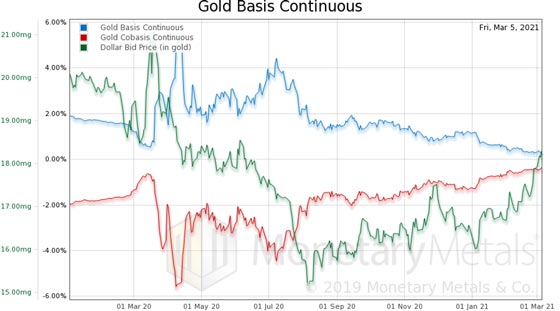
The (continuous) cobasis—the measure of scarcity—is higher now than it’s been in a year (actually since 2016). Notice how it’s been rising steadily as the price of the dollar (inverse to the price of gold, that people insist on measuring in dollars) has been rising.
One could certainly pick a worse setup to buy gold.
Here is silver.
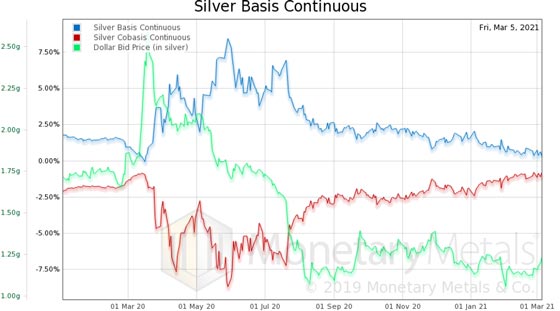
Silver’s scarcity is just about at its high for the year. And the last time, the dollar’s price measured in silver was a lot higher (well over 2 grams silver, compared to 1.2g). The last time it sustained levels this high, the price was over 2.1g (i.e. the price of silver, measured in dollars, was around $14.50).
There are worse setups than to buy silver at this point.
Fedcoin: A Central Bank Digital Currency
The Fedcoin has bipartisan support. Jay Powell, appointed as Federal Reserve Chairman by President Trump, said in October that the Federal Reserve is conducting research into issuing a digital currency, on its own and also in partnership with other central banks and the Bank for International Settlements.
Janet Yellen, appointed as Fed Chair by President Obama, said last week, “It makes sense for central banks to be looking at issuing sovereign digital currencies.”
They give different stated reasons. Powell is more conservative, and his focus is on addressing the potential competitive threat of bitcoin and digital currencies from countries such as China. However, if he really wanted to make the dollar more competitive against the yuan, then he would just abuse the Fed’s credit less.
Yellen nods to a progressive idea, saying that a Fedcoin, “could help address hurdles to financial inclusion in the U.S. among low-income households.” However, if she really wanted the “unbankables” to be able to open accounts, then she would just repeal anti money laundering and other regulations that penalize a bank for crimes committed by its clients.
Both Powell’s and Yellen’s statements are disingenuous. A Fedcoin is coming, because it’s necessary. Allow us to explain the two real reasons. The first is sinister. The second is more pernicious.
Why Fedcoin? Two Real Reasons
The first reason is the pathological fall of interest rates over the last four decades. Interest in the US dollar has not gone negative yet, though it has in the Swiss franc, the euro, the pound, and the yen. Interest will continue to fall.
When the rate goes negative enough, the banks will not be able to hold the line on paying zero interest in deposit accounts. They will be forced to pass through their pain to depositors. This will provide the first incentive to withdraw cash from the banks—thus pulling out capital—since the 1930’s. The paper dollar bill has zero yield. People will prefer zero to negative yield. Free is better than paying to hold your money.
The central banks have three ways to try to fight this. One, they could try to impose losses on dollar bills. They could create an algorithm that deducts from the face value, based on serial number. If they roll this out to point-of-sale devices, then every merchant will know the legal tender value of your cash. That “twenty” could actually be worth $19.93. But this seems impractical and confusing.
Two, they can demonetize cash. People are given until a certain date to turn in their cash for a credit to their bank accounts. After that, the paper will have no legal tender value. But, as Yellen noted, many people are kept out of the banking system.
Or, three, they could issue a Fedcoin and force everyone to trade their paper cash for Fedcoins. Fedcoin would be nothing like bitcoin.
Fedcoin would be programmed to erode at a rate to match the Fed’s negative interest rates. Thus, it would not provide a haven to anyone seeking to hold cash to avoid the erosion of bank balances. They will have you totally trapped.
This is an extension of the same idea behind banning gold in 1933. The people were disenfranchised, unable to opt out of the government’s debt. The most conservative saver was forced to hold government bonds, rather than gold. Indeed, after that, the definition of risk-free asset is the government bond.
After 1975, you can hold gold. But now, it’s not a dollar balance. It has dollar price volatility. Hence, it’s unsuitable for many conservative savers (and financial institutions). If you have a billion dollars of cash, and a liability to pay a billion dollars in two months, then you cannot take the risk on gold. As we write this, the price of gold has dropped $244 dollars since the start of 2021, or about 13% in about two months.
An individual may be able to escape the system by buying gold (or bitcoin), however the dollars are trapped in the system. The seller of the gold (or bitcoin) is the new owner of those dollars. And faces the same awful choice of the tiger or the tiger.
The Fedcoin will be designed to further tighten the noose. Even cash will become entirely electronic, and subject to slow confiscation. Not by inflation. But by negative interest rates that reduce the account balance.