Silver’s on the move, and gold better hang on! Kitco NEWS
Month: May 2021
Gold, silver see price strength amid downbeat U.S. retail sales Kitco NEWS
Gold Price Forecast – Gold Markets Reach Towards Downtrend Line FX Empire

(Peter Jacobsen, Foundation for Economic Education) On Wednesday, the Bureau of Labor Statistics (BLS) released numbers indicating that the average price level of consumer goods has risen 4.2% since this time last year. This is the highest rate since 2008. In other words, the average consumer making the same salary this year has taken a pay cut when you consider what their paycheck can actually buy.
How does the BLS know this? One way the BLS keeps track of inflation is by using the consumer price index (CPI). The CPI uses some of the common goods urban consumers buy, and they keep track of the prices of these goods each year.
A CPI growth of 4.2% means this “basket” of goods the average urban consumer buys has gotten 4.2% more expensive. Economists call this measure inflation.
The CPI is by no means a perfect measure of inflation, nor could any measure be, but it provides some kind of benchmark to compare how much prices are changing over time.
What Is Happening to Our Money?
Why is inflation increasing now? It’s all about the money. Imagine tomorrow that suddenly all US money becomes a 10x larger number. Ten dollar bills become 100 dollar bills, bank accounts with $10,000 turn into accounts with $100,000, and the four quarters in your cup holder transform into a 10 dollar bill.
This might sound nice at first, but consider what happens next. If prices stay the same, suddenly people rush out to buy new things. Suddenly, a student with a $7000 student loan can buy a Porsche. Someone can afford a down payment on a house who was months away before. A kid with a generous allowance buys a flat-screen TV.
But now the problems appear. All cars for sale are being driven off the lot. TV shelves are empty. House offers pour in only minutes after listing. There is more money, but the exact same amount of goods exist. With so many customers demanding new goods, sellers have 10 customers fighting over one product. So what happens? The price is bid up.
In fact, prices in this world will make, on average, the same change as bank accounts. One dollar candy bars become $10, average quality TVs cost thousands of dollars, and the $100,000 two-bedroom in Kansas becomes a million-dollar purchase.
If more dollars chase the exact same goods, prices will rise.
The Money Printer Goes Brrr
Although the above example is simplified, the general idea holds in the real world. Unfortunately, not everyone has gotten 10x more money, but new money has been introduced to the economy.
The quantity of money (measured as “M2” by the Federal Reserve) has increased more than 32.9% since January 2020.
That means nearly one-quarter of the money in circulation has been created since then. As the following graph shows, a change like this is unprecedented in recent history.
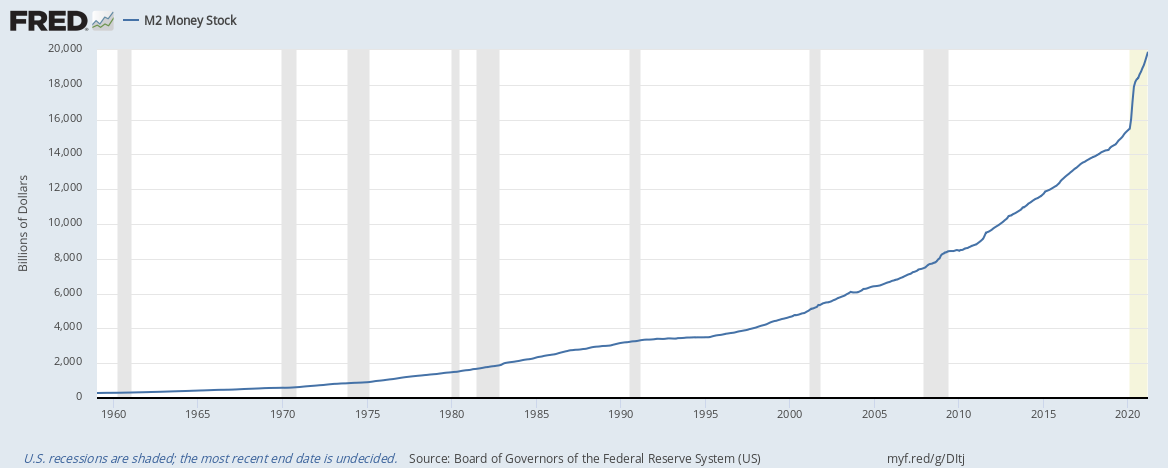
The newly printed money helps fund the slew of trillion-dollar coronavirus spending which benefitted massive corporations. It also is an attempt to satisfy consumers’ demand to hold money so they will be comfortable spending again. And spending they are.
As lockdowns end and finally allow consumers to return to normal economic activity, the new money begins to move through the economy more quickly. Banks have more money to lend out and people are building new homes. As more homes are built, the demand for wood increases. As the demand for wood increases, the price of wood goes up. Sound familiar?
Although the new money won’t hit all markets at the same time, and it may take some time for demand to return to pre-lockdown levels, the inflation numbers indicate this process has begun. In order for inflation to slow down, either spending would have to slow down, or the government would have to lower the money supply.
Is It That Bad?
None of this means hyperinflation is coming tomorrow or ever. In fact, it could be a blip caused by a low CPI benchmark. But given all the new money floating around, it shouldn’t surprise anyone if this rate of inflation were to persist or increase.
The Federal Reserve members aren’t worried, and, in fact, they claim to not be considering contractionary monetary policy until inflation is this level for some time. Many economists argue inflation would need to be much higher to be worth worrying about. But inflation need not be hyperinflation to be harmful to many. Inflation’s effects are not equal.
After a year of lockdowns leading to job losses and pay cuts, many Americans aren’t in a position to pay 4.2% higher prices. It’s easy for someone with a comfortable job or nest egg to scoff at these price increases, but working-class and poor Americans feel the difference.
At a time when Americans work to rebuild their savings to protect their families from future uncertainty, is it wise to ignore a policy that slowly eats away at their savings while they scramble to find new coupons for groceries or consider taking a much longer public transit route to save on gas? These struggles are worth consideration.
So will inflation rise? Will it fall? No one can say for sure. But we can say for sure that inflation doesn’t need to be in the double digits to hurt…Original Source…
image credit: Paolo Camera


Financial markets have become a complete joke. From GameStop to Dogecoin to non-fungible tokens (NFTs), a plethora of assets have been pushed to laughable heights with the help of the Federal Reserve’s funny money.

Just about everyone, except for stone-faced Fed officials, seems to be in on the joke.
Dogecoin promoter and billionaire Tesla founder Elon Musk poked fun at cryptocurrencies and the U.S. dollar itself during his hosting duties last weekend on Saturday Night Live.
During the “Weekend Update” segment, Musk appeared in character as a cryptocurrency guru. He admitted Dogecoin began as a joke.
“What is Dogecoin?” Musk was repeatedly asked. The punchline was that any answer he gave failed to explain what it actually is.
Whatever it is, Dogecoin climbed to over $80 billion in value after a crazy 130-fold rise this year ahead of Musk’s SNL gig.
“It’s a hustle,” Musk finally confessed, after quipping that Dogecoin is “about as real” as the U.S. dollar.
He has a point. Neither dollars nor Dogecoins have any tangible backing. Their value is essentially made up.
Musk’s SNL bit caused the Dogecoin market to swing wildly, with the cryptocurrency suffering a Saturday night mini-crash. So far, it hasn’t fully recovered from it.
Why would anyone put serious money into a joke of a cryptocurrency that literally moves based on comedy sketches?
Speculators are free to speculate on anything for any reason, of course. But they should be aware that what they are speculating on lacks even scarcity value. There are currently over 120 billion Dogecoin units in circulation and, unlike with Bitcoin, that supply is set to expand in perpetuity.
Investors who view protecting themselves from inflation as no laughing matter are buying assets with more solid fundamentals.
Physical precious metals represent sound money – the ultimate alternative to digital and fiat profusions.
The unprecedented amount of spending and borrowing being carried out by the Joe Biden administration will require the Fed to keep purchasing Treasury securities with trillions of newly created dollars.
Silly season in Washington is whenever Congress is in session. And with fiscal responsibility out the window, monetary policy will be on full blast for the foreseeable future.
Federal Reserve’s dual mandate is to pursue full employment and stable prices. If you believe the Fed’s stated policy objective of raising the official inflation rate above 2% for an extended period fits the definition of price stability, then the joke’s on you!
On Wednesday, the Labor Department reported that the Consumer Price Index rose a higher than expected 4.2% from the prior year. The CPI in April accelerated at its fastest pace in more than 12 years.
Then on Thursday, the Producer Price Index came in hotter than expected – showing a year-over- year surge in industrial costs of 6.2%. That’s the largest increase since the Bureau of Labor Statistics began tracking the data set in 2010.
Fed officials insist these price spikes are transitory and don’t yet warrant any monetary tightening.
By the time inflation becomes so big of a problem that central bankers can’t deny it anymore, it may be too late for investors to exit vulnerable assets and obtain inflation protection – at least not at prices that are as favorable as can be had today.
Gold and silver remain cheap relative to the stock market and the exploding U.S. currency supply. Although gold bugs are often subjected to ridicule by the Wall Street-centric financial media, what’s truly ridiculous is some of the valuations attached to stocks and cryptocurrencies.
In this current clown world, Woke corporations are abdicating their fiduciary duty to shareholders in order to pursue social activism.
Fast food and beverage companies have taken it upon themselves to tell states what their voting laws should be. They have taken it upon themselves to tell their customers what they should think about racial controversies and what stands their investors should take on sexual identity issues.
Ronald McDonald used to represent a company that existed to sell burgers and fries. Now McDonald’s sells “modern and progressive” politics with its junk food.
Blue-chip brands are so flush with cash, they apparently feel they can afford to ramp up their social activism rather focus on cutting costs. But the post-COVID boom times will eventually go bust – and perhaps much of the financial silliness enabled by “free” money from Washington will go away as well.
When stocks roll over into their next bear market and some of the over-hyped digital assets fail to provide safe haven, holders of precious metals may get the last laugh.
Categories
Fun on Friday: A Sacrifice to the Gods
Monday is tax day. That means I have to send a big check to my overlords – a sacrifice to the gods of government if you will. Of course, sacrifice to the gods is nothing new. In fact, wealthy Norse elites buried gold pendants as a sacrifice to the gods. Seven such artifacts were recently […]
The post Blog first appeared on SchiffGold.
CPI came in much hotter than expected. Fed Vice Chairman Richard Clarida actually said, “We were surprised by higher than expected inflation data.” But should we really be surprised by this? In this episode, Friday Gold Wrap host Mike Maharrey talks about inflation and suggests maybe you shouldn’t be shocked. He also discusses the whacked-out […]
The post Blog first appeared on SchiffGold.
Categories
Inflation Everywhere, US Drought Increasing
With gas shortages that pop up out of nowhere and expensive commodity prices spiking everywhere, there is good reason to be alarmed… Greg Hunter gives The Weekly News Wrap-Up for […]
Thought inflation was already pretty bad? It’s actually worse than that. Much, much worse… (by Half Dollar) I’m a World Class Master Pizza Baker, and I don’t say that to […]
Categories
GOLD vs $200 TRILLION COUNTERFEITED MONEY
Few realize the consequences of the world’s insatiable need of fake money. The coming rise in the gold price combined with very… by Egon von Greyerz of Gold Switzerland “O […]