Categories
Gold

New Jersey to Consider Ending Taxes on Precious Metals

(Trenton, NJ, USA – January 14, 2022) –  Legislators from New Jersey are trying to restore sound money in the Garden State. 

Originally introduced in 2021 by Asm. Dancer (12-R) and Sen. Doherty (23-R) but carrying over to 2022, these house and senate bills would end the practice of taxing the purchase of the monetary metals. Under current law, New Jersey citizens are discouraged from insuring their savings against the devaluation of the dollar because they are penalized with taxation for doing so. Passage of this measure would remove disincentives to holding gold and silver for this purpose. These bills are important for a few reasons:

New Jersey does not tax the purchase of any other investment. New Jersey does not tax the purchase of stocks, bonds, ETFs, currencies, and other financial instruments. Gold and silver are held as forms of savings and investment. Taxing precious metals is unfair to certain savers and investors. 

Studies have shown that taxing precious metals is an inefficient form of revenue collection. The results of one study involving Michigan show that any sales tax proceeds a state collects on precious metals are likely surpassed by the state revenue lost from conventions, businesses, and economic activity that are driven out of the state.

The harm is exacerbated when you consider that all of New Jersey’s neighboring states (Delaware, New York, Pennsylvania) have already stopped taxing gold and silver. Even nearby Maryland, Connecticut, Massachusetts, and Rhode Island, have enacted their own sales tax exemptions for precious metals.

In total, 42 states have reduced or eliminated sales tax on the monetary metals.

Taxing gold and silver harms in-state businesses. It’s a competitive marketplace, so buyers will take their business to any neighboring state (all of which have eliminated or reduced sales tax on precious metals), thereby undermining New Jersey jobs. Levying sales tax on precious metals harms in-state businesses who will lose business to out-of-state precious metals dealers. Investors can easily avoid paying $130 in sales taxes, for example, on a $1,950 purchase of a one-ounce gold bar.

Levying sales taxes on precious metals is inappropriate. Sales taxes are typically levied on final consumer goods. Computers, shirts, and shoes carry sales taxes because the consumer is “consuming” the good. Precious metals are inherently held for resale, not “consumption,” making the application of sales taxes on precious metals inappropriate.

Taxing precious metals is harmful to citizens attempting to protect their assets. Purchasers of precious metals aren’t fat-cat investors. Most who buy precious metals do so in small increments as a way of saving money. Precious metals investors are purchasing precious metals as a way to preserve their wealth against the damages of inflation. Inflation harms the poorest among us, including pensioners, New Jerseyians on fixed incomes, wage earners, savers, and more.

The Sound Money Defense League and Money Metals Exchange strongly supports and is actively working with lawmakers in Virginia to ensure passage of this important measure. Kentucky, Mississippi, Hawaii, and Alabama are just a few of the other states fighting their own sound money battles in 2022.

      
Categories
Gold

West Virginia Seeks to Eliminate ANOTHER Tax on Gold and Silver

(Charleston, WV, USA – January 13, 2022) – In 2019, the Sound Money Defense League teamed up with lawmakers and in-state supporters to eliminate the sales tax on the sale of precious metals in West Virginia. This year, a pro-sound money legislator hopes to take it a step further and remove yet another tax from the monetary metals.

Introduced by Del. Chris Pritt (36-R), House Bill 3135 creates a nonrefundable tax credit for capital gain transactions on the exchange of gold and silver for another coin or form of legal tender, as well as declaring gold and silver legal tender in West Virginia.

Arizona, Utah, and Wyoming have enacted similar measures into law. Idaho has considered this measure recently and similar measures are currently being heard before the Alabama and South Carolina legislatures.

In recent decades, monetary gold and silver — and dollars redeemable in gold and silver — have been supplanted by the Federal Reserve Note as America’s currency. However, an increasing number of West Virginia citizens are realizing that holding gold and/or silver as a form of savings can help protect against the ongoing devaluation of the Federal Reserve Note.

Here are a few reasons why slapping an income tax on the monetary metals is wrong:

  • Current West Virginia law assesses taxes on imaginary gains. Under current law, a taxpayer who sells precious metals may end up with a capital “gain” in terms of Federal Reserve Notes. This capital “gain” is not necessarily a real gain, it’s often a nominal gain that results from the inflation created by the Federal Reserve and the attendant decline in the dollar’s purchasing power.

            Yet this nominal gain is taxed at the federal level – and, because West Virginia uses federal adjusted gross income (AGI) as a starting point for West Virginia income calculations, this nominal gain is taxed again by the Mountain State. 

  • Inflation harms the poorest among us. Inflation is a regressive tax. The hardest hit are wage earners, savers, and pensioners on fixed incomes – as well as those who own few or no tangible assets. 
  • Taxing imaginary gains is harmful to citizens attempting to protect their assets. Investments in precious metals coins and bullion are rightly exempt from West Virginia’s sales tax. Neutralizing West Virginia’s income tax treatment of the monetary metals would remove the last major disincentive in West Virginia that stands against the ownership and use of the monetary metals.

Policies that penalize savers in precious metals reduce the likelihood that West Virginia citizens will take prudent steps to insulate themselves from the inflation and financial turmoil caused by the Federal Reserve.

West Virginia savers, wage earners, and all those who use gold and silver to insulate against the devastating effects of inflation should be able to protect themselves without getting punished by taxation.

      
Categories
Gold

Washington State Aims to Remove All Tax Liability from Sound Money Transactions

(Olympia, Washington, USA – January 14, 2022) – Washington State removed sales taxes against sound money decades ago, but a lawmaker hopes to take it a step further. House Bill 1417, introduced in 2021 by Representative Rob Chase and co-sponsored by Representative Bob McCaslin, seeks to eliminate all Evergreen State taxes on the only form of money mentioned in the U.S. Constitution.

Washington has had a long standing sales tax exemption on sound money, but there have been several attempts over the last couple of years to repeal this law. House Bill 1417 would ensure “the exchange of one type or form of precious metal bullion made of gold or silver, or monetized bullion, for a type or form of legal tender may not give rise to any tax liability.”

By eliminating capital gains and sales taxes on precious metals, Washington would stand among the best states in the union on this issue. Here are a few reasons why slapping an income tax (or any tax) on gold and silver is wrong:

  • Current Washington law assesses taxes on imaginary gains. Under current law, a taxpayer who sells precious metals may end up with a capital “gain” in terms of Federal Reserve Notes. This capital “gain” is not necessarily a real gain, it’s often a nominal gain that results from the inflation created by the Federal Reserve and the attendant decline in the dollar’s purchasing power.

            Yet this nominal gain is taxed at the federal level – and, because Washington uses federal adjusted gross income (AGI) as a starting point for Washington income calculations, this nominal gain is taxed again by the Evergreen State.

  • Inflation harms the poorest among us. Inflation is a regressive tax. The hardest hit are wage earners, savers, and pensioners on fixed incomes – as well as those who own few or no tangible assets.
  • Taxing imaginary gains is harmful to citizens attempting to protect their assets. Investments in precious metals coins and bullion are rightly exempt from Washington sales tax. Neutralizing Washington income tax treatment of the monetary metals would remove the last major disincentive in the state that stands against the ownership and use of the monetary metals.

The Sound Money Defense League and Money Metals Exchange strongly support and are actively working with lawmakers in Washington to ensure passage of this important measure. Kentucky, Mississippi, Hawaii, and Alabama are just a few of the other states fighting their own sound money battles in 2022.

      
Categories
Gold

Successful Junior Miner Sees Cash Flow

Source: Michael Sheikh   01/13/2022

Michael Sheikh explains what makes Guanajuato Silver Co. a unique opportunity and takes a look at five other companies that caught his eye.

Guanajuato Silver Co. (OTCMKTS:GSVRF; TSX.V:GSVR) is a junior miner that has had arguably unprecedented operational success over the last year enhancing its cash flow. Junior miners aren’t supposed to have cash flow, so that makes Guanajuato a very special exception that mining investors should pay keen attention to. 

Despite the exceptional operational success, the stock hasn’t really moved too much over the past year. This price stagnation could change as the company ramps up its production, continues in its exploration projects, and potentially makes some moves in the local area to take on some new mining projects that could synergize with their existing sites.

Junior mining used to comprise smaller operational mines but in recent decades the actual mining has largely been left to large-scale operations and thus bigger companies. There’s a ton of capital expenditures required for mining and for years companies can raise money and spend it while only really trying to prove whether there’s an economic mineral deposit to be mined later.

For instance, Kinross Gold Corp. (K:TSX; KGC:NYSE) recently acquired a junior miner called Great Bear Resources Ltd. (GBR:TSX.V; GTBDF:OTCQX) for $1.4 billion upfront, but various estimates suggest the company will need hundreds of millions—up to $700 million—in capex to build infrastructure and become fully operational.

And this comes only after spending years on-site and millions of dollars on exploration.

For any junior miner, $700 million is a daunting number especially when many have market capitalizations much lower than that.  Most junior miners have a simple plan to get acquired by a larger mining behemoth. For instance, Discovery Silver Corp. (OTCMKTS:DSVSF) recently announced the results of its preliminary economic assessment (PEA), which “positions Cordero [their project] as a Tier 1 silver asset.”

According to the company, the project would require “modest development capex of $368 M.”

But for Guanajuato, it’s a different story. The company acquired an already existing mine with onsite bulk material processing equipment for an aggregate of about $20 million (plus $50 million in milestones) after accounting for some improvements made to the facilities. And now they’re already producing from the existing shaft. To have an operational mine with such a low capital cost and a short time to production is truly a testament to the excellent allocation of invested capital.

But to understand the management’s excellent decision making and execution to date as well as catalysts that could continue to move shares much higher, one has to understand the history of the company and what the company can do with mergers and acquisitions, or business development in the future.

The History

Guanajuato Silver completed the purchase of its mining assets from another larger silver mining company just 8 months ago, in April of 2021. The asset had previously been purchased from AuRico (now Alamos Gold Inc. (AGI:TSX; AGI:NYSE)) for $200 million by Endeavour Silver Corp. (EDR:TSX; EXK:NYSE; EJD:FSE) before being closed down after producing part of the mine.

Endeavor had plans to increase production from the mine, but as they churned through the wide parts of high-grade mineral, they could not continue to justify mining such tonnage with a declining average grade of silver and gold. And so they suspended El Cubo operations in 2019. In the end, their rationale for closing it was tied to the operational efficiencies of their mining equipment on site. The remaining mineralization of the mine consisted of a thin vein that is only 4.5ft wide but rich in mineralization. The industrial drum cutters used in the mine, as well as the mine plan, usually cut a path that is, for instance, 12 ft wide which introduced a lot of excess rock for processing. This lowered the grade of the ore to the point that it was not cost-effective to mine. Guanajuato Silver addressed this challenge by utilizing a cut and fill technique along with resue mining. The resue mining works by cutting a path along the vein and then removing the ore vein afterward to reduce the amount of rock outside the vein. 

Guanajuato decided to take over the project as their revaluation of the deposit showed that the high-grade mineralization was simply narrow in some areas, such that high-quality tonnage could be mined at a narrower width. But this supply wouldn’t and couldn’t bring the El Cubo processing equipment to maximum capacity. So, Guanajuato is supplementing that production with production from their other mine nearby called El Pingüico. And work is being done to see if the bulk materials from both can be mixed together as they potentially come from the same overall geological vein structure or fracture, thus having similar mineral properties allowing for the same process to be used to extract the gold and silver.

The great thing for Endeavor was that they got to remain somewhat exposed to the project without having to manage it, through part ownership of Guanajuato Silver. Currently, they’re the largest shareholder at over 10% ownership. This also is a testament to the legitimacy of Guanajuato Silver’s endeavors.

The El Cubo Site

The El Cubo site Guanajuato purchased is really something special. The area has hundreds of years of history as a mining hub and has a vibrant town close by. This means it’s easy to hire experienced local mining talent, which both ensure operations run seamlessly and that the local community and government support the company as operations are led by Mexican nationals and the company can help bring wealth into the area. In fact, Guanajuato is working with about 100 Mexican nationals in its operations.

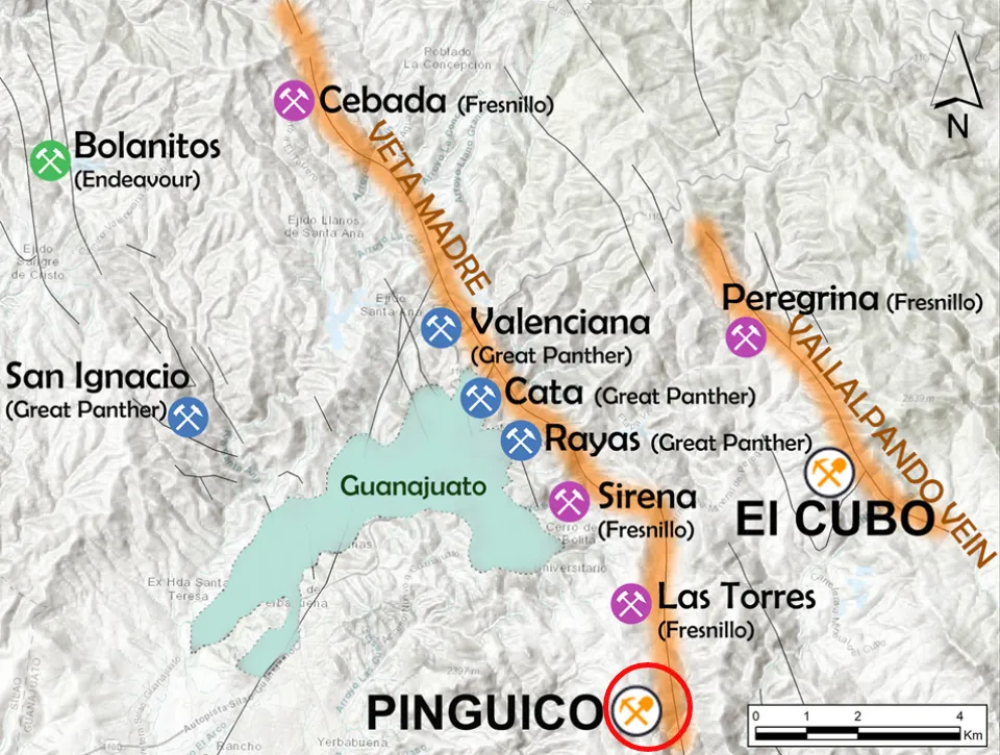
Map of Guanajuato and Notable Mining Sites Nearby

The above map depicts the town of Guanajuato near two main mineral deposits—the Veta Madre (the “Mother Lode”), and another potentially anastomosing/contiguous (coming from the same fault, or branching from the same vein further down in the ground) region, the Villalpando Vein.

The company has mines at its sites, El Pinguico and El Cubo. The company’s current plan is to use existing stockpiles at El Pinguico (low grade at surface and medium grade underground) to use up excess capacity at their processing equipment at El Cubo mine while they ramp up El Cubo to its own max capacity.

Both sites together still probably won’t keep the processing line at max capacity, so Guanajuato recently announced that they’re taking silver and gold mineralized material from third parties:

“James Anderson, Chairman and CEO, said, ‘It is GSilver’s intention to use the approximately 20,000 tonne per month of excess capacity at the El Cubo mill to profitably process mineralized material from various potential sources in the Guanajuato area. Whether the business arrangement is designed as toll milling, raw material purchasing, or profit sharing, if it serves to contribute to our bottom line and helps to expand our presence in the 480-year-old mining camp of Guanajuato, then we will pursue it.’”

guanajuato silver
Stockpile at El Pinguico

Projecting High Rates Of Return

Guanajuato engaged an engineering firm to do a preliminary economic assessment of El Pinguico and El Cubo.

And this is really where it becomes clear that the Guanajuato Silver team are excellent capital allocators and will be able to drive strong returns.

Although their mines were active decades ago and some of the resources were depleted, there are other resources not mined yet and a significant amount of unexplored territory where there is possibly a large amount of medium and high-grade silver.

In fact, Guanajuato just released some encouraging drilling results from El Cubo.

The company’s economic assessment showed a projected internal rate of return (IRR) of 105%, which is extremely high. This is because the sizeable production the company is managing was made possible with such small capital investment in such a short period of time. Another competitor, Discovery Silver Corp (OTCMKTS: DSVSF), reported “excellent project economics” with a projected IRR of only 38% (but a higher NPV). The difference is that Guanajuato’s project basically will be able to finance aggressive exploration without significant dilution of the stock. And this exploration and any resources proved from it are not included in the PEA, just the El Pinguico stockpiles and preliminary El Cubo resources.

Potential Central Mexico Consolidation

Guanajuato might also use their cash flows for potential consolidation in the area. With excess capacity at El Cubo, it might make sense to either continue collaborating with other companies running smaller operations in the area or to revive old operations that are currently defunct.

The key thing to keep in mind, however, is that Guanajuato is unlikely to perform any M&A outside Mexico so that they can stay focused and continue executing in a timely and cost-effective manner, something quite uncommonly seen in small-cap companies. Really, any M&A should in some way synergize with existing strategies and operations.

Conclusion

Guanajuato Silver is really only priced based on its existing project. Should the company perform additional M&A or any exploration that would provide it with additional inferred or indicated resources, which could cause a rerating of shares sharply to the upside. With their main two projects existing along the “mother lode” that was the source of a gold rush 500 years ago, continuing strong operations until decades ago, and a new understanding of the geological complexes in the area, Guanajuato has unseen optionality for investors looking to capitalize on its programs before they are obviously proven. The company has been executing flawlessly and now is in a position of strength as it works toward steady, cash flow positive production. The only thing investors don’t know is whether Guanajuato will acquire a new project or use the money to explore existing claims. But since the management team has proven themselves to be prudent and savvy, this should be of no concern.

Sign up for our FREE newsletter at: www.streetwisereports.com/get-news

Disclosures:

1) Michael Sheikh: I, or members of my immediate household or family, own securities of the following companies mentioned in this article: Company Name/None. I personally am, or members of my immediate household or family are, paid by the following companies mentioned in this article: None. My company has a financial relationship with the following companies referred to in this article: None.  Funds controlled by Name of Company hold shares of the following companies mentioned in this article: Guanajuato Silver Co. I determined which companies would be included in this article based on my research and understanding of the sector. 

2) The following companies mentioned in this article are billboard sponsors of Streetwise Reports: None. Click here for important disclosures about sponsor fees. The information provided above is for informational purposes only and is not a recommendation to buy or sell any security.

3) The article does not constitute investment advice. Each reader is encouraged to consult with his or her individual financial professional and any action a reader takes as a result of information presented here is his or her own responsibility. By opening this page, each reader accepts and agrees to Streetwise Reports’ terms of use and full legal disclaimer. This article is not a solicitation for investment. Streetwise Reports does not render general or specific investment advice and the information on Streetwise Reports should not be considered a recommendation to buy or sell any security. Streetwise Reports does not endorse or recommend the business, products, services or securities of any company mentioned on Streetwise Reports.

4) From time to time, Streetwise Reports LLC and its directors, officers, employees or members of their families, as well as persons interviewed for articles and interviews on the site, may have a long or short position in securities mentioned. Directors, officers, employees or members of their immediate families are prohibited from making purchases and/or sales of those securities in the open market or otherwise from the time of the decision to publish an article until three business days after the publication of the article. The foregoing prohibition does not apply to articles that in substance only restate previously published company releases.  


( Companies Mentioned: AGI:TSX; AGI:NYSE,
OTCMKTS:DSVSF,
EDR:TSX; EXK:NYSE; EJD:FSE,
GBR:TSX.V; GTBDF:OTCQX,
OTCMKTS:GSVRF; TSX.V:GSVR,
K:TSX; KGC:NYSE,
)

Categories
Gold

Sell-Side Research Started On Copper Mining Co.

The Quick Take

  • Zacks Small-Cap Research has a $2.03 per share target price on World Copper.
  • Zacks SCR initiated coverage on World Copper in light of its 2022 work plans to increase its overall resource base, the impending closing of its acquisition of Cardero Resource/the Zonia project and upcoming catalysts, reported analyst Steven Ralston in a Jan. 12 research note.
  • World Copper has three assets:
    • The Escalones copper-gold porphyry-skarn project in Chile, the Main zone of which has an updated Inferred mineral resource of about 426,200,000 tons of copper oxide ore, grading 0.367% copper.
    • The Zonia copper-oxide project in Arizona (pending the imminent acquisition closing), for which a preliminary economic assessment (PEA) was done in 2018 but now is obsolete.
    • A 100% earn-in option on the Cristal copper porphyry property in Chile.
  • To grow its overall resources, World Copper plans to do the following work, which could result in share price increases as it is completed:
    • Fast track a PEA on the Main zone at Escalones.
    • Conduct a small initial drill program at the Mancha Amarilla target, south of the Main zone, once permits are received, to grow the Escalones resource.
    • Explore three prospective targets north of the Main zone at Escalones: Rio Negro (priority No. 1), Argüelles East and Argüelles.
    • Commission an updated PEA on the newly acquired Zonia project.
    • Explore the prospective northeast copper porphyry target at Zonia.
    • Drill two holes at Cristal in the areas of anomalies identified on geophysical surveys.

World Copper Ltd. (WCU:TSX.V; WCUFF:OTCQB) aims to increase shareholder value by acquiring and advancing copper projects, and it is doing just that, according to Zacks Small-Cap Research analyst Steven Ralston.

For one, the copper explorer is advancing its Escalones project and doing so “in a novel direction,” the analyst wrote. Rather than pursuing it as a precious metals project focusing on the sulphide mineralization like historical owner-operators have done, World Copper is approaching it as an oxide copper project given that the copper oxide overlies the sulphide mineralization.

This approach is more economical and environment friendly, Ralston pointed out. Mining shallow copper-oxide ore, via open pit with a lower strip ratio, is more cost effective than mining deeper copper sulfide ore. Also, heap leaching can be used to process oxidized ore, and it is less expensive and greener than the alternative.

As for the Zonia project, Copper World’s he acquisition of it is slated to close soon. Once it does, the new owner plans to focus on advancing it as well.

Though Escalones and Zonia are the company’s main focus now, management plans to carry out some exploration work at Cristal this year, too. As for its earn-in option on this project, once World Copper pays the requisite tranches through January 2025, it will grant a 30% stake of Cristal to New Energy Metals and hold the remaining 70% interest.

Disclosures:
1) Doresa Banning compiled this article for Streetwise Reports LLC and provides services to Streetwise Reports as an independent contractor. She or members of her household own securities of the following companies mentioned in the article: None. She or members of her household are paid by the following companies mentioned in this article: None.
2) The following companies mentioned in this article are billboard sponsors of Streetwise Reports: None. Click here for important disclosures about sponsor fees. The information provided above is for informational purposes only and is not a recommendation to buy or sell any security.
3) Comments and opinions expressed are those of the specific experts and not of Streetwise Reports or its officers. The information provided above is for informational purposes only and is not a recommendation to buy or sell any security.
4) The article does not constitute investment advice. Each reader is encouraged to consult with his or her individual financial professional and any action a reader takes as a result of information presented here is his or her own responsibility. By opening this page, each reader accepts and agrees to Streetwise Reports’ terms of use and full legal disclaimer. This article is not a solicitation for investment. Streetwise Reports does not render general or specific investment advice and the information on Streetwise Reports should not be considered a recommendation to buy or sell any security. Streetwise Reports does not endorse or recommend the business, products, services or securities of any company mentioned on Streetwise Reports.
5) From time to time, Streetwise Reports LLC and its directors, officers, employees or members of their families, as well as persons interviewed for articles and interviews on the site, may have a long or short position in securities mentioned. Directors, officers, employees or members of their immediate families are prohibited from making purchases and/or sales of those securities in the open market or otherwise from the time of the decision to publish an article until three business days after the publication of the article. The foregoing prohibition does not apply to articles that in substance only restate previously published company releases. As of the date of this article, officers and/or employees of Streetwise Reports LLC (including members of their household) own securities of World Copper Ltd., a company mentioned in this article.

Sign up for our FREE newsletter at: www.streetwisereports.com/get-news

The following disclosures relate to relationships between Zacks Small-Cap Research (“Zacks SCR”), a division of Zacks Investment Research (“ZIR”), and the issuers covered by the Zacks SCR Analysts in the Small-Cap Universe.
ANALYST DISCLOSURES: I, Steven Ralston, hereby certify that the view expressed in this research report accurately reflect my personal views about the subject securities and issuers. I also certify that no part of my compensation was, is, or will be, directly or indirectly, related to the recommendations or views expressed in this research report. I believe the information used for the creation of this report has been obtained from sources I considered to be reliable, but I can neither guarantee nor represent the completeness or accuracy of the information herewith. Such information and the opinions expressed are subject to change without notice.
INVESTMENT BANKING AND FEES FOR SERVICES: Zacks SCR does not provide investment banking services nor has it received compensation for investment banking services from the issuers of the securities covered in this report or article.
Zacks SCR has received compensation from the issuer directly, from an investment manager, or from an investor relations consulting firm engaged by the issuer for providing non-investment banking services to this issuer and expects to receive additional compensation for such non- investment banking services provided to this issuer. The non-investment banking services provided to the issuer includes the preparation of this report, investor relations services, investment software, financial database analysis, organization of non-deal road shows, and attendance fees for conferences sponsored or co-sponsored by Zacks SCR. The fees for these services vary on a per-client basis and are subject to the number and types of services contracted. Fees typically range between ten thousand and fifty thousand dollars per annum. Details of fees paid by this issuer are available upon request.
POLICY DISCLOSURES: This report provides an objective valuation of the issuer today and expected valuations of the issuer at various future dates based on applying standard investment valuation methodologies to the revenue and EPS forecasts made by the SCR Analyst of the issuer’s business.
SCR Analysts are restricted from holding or trading securities in the issuers that they cover. ZIR and Zacks SCR do not make a market in any security followed by SCR nor do they act as dealers in these securities. Each Zacks SCR Analyst has full discretion over the valuation of the issuer included in this report based on his or her own due diligence. SCR Analysts are paid based on the number of companies they cover. SCR Analyst compensation is not, was not, nor will be, directly or indirectly, related to the specific valuations or views expressed in any report or article.
ADDITIONAL INFORMATION: Additional information is available upon request. Zacks SCR reports and articles are based on data obtained from sources that it believes to be reliable, but are not guaranteed to be accurate nor do they purport to be complete. Because of individual financial or investment objectives and/or financial circumstances, this report or article should not be construed as advice designed to meet the particular investment needs of any investor. Investing involves risk. Any opinions expressed by Zacks SCR Analysts are subject to change without notice. Reports or articles or tweets are not to be construed as an offer or solicitation of an offer to buy or sell the securities herein mentioned.
CANADIAN COVERAGE: This research report is a product of Zacks SCR and prepared by a research analyst who is employed by or is a consultant to Zacks SCR. The research analyst preparing the research report is resident outside of Canada, and is not an associated person of any Canadian registered adviser and/or dealer. Therefore, the analyst is not subject to supervision by a Canadian registered adviser and/or dealer, and is not required to satisfy the regulatory licensing requirements of any Canadian provincial securities regulators, the Investment Industry Regulatory Organization of Canada and is not required to otherwise comply with Canadian rules or regulations.

( Companies Mentioned: WCU:TSX.V; WCUFF:OTCQB,
)

Categories
Gold

A Critical Q & A With Kenorland Minerals CEO Zach Flood

Source: The Critical Investor   01/13/2022

After Kenorland Minerals announced its latest batch of drill results, the Critical Investor took the opportunity to do an extensive interview with CEO Zach Flood to discuss results, programs, strategy, and projects for 2022.

After completing their latest 17,792 meter 2021 summer drill program at their Regnault target, part of their Frotet project in Quebec, Kenorland Minerals Ltd. (KLD:TSX.V; 3WQO:FSE) announced a large batch of results late December last year from the first 32 holes (9,824 meters), with assays from the last 25 holes remaining once received back from the labs and interpreted properly. As almost all holes hit mineralization, and highlights were impressive once more, Chief Executive Officer Zach Flood and Vice President of Exploration Francis McDonald were very pleased with the outcomes so far, as the results confirmed their exploration strategy. As trends and gold structures are shaping up now more clearly, it seemed the right moment to do an in-depth interview with Flood about Regnault, whereas progress at their other projects will be discussed as well.

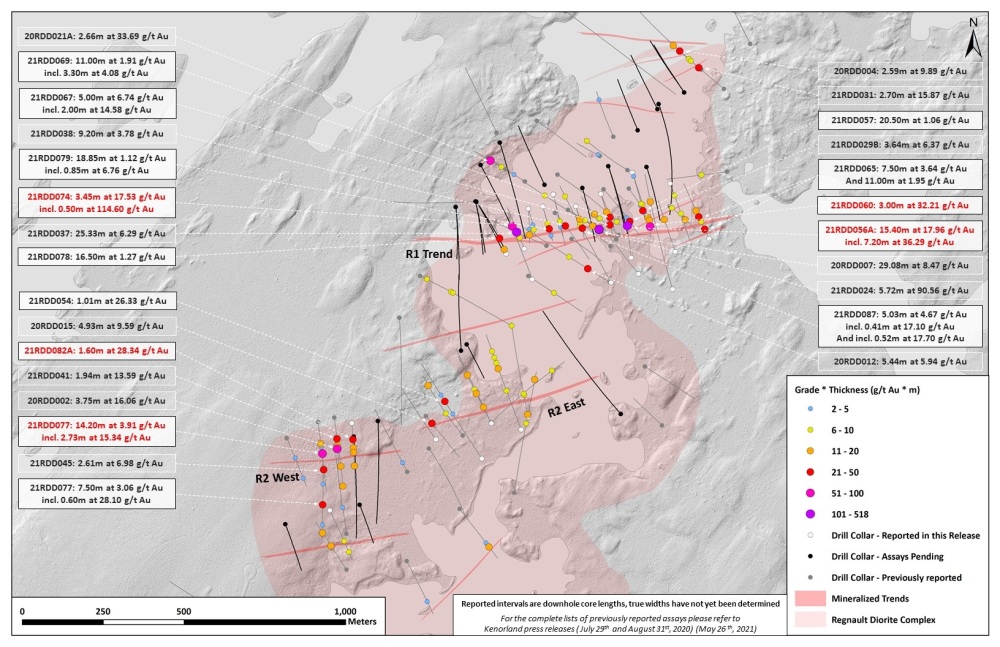
Let’s have a quick look at the latest results first. The absolute highlight was hole 21RDD056A, drilled along the R1 Trend which intercepted 15.4 meters at 17.96 g/t Au (276.6 g*m, including 7.2 meters at 36.29 g/t Au). Other strong R1 results were provided by hole 21RDD060 (3 meters at 32.21 g/t Au) and hole 21RDD074 (3.45 meters at 17.53 g/t Au, incl. 0.5 meters at 114.6 g/t Au).

Drilling along the R2 Trend more to the south also returned solid results, for example at R2 West, hole 21RDD077 resulted in 2.73 meters at 15.34 g/t and 7.5 meters at 3.06 g/t Au. Hole 21RDD082A returned 1.6 meters at 28.34 g/t Au, 1.23 meters at 13.9 g/t Au, 1.19 meters at 14.12 g/t Au, and 2.81 meters at 5.81 g/t Au. At R2 East, hole 21RDD054 generated 1 meter at 26.33 g/t Au, and hole 21RDD063 returned 22 meters at 0.73 g/t Au. These are nice highlights, as the dip of most holes is about -45 degrees, so most intercepts would have to be divided at most by 1.4, assuming almost vertical gold structures at least. McDonald had this to comment on this assumption: “R1 is dipping approximately 70* to the north and R2 is dipping shallowly to the north at approximately 15* or so.” So, likely the intercepts don’t have to be divided by 1.4 but much less, which is positive for potential mineralization of course.

The goal of this program was to not only systematically step out along strike and down dip of the already identified gold structures R1, R2 West, and R2 East, to better understand the controls on mineralization, but also look for potential new structures. As the map above and the section below reveal, they have been successful in finding higher grade intercepts now in areas of R1 where they only hit low graded, short intercepts before (see red vs. yellow dots):  

This obviously means the structures, which probably can be described as lenses, of which mineralization starts at surface (in this case the bottom of a shallow lake most of the time), have a tendency to pinch and swell, as vein systems often do. The good news is the average grade increases with these higher grade intercepts, and as most holes hit mineralization anyway, the R1 structure appears to be pretty continuous. In my view, most recently reported holes for R1 actually seem to be infill holes as they fill in the blanks between holes already drilled, just a few holes like 065, 074, and 078 look like careful 50-meter step outs. Lots of R1 holes which are assayed at the moment (see black dots on the section above) appear to be step out holes to the west and a few at depth, and R2 drilling saw relatively more step out drilling along strike and at depth, and more aggressively.

In general, the geologists at Kenorland have concluded so far that gold mineralization for R1 is characterized by shear-hosted, laminated quartz-carbonate-pyrite veins, often haloed by variably deformed extensional stockwork quartz veining. For R2, mineralization is found in stacked, shallow north-dipping extensional type quartz veins  (R2 West) and steeply north-dipping shear hosted quartz-carbonate veins (R2 East). As can be seen in the extensive table of the Dec. 20, 2021 news release with the latest 32 drill results, most holes had at least two different intercepts, indicating the laminated character of veins. The table also indicates that R1 is by far the most important mineralized trend for now, but management believes R2 East and R2 West could have the potential to add significant ounces. A few important step out holes to the most eastern and western boundaries of both trends will indicate strike length potential.

This sums up a summary of the latest drill results, so now it is time to discuss things further with CEO Zach Flood.

The Critical Investor (TCI): Thank you for your time. Let’s talk about a few general themes first. As you know, the world isn’t liberated from COVID-19 yet, and the Omicron variant is again increasing numbers of infections, intensive care patients, etc., and halting events. Even the VRIC has been cancelled a week ago and moved to May, as too many exhibitors and speakers viewed such a large scale event as too risky, and the organization had no other option but to reschedule unfortunately. At the same time the Fed is becoming wary of the current, multi-decade high inflation, and seems to signal to the markets that series of rate hikes are not out of the question as inflation could be here to stay. Usually inflation is good for gold, and real interest rates will be negative for a long time as inflation outruns rate hikes for a long time as well, which is also good for gold. But markets don’t particularly like the latest actions of the Fed, and a COVID-19 hampered economy could put the brakes on further. What do you think of all this, and more specifically what could be the outcome for gold and junior mining stocks?

Zach Flood (ZF): Regardless of the gold price there is no greater way to create value than making an economic discovery. That said, I’m quite optimistic of future metal prices, gold included, but then again, my time horizons are likely longer than most speculators. At Kenorland we take a similar long-term approach and are committed to finding new mineral deposits for future generations.

TCI: Let’s shift a bit more towards Kenorland now with regard to the pandemic. You told me recently that Sumitomo will decide somewhere in January about the next drill program at Frotet, which could be larger than all programs so far. Could extensive pandemic measures be of influence here? Could Kenorland in other ways feel the impact of such measures, for example at other projects or at assay labs?

ZF: Throughout the pandemic we have taken extraordinary measures to protect our personnel and other stakeholders in the field. This year will be no different. In terms of our operations, we have not yet experienced any major issues other than long delays at analytical labs. I don’t expect the lab issues to be resolved this year either, however, if everyone makes it home safe at the end of the day, then we are satisfied.

TCI: Before we delve into the Regnault project, I would like to ask you a few questions about your exploration strategy in general. I watched a video of Francis McDonald on your website, and I must say I was impressed. It seems as if Francis and yourself are doing things differently, based on your mindsets crafted at Newmont and Ivanhoe. The systematic approach and analysis is fascinating, you guys leave no stone unturned. Among other things, he said in an interview that he believes too much attention goes to outcrops and mineral occurrences in Canada, whereas in Australia there are no outcrops, etc., so you have to come up with systematic exploration and geological models. It seems logical that most significant near surface deposits have been discovered by now, at least in prospective areas that have seen exploration, so pushing the boundaries and shifting focus on potential mineralization under cover, or till sample large, under-explored but prospective areas seems like a sound strategy in my view. Exploring large properties to increase the odds seems logical, too. Why isn’t everybody doing this?   

ZF: Great question. Grassroots exploration is viewed as very high risk with long lead times to discovery. Most companies and shareholders do not have the appetite for it. At Kenorland, we founded the company and started building the portfolio in 2016, as well as forming partnerships with other major mining companies to advance these projects. We listed the company in 2020, after we had made one major discovery in Quebec. We have already undertaken many years and multiple campaigns of early stage exploration and target generation on many of the projects in the exploration pipeline which covers a vast amount of ground, over 500,000 hectares. This is the type of company that you can’t form overnight, it takes time, dedication, lots of exploration to make new discoveries. There are not many juniors out there executing early stage exploration at the scale which Kenorland is operating, and that is key. The more ground you cover in a diligent manner, the higher your odds of exploration success are, so we scaled up and we keep adding to that portfolio. Eventually, we will make more discoveries as long as we keep moving forward in this manner.          

TCI: I agree, you have set the bar high. I am also fascinated by the data analysis that is part of your exploration strategy. You and Francis analyzed lots of other projects, drill results and exploration programs, and reached all sorts of conclusions, all apparently tailored to optimize your own exploration programs. For example, the average number of exploration programs to discover greenfields deposits is about three including early stage programs.

Other metrics are 5 Moz Au deposits are on average discovered after an initial drill program produced an intercept of over 134 g*m, or as you call it GT (grade x thickness), with an intercept length of over 10 meters. For 2 Moz Au deposits, the numbers are >50 GT and >5 meters. Another set of metrics: The median drill program on a successful discovery program is 4,218 meters, and if a company drills less than 4,000 meters on an initial drill program but still produces an intercept being > 50 GT, this could be very significant. On the upper side, a program larger than 10,000 meters that doesn’t produce a >100 GT intercept, is likely unsuccessful. I love these type of statistics, and it likely adds to your chances of effectively sampling, drilling, and killing projects. Do you also normalize historic drilling/discoveries towards current practices, and do you for example separate quality exploration from lifestyle exploration, filtering out further?

ZF: We completed this internal study to understand how many meters we should put into a grassroots target for an effective “test” to reach a go or no go decision.  That number is somewhere between 4,000 and 10,000 meters, which is likely more than most people would guess. There are of course outliers on both sides, but this is the size of program we need to plan for in order to test and confidently walk away from a target if we don’t achieve the results, for example, 100 gram meters, or if we do, proceed to the next phase of exploration.  

TCI: I was also impressed by your knowledge of the mechanics of till sampling, and the kind of work that goes into till sampling under cover, looking for very small amounts of mineralization, plus having to determine where it all came from, taking into account glacier movements etc. This has been the central strategy for the Frotet project, are you applying this knowledge for most of the other projects of Kenorland at the moment as well?

ZF: Absolutely, most of our projects are located in areas covered by glacial till. There is widespread glacial cover over vast parts of Canada that are also highly prospective for mineral deposits and this is where we focus. The easiest way to conceal a deposit is to bury it under glacial till and therefore the most likely place to make a new discovery is in areas covered by till, like Regnault for example. All of the projects we operating in Quebec are similar—Chebistuan, Chicobi, O’Sullivan, Hunter, Frotet—we are using very similar techniques on all of these projects to search for new mineral deposits under cover.   

TCI: Interesting, to almost intentionally define the next exploration frontier, and turn it into your advantage. Could you explain a bit further for the audience why geochemistry and alteration are the best exploration tools? I assume geochemistry and alteration can only be identified by drilling, and I see drilling as the most advanced exploration method, and geophysics for example as more early stage. Personally I don’t feel these methods can be compared in a sense of one being superior to the other, every method is applied at a different stage with a different purpose, for example till sampling and airborne surveys cover huge areas to select targets, trenching and drilling work these targets to find mineralization. No meaningful drilling without targeting.

ZF: Normally, the actual deposit footprint is quite small relative to the geochemical or alteration footprint. So you are really looking for the smoke first that will lead you to the fire. Back to till sampling for example—the gold dispersion plume at Regnault is over 5 kilometers long. It was much easier to find the plume first and then narrow in on the veins which are orders of magnitude smaller in terms of their own footprints. Alteration is similar around a big hydrothermal system, like a porphyry copper deposit, it can extend kilometers from the actual orebody, so the alteration is the first thing you look for.   

TCI: It is probably all semantics. Something else: I noticed you focus on understanding major deposits, does this mean you are exclusively interested in exploring for Tier I deposits with Kenorland? If so, why is this? They are extremely difficult to find and very rare, and become more rare over time. Do you aim at specializing for major deposits, so the majors could see Kenorland as the go to shop for their exploration ideas?

ZF: We do a lot of work analyzing Tier 1 deposits to understand their footprints, so we can recognize what a Tier 1 deposit looks like in terms of the exploration data, for example surface geochemistry, geophysical expression, deposit outline, initial drilling, etc. This allows us to make more informed decisions when analyzing our own exploration data. We prefer to start looking in areas that have real potential to host those types of deposits. We may find deposits of many shapes and sizes by carrying out large scale systematic exploration.  

TCI: Let’s talk about the Regnault project now. In my view most reported results on R1 are infill drill results, although in the news release they are described mostly as step outs? I feel this is only warranted for the upcoming assays. Where do I go wrong here, if so?

ZF: We are reporting on both broad infill and step out drilling. The terms are bit subjective at this stage because if you have two holes a few hundred meters apart, a hole in between could be considered infill but also could be considered a step out from one of the other holes, its more exploration than resource definition. Infill drilling should really describe more advanced exploration to resource definition.  At this stage, most of our drilling is still very exploratory in nature, and we are still looking to define the geometry and orientation of higher-grade shoots within the vein system itself, as well as prove up additional veins.    

TCI: Good to see the difference between exploration and resource definition drilling terms. Most drilling appears to be done on ice, as most of the R1 structure is located under a shallow lake. Do you plan to step out aggressively on land with the next program?

ZF: We will continue to step out along strike, but our focus is really more on deeper step outs down plunge of potential high grade shoots.

TCI: As the nearby Troilus deposit has mineralization that runs much deeper, do you plan on drilling much deeper at Regnault as well?

ZF: Absolutely, the next program will see more aggressive step outs down dip.

Troilus deposits (Source: Troilus Gold presentation)

TCI: The long section shows mineralization at almost every hole which indicates good continuity, although the GT numbers vary a lot. Could this imply a complex geologic structure, or multiple fault lines, or else? Or just pinching and swelling of gold mineralization?

ZF: Yes, the vein system is quite complex, although it is consistently present along strike and at depth. This is typical in orogenic gold systems. The first step for us early last year was to define the orientation of the vein, which we achieved, R1 for instance is oriented roughly East-West. The next program during last summer was to drill along the vein and find the blowouts, shoots, higher-grade sections, etc. We believe we have defined a few of these areas as well so now the objective going forward will be to extend those at depth. Most high-grade structurally controlled gold systems are complex and they take a lot of drilling and effort to work out. Surprisingly, Regnault is not as complex as most, the veins are relatively consistent in terms of strike and dip.

TCI: Yes, the consistency is a good thing to have. You told me the R1 structure is dipping steeply to the north, do you also expect this for the R2 structures, of any other, new structure found on the property, as part of some overall geological concept? What kind of structural controls are defined yet? Are you looking for feeder systems?

ZF: R2 is a different beast than R1. R1 veins are hosted in a shear through the intrusive complex while R2 West veins are very shallow dipping extensional veins sitting between two shears. R2 East is more steeply dipping and controlled by shearing, similar to R1. We have found other shears in the intrusive complex as well, some dipping north, some to the south.  We are just beginning to understand the structural controls on high-grade mineralization but still have a long ways to go. In general we are looking at the intersection between NNE steeply dipping D1 deformation and D2 shearing such as we see along R1.

TCI: I did some very global back-of-the-envelope estimates on the Regnault structures, and arrive for R1 at 1000 x 200 x 5 x 2.75 = 2.75 Mt, at an average guesstimated grade of 5 g/t Au. This would mean a hypothetical 440 koz Au. For R2, this could be 400 x 250 x 2 x 2.75 = 550 kt, at an average guesstimated grade of 7.5 g/t Au is a hypothetical 133 koz Au. So the total estimated gold mineralization could be closing in on a hypothetical 600 koz Au. Do you feel this is a ballpark number in the right direction? I believe you once told me there is considerable low-grade disseminated gold in the R1 structure, could this make a difference?

ZF: It’s too early for me to comment on a resource at Regnault unfortunately.

TCI: No problem. As we briefly discussed your preferences for large deposits, do you have a resource target in mind for Regnault?

ZF: In order for most major mining companies to proceed with development, they likely need to see greater than 3-5 moz Au potential. I do not actually know what Sumitomo’s threshold is, but I could guess it is somewhere within or north of that range. It’s still early days at Regnault but the next few programs should shed more light on what the potential is there. As I said, we are just beginning to understand the controls on mineralization.   

TCI: Are you looking at targets further away from the direct vicinity of Regnault?

ZF: Yes, we have multiple targets we will be following up on within the Frotet Project, some of these will see drilling next winter.

TCI: Your staff is building a Leapfrog 3D model now of Regnault, it will be very interesting to see the mineralized envelope and sections of geology and mineralization. When will this be finished you think?

ZF: We will likely begin to see the geologic model once all of the data from the last program is taken into account. Stay tuned.

TCI: You told me earlier the upcoming 10,000-meter drill program for Regnault will consist of 60% focus on R1, 25% on R2 ,and 15% on new targets, so heavily geared towards R1.

Update: A news release came out Jan. 12, 2022, confirming this and announcing the commencing of drilling as well, with additional info here:

“Approximately 60% of the proposed drilling will be allocated to step-outs along the R1 structure, targeting down plunge extensions of higher-grade mineralization along the vein corridor. Twelve drill holes are planned to significantly expand the R1 vein system at depth to approximately 500 meters below surface beyond the current known extent of approximately 275 meters vertical depth. Along the R2 Trend, up to 25% of the proposed program will be allocated towards broad-spaced infill drilling to determine the structural framework linking R2 West and R2 East. The remaining 15% of the proposed drill program is designed to expand on known mineralization and test additional gold-bearing structures north of the R1 corridor.”

You are planning to drill much deeper down dip at R1, could you tell us how much deeper?

ZF: We are looking to approximately double the vertical extend of the R1 vein system from ~250 meters to ~500 meters.

The map of the planned drilling of this program can be seen below:

The Q1 2022 program follows the recently completed 17,792 meter drill program, of which 9,824m have been reported. The company expects assays for the remaining 7,968m to be announced in the coming weeks, but this is all depending on the assay labs of course which have seen lots of delays.

TCI: I believe that concludes Regnault for now. A different subject that might be frustrating for you and shareholders is the share price of Kenorland. After lots of exploration success, a solid treasury, top notch exploration management and with a gold price still hovering around US$1800/oz, the stock is side-ranging close to its lows since listing. Do you have an explanation for this, and what is your plan to get things moving again? What could be a catalyst?

Share price 1 year period; Source: tmxmoney.com

ZF: 2021 was a difficult year for gold equities in general. Kenorland actually held up surprisingly well, although I do understand we are far below our all-time highs as well as the last two financings which were both completed at CA$1/share. I see a huge amount of upside in the stock, we are in a much stronger position today than we were last year at higher prices. We are entering 2022 with over CA$9 million in working capital, projects which are more advanced, and a number of deals we completed last year that have significantly added to our bottom line on the financial statements. We also have an incredible amount of exploration which we will undertake this year, the results from which will be the real driving catalyst in the share price.

TCI: Large-scale exploration remains a high risk/high reward game, but if any team could be successful at it, it seems to be Kenorland Minerals, in my view. Talking about large scale, as you optioned out the South Uchi Project to Barrick Gold on Sept. 20, 2021, we contemplated Barrick could do a move for Great Bear. Instead, Kinross stepped in and Barrick doesn’t make a sound. If Barrick doesn’t surpass Kinross with a better bid, could this have implications for the strategy of Barrick, and more specific for South Uchi?

ZF: I do not believe this will change Barrick’s strategy in the Red Lake District. I think the speculation around the potential suitor for GBR was exactly that, speculation. Barrick is committed to this part of the Canadian shield in terms of its exploration strategy for good reason—it’s a highly prospective region and still very under-explored as demonstrated by GBR along the LP Fault. We’re very excited to see what Barrick comes up with after last fall’s large-scale regional till sampling program they carried out at South Uchi.

TCI: It sure would be interesting to see a major like Barrick venturing into substantial drill programs for example. What is the current status of the Healy Project, Alaska (optioned from Newmont Corporation), as a 5,000 meter maiden diamond drill program has been completed, plus several surveys, all results were expected in January 2022?

ZF: We are still awaiting complete assays from the labs but expect results to be announced in Q1. We are all of course eager to see the results ourselves as we encounter widespread mineralization and alteration in much of the drilling there.

Healy Project; proposed drilling/sampling results

TCI: After Healy, another important project for Kenorland is Tanacross (Alaska). Extensive soil sampling program has been done, a 5 km IP and MT survey was completed, and an airborne magnetics survey was flown over several targets.

The assays were expected over a month ago. Analysis, interpretation and targeting were planned for January. As several of the surveys were delayed, previously announced drilling has been put on hold, and the assigned budget was reallocated for additional drilling at Healy. What is the status here?

ZF: Similar to Healy, we are still waiting for complete assays from the geochemical surveys we completed at Tanacross. And again, the team is eager to see the numbers as we have some very compelling targets already that could be prioritized for drilling this year if warranted.

TCI: Kenorland also completed a VTEM survey at the Hunter project in Quebec (fully owned), a LiDAR survey and mapping at South Uchi (optioned to Barrick), completed a soil sampling program at Chebistuan in Quebec (optioned to Newmont), and completed a sonic drill-for-till geochemical program at their Chicobi project, also in Quebec. A map with the sampling results for Chebistuan looks like this:

TCI: What is the status of a magnetic survey, radiometrics and induced polarization (IP) which will all take place at the Deux Orignaux AOI target zone in January, in preparation for drill targeting?

ZF: Till sampling, boulder prospecting, and airborne magnetics has been completed at Deux Orignaux and currently there are crews there line-cutting in preparation for the IP survey.

TCI: What is the current state of affairs at Chicobi, as drone magnetics, IP and electromagnetics (EM) have been completed, and diamond drilling was scheduled for Q1, 2022?

ZF: We have now received the geophysics data including IP, Magnetics, and EM and have began the drill targeting exercise. We have also began permitting for a drill program which is expected to commence in March.

TCI: This concludes our Q & A, do you have anything to add for the audience?

ZF: I think we covered a lot here already, thanks for the interesting questions and the opportunity to add more color to the Kenorland story.

Conclusion

After another batch of strong drill results, Kenorland Minerals is waiting for JV partner Sumitomo to approve their budget for another extensive drill program at Regnault. The remaining batch of the last completed program is expected to be announced in the coming weeks if the labs don’t face too many delays. In the mean time, the company commenced an already approved 10,000-meter program at Regnault, and is exploring at five other projects, and expects a stream of results from now on. As all projects are of considerable size, any new discovery or substantial step out result at Regnault (for example >200GT) could cause the long-awaited re-rating now for this textbook example of a large scale exploration junior, alongside a cooperating price of gold. Stay tuned!

I hope you will find this article interesting and useful, and will have further interest in my upcoming articles on mining. To never miss a thing, please subscribe to my free newsletter at www.criticalinvestor.eu, in order to get an email notice of my new articles soon after they are published.

All currencies are in U.S. Dollars, unless stated otherwise.  

The Critical Investor is a newsletter and comprehensive junior mining platform, providing analysis, blog and newsfeed and all sorts of information about junior mining. The editor is an avid and critical junior mining stock investor from The Netherlands, with an MSc background in construction/project management. Number cruncher at project economics, looking for high-quality companies, mostly growth/turnaround/catalyst-driven to avoid too much dependence/influence of long-term commodity pricing/market sentiments, and often looking for long-term deep value. Getting burned in the past himself at junior mining investments by following overly positive sources that more often than not avoided to mention (hidden) risks or critical flaws, The Critical Investor learned his lesson well, and goes a few steps further ever since, providing a fresh, more in-depth, and critical vision on things, hence the name.

The author is not a registered investment advisor, and currently has a long position in this stock: Kenorland Minerals Ltd. Kenorland Minerals Ltd. is a sponsoring company.

All facts are to be checked by the reader. For more information go to the companies’ websites and read the company’s profile and official documents on www.sedar.com, also for important risk disclosures. This article is provided for information purposes only, and is not intended to be investment advice of any kind, and all readers are encouraged to do their own due diligence, and talk to their own licensed investment advisors prior to making any investment decisions.

All pictures are company material, unless stated otherwise.

Sign up for our FREE newsletter at: www.streetwisereports.com/get-news

Streetwise Reports Disclosures
1) The Critical Investor’s disclosures are listed above.
2) The following companies mentioned in the article are sponsors of Streetwise Reports: Kenorland Minerals Ltd. Click here for important disclosures about sponsor fees. The information provided above is for informational purposes only and is not a recommendation to buy or sell any security.
3) Statements and opinions expressed are the opinions of the author and not of Streetwise Reports or its officers. The author is wholly responsible for the validity of the statements. The author was not paid by Streetwise Reports for this article. Streetwise Reports was not paid by the author to publish or syndicate this article. Streetwise Reports requires contributing authors to disclose any shareholdings in, or economic relationships with, companies that they write about. Streetwise Reports relies upon the authors to accurately provide this information and Streetwise Reports has no means of verifying its accuracy.
4) The article does not constitute investment advice. Each reader is encouraged to consult with his or her individual financial professional and any action a reader takes as a result of information presented here is his or her own responsibility. By opening this page, each reader accepts and agrees to Streetwise Reports’ terms of use and full legal disclaimer. This article is not a solicitation for investment. Streetwise Reports does not render general or specific investment advice and the information on Streetwise Reports should not be considered a recommendation to buy or sell any security. Streetwise Reports does not endorse or recommend the business, products, services or securities of any company mentioned on Streetwise Reports.
5) From time to time, Streetwise Reports LLC and its directors, officers, employees or members of their families, as well as persons interviewed for articles and interviews on the site, may have a long or short position in securities mentioned. Directors, officers, employees or members of their immediate families are prohibited from making purchases and/or sales of those securities in the open market or otherwise from the time of the decision to publish an article until three business days after the publication of the article. The foregoing prohibition does not apply to articles that in substance only restate previously published company releases. As of the date of this article, officers and/or employees of Streetwise Reports LLC (including members of their household) own securities of Kenorland Minerals Ltd., a company mentioned in this article.

( Companies Mentioned: KLD:TSX.V; 3WQO:FSE,
)

Categories
Gold

Hopes and Prayers Economic Policy: SchiffGold Friday Gold Wrap Jan. 14, 2022

December gave us another big jump in consumer prices. But despite a lot of talk about an inflation war, accommodative monetary policy remains in play. In this episode of the Friday Gold Wrap podcast, host Mike Maharrey breaks down the CPI data, Jerome Powell’s Senate testimony, and Joe Biden’s plan to fix rising meat prices. […]

The post Blog first appeared on SchiffGold.

Categories
Gold

Can the Deficit Fall Below $1 Trillion in 2022?

In the calendar year 2021, federal tax revenues surged by an incredible 25% compared to 2020 and were up 22.8% over 2019 (pre-COVID). But the surge in tax revenues was not enough to overcome a record $6.8 trillion in spending, breaking the spending record set in 2020 by 1.6%. This led to a deficit of […]

The post Blog first appeared on SchiffGold.

Categories
Gold

Silver Short TRAPPED! Bank Can’t Buy Back 800,000,000 OUNCE SILVER SHORT!

It will be the trigger for mass financial destruction… by Bix Weir of Road to Roota Shorting an asset is the most RISKY endeavor in the financial world because you […]
Categories
Gold

Yet Another Retirement Risk You May Not Be Considering

We clearly need to add “outliving our savings” to the ever-lengthening list of future risks. Gold Bugs, that means turbocharge your… by John Rubino of Dollar Collapse The most common […]