- Illegal Gold Mining Causes ‘Devastating’ Mercury Pollution In Amazon Rainforest, Study Says Forbes
- Gold Mining Is Poisoning Amazon Forests with Mercury Scientific American
- Illegal gold mining causing record mercury levels in Peruvian rainforests CBS News
- Amazon forests poisoned by mercury from gold mining | Wake Forest News Wake Forest News
- Illegal Gold Mining in Peruvian Amazon Turns Pristine Rainforests Into Heavily Polluted Mercury Sinks SciTechDaily
- View Full Coverage on Google News
Month: January 2022
- Gold set for worst week since Nov as rate hike bets boost dollar Reuters
- More price pressure on gold, silver early, but risk aversion rising Kitco NEWS
- Gold retreats from a 2-month high, holds its ground after Fed decision MarketWatch
- Gold is shining again as stocks wobble and cryptos melt down CNN
- Gold eyes worst week since Nov as rate hike bets boost dollar CNBC
- View Full Coverage on Google News
Welcome to this week’s Market Wrap Podcast, I’m Mike Gleason.
Gold and silver markets took a hit this week following the Federal Reserve’s meeting announcement.
Although Fed officials didn’t make any policy changes, they did strongly suggest that they will hike their benchmark interest rate in March. Although widely expected, some investors thought the recent stock market swoon might cause the central bank to back down.
The financial media reported Fed chairman Jerome Powell’s tone as hawkish, which in turn spooked markets.
The reality is that Powell is the most dovish central banker in the history of the Federal Reserve. That’s just going by the numbers. Under Powell, the Fed has embarked on an unprecedented Quantitative Easing program that has ballooned its balance sheet to $9 trillion.
It has also pushed interest rates down to record lows in real terms. The Fed funds rate is running at -7% when adjusted for the Consumer Price Index.
Powell admitted during remarks to the press that inflation has been running hotter and has persisted longer than he had let on to the public when he repeatedly called it “transitory”:
Jerome Powell: Both sides of the mandate are calling for us to move steadily away from the very highly accommodated policies we put in place during the challenging economic conditions that the economy faced earlier in the pandemic. There are multiple forces which should be working over the course of the year for inflation to come down. We do realize that the timing and pace of that are highly uncertain, and that inflation has persisted longer than we thought.
And of course, we’re prepared to use our tools to assure that higher inflation does not become entrenched.
And speaking of entrenched inflation, rising prices continue to pinch the pocketbooks of consumers even as the stock market seems to be deflating. Falling equity values don’t necessarily imply a broader trend of disinflation.
While the S&P 500 moved lower in volatile price action again this week, commodities continued to move higher. The CRB commodity index broke out to a 7-year high on Wednesday with West Texas crude oil prices hitting $87 per barrel.
Gold and silver markets, however, are diverging. Gold prices are down 2.7% for the week to trade at $1,792 an ounce. Silver is taking a near $2 or 8.0% pounding this week to bring spot prices to $22.44 per ounce.
Platinum is trading 2.8% lower to come in at $1,013. And finally, palladium prices are diverging positively – up 10.8% or nearly $250 this week to trade at $2,370 per ounce as of this Friday morning recording.
Despite price weakness in most of the metals, we are seeing underlying strength in terms of demand. Over the past few days, gold and silver exchange-traded products have seen their biggest inflows since 2019.
ETFs function as convenient trading vehicles for investors who may want to rotate out of stocks within their brokerage accounts. But at the end of the day, any security that trades on a Wall Street exchange is still a financial asset that carries counterparty risk. Even if it purports to track the price of a precious metal or be backed by physical metal, no exchange-traded product can substitute for bullion itself.
Much doubt has been cast on the extent of actual gold backing of the largest gold ETF. Meanwhile, the biggest silver ETF, the SLV, changed its prospectus last year to allow for the suspension or restriction of new shares when it is unable to obtain enough metal.
The change occurred after the SLV was deluged with unusually high trading volumes last February. The large-scale inflows and outflows caused discrepancies between the market price of SLV and the value of its underlying assets.
As an open-ended fund, SLV doesn’t hold a fixed quantity of silver. It instead relies on layers of financial intermediaries known as “authorized participants” to create shares and adjust its asset base.
That entails counterparty risk, including the risk that some of the silver claimed in vaults by SLV may be rehypothecated, or simultaneously owned by another party.
Owning silver indirectly through financial instruments obviously doesn’t achieve true diversification out of financial assets. But Wall Street types tend to perceive financial instruments as the only game in town.
The fact that some very real demand for precious metals is being diverted into Wall Street products and away from bullion products has suppressed the physical market to some extent. That may be working to keep a lid on spot prices as well – especially as exchange-traded vehicles announce workarounds to obtaining real, physical holdings.
ETFs like the SLV depend almost entirely on the London Bullion Market Association for their physical silver holdings, such as they are. Inventories of LBMA silver bars have grown increasingly scarce throughout the demand surge we’ve seen the past couple years.
Whether that develops into a full-fledged shortage remains to be seen.
But in the event of a run on the bank for physical silver or gold, paper products linked to precious metals would not necessarily benefit in the way holders of them hope. They could even implode.
Meanwhile, in the event of a shortage of available coins, rounds, and bars, scarcity premiums could go through the roof. That gives bullion investors the opportunity to potentially benefit from both rising premiums and rising spot prices – a double play that no ETF offers.
Well, that will do it for this week. Be sure to check back next Friday for our next Weekly Market Wrap Podcast. Until then this has been Mike Gleason with Money Metals Exchange, thanks for listening and have a great weekend everybody.
President of Money Metals Exchange and the Sound Money Defense League, Stefan Gleason joins David Morgan to discuss active sound money legislative battles across the US.
David Morgan:
Welcome everyone. This is another video blog or podcast, whatever you want to call it. This is David Morgan, from the Morganreport.com. Stefan Gleason, been a long time since I’ve seen you in person. He started a bullion dealership which we want to hear about just basically your background. And before I give you the mic, Stefan’s done a lot more than become one of the top-rated bullion dealers in the country. He’s been an advocate for sound money for a long time, and has basically spearheaded the sound money project, which is why I asked him on for this interview. But Stefan, before we start that let’s get a little background from you, what your past has been, and what your bullion business is like and we’ll start it.
Stefan Gleason:
Sure thanks, David. Of course, it’s an honor to be on your show and your podcast. I’ve been listening to you for probably 20 years first as an investor and then ultimately in 2010 as a precious metals dealer, and we’ve gotten to know each other over the last 12 years and developed a great friendship and working relationship. But my background is I first started out by going into public policy. I worked for conservative free market organizations in Washington DC, in particular National Right to work. And where that was an issue that deals with compulsory unionism and the whole idea of forcing people to join and pay money to unions as a condition of employment. And I’ve always had sort of a political and free market, libertarian leaning background and interest.
And that’s kind of what led me into precious metals in the early 2000s and just looking at interest rates, looking at the federal reserve system and just kind of figuring out what an incredibly just ridiculous monetary system we have. And that’s what got me into precious metals as an investor about 20 years ago, and then about 12, 13 years ago as a precious metals dealer. And so, my full-time focus has been for the last 12 years money metals exchange. And we built that up to be one of the top two or three or four precious metals dealers online in the country, in the US. But I still have a very strong interest in the public policy side and of course, precious metals and sound money and the whole relationship of the monetary system to enabling big government and the federal reserve system and how that is really part of the problem of big go in our country and the lack of restraint on big government that flows from our current monetary policy.
Stefan Gleason:
And so, while on one hand, I’m helping my company and our team is helping people get out of the dollar and hedge themselves and get some protection outside of the financial system, through individual ownership in precious metals or sound money, but also now in the last five or six years, really focusing on public policies at the state and federal level and using some of the resources of money metals to try to affect positive legislative change around the country. And that’s kind of the main focus here today is talk about the sound money defense league and the project that we have going on with the help of many, especially our customers and people in the grassroots, and even some other precious metals dealers in looking at some of these policies that we have of that can be reformed at the state level, where there’s actually a pretty decent chance in getting some of these laws fixed or enacted.
Stefan Gleason:
And so kind of as at the outset, about five years ago, we established the sound money index, and we basically figured out what are the policies that impact precious metals at the state level that we should be focused on as trying to improve. And we’ve ranked all the states, we’ve evaluated all the state’s laws on these 12 different topics or areas and now we’re over the last few years been focusing on introducing bills and gaining allies to do things such as repeal sales taxes on precious metals, remove income taxes on precious metals, and then a whole other range of policies that deal with, whether a state will hold gold as a reserve asset, whether a state has a depository type of structure in place, such as Texas, whether a state has gold bonds or issues gold bonds, none of them do currently, but that’s something that we score.
Stefan Gleason:
And then even things like state laws that harass investors and dealers and make it difficult for the dealers to do business and invade the privacy of the investors. And so we’re working on all of these fronts to try to improve public policies. And then of course, to defend those laws that are on the books that are good, such as sales tax exemptions, which are still being threatened from time to time, including in your state, Washington state, where there is an exemption, but the state legislature has tried to remove it on several occasions. And fortunately we’ve been to stop them with the help of a lot of folks in the state as well. So the main thing is the sound money index. We actually have this on our website, how money metals exchange or MoneyMetals.com and it’s a ranking of each year of all the states. And I encourage people to go there and check it out and we can go down some of the things in the index if you like.
David Morgan:
Sure. Well, let me pause you there for a minute. First of all, full disclosure, one is I’ve bought many times from your dealership, another disclosure is that you were, won’t call it disclosure. I mean, we’ve known each other for some time and you gave me a heads up that the governor of Utah was going to sign an act into law about using precious metals as basically any transaction whatsoever. And so thank you for that. And I was actually invited and stood behind him as did you, as he signed that in the law. And I wouldn’t say there’s a flaw, but maybe I will. I’m mixing my words. I actually proposed at that time, that the only way I could see it working well is for the state to have a depository, deposit the precious pedals in there, and then make a transparent it to the merchant, which means to use like a debit card that’s precious metals back.
David Morgan:
And then the bank interface between the depository and the merchant could take care of particulars like what is the exact price of silver, gold when you sell it, what’s the premium and make that transaction, put it into federal reserve notes and put it on your debit card. And it got a little bit of pushback from the legislature. I highly respect, I mean, a great deal of work went into it, but it really hasn’t been utilized that much. I gave that speech at the silver summit. And as you know, one of the audience members came up to me and basically established that parameter, where you can deposit your metal and then it’s a debit card that you can use. Wouldn’t want to go down that hole too far? What I really wanted to bring to the fort is the tax part. That was the other full disclosure.
David Morgan:
I get asked a lot, well what’s tax treatment? And it depends. It’s not only what jurisdiction you are in the world. And we have a worldwide audience. I think we have subscribers in about 40 countries approximately, but primarily the US and Canada. It depends state to state. I don’t want to go through every state, but if you could give me kind of a one, two, three, like the best, the worst and the middle, let’s say taxation, give me ones and then give easiest to do business and hardest to do business. And I think is it, Michigan is the only one where there’s actual regulation on all precious metals dealers?
Stefan Gleason:
Minnesota, yeah.
David Morgan:
Minnesota sorry. Okay I think explain a little if that’s okay.
Stefan Gleason:
Yeah. And part of that law was just gutted by a group of dealers that sued the state and it’s now being battled on appeal, I believe. But yeah, there’s interesting differences between the states and Utah, by the way, there were some people in the state that worked very hard on that. Larry Hilton and UPMA and some of the folks there. Utah did eliminate the income tax on precious metals, that law removed the income tax. It’s actually an income tax credit offsetting your capital gains taxes, but essentially the sale of precious metals in Utah, and several other states, Arizona passed a similar exemption is exempt from income tax. So you don’t pay for any gains if you have them. And that’s only fair because if you think about it, a lot of times, the gains that people have in precious metals are really any asset is a result of inflation, it’s not even a real gain.
Stefan Gleason:
So, Utah and a few other states have no income tax on precious metals. Some of them be by virtue of not having income tax at all. And some of them by virtue of having passed something like Utah did or Arizona did. At the top of our index are Wyoming, Texas, South Dakota, Alaska, New Hampshire, Utah. And that’s because none of them have any sales tax taxes on precious metals. And several of them do not have income tax on precious metals. I mentioned Utah, Texas doesn’t have an income tax at all. Wyoming doesn’t have an income tax at all. And Wyoming has passed a couple other things similar to Utah to say that gold and silver are money specifically sort of calling that out as they already are prescribed under article one, section 10 of the US constitution that states have like Utah and Wyoming have reaffirmed that principle and said, we’ve in our statutes, say that gold and silver are money.
Stefan Gleason:
And so those are some of the things that have put those states at the top. The worst states would be. And some of those have some of these worst states have bills this year that would make them jump probably to the middle of the index. But the worst states would be Hawaii, Mississippi, New Mexico, Wisconsin, Kentucky, Maine, New Jersey, and Vermont. And all of these states have full taxation on precious metals purchases. And they also have income tax on the sale of precious metals. And some of them also have higher than average income tax and sales tax rates, which is another thing that we factor in. And so those are the things that make those the worse states because more than 50% of our index is based on the tax policy, because we think the tax policy is probably the most meaning full thing that either helps or hurts sound money in a state, at least that can be handled at a state level.
Stefan Gleason:
Because if you think about it, tax is the friction on the buying and selling, it’s what makes it difficult to transact in precious metals because of the friction or the costs on both sides. And so we feel that taxes really in order to sort of remonetize gold and silver in a practical sense, removing the taxation is probably the most important thing that you can do. Of course, there’s federal income tax, that’s a federal problem and we have a bill there with Congressman Mooney that would address that, but that’s a much more difficult battle to win. And at the state level we have found the sales tax exemptions have been pretty much the top policy for us. And really the one that probably hurts or helps our customers the most is whether a state has an income tax and or a sales tax.
Stefan Gleason:
And then in the case of the last few years, the Supreme Court actually expanded the ability of states to impose sales tax on businesses that are doing business in the state from out of state. And so all of the major precious metals dealers, including money metals exchange had had to get into the business of being the bagman for state tax bureaucrats across the country when people do business on our website, and it’s a very, very troubling development. It’s a very difficult program for and deal with and then of course you now have an audit risk in 50 states and these are small, more urgent businesses with not huge numbers of employees. We’re not Wayfair, we’re not Walmart. And yet we have a compliance situation in 50 states. So anyways, but on the sales tax front, in the last several years, we have had more states pass exemptions.
Stefan Gleason:
And so today there are now 42 states in the US that either entirely or partially exempt precious metals from the sales tax and of the eight remaining that fully tax precious metals on the sales side, five of them have already introduced bills to repeal the sales tax on precious metals this session. And we may actually pass a couple more of this year, I’m hopeful that we will. Last year, we were involved in helping Ohio enact its sales tax exemption. They had actually reversed it a few years earlier. They had it before and then they put it back on and they repealed it again this year, this last year, but also Arkansas just repealed sales tax on precious metals. And the year before that we had West Virginia and a couple other states in the south. I think Louisiana, Louisiana did also put the exemption in place.
Stefan Gleason:
So there’s a lot of progress being made on the sales tax front. I mean, if you think about the sales tax, I mean we all get it, of course, but just to review, I mean, the whole idea of the sales tax, if it’s on anything, is that okay, it’s a tax on the final consumer of a good, like the user, the person who eats it or expends it and they’re the final user and nobody else pays it but the final user. Well, I mean, obviously precious metals especially bullion are held for resale, they’re inherently held for resale. So the whole idea of taxing money in the first place, and then taxing something that’s held for resale just makes no sense at all. It’s also a regressive tax on investors. It’s the only kind of investment that people generally will end up encountering a sales tax with.
Stefan Gleason:
I mean, you don’t pay sales tax when you buy a stock or a bond. And then of course it’s double taxation because you have income tax on the other side. And so we feel the arguments have been resonating very well on the sales tax front. It’s also been driving coin shows out of those states. They’re not able to have coin shows because all the coin dealers come in and then the tax bureaucrats mills around and starts hitting people up before their tax certificates at the booths and people don’t want to do a show in a state like that. So it’s also hurting business. It’s hurting businesses in those states that have a sales tax on precious metals.
Stefan Gleason:
Their dealers are not able to be as competitive because people can go to another state to make their purchases it’s just there’s plenty of studies. There’s been several studies that have shown people losing business in their state by having an income sales tax on precious metals. And so we’ve very successful so far in both preserving the exemptions that we have and expanding the exemptions.
Stefan Gleason:
So this year we have a bill in Hawaii, we have one in New Jersey, we have one in Mississippi and we have one in Kentucky and there’s actually one more and I’ll remember that in a minute, but we’re working in five states already. And then there’s a couple other states where the exemptions are expiring such as Virginia and Louisiana, I’m sorry, Virginia and Alabama. So those are the two states where the exemption actually has a sunset clause unfortunately, because for whatever reason, a few years ago, the legislators felt they had to put that in to get it passed. We obviously don’t support that idea, but it has to be addressed now because if it’s not extended, well those exemptions will go away. So sales tax is cut in the main battle ground.
David Morgan:
Let me stop you-
Stefan Gleason:
Yeah, go ahead.
David Morgan:
One question, of course we get from time to time is at the federal level, if we’re a collectable or a capital gains type of treatment, can you address that before I forget that.
Stefan Gleason:
Yeah. And so that’s the root of the income tax problem because most of the states actually follow the federal adjusted gross income. So it starts with federal. So people who have a gain on precious metals are expected by the IRS to report that gain and also to pay a discriminatory high 28% income tax rate. So it’s not even taxed at 15% capital gains taxes or 20% for people over, I think 400 or 500,000 in annual income have a higher capital gains tax rate. But gold bullion is considered a collectible and it’s taxed in a long term capital gains tax rate of 28%, and this is being done without statutory basis. It’s being done primarily as a IRS regulatory approach, the IRS and the department of treasury could, and there were discussions during the Trump administration to deal with this, but the IRS could actually change its policy and say, we’re not going to consider gold or silver gains or losses to be a taxation issue at all.
Stefan Gleason:
They could do that unilaterally, but there is legislation by Congressman Mooney that has been introduced. He’s a Republican from West Virginia and he’s been one of the strong advocates of sound money in the last few years since Ron Paul left and a few and there’s others, but he’s kind of the leader. And he has a bill that would remove the income tax from precious metals at the federal level and make it so that it’s literally tax neutral. So you would not report precious metals gains, nor could you deduct so actual losses. Now we know that as a result of inflation and financial repression and the policies that for the most part, people are having gains on precious metals over the long term. So it’s a tax neutral bill that would primarily benefit those who would otherwise pay taxes on precious metals.
Stefan Gleason:
And then the problem goes to the state level from there because most states literally just follow your federal number. And so that’s where states have actually been doing things to say, well, if you have precious metals, income or income in your federal income that comes to the state tax return, we are going to deduct it out. And Arizona did that and Utah did that and there are bills in other states, we’re going to have a bill in Iowa this year. There was a bill just introduced in Oklahoma just to do that very thing. So the income tax issue is sort of the second front in the sound money battle. It’s not as big a front, but I see us moving more and more in that direction as we knock out the rest of these sales tax laws.
David Morgan:
Great. What about, some of the more onerous states, as far as like coming in, which I’ve done many times and just putting federal reserve notes on the counter and walking out with your couple rolls of Eagles.
Stefan Gleason:
Yeah, yeah. One of the things that we rank in the sound money index is something we call precious metals dealer and investor harassment laws. And so what these laws are and some of these are at the municipal level as well and we actually haven’t gone into that. We know they’re there, but we haven’t gone into the full ranking all the way down to the municipal level. But even at the state level, there are laws that harass dealers and customers or investors and we have basically four ways they do it. And the Minnesota law, by the way, that whole regulatory scheme, I’m going to put that aside, that’s a little bit of its own thing. But basically in some states, dealers have to, number one, when they make a purchase from the public, they have to hold that bullion for seven days, 14 days, even longer 20 days and not sell it, number one.
Stefan Gleason:
Number two, they have to upload personal information of their customers who come in to sell things to their shop. They have to upload that to the Sheriff’s office in real time with description of the person, driver’s license information, photos of the things that they sold to the dealer and can be penalized severely if they fail to do so. They also, one case in Arizona, they literally are not allowed to accept federal reserve notes other than via a check or an electronic transfer for a purchase of precious metal. So it’s literally illegal under Arizona law to use cash. I mean, we know there’s a tax on cash, there’s a war on cash, but where is it illegal to use cash to purchase a good or an asset anywhere? I mean yet, I mean, I know that’s where we’re heading maybe, but it’s happening in Arizona.
Stefan Gleason:
At least it’s on the books in Arizona and that’s probably the worst of the dealer harassment because they have all those other things I mentioned, so that’s another area. We don’t have any bills currently to deal with that. Well there is a new secondhand law coming up, I think in New York that we’re going to try to stop. But again, sometimes these happen through a broader law that has to do with dealing with pawn shops where I guess the theory is that you have a stolen watch or you have a stolen earring well, somebody’s going to come to a shop and fence it and that they’re going to stop some of these crimes and catch the thieves or prevent it from being liquidated or melted or whatever before so the sheriff can go to the database and, and find all the reports and maybe they find the goods.
Stefan Gleason:
But when you’re talking about a silver bar or a Gold Eagle coin, these are fungible items. It’s not even possible to individually identify these things. So it’s really just about surveillance and harassment. And so, that’s the part we take issue with, we’re not really involved in these ancillary things like jewelry, but that’s something we think that needs to be addressed over time and we’re looking at that monitoring it and then where we can, we’re activating. And I should mention by the way that David, a lot of these battles that we’re involved and rely on grassroots support from rank and file investors. And we have a large email list and we encourage people to get on our email list because part of that will enable us to send you an alert.
Stefan Gleason:
If you’re in Hawaii, and we have a hearing before the Senate finance committee, which we likely will later this spring, or that just as an example, we will send out emails with the phone numbers of the legislators on that committee and the emails for those individuals and we’ll ask our customers and people on our list and anyone else who’s interested. We’ll share this with other dealers so they can send it to their lists if they wish. And I can tell you that that kind of grassroots contact is perhaps even more effective than just making good arguments, sending in letters, lobbying individually, going around the legislature. When they have phone calls and emails coming in, especially at the state level where they’re not used to this kind of grassroots that happens at the federal level all the time and maybe the staff learn to tune them out.
Stefan Gleason:
But at the state level, you’re talking about people generally, they don’t have a staff, they may have one assistant. If they’re getting phone calls and emails from people within their state on a legislative matter, especially if they’re from their district, they actually pay attention. And I can tell you that this last year we would not have passed the sales tax exemption in Arkansas if it were not for the grassroots investors in Arkansas who were alerted by sound money and money metals about this pending legislation and reached out to their committee members and the chairman called us up, he was actually trying to get us to stop, but it let him know these people care.
Stefan Gleason:
We’re not going to stop until you pass the law, and he did, and he passed it out and it went out to the House floor and it went on from there. So, don’t underestimate the impact. And, and if people go on MoneyMetals.com and get on our email list and we’ll be able to alert them to these things when they come up. And as I mentioned, we have bills in almost 10 states right now. So there will be a lot of that contact over the next few months.
David Morgan:
I want to divert you and if it’s too big a diversion just push back on me, but with Dr. Edwin Viera which thanked you for the introduction. I mean, he’s looked at a lot. And then my view, the number one constitutional attorney/brain in the country. I see he looked at some of this stuff as far as what the legality is of the legal tender laws versus being, I don’t think the silver standard’s ever have been taken out of the law books. I mean, in theory, I think we’re still on a sound money. I mean, I know that sounds preposterous to our listeners, but if I go into Walmart and I throw down 10 silver Eagles to buy something that’s 10 federal reserve notes, they have to accept it as equivalent. Now I know that’s an idiot thing to do. I’m paying $300 of silver value to buy something that’s marked 10 bucks, but my point is that there is no way that they can refuse to do that, correct?
Stefan Gleason:
Right now the legal tender laws, yeah. It’s it. If it’s declared legal tender, they have to accept it. I mean, theoretically, they could say no. And then what do you do? Where do you go from there? Edwin Viera is brilliant. And particularly on the topic of the sound money and the constitution as to gold and silver, this has been one of his, he was actually a staff attorney at national right to work, that’s when I met him. He was no longer with us, he was doing outside work, but he had argued some of the right to work cases at the US Supreme Court, but his other issue, his other issues are the second amendment and sound money. And he actually wrote, and you probably have a copy on your bookshelf. And I think I might actually see it back there, pieces of eight, the monetary, the history, the monetary [inaudible 00:26:51] and disabilities of the US constitution.
Stefan Gleason:
And he literally has documented all of the legal history of the sound money cases starting with the constitution and the coinage act and the legal tender laws during the civil war. So, I mean, it’s hard for me to speak for him, we stay in touch and he’s certainly somebody who offers input when asked, but I can’t hold a candle to him when it comes to addressing the topics, the questions you just raised. I think you had him on your master mind at one point and definitely a great guy to invite back for something like that. He can just cite chapter and verse on anything. I think a lot of this started with the legal tender laws, which were wrong, the legal tender cases, which came up after the civil war, where they first went to paper money and they tried to put this informado of force of legal tender on this paper money. And then the Supreme Court upheld the notion as valid, and that’s kind of where things went off the rails. Because you don’t need a legal tender law to say something is worth money when it is worth money.
Stefan Gleason:
So really legal vendor is compulsion it’s force, it’s government force. And then from there in the 1930s, he can tell you the story of how, of all the dishonest things that were done by the courts and of course, by the Roosevelt administration to demonetize gold and to uphold, to avoid gold clause contracts and all that kind of stuff. So I will just leave, I’ll let him speak for himself. I definitely think he’s a great person to, to talk to and get on your show and in front of your listeners again, but he’s been supportive to the extent I’ve been able to, to work with him and talk to him. He’s been supportive of these efforts. He’s looked at some of the bills that we’ve drafted and he’s offered good input.
David Morgan:
Thank you. That was a good summary and you did hit the high points. One more diversion then I want to go ahead and wrap it up. And that is this interface between cryptos and gold and silver. And I just want to take the mic for a moment it’s just been throughout monetary history, whenever there’s this financial repression, it’s obvious that there’s free market thinkers that pop up any resistance. And that means they invent another way of doing business with each other. And of course, the cryptos came on the scene primarily through Bitcoin and at think it was 2009. And now what we’ve seen over the last more than a decade is a lot of precious metals dealers are actually accepting cryptocurrencies for precious metals. I don’t think it goes the other way. I don’t think you can sell precious metals and be given crypto in exchange.
Stefan Gleason:
You can for Money Metals, actually, we’ll do it.
David Morgan:
Let’s address that. And I want to hear the pros and the cons, because I’m sure you’ve got both because it’s a fairly cumbersome situation I would imagine with the computer, not so much, but these things very wildly at times, and you’ve got to lock in a price and protect yourself if Bitcoin drops down 20% the next day and that kind of thing. So can you, I know it’s not a brief mouthful, but can you kind of outline the basis?
Stefan Gleason:
Well, okay. So Money Metals has been accepting various cryptos directly as payment for precious metals and making payment in cryptos for those who are selling us precious metals, if that’s what they want. We’ve been doing that since about 2014 and we also use the payment gateways like BitPay and so forth. Now there’s a difference because if you use BitPay, then BitPay converts it to cash and as the retailer, you just receive the federal reserve denominated amount, you don’t receive the crypto. What’s interesting is on our website, you can use both options. Most people choose not to use BitPay and they instead just pay us directly in the coin and then we receive that as payment and then of course, we have to decide what to do with that because it is volatile like you said.
Stefan Gleason:
Now it’s more difficult to hedge. Unlike precious metals, you can hedge very easily in real time and with very little costs. So it is difficult to hedge crypto that you receive as a payment at 2:00 AM in the morning while you’re asleep on your website. So there are limits to how much a dealer can do that. There’s a limit to how much we do that. We have transaction size limits, but that said there, we’re happy to do it even in large amounts, if it’s a really large transaction, then we like to do that manually over the phone and in real time, because if somebody wants to sell us or as I should say, if somebody wants to buy a million dollars worth of gold with Bitcoin or some even more volatile crypto, we’re going to need to either dispose of that immediately or hedge it immediately and these are small margin transact when you’re dealing with golden silver, so you can immediately lose your entire margin.
Stefan Gleason:
And then some based on a small movement, what’s considered a small movement in Bitcoin, 5% or something, you’ve lost your margin, particularly on gold where the margin’s generally a lot less than that. So, it’s tricky. We don’t have a high amount of… Percentage wise, it’s not broadly adopted. I mean, it’s just a few percent at most, it tends to be larger transactions on average, but we’re enabled for that have been for a long time. Other dealers are enabled for it as well. I don’t see that as being sort of the driver of what brings the growth in our marketplace, I feel like there is a difference between the average crypto investor and the average precious metals investor, at least at the retail level.
Stefan Gleason:
I think the people that are buying precious metals are buying it because they physically want to hold the metal, they want to have it in their possession, they don’t want counterparty risk. They don’t necessarily trust the electronic payment system. And so that’s one type of person. And then you have the crypto folks who are also looking for free market money. And I think they all have that in common, but they have a much greater sort of trust and are willing to transact in that kind of world. And I don’t think there’s a huge overlap.
Stefan Gleason:
I mean, there is some, and those are obviously, those are the people that we’re doing business with involving crypto payments, but it’s not as much of an overlap. It’s sort of like a parallel they’re fellow travelers, but they’re not really the same people with a small overlap. But I think it’s promising and obviously I’m in favor of any kind of free market, alternative money. That’s really the way it ought to work and the best money will prevail in a free market system and people will be benefited by that. So all of these things I think are positive developments.
David Morgan:
Well, thank you for your time. Let me hand it back to you. Just go over your website again, and how people get ahold of you. And also, I want to emphasize, please get on the [inaudible 00:34:15] list. They put out a great summary electronically and there’s a lot of information and we need to work together as Stefan said on this legislation thing, and nothing would make me happier than seeing some money pervasive throughout the world, but that’s a big wish. But beyond that, just getting this ridiculous collectable status off the precious metals. I know the silver Institute has been working on that ever since I became aware of them and it’s still there. So maybe something.
Stefan Gleason:
Yeah. Well, I think there’s reason to be encouraged in the last few years. There’s definitely more talk around the sound money issue. I mean, really part of it is a function of things getting worse financially, unfortunately, but I do think that we’re gaining momentum for these efforts. There’s more people that own precious metals in the US than a couple years ago. By far, we’ve seen an explosion in that. There’s more interest at the state level to pass these bills that we’re talking about, sales tax, removal, income tax removal, and other sound money bills.
Stefan Gleason:
So I think that the trend is on our side and yeah, I hope people would go to MoneyMetals.com get on our email list so that we can in particular, get you information about sound money battles in your state. But in general, we have a lot of great content as a precious metals dealer. The overall company, we’re sort of, other than the sound money project, which I’ve been talking about today, I mean, we’re one of the largest precious metals dealers in the US.
Stefan Gleason:
We also have a depository that’s fully integrated with Money Metals exchange, it’s called Money Metals depository, it’s seamless. If you’re one of these folks who wants to have a portion of their metal held in a depository, which we always encourage take at least some possession of some of it initially, but for larger amounts, or if it’s something you wanted more easily sell, then that’s where depository plays a role. And we have a great option there both from an ease of use standpoint and a pricing standpoint.
Stefan Gleason:
We’re also, we have a monthly savings plan. There’s almost 10,000 people in our monthly savings plan who have a monthly amount that is an automatic purchase. And so we’re involved in all of these projects, the sound money project. We have a scholarship, even if you have a student who’s going into college, sound money, defense league, and Money Metals has a scholarship where every year we give away about $10,000 in scholarships to people who turn in an essay, one of the best essays, we have five or six that we give out. We get about 100 applicants, 50 to 100 applicants a year. So that’s another thing we do, but all it’s there at MoneyMetals.com. And I appreciate the opportunity to tell people about it today, David.
David Morgan:
Well, very good, Stefan. Thank you for our interview and our friendship. And I think as time wears on here, I may have you back. I want to explore, and we don’t have time the conjunction, I guess I’ll call it between the crypto world and the precious metals world because as you know, there is that marriage going on in more than one place. And I think it could be kind of the next wave, but really that’s my bias towards [inaudible 00:37:33]. Until next time Stefan, thank you very much.
Stefan Gleason:
Thanks, David.
This Junior Miner Is Looking for Big Gold
Source: The Critical Investor 01/27/2022
The Critical Investor is looking into Aztec Minerals, which is aiming to delineate two oxide deposits in Mexico and Arizona, both with large scale porphyry/CRD potential at depth.
Some of the most interesting juniors are the ones that already have sufficient, solid drill results to delineate a very decent NI43-101 resource, but can grow them even larger, and have flown under the radar for a long time while quietly completing their drill programs.
Often a change in management and/or changing metal sentiment are all it takes to achieve significant re-ratings. Aztec Minerals Inc. (AZT:TSX.V; AZZTF:OTCQB) seems to be just that type of junior mining company, focusing on gold/copper projects, with the additional benefit of a high-profile founder (Bradford Cooke, Executive Chairman and founder of Endeavour Silver), and interestingly lots of exploration potential at depth for both their JV projects, Cervantes (Mexico) and Tombstone (Arizona, U.S.). With about CA$2 million in the treasury, drill results for Cervantes coming in the second half of February, and another drill program planned for Tombstone, it looks to become a busy and interesting year for Aztec Minerals.
About Aztec Minerals
Aztec Minerals is a mineral exploration company focused on the discovery of large polymetallic mineral deposits in the Americas. The current flagship project is the Tombstone project in Arizona, containing historic mines which produced 32 Moz silver and 240 koz gold from 1878 to 1939. The former flagship Cervantes project is a porphyry gold-copper property in mining-friendly Sonora, Mexico. Both projects have seen sufficient drilling to indicate significant oxide heap leach resource potential, and both have large scale exploration (porphyry and CRD type mineralization) potential at depth.
Aztec Minerals was listed in 2017, with Cervantes as their qualifying asset at the time. Despite strong drill results generating impressive gold-copper intercepts in 2018, often starting almost from surface, negative mining sentiment didn’t help the story, and the company didn’t follow up with drilling at depth at Cervantes at the time. During 2017, the Tombstone property was optioned, but didn’t see any drilling. Both properties have seen further geophysical surveys and target definition, and after the COVID-19 crash of March 2020, Aztec management made the most of a complete market turnaround, initiated by the huge $2 trillion stimulus package.
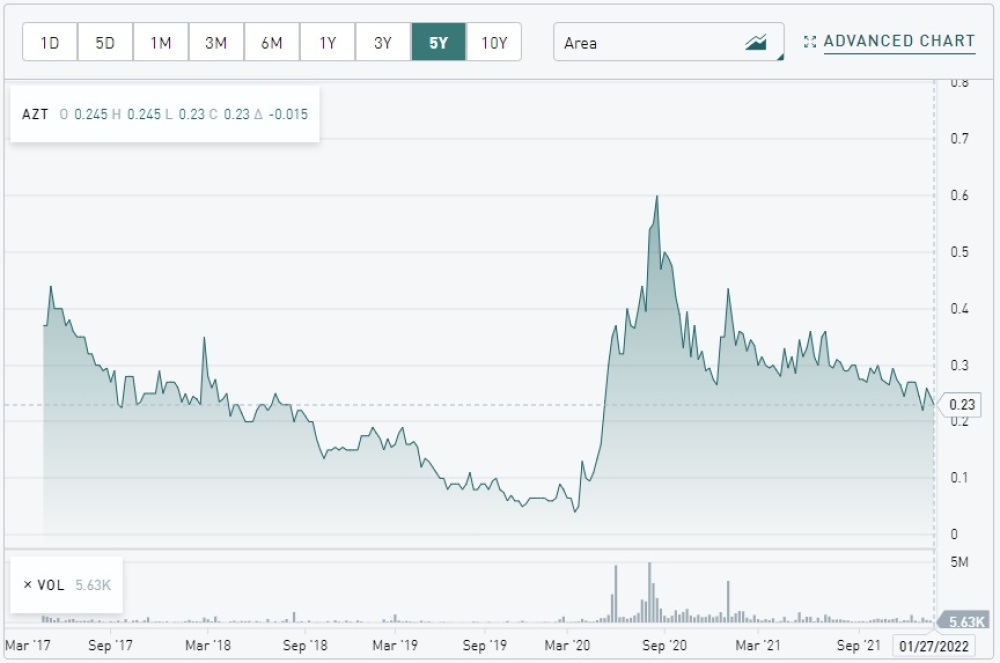
The newly incoming Chief Executive Officer Simon Dyakowski enjoyed a recovered share price and a CA$3 million raise in the summer of 2020, and drilling at Tombstone resulted in strong oxide intercepts. Unfortunately, the newly enjoyed positive mining sentiment didn’t follow the continuing general stock market recovery, which went on to new all-time highs until very recently when the Fed decided to utilize a more hawkish stance on rising interest rates, and Aztec was no exception:

Share price 5-year timeframe (Source: tmxmoney.com)
Despite macro economic antics, it looks like the share price is bottoming now. With the current high inflation environment, the negative real rates, being the main (at least for me) sentiment driver for gold, seem stronger than ever. So it looks like the gold price seems set for a move higher soon.
When looking at management and the Board of Directors, the most recognizable name is of course founder and Chairman Bradford Cooke (MSc Geology), who is also the founder and Chairman of Endeavour Silver (CA$883 million market cap, over CA$1.5 billion in May 2021) and Canagold Resources. At the helm is President and Chief Executive Officer Simon Dyakowski (CFA, MBA), who has extensive experience in corporate development and capital markets (RBC, Bank of Tokyo, Salman Partners, and various junior mining companies). He is assisted by Vice President of Exploration Allen Heyl (BSc, P.Geo), who has over 38 years of experience, mostly in the Americas. Allen was important to the discovery and evaluation of over 30 Moz gold and 25 Mt copper, including Marmato-Enchidia (Aris Gold), Motherlode (Corvus/Anglogold Ashanti), Rio Blanco (Zijin Mining), and Tres Cruces and Nueva Condor/Huampar (Oroperu). Management is assisted by a Board of Directors with lots of experience in all relevant fields, and supported by an advisory board with another 70 years of relevant experience.
Some basic information on share structure: Aztec Minerals has a tight 64.96 million shares outstanding, and trades at an average daily volume of 63,000 shares. There are 13.2 million warrants (bulk of it priced at CA$0.40, expiring in August 2022) and 4.845 million options (weighted average price of 25 cents with an average remaining life of 2.1 years), meaning the fully diluted number of shares stands at 83 million shares now. Management and the Board of Directors hold 10%, other insiders 3%, and a few funds and high net worths hold 20%.
The cash position is estimated at CA$2 million, with no debt, and management is looking to raise more depending on drill results. For the last nine months ended Sept. 30, 2021, G&A was CA$1.06 million, which was substantial as exploration expenditures for the same period came in at just CA$1.03 million. Dyakowski had this to say about it: “G&A was higher due to legal fees to negotiate the Cervantes JV. We also had to support the exercise of warrants that expired in July 2021 and October 2020.”
The current share price is CA$0.23, resulting in a current, tiny market cap of CA$14.94 million, and this is one of the reasons I believe this little junior could become a genuine multi-bagger in a year or two. Let’s have a look at their projects to see why I believe this kind of potential could be there.
The Tombstone and Cervantes Projects
Aztec Minerals has two core assets in its portfolio, which are Cervantes and Tombstone. Both projects are part of a JV, where Aztec Minerals is the operator and majority owner in both JVs, and both projects are located in mining friendly and prolific areas, as can be seen here:

The current flagship project of Aztec Minerals is the 434 hectare Tombstone project in Arizona. The company is the operator of a 75/25 JV with private Tombstone Partners. Tombstone hosts a historical mine from the old days, called the Contention Mine, producing 32 Moz of silver and 240 koz of gold, mostly from CRD deposits and oxide ores between 1878 and 1939. Historic mining was terminated because of lack of technology to counter the water table related inflows at the time.

In a nutshell, CRD stands for Carbonate Replacement Deposits, where the orebody is formed by replacement of sedimentary, usually carbonate rock by metal-bearing solutions in the vicinity of igneous intrusions. Igneous intrusions form when magma was forced into older rocks at depth, then cools and solidifies before it reaches the surface. Three common types of intrusion are sills, dykes, and batholiths. In many cases, CRD deposits are close to skarn/porphyry deposits, and often have the shape of vertical chimneys or more horizontal blankets (called mantos). A well-known and nearby example is the large Taylor deposit, discovered by Arizona Mining (taken over by South32 recently for CA$1.8 billion). A schematic section of a geological model for CRDs, developed by Dr. Peter Megaw, who was the first to describe them in his doctoral thesis, can be seen here:

The intrusive stock drawn in the model above usually stands for Cu-Au or Moly porphyry mineralization. Usually in these geological models, the zonation for metals begins with copper/gold/moly at depth, then there is a zinc/lead/silver zone, and more close to surface one can find silver/gold. Quite often, a CRD or porphyry has an oxide gold/silver cap at surface, which is heap leachable, and this is exactly the case at Tombstone (CRD) and Cervantes (porphyry).
RC drill programs completed in 2020 and 2021 at the Contention pit indicated substantial mineralization, as all but one of the 44 drill holes intercepted gold and silver. Intercepts were often long, and also predominantly longer than the thickness of overburden at each hole, indicating a potentially favorable stripping ratio which could bode extremely well for future economics. For example, the drill results of 2020 are shown in the table below, with only 6 of 21 holes starting at a depth deeper than the length of intercept itself (probably handy to zoom in with your browser):

Highlights are TR20-002: 67m @ 1.07g/t Au (1.6g/t AuEq) from 19.8m, TR20-003: 93m @ 0.77g/t Au (1.07g/t AuEq) from 6.1m, TR20-009: 30.48m @ 3.31g/t Au (3.78g/t AuEq) from 32m, TR20-017: 140.21m @ 0.38g/t Au (0.62g/t AuEq) from 1.5m, and TR20-018: 32m @ 1.4g/t Au (2.09g/t AuEq) from 80.8m. Please note several holes were drilled under significant angles like hole TR20-017 and TR20-018, reducing true width to sometimes even 30% of apparent length. Notwithstanding this, these are amazing results, for sure when taking into account that almost all holes bottomed in mineralization, and that the encountered mineralization was oxidized and heap-leachable. Interesting to see are the intersected historic underground workings, being developments, or (very) high grade veins being mined below the historic open pit.
The 2021 program was designed to step out from the 2020 holes, spaced 50 meters apart along fence patterns trending north-northeast, dipping from near vertical to -45 degrees east. The 2020 drill collars are indicated in green, the 2021 collars in red:

The news release from Dec. 7, 2021 provided a complete list of all drill results, and these didn’t exactly disappoint either. Highlights are TR21-03: 32m @5.7g/t Au (6.3g/t AuEq) from 80.7m, TR21-06: 74.7m @ 0.22g/t Au (0.47g/t AuEq) from 83.3m, TR21-10: 96m @1.39g/t (2.2g/t AuEq) from 25.9m, TR21-11: 24.4m @ 1.2g/t Au (2.22g/t AuEq) from 82.3m, TR21-16: 64m @0.8g/t Au (1.03g/t AuEq) from 48.8m, TR21-017: 64m @ 1.73g/t Au (2.53g/t AuEq) from 27.4m, and highlight among the highlights hole TR21-22: 65.5m @ 2.44g/t Au (3.4g/t AuEq) from 21.3m. This last hole was a twin hole from a historic hole, and the result was even exceeding expectations. Please note true width sometimes varies considerably from apparent widths as well in this drill program, as mineralized zones tend to dip from 20 to 80 degrees. Although the most southern-located holes TR20-10 to 15 returned decent intercepts of lower-grade mineralization, these are still economic. Therefore, it seemed reasonable to follow up by “infill-stepout” holes more to the north, but this didn’t happen yet. According to Dyakowski, this was due to more competent rock in that area, so they decided to drill this part later on with diamond drilling, and also to drill deeper which requires diamond drilling to hit targets at depth.
In the following section, it can be observed how consistent the gold mineralization is, and more importantly, is open at depth:

The water table is located at about -150 meters depth, but poses no problem whatsoever with current dewatering equipment. Standard open pit depths are about -200 meters, so there is more exploration potential at depth, but also laterally. The total drilled area now measures 900 meters long by 230 meters wide, and to maximum depths of 200 meters. When doing a back-of-the-envelope guesstimate, this could result in a 900 meters by 150 meters by 50 meters by 2.75 t/m3 = 18.5 Mt mineralized envelope, at an average grade of 1g/t AuEq this could already result in an estimated 600 koz AuEq resource. As the area is open laterally and at depth, I’m curious how far Aztec management can take this.
Besides this open pit potential, management firmly believes there could be large CRD type mineralized potential at depth (150 meter to 1,000 meter depth), based on several meaningful deeper drill results which already had results like 7.16m @ 6.5%Pb and 2.6%Zn, indicating high grade CRD mantos, the presence of nearby manganese-silver rich mines, and other polymetallic mines located in the same type of host rock, in this case Paleozoic limestone. Besides this, Tombstone is on the same trend and just 60 kilometers away from the Taylor deposit (Arizona Mining/South 32):

Whereas results and interpretation of Phase 2 RC drilling program tested shallow epithermal gold-silver mineralization, the upcoming Phase 3 drill program is designed to target deeper epithermal gold-silver mineralization below the Contention pit, and the coveted deep CRD silver-lead-zinc-copper-gold mineralization in Paleozoic limestones underlying the Bisbee Sediments. This program will be scheduled after Cervantes drilling has been wrapped up, and more money is raised according to management.
A geophysical survey involving resistivity already outlined a significant target at depth, which can be seen below:

This will be the focus of the deep drilling from the Phase 3 program at Tombstone. For clarity: The vertical brown line is an interpretation of the Contention Fault which runs from north to south along the Contention Pit.
The second project of Aztec Minerals is the former flagship 3,650 hectare Cervantes project, which is a porphyry gold-copper property in mining-friendly Sonora, Mexico, and Aztec Minerals is the operator of a 65/35 JV with listed Kootenay Silver).

The Cervantes project has already seen a lot of reconnaissance exploration, such as IP surveys, airborne magnetics and radiometrics, but also soil sampling which can be seen on the map below. But only the California target has seen drilling so far, with strong results, as Phase 1 highlights show:
- 160 meters of 0.77gpt Au, 0.13% Cu and 3.4gpt Ag
- 139 meters of 0.70gpt Au, 0.10% Cu and 2.1gpt Ag
- 43 meters of 1.18gpt Au, 0.16% Cu and 5.1gpt Ag

A map with the 2018 drill collars from a 17-hole 2,675 meter Phase 1 program, testing a 900 meters by 600 meters gold in soils anomaly can be found below. All holes intersected gold-copper-silver mineralization:

To get a good grasp on results at California, have a look at the table with the full results from the 2018 program, with the best holes highlighted in red:

It was interesting to read about preliminary metallurgical test work on oxidized drill core, as recoveries were achieved up to 88% for gold, and 78% on mixed oxide-sulphide material. This is extremely good for oxide recoveries and transitional ore recoveries, more standard are 70% to 75% for oxides and 50% to 60% for transitional ore.
Aztec Minerals estimates a drilled area of 800 meters length by 200 meters width to a depth of about 150 meters. As can be seen on the section below, all drill holes were drilled under an angle, but as the surface and thus the mineralization itself are dipping under a gentle angle as well, it can be assumed that true width in the case of Cervantes is 60% to 70% of apparent width. This in turn made me guessing about a 800 meter by 200 meter by 70 meter by 2.75 t/m3 = 30.8Mt mineralized envelope, assuming an average grade of 0.6 g/t Au this would result in an estimated 600 koz Au, excluding copper and silver credits, so slightly more than Tombstone. Not bad at all for an oxide deposit if management can prove this up and hopefully expand these numbers further. But this is not all, as you are probably already aware of potential at depth by now.
A 12.8 km pole-dipole IP survey was completed in 2016 over 220 hectares covering portions of the California soil anomaly and the Jasper prospect. Strong chargeability anomalies starting from the surface to depths of at least 600 meters were outlined. Such broad, strong chargeability anomalies are often associated with large zones of disseminated sulfide mineralization typical of porphyry copper deposits.

A three-dimensional IP survey covering 520 hectares was conducted in 2019, extending the coverage from the 2016 survey towards the west and southwest covering three additional targets: Estrella, Purisima East, and Purisima West. Impressive and extensive IP anomalies were detected from near surface to depths of 500 meters on all three targets.

Aztec Minerals started a substantial Phase 2 5,000 meter RC drill program on Dec. 14, 2021, and depending on drill results, is looking to delineate a resource estimate on the California, California Norte, Jasper, and Purisima East targets. According to a very recent Jan. 26, 2022, news release, the first 14 holes are completed now, totaling 2,810.6 meters, and results are anticipated in the next several weeks. Two holes of 500 meters depth are planned at California to test the IP chargeability anomaly as pictured above. The balance of the Phase 2 program will test an IP chargeability anomaly at California Norte, and an outcrop at the Jasper target. As Aztec Minerals also identified very large IP chargeability anomalies at depth, it is looking to find large porphyry sulfide gold-copper mineralization there, which will also be explored in the ongoing Phase 2 program, and could very well shape up to be a very interesting wild card for investors.
Wild cards aside for gamechanging opportunities at depth, personally I like the oxide resource potential of say 600 koz to 1 Moz Au for both projects the most, as only one economic oxide project of this size could easily already support a CA$50 million market cap, let alone two. And without any further discoveries at depth included.
Positioned For a Re-Rating
At a current market cap of just CA$15.9 million with about CA$2 million in the treasury, with two realistic chances on an economic oxide deposit AND two wildcard chances on deep, large scale mineralization, plus inflation running wild which could provide gold with a perfect setup for higher levels, Aztec Minerals seems to be positioned well for a re-rating this year. Drill results for Cervantes are due in the second half of February 2022, and a new drill program is planned for Tombstone. In addition, management indicated it is seeking opportunities in safe jurisdictions within the Americas for projects with high quality bulk tonnage gold/silver/copper potential, so an acquisition is not out of the question in 2022, which seems to be shaping up to be another busy year for Aztec Minerals.
I hope you will find this article interesting and useful, and will have further interest in my upcoming articles on mining. To never miss a thing, please subscribe to my free newsletter on www.criticalinvestor.eu in order to get an email notice of my new articles soon after they are published.
All presented tables are my own material, unless stated otherwise.
All pictures are company material, unless stated otherwise.
All currencies are in U.S. Dollars, unless stated otherwise.
Please note: the views, opinions, estimates, forecasts or predictions regarding Aztec’s resource potential are those of the author alone and do not represent views, opinions, estimates, forecasts or predictions of Aztec or Aztec’s management. Aztec has not in any way endorsed the views, opinions, estimates, forecasts or predictions provided by the author.
The Critical Investor is a newsletter and comprehensive junior mining platform, providing analysis, blog and newsfeed and all sorts of information about junior mining. The editor is an avid and critical junior mining stock investor from The Netherlands, with an MSc background in construction/project management. Number cruncher at project economics, looking for high-quality companies, mostly growth/turnaround/catalyst-driven to avoid too much dependence/influence of long-term commodity pricing/market sentiments, and often looking for long-term deep value. Getting burned in the past himself at junior mining investments by following overly positive sources that more often than not avoided to mention (hidden) risks or critical flaws, The Critical Investor learned his lesson well, and goes a few steps further ever since, providing a fresh, more in-depth, and critical vision on things, hence the name.
Sign up for our FREE newsletter at: www.streetwisereports.com/get-news
The author is not a registered investment advisor, and has a long position in this stock. Aztec Minerals is a sponsoring company. All facts are to be checked by the reader. For more information go to aztecminerals.com and read the company’s profile and official documents on www.sedar.com, also for important risk disclosures. This article is provided for information purposes only, and is not intended to be investment advice of any kind, and all readers are encouraged to do their own due diligence, and talk to their own licensed investment advisors prior to making any investment decisions.
Streetwise Reports Disclosures:
1) The Critical Investor’s disclosures are listed above.
2) The following companies mentioned in the article are sponsors of Streetwise Reports: None. Click here for important disclosures about sponsor fees. The information provided above is for informational purposes only and is not a recommendation to buy or sell any security.
3) Statements and opinions expressed are the opinions of the author and not of Streetwise Reports or its officers. The author is wholly responsible for the validity of the statements. The author was not paid by Streetwise Reports for this article. Streetwise Reports was not paid by the author to publish or syndicate this article. Streetwise Reports requires contributing authors to disclose any shareholdings in, or economic relationships with, companies that they write about. Streetwise Reports relies upon the authors to accurately provide this information and Streetwise Reports has no means of verifying its accuracy.
4) The article does not constitute investment advice. Each reader is encouraged to consult with his or her individual financial professional and any action a reader takes as a result of information presented here is his or her own responsibility. By opening this page, each reader accepts and agrees to Streetwise Reports’ terms of use and full legal disclaimer. This article is not a solicitation for investment. Streetwise Reports does not render general or specific investment advice and the information on Streetwise Reports should not be considered a recommendation to buy or sell any security. Streetwise Reports does not endorse or recommend the business, products, services or securities of any company mentioned on Streetwise Reports.
5) From time to time, Streetwise Reports LLC and its directors, officers, employees or members of their families, as well as persons interviewed for articles and interviews on the site, may have a long or short position in securities mentioned. Directors, officers, employees or members of their immediate families are prohibited from making purchases and/or sales of those securities in the open market or otherwise from the time of the decision to publish an article until three business days after the publication of the article. The foregoing prohibition does not apply to articles that in substance only restate previously published company releases.
( Companies Mentioned: AZT:TSX.V; AZZTF:OTCQB,
)