Categories
Gold

2022 Bermuda Gold Cup cancelled >> Scuttlebutt Sailing News – Scuttlebutt Sailing News

2022 Bermuda Gold Cup cancelled >> Scuttlebutt Sailing News  Scuttlebutt Sailing News
Categories
Gold

Gold tallies a 4th straight session gain and highest finish in a month – MarketWatch

Gold tallies a 4th straight session gain and highest finish in a month  MarketWatch
Categories
Gold

Perseus Discovers More High-Grade Gold at Yaouré Mine – GlobeNewswire

Perseus Discovers More High-Grade Gold at Yaouré Mine  GlobeNewswire
Categories
Gold

Dysfunctional U.S. Mint Sees Strongest Gold Demand in 23 Years

According to recent U.S. Mint production reports, demand for gold coins remains super strong.

Rampant global inflation, the war in Ukraine, stock market volatility, and central bank missteps have fueled retail interest.

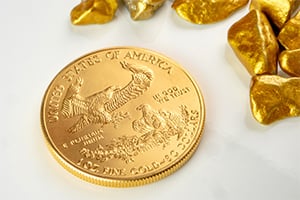
US Mint Gold Eagle with Gold Nuggets

Last week, the U.S. Mint reported sales of 426,500 ounces in gold coins during the first quarter of 2022 – up 3.5% from the first quarter of 2021 and the highest in 23 years! In fact, March sales for the U.S. Mint was its best since 1999.

Even as the government-run institution continues to be plagued by its ongoing mismanagement, it sold 155,500 ounces of various denominations of the American Eagle gold coin in March alone, up 73% from the prior month.

With this morning’s 8.5% Consumer Price Inflation (CPI) reading from the Bureau of Labor Statistics, inflation is no longer a topic confined to pundits and economists; its painful bite on Main Street has become widely acknowledged and felt.

Extremely high inflation globally, combined with war in Eastern Europe and a shaky start to the year for equities, should underpin volatility-based demand for bullion throughout the year.

Meanwhile, although the U.S. Mint’s silver coin sales remain strong, high premiums caused by production shortages at the dysfunctional government “enterprise” has put a crimp on sales as compared to early 2021.

The U.S. Mint reported silver sales of roughly 7.5 million ounces in the first quarter, a decline of 37% from the year prior.

Extraordinarily high premiums on silver American Eagles have pushed savvy investors to consider the wide array of more affordable silver options – especially silver bars and rounds along with silver coins produced by other sovereign mints.

      
Categories
Gold

Virginia Ends All Taxes on Purchases of Gold and Silver

(Richmond, Virginia – April 12, 2022) – By signing sound money legislation last night, Virginia Governor Glenn Youngkin has ended Virginia’s discriminatory practice of assessing sales taxes on smaller purchases of gold, silver, platinum, and palladium bullion and coins.

Virginia’s House Bill 936, originally introduced by Del. Amanda Batten, was considered by multiple House and Senate committees before passing overwhelmingly out of both chambers and reaching the governor’s desk.

Virginia had been one of only seven states in the United States maintaining merely a partial sales tax exemption on purchases of precious metals. Virginia’s regressive practice of taxing only purchases under $1,000 singled out small-time savers for a tax penalty that larger gold and silver purchases do not face.

By enacting HB 936, Virginia has set an example for legislators in California, Connecticut, Florida, Massachusetts, Maryland, and New York, where smaller-sized purchases (under $500, $1,000, or $1,500) of precious metals are still hit with sales taxes.

Gold and Silver Bullion

The full Virginia sales tax exemption on the monetary metals will take effect on July 1 and remain in effect until at least June 30th, 2025.

Meanwhile, full exemption bills are pending in Alabama, Hawaii, New Jersey, and Tennessee, as the national backlash against taxing constitutional money accelerates in today’s environment of rising inflation and geopolitical conflict.

Including Virginia, 41 U.S. states now fully or partially exempt gold and silver from the sales taxes. That leaves 9 states and the District of Columbia as the primary jurisdictions that still harshly penalize citizens seeking to protect their savings against the serial devaluation of the Federal Reserve Note.

Jp Cortez, policy director for the Sound Money Defense League, explained that “by eliminating sales taxes on purchases of precious metals under $1,000, a huge impediment has been removed to storing one’s wealth in gold and silver.”

In her testimony in support of the bill, Del. Batten explained that it doesn’t make sense for someone to make large purchases of gold and silver tax free, but someone who wants to invest a smaller amount is punished with a tax… a tax which targets those who can afford it the least.

“Inflation has become an undeniable problem due to financial mismanagement by the Federal Reserve and by the politicians in Washington DC. Thankfully, both large and small investors in the Old Dominion can now protect the purchasing power of their wealth with sound money without being taxed,” said Money Metals Exchange president Stefan Gleason, whose company has helped lead sound money policy efforts.

States have been removing sales taxes from monetary metals for the following reasons:

  • Taxing precious metals is unfair to certain savers and investors. Gold and silver are held as forms of savings and investment. States do not tax the purchase of stocks, bonds, ETFs, currencies, and other financial instruments, so it makes no sense to tax monetary metals.
  • Levying sales taxes on precious metals is illogical because gold and silver are inherently held for resale. Sales taxes are typically levied on final consumer goods. But precious metals are inherently held for resale, not “consumption.”
  • Taxing gold and silver harms in-state businesses. It’s a competitive marketplace, so buyers in states with precious-metals sales taxes often take their business to neighboring states that have eliminated or reduced sales tax on precious metals. Coin conventions also tend to avoid the sales tax states.
  • Taxing precious metals is harmful to citizens attempting to protect their assets. Purchasers of precious metals aren’t fat-cat investors. Most who buy precious metals do so in small increments as a way of saving money. Precious metals investors are purchasing precious metals as a way to preserve their wealth against the damages of inflation. Inflation harms the poorest among us-including pensioners, Virginians on fixed incomes, wage-earners, savers, and more.

The Sound Money Defense League, a non-partisan, national public policy group working to restore sound money at the state and federal level and publisher of the Sound Money Index. Money Metals Exchange is a national precious metals investment company and news service with more than 500,000 readers and 350,000 customers. It also operates Money Metals Depository for vaulting of gold and silver and Money Metals Capital Group, a collateral lending institution.

      
Categories
Gold

Rare Earths Crucial to Advancement of Green Economy, Defense Systems

Source: McAlinden Research   04/12/2022

With geopolitical tensions rising, the US recently banned defense contractors from purchasing REE metals from China and will consequently attempt to revive its domestic rare earths industry. However, the US has just one rare earth mine and no processing technology, which highlights the need for a new wave of investment, writes McAlinden Research Partners.

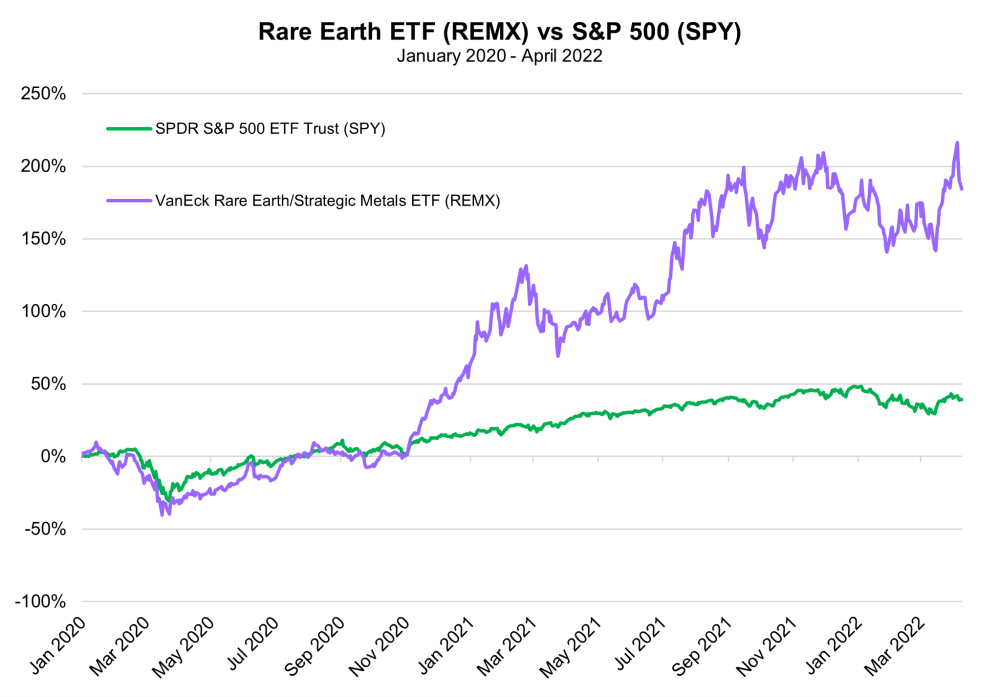
Rare earth elements (REE), which consist of a group of seventeen metals, are some of the most important minerals on earth that are used to manufacture several products key to the future of the modern world.

Rare earths are used in the production of smartphones and semiconductors, both of which are expected see increased demand throughout the coming years as the world shifts online and becomes more and more reliant on technology.

MRP has recently highlighted the importance of semiconductors amid the ongoing shortage and a permanent shift in behavior due to a global digital transformation. As that transformation accelerates, the role of rare earths will also rise.

These metals are also an integral part of the renewable energy transition sweeping across the globe.  According to a report from the International Energy Agency (IEA), the amount of minerals necessary for a new unit of power generation have increased by 50% since 2010 and that number is likely to rise as the United States continues to embrace clean energy.

Wind energy is especially dependent on rare earth metals. According to Lynas Rare Earths, the wind turbine market is expected to account for approximately 30% of the global growth in the use of rare earth magnets by 2025.

Last week, MRP highlighted the growing demand for battery metals due to the rising number of electric vehicles hitting the road. Demand for rare earths is also expected to increase due to those lofty EV goals currently set by the Biden administration. Per a September report from Forbes, the United States needs more than ten times its current rare earth supplies to reach Biden’s goal of having 50% of cars sold in 2030 be zero-emission electric vehicles.

To meet the burgeoning needs of the rapidly expanding green economy, the US will need more than 20 to 25 times its current supply as investment into electric vehicles, wind power and other renewable technologies climb through the decade.

These minerals are also imperative in the production of many defense applications. In the industry, two rare earth metals, neodymium and samarium, are used to create magnets that are resilient to high temperatures which is important for mission-critical electronic and defense applications.

Other rare earths are used to manufacture fighter jets and soldier semiconductors, a sector that Army Technology notes is projected to be valued at $17.5 billion by 2030. With global tensions rising around the world amid the Russian invasion of Ukraine, building up domestic supplies of these metals is key to avoiding reliance on Chinese imports.

Bank of America predicts that demand for rare earths is set to increase by 500-600% in the coming decades, while US policymakers have acknowledged that relying on China and other international suppliers is no longer a feasible strategy.

US Looks to Ease China Dependence, New Funding Key to Securing Supply

While the importance of rare earth metals cannot be understated, the level of investment put into domestic production in the United States is certainly a cause for concern.

Roughly 38% of the world’s rare earth reserves are found in China, and the country was responsible for 90% of all global exports in 2019. China accounted for roughly 80% of the Unites States imports of those metals two years ago, a worrying sign that the US is entirely too dependent on foreign nations for their rare earth supplies.

Army Technology points out if China were to close the tap of their rare earth reserves or reduce their exports amid a trade war with the US, US rare earth supplies would be significantly limited at a time when demand is soaring. China has previously temporality blocked rare earth exports to Japan in 2010 and has also formerly made vague threats that it could do the same to the United States.

mcalinden rare earth metalsrare earth metals

Pini Althaus, founder of USA Rare Earth, told Global Defence Technology that the US is in an extremely precarious position and the only way to have a secure rare earth supply chain is to start developing projects domestically.

The US has made efforts to boost domestic production of these metals, but they remain woefully lacking. Reuters reported in January that the US only has one rare earths mine in the US and currently has no capability to process rare earth minerals.

To try and ease the dependence on China, the Restoring Essential Energy and Security Holdings Onshore for Rare Earths Act of 2022 was introduced that would essentially force defense contractors to stop buying rare earths from China by 2026. The bill is expected to be looped into Pentagon funding legislation later this year.

A month after that bill was introduced, the Pentagon announced it is developing plans to boost the current stockpiles of both rare earths and battery metals, a move that would require much more domestic mining production, per Reuters.

Real Clean Energy believes mining is only the first step. The US must put that same amount of investment into the refining and processing parts of the domestic rare earths supply chain, which while currently a small sector, has significant growth potential in the coming decades.


To conclude, rare earths remain a critical group of minerals for the global defense industry, renewable energy development and the rapidly accelerating digitization of the modern economy. The US is at risk of falling behind in the race to secure rare earth supplies if it does not soon boost domestic mining and processing of these metals and shift away from the overwhelming reliance on China.

Originally published April 11, 2022.

McAlinden Research Partners (MRP) provides independent investment strategy research to investors worldwide. The firm’s mission is to identify alpha-generating investment themes early in their unfolding and bring them to its clients’ attention. MRP’s research process reflects founder Joe McAlinden’s 50 years of experience on Wall Street. The methodologies he developed as chief investment officer of Morgan Stanley Investment Management, where he oversaw more than $400 billion in assets, provide the foundation for the strategy research MRP now brings to hedge funds, pension funds, sovereign wealth funds and other asset managers around the globe.

Sign up for our FREE newsletter at: www.streetwisereports.com/get-news

Disclosures

1) McAlinden Research Partners disclosures are below.

2) The following companies mentioned in this article are billboard sponsors of Streetwise Reports: None. Click here for important disclosures about sponsor fees. The information provided above is for informational purposes only and is not a recommendation to buy or sell any security.

3) Statements and opinions expressed are the opinions of the author and not of Streetwise Reports or its officers. The author is wholly responsible for the validity of the statements. The author was not paid by Streetwise Reports for this article. Streetwise Reports was not paid by the author to publish or syndicate this article. Streetwise Reports requires contributing authors to disclose any shareholdings in, or economic relationships with, companies that they write about. Streetwise Reports relies upon the authors to accurately provide this information and Streetwise Reports has no means of verifying its accuracy.

4) This article does not constitute investment advice. Each reader is encouraged to consult with his or her individual financial professional and any action a reader takes as a result of information presented here is his or her own responsibility. By opening this page, each reader accepts and agrees to Streetwise Reports’ terms of use and full legal disclaimer. This article is not a solicitation for investment. Streetwise Reports does not render general or specific investment advice and the information on Streetwise Reports should not be considered a recommendation to buy or sell any security. Streetwise Reports does not endorse or recommend the business, products, services or securities of any company mentioned on Streetwise Reports.

5) From time to time, Streetwise Reports LLC and its directors, officers, employees or members of their families, as well as persons interviewed for articles and interviews on the site, may have a long or short position in securities mentioned. Directors, officers, employees or members of their immediate families are prohibited from making purchases and/or sales of those securities in the open market or otherwise from the time of the decision to publish an article until three business days after the publication of the article. The foregoing prohibition does not apply to articles that in substance only restate previously published company releases.

McAlinden Research Partners:
This report has been prepared solely for informational purposes and is not an offer to buy/sell/endorse or a solicitation of an offer to buy/sell/endorse Interests or any other security or instrument or to participate in any trading or investment strategy. No representation or warranty (express or implied) is made or can be given with respect to the sequence, accuracy, completeness, or timeliness of the information in this Report. Unless otherwise noted, all information is sourced from public data.
McAlinden Research Partners is a division of Catalpa Capital Advisors, LLC (CCA), a Registered Investment Advisor. References to specific securities, asset classes and financial markets discussed herein are for illustrative purposes only and should not be interpreted as recommendations to purchase or sell such securities. CCA, MRP, employees and direct affiliates of the firm may or may not own any of the securities mentioned in the report at the time of publication.

Charts and graphs provided by McAlinden Research Partners.

Categories
Gold

Analyst Sees ‘Growth Ahead’ for These 2 Gold Firms

Source: Adrian Day   04/11/2022

Editor of Adrian Day’s Global Analyst, Adrian Day explains what he sees in the future for two gold companies and reveals his pick that had an $11.8m market value increase.

In this bulletin, we review developments at a few resource companies on our list, though it was a slow week for material news. We also address more of your questions.

Growth Ahead for Yamana and Barrick


Yamana Gold Inc. (YRI:TSX; AUY:NYSE; YAU:LSE) held an investor day at which it reviewed its previously released 10-year plan (see Bulletin #807), which sees production increase by 50% to 1.5 million gold-equivalent ounces within six years. Most of the increase comes from expansions at existing mines. Wasamac, in the same gold belt as 50%-owned Canadian Malartic, is expected to come onstream by 2026.

Another undeveloped project, Mara, is considered too large for Yamana, which is studying alternatives including taking it public. A feasibility study is underway, and a decision is expected this year. Hold.

Barrick Gold Corp. (ABX:TSX; GOLD:NYSE) announced that the Dominican Republic government had completed its study on the location of a tailing facility for the Pueblo Viejo expansion, intended to prevent an anticipated production decline and extend the mine life beyond 2040. The expansion has been the subject of local protests. Barrick also studied alternative sites, and now two potential sites are receiving additional review.

Barrick expects its share of the 60%-owned mine to exceed 400,000 ounces this year. It is also a major employer and taxpayer in the country, paying $527 million in taxes last year alone.

In and of itself, the news is not especially important, but just a step in the process; it’s a slow news week! But is shows that the Dominican government is working to find an answer acceptable to various local groups. It also is an illustration of the amount of work on multiple fronts that goes into a new mine or expansion.

We are holding.

Altius’ Investments Continue to Perform Well


Altius Minerals Corp. (ALS:TSX.V) released its quarterly report on its prospect generator and junior portfolio. The market value increased to CA$67.3 million, up from CA$55.5 million at the end of the year, with most of the increase attributable to shares it received from three different companies for the sale of properties. New investments exceeded equity sales for a net cost of CA$1.4 million.

During the quarter, Altius bought additional shares in Orogen, bring its ownership to 16.5%, excluding warrants it holds. Hold.

TOP BUYS this week include Vista Gold (VGZ.NY, 1.02); Midland Exploration (MD,To., 0.50); Orogen Royalties (OGN, To., 0.45); and Lara Exploration (LRA, To., 0.62).

The best buys this week are junior companies. The seniors and mid-tier have moved strongly in the last couple of months while the juniors have tended to lag. Even Fortuna, for example, which I rate a buy because it is fundamentally undervalued, has moved from $3.24 in February so could slip back if gold retreats. Other large companies are equally vulnerable to a drop in the gold price.

Your Questions: Do Institutions Take Delivery of Certificates?


I wanted to follow-up on the question in last week’s issue regarding taking delivery of certificates. How do mutual funds and institutions handle this?

Funds and most institutions will use a single custodian, buying shares through several different brokerage firms and have the shares electronically delivered to their custodian.

They do not hold in certificate form, though a fund or institution can instruct its custodian not to lend our their shares. Individual shareholders can also request that their shares are 
not loaned out at many firms, though some put up obstacles.

The source of the advice to take delivery was, as I thought, James Sinclair. Whatever his attributes, I would not describe him as “conservative.”

My broker will allow me to sell my position in Polymetal’s ADRs but not to buy any more. Would I have been better off buying the London shares?

From what I have gathered, the firms that allow buys in the London shares also allow buys in the ADRs and those that prohibit new buys in the London shares do not allow buys in the ADR. This––the latter––applies to IB, for example. If you want to buy, you should ask your broker. I am informed that TD has now changed its policy and is now allowing buys of AUCOY, Polymetal’s ADR. If they are allowing that, I should think they would also allow purchases of the London shares, but do not know.

So while it may not make a difference whether you could or could not buy the shares, it would make a significant difference to the price you pay. On Friday, for example, POLY in London was trading at the equivalent of US$3.85, while the ADRs were trading at $4.06 and as high as $4.20. This is an unusually wide difference between an ord (the main listing) and an ADR, due to the specific nature of Polymetal at this time.

Ords, OTC. or ADRs?


My general rule is to buy the ordinaries in the home market unless the stock is listed on a U.S. exchange (New York or Nasdaq). If the company has a sponsored ADR, they are usually acceptable as well, while unsponsored ADRs, and even worse the OTC trading ofthe ordinary shares, are usually to be avoided. The liquidity can be extremely low, with large bid-ask spreads, while ADRs (more so unsponsored ADRs) clip fees from dividends and on trading.

Take, for example, Hutchison Port, which trades millions of shares each day in its home market of Singapore — often as many as 40 million shares — with a half-cent spread.

These shares trade over-the-counter in the U.S. (HCTPF); they traded 10,000 shares on Thursday (none on Friday), with volume of 10,000 shares and a bid-ask spread wide enough to drive a truck through (0.233 x 0.262, that’s 12.5% spread). Before that, it last traded on March 31, trading just seven days throughout the month. On March 18, the only trade in the U.S. was at 27 cents in the U.S., while in Singapore the high trade was 24 cents. I go into this detail so you can see exactly the issue. Many foreign stocks are worse; another Singapore stock on our list, Kingsmen Creatives, last traded in the U.S. (KMNCF) in November!

How much will you actually get when you sell?


But it gets worse: if you want to buy a stock on the OTC, there will usually be a very small number of shares offered; I can guarantee you that if you go to buy even a few thousand dollars worth of a stock, you will fill one or two hundred at the offer and then the ask will mysteriously move up. It is even worse when you go to sell a stock. You can use a limit, but may miss the trade. Some brokers are good at working the OTC market and searching for shares, but most, particularly with small orders, just place them.

Of course, the above has exceptions (which is why it is “my general rule” and not an absolute one). Sometimes you may prefer not to buy in the local market, or, as in the case of Brazil, Taiwan and Korea, it may be very difficult. Your broker may not have access to a particular foreign market, Thailand, for example, so you would have to buy over-the-counter — and be very careful so doing.

Equally, some OTC stocks or unsponsored ADRs have sufficient liquidity to obviate most of the above. Nestle’s ADRs (NSRGY), which are unsponsored, have reasonable liquidity (258,000 shares with a 0.5% spread). On the home market, Nestle trades several million shares a day with a miniscule spread, so I would still prefer buying the ords, but won’t go apoplectic is you buy the ADRs.

QUESTIONS? I welcome your investment or economic questions, which I shall attempt to answer here. Please write to globalanalyst@adrianday.com. 

Originally published on April 10, 2022.

Adrian Day, London-born and a graduate of the London School of Economics, is editor of Adrian Day’s Global Analyst. His latest book is “Investing in Resources: How to Profit from the Outsized Potential and Avoid the Risks.”

Sign up for our FREE newsletter at: www.streetwisereports.com/get-news

Disclosures

1) Adrian Day: I, or members of my immediate household or family, own securities of the following companies mentioned in this article: All. I personally am, or members of my immediate household or family are, paid by the following companies mentioned in this article: None. My company has a financial relationship with the following companies mentioned in this article: None. Funds controlled by Adrian Day Asset Management, which is unaffiliated with Adrian Day’s newsletter, hold shares of the following companies mentioned in this article: All. I determined which companies would be included in this article based on my research and understanding of the sector.

2) The following companies mentioned in this article are billboard sponsors of Streetwise Reports: None. Click here for important disclosures about sponsor fees. The information provided above is for informational purposes only and is not a recommendation to buy or sell any security.

3) Statements and opinions expressed are the opinions of the author and not of Streetwise Reports or its officers. The author is wholly responsible for the validity of the statements. The author was not paid by Streetwise Reports for this article. Streetwise Reports was not paid by the author to publish or syndicate this article. Streetwise Reports requires contributing authors to disclose any shareholdings in, or economic relationships with, companies that they write about. Streetwise Reports relies upon the authors to accurately provide this information and Streetwise Reports has no means of verifying its accuracy.

4) This article does not constitute investment advice. Each reader is encouraged to consult with his or her individual financial professional and any action a reader takes as a result of information presented here is his or her own responsibility. By opening this page, each reader accepts and agrees to Streetwise Reports’ terms of use and full legal disclaimer. This article is not a solicitation for investment. Streetwise Reports does not render general or specific investment advice and the information on Streetwise Reports should not be considered a recommendation to buy or sell any security. Streetwise Reports does not endorse or recommend the business, products, services or securities of any company mentioned on Streetwise Reports.

5) From time to time, Streetwise Reports LLC and its directors, officers, employees or members of their families, as well as persons interviewed for articles and interviews on the site, may have a long or short position in securities mentioned. Directors, officers, employees or members of their immediate families are prohibited from making purchases and/or sales of those securities in the open market or otherwise from the time of the decision to publish an article until three business days after the publication of the article. The foregoing prohibition does not apply to articles that in substance only restate previously published company releases.  

Adrian Day’s Disclosures

Adrian Day’s Global Analyst is distributed by Investment Consultants International, Ltd., P.O. Box 6644, Annapolis, MD 21401. (410) 224-8885. Publisher: Adrian Day. Owner: Investment Consultants International Ltd. Staff may have positions in securities discussed herein. Adrian Day is also President of Global Strategic Management (GSM), a registered investment advisor, and a separate company from this service. In his capacity as GSM president, Adrian Day may be buying or selling for clients securities recommended herein concurrently, before or after recommendations herein, and may be acting for clients in a manner contrary to recommendations herein. This is not a solicitation for GSM. Views herein are the editor’s opinion and not fact. All information is believed to be correct, but its accuracy cannot be guaranteed. The owner and editor are not responsible for errors and omissions. ©2021. Adrian Day’s Global Analyst. Information and advice herein are intended purely for the subscriber’s own account. Under no circumstances may any part of a Global Analyst e-mail be copied or distributed without prior written permission of the editor. Given the nature of this service, we will pursue any violations aggressively.

( Companies Mentioned: ALS:TSX.V,
ABX:TSX; GOLD:NYSE,
YRI:TSX; AUY:NYSE; YAU:LSE,
)

Categories
Gold

Peter Schiff: March Madness in the Bond Market

There was a little March Madness on Wall Street. In fact, the month turned into an old-fashioned blood bath. But you wouldn’t have found any carnage in the stock market. In fact, the Dow Jones gained a decent 2.3% on the month. But beneath that glittery stock market stage (that attracts the most investor attention) there […]

The post Peter Schiff: March Madness in the Bond Market first appeared on SchiffGold.

Categories
Gold

ETF Gold Holdings Surged in March

Global ETF gold holdings surged in March, charting the third straight month of inflows. Net inflows of gold into ETFs came in at 187.3 tons last month, as total holdings rose to 3,837 tons, just shy of the all-time record high. It was the biggest jump in ETF gold holdings since July 2020, according to […]

The post ETF Gold Holdings Surged in March first appeared on SchiffGold.

Categories
Gold

The Dollar’s Reserve Status Is Ending. Will Bitcoin Save Us?

Government can’t create gold out-of-thin-air to fund its expansion into every aspect of our lives. But change is… by Ron Paul of Ron Paul Liberty Report Government forbids competition in […]