Click here to get this article in PDF
Gold & Silver Treasure Finds of 2025
While gold and silver spot prices made headlines this year, the metals also made headlines for troves of unearthed discoveries, reminding us of the ancient connection to gold and silver as currency.
Buried treasure isn’t just for movies. In 2025, real gold and silver discoveries—from shipwreck coins off Florida to Byzantine gold in Israel—proved that history is still being unearthed by archaeologists, divers, and everyday metal-detector hobbyists. Here are the top finds from 2025.
Quick Highlights (2025)
- Spanish Treasure Fleet coins recovered off Florida’s Treasure Coast
- Byzantine gold coin hoard and jewelry uncovered at Hippos (Sussita), Israel
- Multiple Celtic gold and silver coin troves discovered in Bohemia (Czech Republic)
- Medieval silver coin pots and a Roman-era gold necklace found in Poland
- Merovingian “devil’s money” ritual deposits revealed in the Netherlands
1715 Spanish Treasure Fleet Coins (Florida)

During the warm summer months, a skilled team of salvage divers contracted with 1715 Fleet-Queen Jewels, LLC, working off Florida’s Treasure Coast, made an extraordinary recovery: a cache of colonial-era gold and silver coins from Spain’s ill-fated 1715 Treasure Fleet. The fleet of 12 Spanish galleons met its demise on July 31, 1715, due to a devastating hurricane off the coast of Vero Beach, Florida.
1715 Fleet – Queen Jewels announced the recovery of more than 1,000 silver coins (often called pieces of eight), five gold escudo coins, and several additional gold artifacts. The collection’s estimated value is around $1 million (Candido, 2025).
Beyond the dollar figure, these coins are a direct link to Spain’s imperial trade network and the people who sailed it during the “Golden Age of the Spanish Empire.” Minted across Spanish mints in the New World, the pieces expand the historical narrative of the 1715 wrecks and will be conserved for study, public display, and sale to the public. PCGS and NGS have graded several of these historical collectible coins, which sell for upwards of $57,000 each.
Byzantine Gold Hoard at Hippos (Israel)

In July, an archaeological team excavating the ancient city of Hippos (Sussita) in Israel uncovered a treasure that had remained undisturbed since the 7th century.
Following a volunteer’s metal detector signal, the team recovered 97 pure gold Byzantine coins and a striking collection of jewelry, including pearl earrings and necklaces.
The hoard’s style and purity suggest it belonged to wealthy locals who likely buried it amid the turmoil following the Sasanian Persian invasion of 614 CE. Although the owner never retrieved it, this act reflects humans’ instinct to hoard gold as a form of monetary protection in times of crisis.
As one of the region’s more significant Byzantine gold discoveries, it offers a vivid glimpse into Hippos’ final days—its economy, artistry, and the fear that drove people to hide and preserve their wealth.
Celtic Gold and Silver Coin Trove (Western Bohemia, Czech Republic)

September brought an unusual discovery from archaeologists in western Bohemia near Pilsen, where hundreds of Celtic gold and silver coins were unearthed alongside bronze jewelry and a small decorative horse figure.
For security reasons, the exact location has not been disclosed. Specialists noted that many of the coin types had never been documented before, making the find especially valuable for researchers.
Discovered during a rescue excavation, the hoard challenges older assumptions about Celtic settlement patterns in the region. It suggests that what was once considered a peripheral area was actually connected to broader trade and minting networks. Additionally, the coins offer deeper insights into the everyday Cetic culture and the use of stamped coinage before the Roman era.
La Tène Market Hoard (Eastern Bohemia, Czech Republic)

In mid-2025, another major find emerged further east in Bohemia, near Hradec Králové, during a survey related to highway construction.
Archaeologists uncovered a massive Iron Age settlement spanning dozens of hectares from the La Tène period, between the 6th and 1st centuries B.C. Among the discoveries were hundreds of Celtic coins (gold and silver) and more than 1,000 pieces of jewelry and decoration.
What makes this site especially compelling is the evidence of coin-minting equipment found alongside the hoard of finished coins, including gold and silver ingots, raw flakes, and lumps of gold. These findings indicate a hub for coin minting and production that was previously undocumented in this area. Further suggesting the importance of a widespread monetary exchange.
The scale and variety of artifacts are helping reshape historians’ understanding of Celtic economic sophistication and long-distance exchange in Central Europe.
Medieval Coin Pots and a Roman-Era Gold Necklace (Poland)

In Poland, a local metal-detecting society stumbled into an unforgettable discovery near Kalisz: three sealed ceramic pots hidden in a wooded area, each filled with silver coins and medieval relics.
The first pot contained 631 early medieval items, including coins, ingots, and ornaments spanning a wide geographic range across Europe.
The second pot held even more silver treasures, but the standout discovery came from the third pot: a 222-gram pure gold necklace dating to the 5th century, potentially from the late Roman or Gothic period.
While the material value is substantial, the historical value is even greater—showing how a single region can conceal layers of wealth and human movement across centuries.
Pagan “Devil’s Money” Hoard (Netherlands)

A Dutch publication released early in the year revealed results from a 2021 excavation of a 7th-century ritual site in the Netherlands. First identified by a metal detectorist, the site yielded over 100 gold and silver coins, along with jewelry fragments from the Merovingian period.
These weren’t emergency stashes hidden during war. Instead, they were intentional religious offerings—sometimes called “devil’s money”—left over generations by non-Christian communities resisting the spread of Christianity.
Finds included gold tremisses, necklaces, and silver earrings, believed to be tied to ritual rather than commerce. Excavations also revealed a wooden building oriented toward the sunrise, supporting the interpretation of a pagan sanctuary. Gold held historical significance, serving not only as currency but also as a tribute to the gods.
Conclusion
From shipwrecks under the Atlantic to gold hidden beneath ancient soil, 2025 has reaffirmed that the world still holds remarkable treasures. Each discovery—whether pulled from the ocean floor or uncovered in a forest—connects us to our ancestral use of gold and silver as currency for trade, economic status, and deity tributes throughout the centuries.
Image Credits: *Hoard of Celtic gold coins from Libčice nad Vltavou (Prague- West district, Bohemia). Remaining rest. Most of the findings ended in 1772 as material for gold coins. La Tène culture. The Celts, Exhibition in the National Museum in Prague. Creative Commons License. Author: Zde
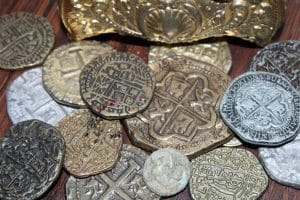
Unless credited, all images are stock images for example purposes and are not an exact representation of the mentioned items.
The post Gold & Silver Treasure Finds of 2025: Shipwreck Coins, Hoards, and Hidden History first appeared on CMI Gold & Silver.