Click here to get this article in PDF
Gold is down around 20% from recent highs, even as oil prices surge. These two commodities usually rise in tandem, leading many investors to wonder what’s causing the disconnect. Meanwhile, China is challenging the Western-led gold market by building its own bullion exchange.
In this week’s The Gold Spot, Scottsdale Bullion & Coin Founder Eric Sepanek and Precious Metals Advisor Damian White discuss the dip in gold prices, how this price action mirrors that of the 2008 Global Financial Crisis, why central banks remain bullish on gold, and how Beijing is sizing up the gold market.
From January Bull to March Bear
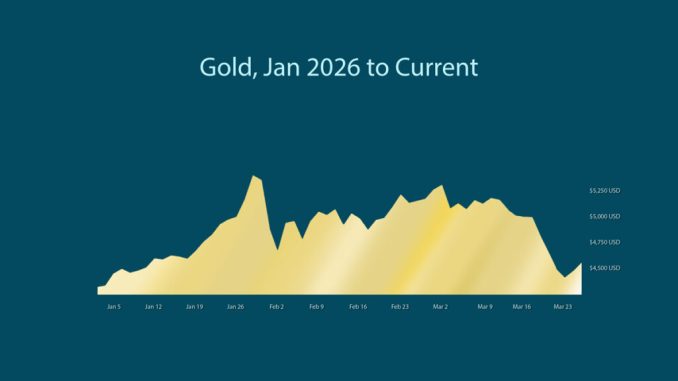
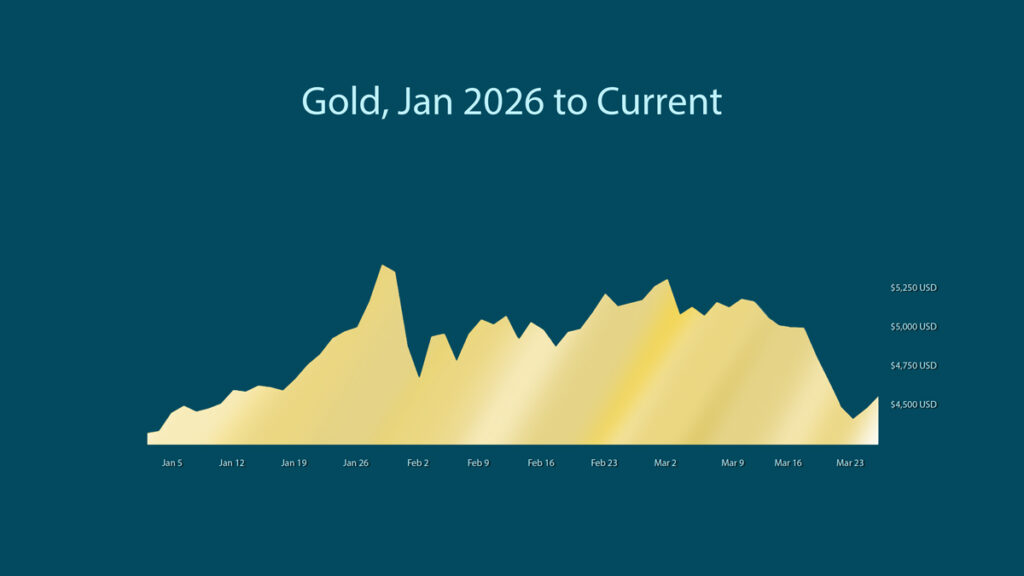
Off the back of a stellar 64.54% run in 2025, gold prices soared in the first month of this year. By the end of January, the yellow metal stood at an all-time high of $5,589/oz, marking a stunning 29.43% gain in a single month. For perspective, gold achieved nearly half of last year’s gains within 30 days of 2026.
This remarkable momentum has been followed by a seemingly stark drop, as gold prices fell below $4,500/oz this week. Overall, the metal has fallen more than $1,000 from its recent peak, or by nearly 20%. Despite these seemingly dramatic downturns, gold remains up 10% on the year and over 200% over the past two years.
In last week’s The Gold Spot, we explained that gold under $5,000 and the national debt over $39 trillion are the perfect demonstration of why the outlook for precious metals remains strong: the underlying macroeconomic and geopolitical factors driving prices higher remain in full effect.
The Gold & Oil Dichotomy
The U.S. has artificially tied the U.S. dollar to oil prices through the petrodollar system, but it’s not the only asset that responds closely to the petroleum market. Gold has a natural correlation with oil, tending to rise alongside the widely traded commodity. Rising oil prices can trigger economic downturns as the cost of living and inflation rise. Gold’s historic tendency to keep pace with inflation explains this pairing.
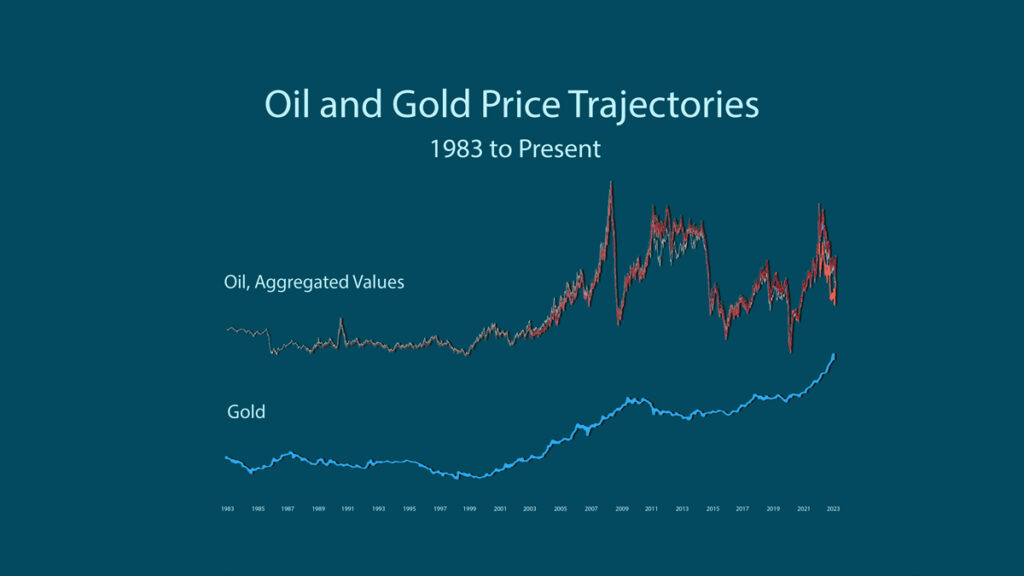
Given this propensity, many investors were confused to see gold remaining subdued as gas prices spiked by 36% since the start of the Iran war, reaching $119 per barrel, according to Reuters. Meanwhile, gold prices continue slowly ceding ground gained in the first month of the year.
This clear discrepancy between two correlated commodities has a few potential explanations:
Gold Lags Behind
The most cut-and-dry reasoning behind the disconnect between surging oil prices and stagnant gold is a simple market delay. The Iran war is having a direct and devastating impact on the oil market, as the Strait of Hormuz, a vital chokepoint in the global petroleum trade, remains under Iranian closure. Only a few weeks into the war and with mixed economic messages, gold could be waiting to respond.
Big Whales Short Sell
Another possibility is the influence of major financial institutions. For decades, experts have called out market manipulation of large players who purposefully short paper markets to artificially suppress prices only to scoop up physical gold at discounted prices.
Gold Becomes Operational
Perhaps the most momentous factor driving the wedge between oil and gold’s typical tandem price action is how governments use gold. Following the weaponization of the dollar after Russia invaded Ukraine, many countries accelerated de-dollarization to reduce exposure to U.S. influence, turning to gold to fill the void. Now, officials are actively deploying gold to dampen prices.
Gold Echoes 2008 Bull Run
In the early months of the 2008 GFC, gold crashed 32%, about 40% of its prior bull-market gain. After gold bottomed, it surged 178% over the next three years. Gold nearly hit $4,100 today, down 27%, about 40% of its gain since $2K. A 178% surge from that low puts gold at $11,400.
— Peter Schiff (@PeterSchiff) March 23, 2026
This week, renowned financial commentator and Schiff Gold founder Peter Schiff highlighted the parallels between the current movement and the metal’s performance during the 2008 Global Financial Crisis. In the early stages of the real estate crash, gold didn’t take off immediately. Instead, it fell by about 32% over a matter of months, shedding 40% of its prior bull-market gains. Following this temporary dip, gold prices staged a sharp upward trend.
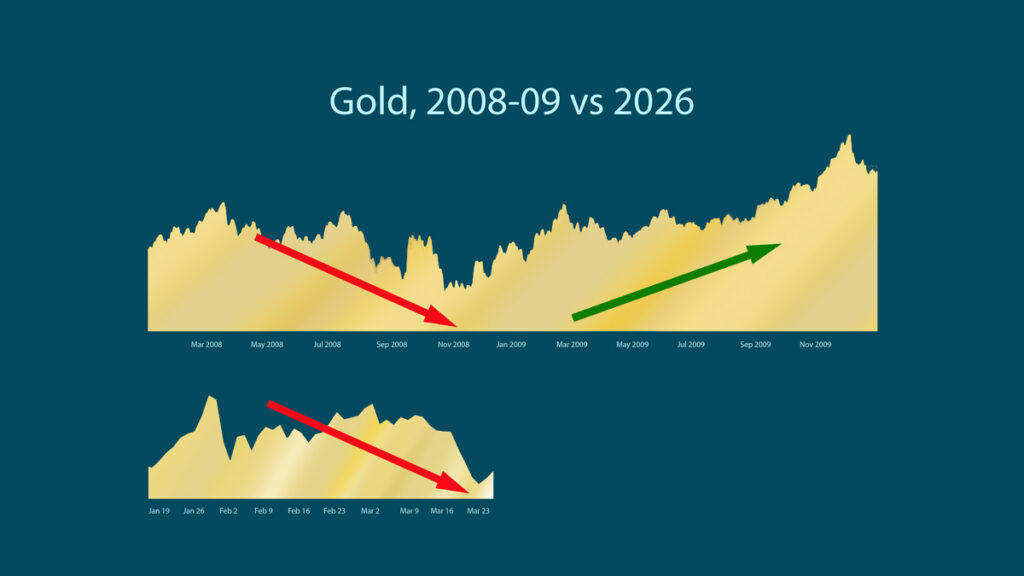
A similar pattern is panning out right now, with gold prices about 20% below recent highs after a years-long rally. If the historical comparison rings true, Schiff says prices could jump to $11,400/oz, marking a staggering 178% gain.
“Whether you take that target of $11,400 literally or not, the structural argument behind it is really hard to dismiss.”

Damian White
Sr. Precious Metals Advisor
This number may seem fanciful at first, but bear in mind that Schiff didn’t put a strict timeline on the estimate. Plus, gold’s rally lasted several years after the 2008 crash. Besides, many 2026 gold price predictions have gold hitting $6,000/oz and higher by year’s end.
Dalio Recommends Higher Gold Allocation Amid “Capital War”
Bridgewater Associates founder and famed investor Ray Dalio bolstered Schiff’s bold projection, calling gold “the safest money.” Instead of focusing on pricing, however, Dalio honed in on the broader economic shifts occurring behind the scenes.
He warns that the world is on the brink of a “capital war” where fiat currency is used as a geopolitical weapon in the form of sanctions, capital controls, and foreign asset freezes. In this scenario, every country plugged into the hyperconnected global economy is at risk of more powerful nations leveraging their control.
This is a natural byproduct of the U.S.-led financial penalties against foreign governments, driving the push into gold. As Dalio puts it, gold is “not someone else’s liability,” making it uniquely positioned in a world where trust in financial systems is increasingly uncertain. The official trend toward owning more gold should be followed up by retail investors increasing their allocation, as Dalio argues. He recommends a position of up to 15% in physical bullion.
The Gold Rush is Already Underway
Don’t mistake Dalio’s comments for a far-fetched possibility. In reality, it’s a logical extension of a trend that has been building for years. This is clearly reflected in the unprecedented gold demand over the past five years.
Between 2021 and 2024, annual central bank purchases consistently approached or exceeded 1,000 tons, followed by 863 tons in 2025. Together, this marks one of the most aggressive periods of accumulation in modern history. Even more telling, recent surveys show that 95% of central banks expect global gold reserves to continue rising over the next 12 months.
“Central banks are no longer just holding gold simply as a reserve. They’re being forced to sell it and use it as an operational currency in certain situations. Gold is not just stored wealth, it’s actual money for them.”
Damian White
Sr. Precious Metals Advisor
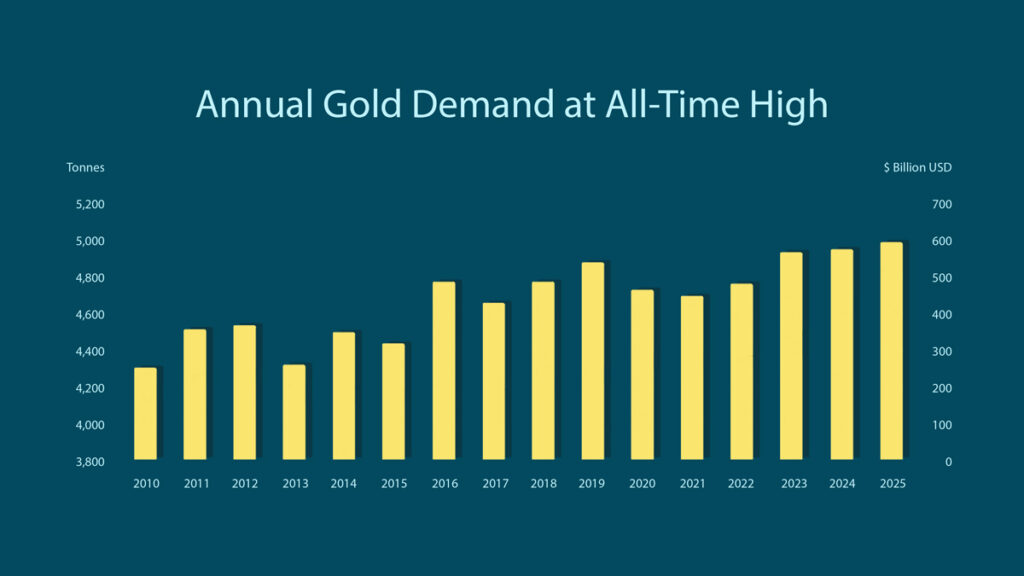
Plus, they’re not the only ones. Total gold demand — across official, institutional, and retail buyers — reached an all-time high of roughly 5,000 tons in 2025, signaling that this shift is broad-based across the entire market. While prices may fluctuate in the short term, the underlying demand is being driven by long-term strategic decisions.
China Is Challenging the Gold Market Status Quo
Another major shift is unfolding in the global gold market, led by China. Recent moves to position Hong Kong as a major gold trading hub signal a clear effort to challenge the long-standing dominance of Western pricing centers like London and New York.
Markets such as the Shanghai Gold Exchange have at times reflected higher gold prices than Western benchmarks, suggesting that supply and demand may be more freely expressed outside traditional systems.
As China promotes a more physically driven market, the result could be a more fragmented, multipolar pricing structure. Over time, this shift raises the possibility that current gold valuations may not fully reflect underlying demand, pointing toward a broader repricing on the global stage.
Avoid Costly Gold Investing Mistakes
Understanding the large-scale moves in the gold market and the behind-the-scenes drivers is one thing. Properly structuring precious metals within your portfolio for optimal wealth preservation is another.
In a market like this, small mistakes can make a big difference. Many investors get the big picture right but lose out through poor execution, whether that’s buying the wrong products, misunderstanding pricing, or mistiming their entry.
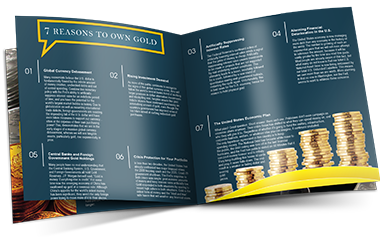
If you’re considering gold, it pays to get the details right. Grab a FREE copy of our Rookie Mistakes Guide that breaks down the most common mistakes investors make and how to avoid them so you can kickstart your investment journey in the best position possible.
Everything you need to know to get started in Precious Metals
Learn how precious metals can strengthen your portfolio, protect your assets and leverage inflation.
Request the Free Guide
Question or Comments?
If you have any questions about today’s topics or want to see us discuss something specific in a future The Gold Spot episode, please add them here.
CommentPowered by WPeMatico
Questions or Comments?
“*” indicates required fields