Categories
Gold

How high is gold price going next week? It all depends on these 3 factors – Kitco NEWS

  1. How high is gold price going next week? It all depends on these 3 factors  Kitco NEWS
  2. Gold Price Rallies as Stocks Rise After March’s Record-Breaking Coronavirus Shocks | Gold News  BullionVault
  3. Gold up on bleak US payrolls data; stronger dollar caps gains  CNBC
  4. Gold prices fall today but silver rates move higher  Livemint
  5. Gold inches up on bleak US nonfarm payrolls, firmer dollar caps gains  Economic Times
  6. View Full Coverage on Google News
Categories
Gold

Gold, silver and platinum pop – Kitco NEWS

Gold, silver and platinum pop  Kitco NEWS
Categories
Gold

Gold price pushes higher after the U.S. economy lost 701K jobs in March – Kitco NEWS

Gold price pushes higher after the U.S. economy lost 701K jobs in March  Kitco NEWS
Categories
Gold

Gold prices remain volatile after resilient ISM service sector sentiment – Kitco NEWS

Gold prices remain volatile after resilient ISM service sector sentiment  Kitco NEWS
Categories
Gold

The Key Detail for Gold… Doesn’t Come from Gold – Yahoo Finance

The Key Detail for Gold… Doesn’t Come from Gold  Yahoo Finance
Categories
Gold

GLOBAL SILVER SUPPLY COLLAPSE ON ITS WAY

Due to Mexico’s Ministry of Health issuing an Executive Order for the immediate suspension of non-essential activities until April 30th, the mining industry in the country has now come to an abrupt halt. The mining industry was hoping for an exemption to the Executive Order, but was not granted one. So, companies are now suspending production and putting their mines on care and maintenance.

Mexico Mining Suspension to hit Silver Supply

According to the article on the Mining Journal website, Mexico mining suspension to hit silver supply:

Under the government decree, non-essential activities are to be suspended immediately until April 30.

The decision is expected to have a significant impact on the supply of silver at a time when demand for silver coins is high. Mexico is the world’s largest silver producer at some 23% of world production and produced more than 200 million ounces in 2019, up from 196.6 million ounces in 2018.

With Mexico shutting down its mines, including the continued closure of Peru’s Mining Industry announced on March 15th, nearly 40% of global silver production is offline. Peru’s government stated that the national quarantine would last 15 days. However, we have passed that point, and there is no announcement of a return back to work.

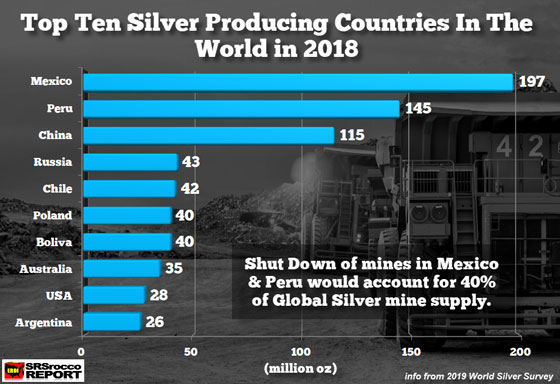
Here are the top ten silver producing countries in the world in 2018:

Top 10 Silver Producing Countries in the World in 2018

In 2018, Mexico and Peru accounted for 342 million oz of silver production. If mines in Mexico and Peru remain shut down for a month, that will cut silver production by 28 million oz. So, each month that Mexico and Peru are offline, would reduce silver mine supply by 28 million oz. However, I believe we are going to see more countries shut down their mines for an extended period as the global contagion continues to spread.

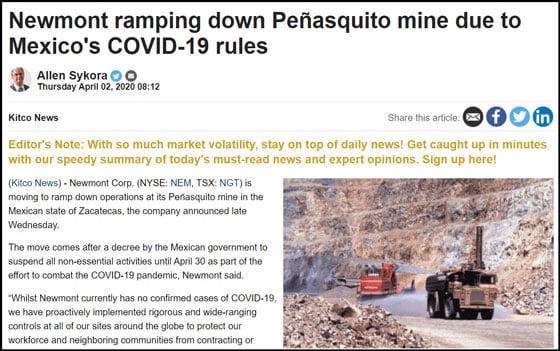
Today, Newmont and Pan American Silver announced closures of mines in Mexico. Newmont is now ramping down production at is massive Penasquito Mine, which produced 18 million ounces of silver in 2018:

Newmont Ramping down Peñasquito Mine due to Mexico's Covid-19 Rules

Also, Pan American Silver announced the shutdown of its La Colorada and Dolores mines in Mexico. These two mines produced 13.3 million ounces of silver in 2019:

Pan American Silver Provides Operations Update in Response to Covid-19

As we can see, the mining industry is now being shut down due to the global contagion. It will be interesting to see when Peru’s government announces a return to work policy. Again, it has been more than 15 days since Peru announced a national quarantine with no indication yet of a return to work.

With Mexico, the largest silver producing country in the world now on lockdown, the collapse of global silver mine supply is underway. The shutdown of silver mines throughout the world is taking place when investors are buying a record amount of physical silver bullion. This has now become a PERFECT STORM for the silver price going forward.

       
Categories
Gold

Crisis Exposes Devastating Result of Ongoing Fed Policy

Two weeks ago, during a March 17 address to the nation in response to the COVID-19 outbreak, President Donald Trump asked that Americans work from home, postpone unnecessary travel, and limit social gatherings to no more than 10 people.

And last week, on March 27, Trump signed a stimulus package of over $2 trillion dollars to provide relief to an economy on the precipice of collapse.

The aid package includes handouts and loans to individuals, small businesses, and other distressed industries.

Despite Trump’s “having created the greatest Economy in the history of our Country,” when the markets tanked, massive and immediate government intervention was the only thing left to forestall a total collapse.

So why can’t the greatest economy in the world can’t handle a temporary shock without needing trillions of dollars injected to stay afloat?

The Federal Reserve and its vicious and ongoing war on savers are to blame.

Using the Federal Reserve Note – commonly (but incorrectly) referred to as the dollar – introduces a dilemma. Because of inflationary monetary policy, Americans have long been forced to select among three undesirable options:

A) Save. Hold Federal Reserve Notes and be guaranteed to lose at least 2% in purchasing power every single year.

B) Consume. Spend Federal Reserve Notes on immediate goods and services to get the most out of current purchasing power.

C) Speculate. Try to beat the Fed’s deliberate inflation, seeking a higher return by investing in complicated and unstable asset markets.

With businesses and Americans defaulting on their rent and other obligations only days into the collapse, the problem is clear: Few have any savings… and why should they when saving their money at negative real rates of return has been a sucker’s game?

Lack of sound money, or money that doesn’t maintain its purchasing power over time, has discouraged savings while encouraging debt-financed consumption.

“Few have any savings… and why should they when saving their money at negative real rates of return has been a sucker’s game?”

Tweet This

American businesses and individuals are so overleveraged that once their income goes away, even briefly, they are too often left with nothing.

Fiat money is especially pernicious in the way it harms its users. To some, small 2% losses can go easily unnoticed, year to year. Over 100 years, the loss has been well over 97%.

And who can save for emergencies when you’re being forced to work and spend more – simply to maintain the same quality of life?

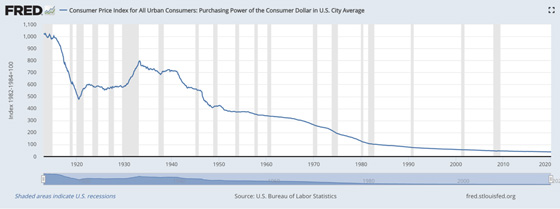
Consumer Price Index chart

Over 100 years, the Federal Reserve has destroyed more than 97% of our currency’s purchasing power.

With the Fed slashing short-term rates to zero, the US Federal Reserve Note has been further destroyed as a method of preserving savings. (And negative nominal interest rates could be coming next.)

Inflationary economic policy, absent the guardrails of sound money, has created a situation with an obvious and deadly conclusion: that many Americans lack savings to protect themselves against downturns.

This situation isn’t necessarily the fault of the people, but rather the fault of a system in which discouraging and punishing savers is a crucial tenet of the entire framework.

The Federal Reserve, the U.S. Treasury, and the White House are trying to reassure the public that everything is “under control,” that “the U.S. economy’s fundamentals are still strong,” and that the economy will skyrocket once COVID-19 is taken care of. What if they’re wrong?

Maybe the greatest monetary experiment in history is coming to an end. Maybe sound money can still save the day, but we must not waste any more time in restoring it.

       
Categories
Gold

Supply & Demand Are BOTH Crashing in the Unfolding Carnage

Welcome to this week’s Market Wrap Podcast, I’m Mike Gleason.

We continue to see unprecedented demand for gold and silver here at Money Metals Exchange, so we will forego an outside guest interview again this week in the interest of time. Servicing our customers has been an all-hands-on-deck effort with lots of overtime and new hires in order to get the job done. I’m proud to report that we continue to ship out your orders at a breakneck pace — and Money Metals STILL has more inventory in stock and ready to ship than most of our competitors it seems. Well without further ado, here is this week’s market update.

A surge in coronavirus cases, an expansion of economic lockdowns, and an explosion in unemployment claims hit markets this week. But this deluge of bad news didn’t seem to catch investors by surprise. Instead of crashing to new lows, the stock market held within a trading range and rallied yesterday following the release of a horrific jobs report.

It’s been a huge week for commodity markets as oil prices posted their biggest single day percentage gain ever Thursday, popping more than 25%. Oil prices lifted from their severely depressed $20 per barrel level after President Donald Trump met with oil executives and announced Russia and Saudi Arabia would agree to curtail production.

Turning to the precious metals, volatility finally tamped down a bit after three straight weeks of some of the wildest moves we’ve ever seen in both the spot market and the bullion market. Gold spot prices currently check in at $1,640 per ounce, down 0.7% for the week. Silver, meanwhile, is essentially unchanged on the week to trade at $14.75 an ounce as of this Friday morning recording.

With so many disruptions and dislocations now hitting the economy, investors have to ask themselves: What is truly sustainable? A great many businesses won’t be around after this global pandemic finally recedes. Entire industries will never be the same. And so many families will be financially wiped out.

Government “stimulus” may well prevent politically favored companies from going under. But at the cost of putting federal spending and borrowing on an even more unsustainably steep trajectory.

While there is no limit to how much currency the Federal Reserve can create to prop up the government and the entire financial system, there are limits to the U.S. dollar’s credibility as a store of value. And they are likely to be tested as the currency supply accelerates upward.

At the same time, production of scarce assets such as precious metals and an array of commodities is likely to fall off a cliff. The current supply and demand dynamic in most raw materials is both unprecedented and unsustainable.

The big story we have been told with regard to crude oil is pandemic-driven demand destruction. The global oil market is seeing demand contract by up to 25 million barrels per day as economies remain virtually shut down.

To make matters worse for oil producers, Russia and Saudi Arabia had been flooding the world with more output. They drove crude prices down so low that the entire North American shale industry, which was already reeling, now faces the prospect of being driven out of business.

In the first quarter of 2020, oil prices suffered a 66% crash – a record drop for a single quarter – settling right around $20 per barrel. At that price, nearly the entire energy sector is unsustainable. From the frackers to the deep-sea drillers to even the more conservatively positioned diversified energy giants, $20 oil simply doesn’t work.

Until oil prices get back above $40, the only way some of these companies can hope to survive is by drastically shrinking their operations. Wells are being capped. Industry analysts anticipate a 70% drop in U.S. drilling over the coming months.

At the same time, demand is also expected to recover from current levels. Although energy use will increase gradually at first as sections of the economy reopen, demand can increase a lot faster than supply – especially when that demand is being accelerated by $6 trillion in federal stimulus so far, and likely even more ahead.

Similar supply and demand pressures face the base metals and precious metals mining industries. Multiple mines around the world – from South Africa to South America – are currently shuttered due to the coronavirus.

Even before the pandemic, the mining industry was in distress due to low market prices for metals. First Majestic CEO Keith Neumeyer had determined it made more business sense for the company to hold onto its silver assets rather than sell them into the market at extremely depressed prices.

This year could see a record decline in mining supply for silver and other metals. And while the crude oil market entered the year with a supply glut that has only continued to grow, silver and palladium in particular were headed for supply deficits. Although industrial demand is currently way down, when it does recover, it will be difficult to see how those deficits don’t widen and perhaps lead to price spikes.

Analyst and MoneyMetals.com contributor Steve St. Angelo expects investors will continue to seek precious metals for financial security during this pandemic and its aftermath. But there may simply not be enough gold and silver above ground to go around – not at current prices, anyway.

Here are some more of Steve St. Angelo’s thoughts from a video presentation he posted earlier this week:

Steve St Angelo: As a lot of large cities in the US and around the world, and countries are on lockdown and they’re going to continue to be unlocked down. I believe the US now according to Trump, is on lockdown till the end of April. That’s another month. This is really going to damage the system and so we’re going to get into a financial storm in the next several months. So, I believe the precious metals, you’re going to see a lot more investors move into the precious metals and there just won’t be the supply.

I believe we’re going to see serious trouble with the bond market in the next month or so. And that’s going to cause trouble with actual bank accounts, the money market accounts, all the money… the digits that are held in the commercial banks, and then as well as the fiat money, the currency in circulation. So right now, the total gold value, and this is identifiable above ground investment stocks, central bank and private is valued about $4 trillion. Compare that to the base money supply, which is about $28 trillion. That’s seven times more than all the gold. Now, get silver, total silver value is only $40 billion. It’s 100 of the gold. Again, to me, I believe the most undervalued asset is physical silver, and we’ll start to see that in the future as more and more investors move into silver to protect wealth.

Well that will do it for this week, thanks for listening. Be sure to check back next Friday for our next Weekly Market Wrap Podcast. Until then, this have been Mike Gleason with Money Metals Exchange, thanks for listening and have a great weekend everybody.

       
Categories
Gold

Virus Impact Unknown for Many Companies

Source: Adrian Day for Streetwise Reports   04/02/2020

Money manager Adrian Day reviews non-resource stocks from around the world, noting that although he is cautious on global markets right now, with a few exceptions, some of the stocks on his list will be rated good buys on any dips.

Loews Corp. (L:NYSE, 33.70) reported a profit in the last quarter, driven by earnings at CNA Insurance and Boardwalk Pipelines, as well as investment income at the parent level. But investment income will likely disappear for the next quarter or so, while Diamond Offshore will continue to struggle and Loews Hotels will suffer from coronavirus travel restrictions.

Loews has a rock-solid balance sheet however, with more than $2.6 billion in cash, plus another $1 billion in investments (though less today because of the decline in the stock market, no doubt). It has continued its share buyback program, buying 21 million shares last year, representing about 8% of the shares outstanding at the beginning of the period. As of year-end, the book value had risen to $65.71, while the shares were trading a little over $52 a share. Book value has declined in the recent market turmoil—its largest holding, CNA Financial, has dropped nearly 30% since year-end—but so too has the share price; there remains a significant discount to net asset value (NAV) and a strong cash position.

Loews will survive, no doubt, and equally has cash available to help its portfolio companies as well as, potentially, make a new investment. It is currently trading at just 10x earnings—though it remains to be seen how much earnings will suffer from the virus-restrictions—and just off its lowest price since 2009.

Because its large holding in Diamond Offshore is vulnerable to continued weakness in the oil market, while the hotel business will suffer from the fallout of COVID-19, Loews may see further weakness. We would be buyers only on weakness.

A defensive company with innovative growth

Nestle SA (NESN:VX; NSRGY:OTC, 97.45) continues to shuffle its portfolio of food and healthcare as it moves ahead with more healthful products. For the most part, it has been selling low-margin, low-growth, highly competitive segments. It has put its U.S. ice cream into a global joint venture; it sold its European meat products company; and it sold Nestle skin health for Sfr10 billion.

On the healthful foods front, it has experimented with several alternatives to sugar in sweets and candies, but some have not been a hit with consumers in several markets. It has also moved to take advantage of its acquisition of rights to Starbucks in stores, with premium brands in the U.S.

Not cheap but defensive

Nestle completed a Sfr20 billion buyback program at the end of the year, and launched a new Sfr20 billion program. The stock outperformed over the past couple of years, and has held up well in the recent market volatility. The company has raised its dividend virtually each year for the past 20, and another increase is expected in April, though the COVID-19 pandemic may scuttle those plans. With a yield of 2.5%, it is trading now at its lowest yield for at least a decade.

Though we are not buying at these valuations, we are holding, for two main reasons: Nestle is a defensive company that can survive difficult times; and the stock is more likely to hold up than the overall market. Our experience with 2008 suggests that, even if the stock gets caught up in a global downdraft, it will recover sooner and stronger than the market.

Asian port company hit from all sides

Hutchison Port Holdings Trust (HPHT:Singapore, US$0.11) had only started to recover from the China-U.S. trade tensions than the COVID-19 pandemic slammed global trade. Not surprisingly, the distribution (dividend) for 2019 came in at the low end of guidance, while the estimated distribution for this year has been cut to $0.08–0.11 against $0.11 last year). The distribution has declined each year since 2013. One positive: The trust’s large, five-year debt repayment program is close to an end, with little more than a year to go. And while the decline in trade from COVID-19 is a negative, the company’s guidance and the stock price likely fully discount that.

The stock is trading at a significant discount to book, under 50% over the past several months, the lowest since the trust was launched; while the 12% yield is close to the high. Once the pandemic is over, global trade could rebound quickly as there will be a catch-up effect, and Hutchison stock should follow suit. While there may be more pain ahead, we are holding.

Travel restrictions hits this company

Kingsmen Creatives Ltd. (KMEN:SI, 0.20), despite revenue increasingly marginally last year compared with the prior year, reported a 94% decline in net profit, on higher costs, including bad debts, tax and the lack of one-off items from the prior year. Initiatives for 2020 looked promising until COVID-19 hit. In limiting travel and human interaction, the virus and associated restrictions have already hurt business activities, particularly exhibitions and events. For the most part, contracts for interior fit-outs have continued, and contracts exhibitions and so forth for H2 also continued.

The company, however, decided to cancel its regular final dividend (normally payable in May) “as the group wishes to retain cash for its business operations.” So, assuming the

interim is still paid in September—though it is too early to say if that will be the case—the shares are now trading at a forward yield of 5% (compared with a better-than 12% backward yield). The company, however, is well-positioned for when the virus-related restrictions are lifted. Kingsmen is a buy but without chasing it.

Top Buys

Best buys now at Friday’s closing prices include: Altius Minerals Corp. (ALS:TSX.V, 6.67); Gladstone Investment Corp. (GAIN: NASDAQ, 8.33); Lara Exploration Ltd. (LRA:TSX.V, 0.46); Ares Capital Corp. (ARCC:NASDAQ, 11.29); and Evrim Resources Corp. (EVM:TSX.V, 0.235). Other than Altius, which is at a price last since in 2009, all these stocks have experienced a rebound of some degree in the last week or so. Ares, for example, is up from a low of 7.90 on Monday, and I suspect we may see lower prices this coming week, so you should be very disciplined on limits and not chase stocks higher.

Originally posted on March 28, 2020.

Adrian Day, London-born and a graduate of the London School of Economics, heads the money management firm Adrian Day Asset Management, where he manages discretionary accounts in both global and resource areas. Day is also sub-adviser to the EuroPacific Gold Fund (EPGFX). His latest book is “Investing in Resources: How to Profit from the Outsized Potential and Avoid the Risks.”

Sign up for our FREE newsletter at: www.streetwisereports.com/get-news

Disclosure:
1) Adrian Day: I, or members of my immediate household or family, own securities of the following companies mentioned in this article: Altius Minerals, Gladstone Investments, Ares Capital, Lara Exploration and Evrim Resources. I personally am, or members of my immediate household or family are, paid by the following companies mentioned in this article: None. My company has a financial relationship with the following companies mentioned in this article: None. Funds controlled by Adrian Day Asset Management hold shares of the following companies mentioned in this article: All. I determined which companies would be included in this article based on my research and understanding of the sector.
2) The following companies mentioned in this article are billboard sponsors of Streetwise Reports: None. Click here for important disclosures about sponsor fees. The information provided above is for informational purposes only and is not a recommendation to buy or sell any security.
3) Statements and opinions expressed are the opinions of the author and not of Streetwise Reports or its officers. The author is wholly responsible for the validity of the statements. The author was not paid by Streetwise Reports for this article. Streetwise Reports was not paid by the author to publish or syndicate this article. Streetwise Reports requires contributing authors to disclose any shareholdings in, or economic relationships with, companies that they write about. Streetwise Reports relies upon the authors to accurately provide this information and Streetwise Reports has no means of verifying its accuracy.
4) This article does not constitute investment advice. Each reader is encouraged to consult with his or her individual financial professional and any action a reader takes as a result of information presented here is his or her own responsibility. By opening this page, each reader accepts and agrees to Streetwise Reports’ terms of use and full legal disclaimer. This article is not a solicitation for investment. Streetwise Reports does not render general or specific investment advice and the information on Streetwise Reports should not be considered a recommendation to buy or sell any security. Streetwise Reports does not endorse or recommend the business, products, services or securities of any company mentioned on Streetwise Reports.
5) From time to time, Streetwise Reports and its directors, officers, employees or members of their families, as well as persons interviewed for articles and interviews on the site, may have a long or short position in securities mentioned. Directors, officers, employees or members of their immediate families are prohibited from making purchases and/or sales of those securities in the open market or otherwise from the time of the interview or the decision to write an article until three business days after the publication of the interview or article. The foregoing prohibition does not apply to articles that in substance only restate previously published company releases. As of the date of this article, officers and/or employees of Streetwise Reports LLC (including members of their household) own securities of Altius Minerals, Lara Exploration and Evrim Resources, companies mentioned in this article.

Adrian Day’s Global Analyst disclosures: Staff may have positions in securities discussed herein. Adrian Day is also President of Global Strategic Management (GSM), a registered investment advisor, and a separate company from this service. In his capacity as GSM president, Adrian Day may be buying or selling for clients securities recommended herein concurrently, before or after recommendations herein, and may be acting for clients in a manner contrary to recommendations herein. This is not a solicitation for GSM. Views herein are the editor’s opinion and not fact. All information is believed to be correct, but its accuracy cannot be guaranteed. The owner and editor are not responsible for errors and omissions. © 2020.

( Companies Mentioned: ALS:TSX.V,
ARCC:NASDAQ,
EVM:TSX.V,
GAIN: NASDAQ,
HPHT:Singapore,
KMEN:SI,
LRA:TSX.V,
L:NYSE,
NESN:VX; NSRGY:OTC,
)

Categories
Gold

Fun on Friday: Coronavirus Lockdown Edition

OK. I gotta be honest. Being effectively under house arrest isn’t very much fun. But it’s the world we live in now, so might as well make the best of it. I mean, I can at least still legally ride my bike. Not on the beach, mind you. But other than that, the outside isn’t […]