Categories
Gold

A Tale of Two Markets

Source: Michael Ballanger for Streetwise Reports   03/30/2020

Sector expert Michael Ballanger looks at how economic forces are pulling markets in contradictory directions.

“It was the best of times, it was the worst of times, it was the age of wisdom, it was the age of foolishness, it was the epoch of belief, it was the epoch of incredulity, it was the season of Light, it was the season of Darkness, it was the spring of hope, it was the winter of despair, we had everything before us, we had nothing before us, we were all going direct to Heaven, we were all going direct the other way.” —Charles Dickens

When I was in university in Saint Louis, I was once ordered by one of the Jesuit priests to submit a “review” of a book entitled “A Tale of Two Cities” by an author that I later grew to greatly admire, Charles Dickens of “A Christmas Carol” fame.

However, at the time, I had no interest whatsoever in picking up that book and opening its dust-ridden pages—unless, of course, it was shortly after midnight and lacking the sleep-inducing influence of draft beer and pizza, I needed a sedative. As vigorously as I might protest, the cassock-clad professor took me aside and explained in minute detail that this was anything but a “polite request.” Quite the opposite, this was a directive, an edict, an order, and failure to comply would result in a failing grade, a suspension from the varsity hockey team, and total personal humiliation, ignominy and disgrace.

Begrudgingly, I returned to my dormitory, cracked open a Bud, and with a sigh of resignation and gritty resolve, I tore into “A Tale of Two Cities,” an extraordinary novel written in 1859 but one whose opening paragraph (shown at the beginning) could have originated today in the mind of the author, given the surrealism of the events of the last three months. What I had rued as a totally unnecessary and agonizingly dull task turned into a delight, and the book remains one of my favorites of all time.

Watching this gaggle of TV-star politicians around the world scramble to try to halt the inevitable arrival of this economic winter is like watching the mighty Mississippi in the springtime overflow its banks, tossing aside sandbagged defenses as though they were Styrofoam coffee cups. As I opined last weekend, this Kilimanjaro of debt, amassed around the world in staggering size and reach over the past five decades, has now overrun its banks and threatens to flood the economic heartland with defaults, bankruptcies and massive unemployment. Painfully and predictably, the banco-politico elite have turned to their problem-solving toolkit and engaged the only implement they know—the printing press.

Even more excruciating than listening to these opportunistic counterfeiters is seeing the queue of corporate crybabies, complete with extended hands and pointed fingers, blaming the government-imposed shutdown on the demise of their company stock prices and accompanying destruction of their option-package enrichments. The cruise lines that operate out of tax-friendly Panama bellying up to the bar of taxpayer libation for relief packages is not only an outrage, it is an embarrassment. If the average breadwinner can squirrel away a few acorns for a rainy day or for a winter of frozen ground and lean pickings, why is the corporate world entitled to relief in the trillions and the average worker a month’s rent?

This is not just a Tale of Two Markets (and I’ll get to that in a moment), it is a Tale of Two Societies, the first being “entitled” and the second, “not so much.” After all, did we not just go through a self-inflicted immolation of the banking cartel and subsequent public bailout of same a mere twelve years ago? Did the corporate world not learn any degree of prudence during or since that time? Could that last $1.5 billion stock buyback (into which they exercised options and sold their stock resulting in massive self-enrichment) not have been delayed or avoided, and instead gone into a rainy-day war chest of sorts?

The actions of the US Treasury, Federal Reserve and Congress (and their Canadian and European counterparts) have unleashed the hounds of fiscal and monetary hell upon the world, with the term “moral hazard” standing out like a lighthouse beam at midnight. Sir Winston was so very much on-the-mark with his now-famous quote, “Never let a good crisis go to waste,” to the extent that there now exists an inverse correlation between decibel level of political and corporate wailing and the level of the Dow Jones Industrial Index. And if it weren’t so pathetic, it would be laughable.
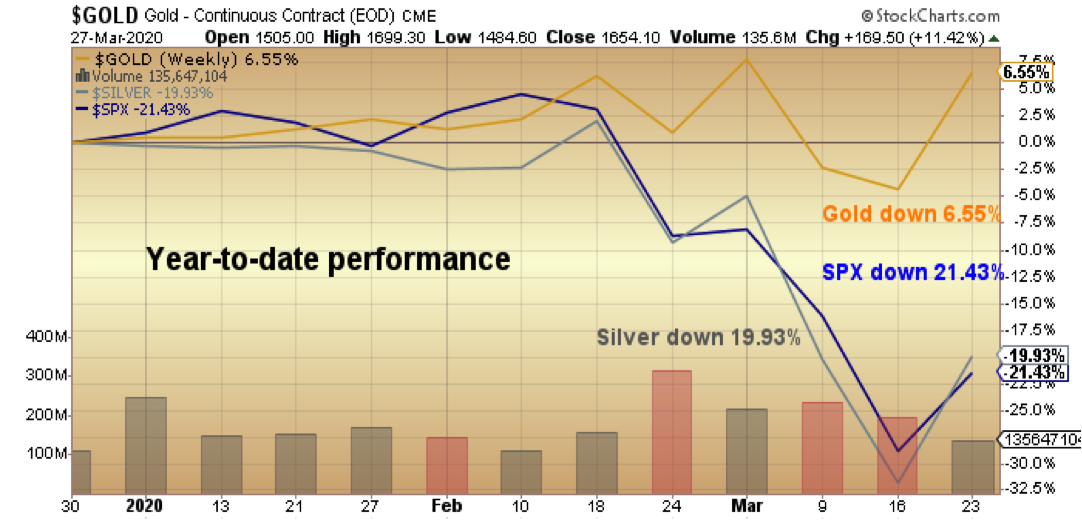
Most markets found their footings last week, with gold, silver and the S&P all staging sharp reversals—but then again, it was an easy call with the Fear-Greed Index at “1.” Performance year to date has once again placed gold in the “outperformer” category (an event that must be driving White House economic advisor Larry Kudlow absolutely off his rocker). Gold has done exactly what it was supposed to do in times of turmoil, and while silver has not, it is still performing better than the S&P year to date.

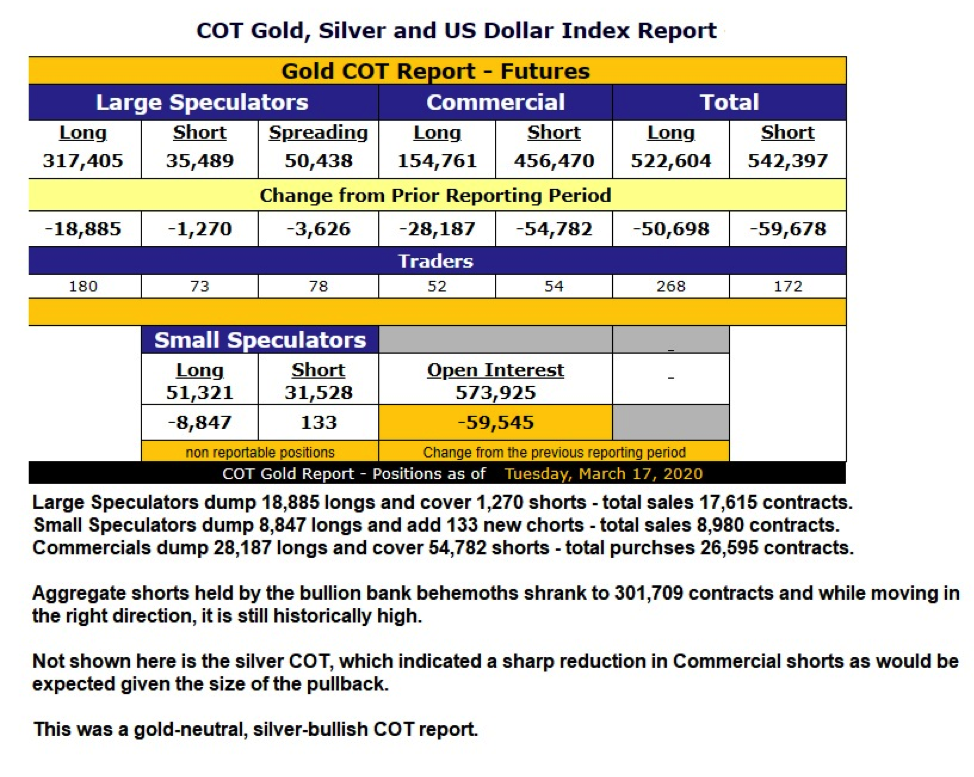
Further, the March 17 COT report has finally tilted in favor of a silver rally, and it couldn’t happen at a more opportune time.
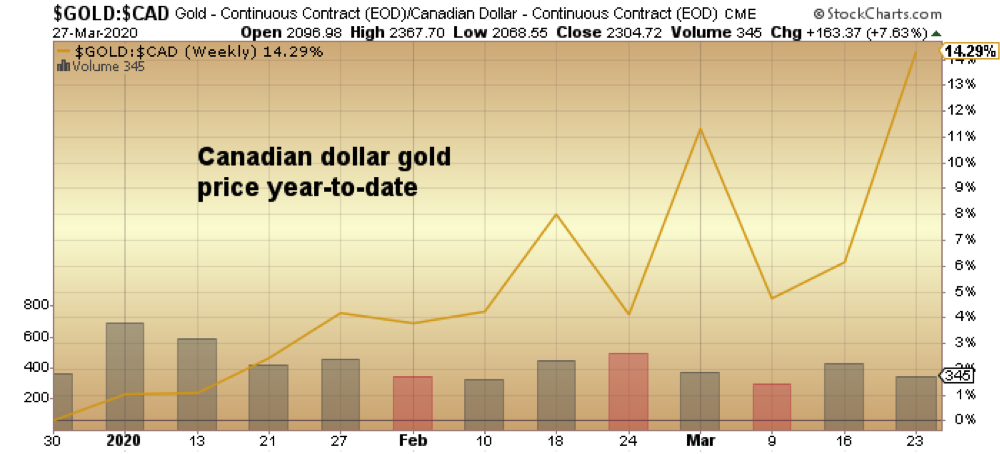
Of even greater significance is the performance of gold in non-US-dollar currencies and no better one to show than the Canadian dollar gold price which, for Canuck investors, has been a veritable nugget of safe-haven alpha for the prescient portfolio manager.
If you are an American investor looking for a currency play, the gold miners whose production is primarily in Canada or Australia (or both) are enjoying the dual benefits of weak domestic currency and weak energy. This allows a huge boost in revenue while expenses drop, and what falls out of the bottom is increased profits, the mother’s milk of all bull markets.
It was two weeks ago that I published the two charts of GDX and GDXJ with the caption “Generational Buying Opportunity.” The lows of that following Monday were textbook bottoms, with those purchases now serving to significantly repair the damage done by the silver takedown, an event I most surely did not expect.

I elected to go “all-in” with the Senior Gold Miner exchange-traded fund (ETF) (GDX:US), not because of any self-congratulatory “analysis” but because I totally missed the March 16 lows in the junior ETF (GDXJ:US), under US$20, because a) I was overly pessimistic about the opening price (I bid $16—idiot), and b) I was terrified. Actually, I have learned over the decades that fighting the terror of a knife-catching bottom is, if successful, a 100% winning trade and no better example was the GDXJ that day.

The only problem I have right now with the gold and silver miners is this: Will they, as “stocks” be able to decouple from the algobot-driven attack dogs that are controlling the broad stock market. With gold back in the US$1,600s and with oil around US$21, you could not get a more bullish fundamental backdrop for the gold producers. But as we know, when you are up against a swarm of bid-destroying algos, fundamentals don’t count, and therein lies the conundrum.
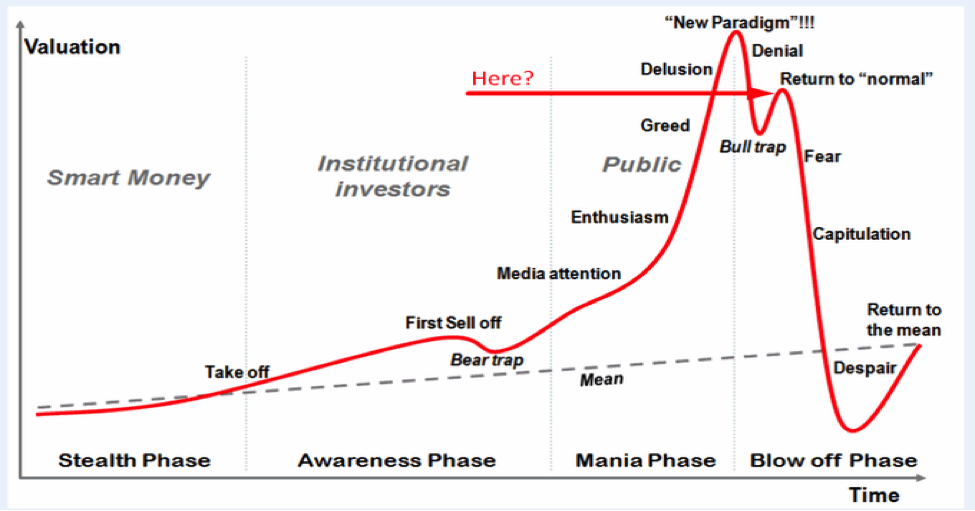
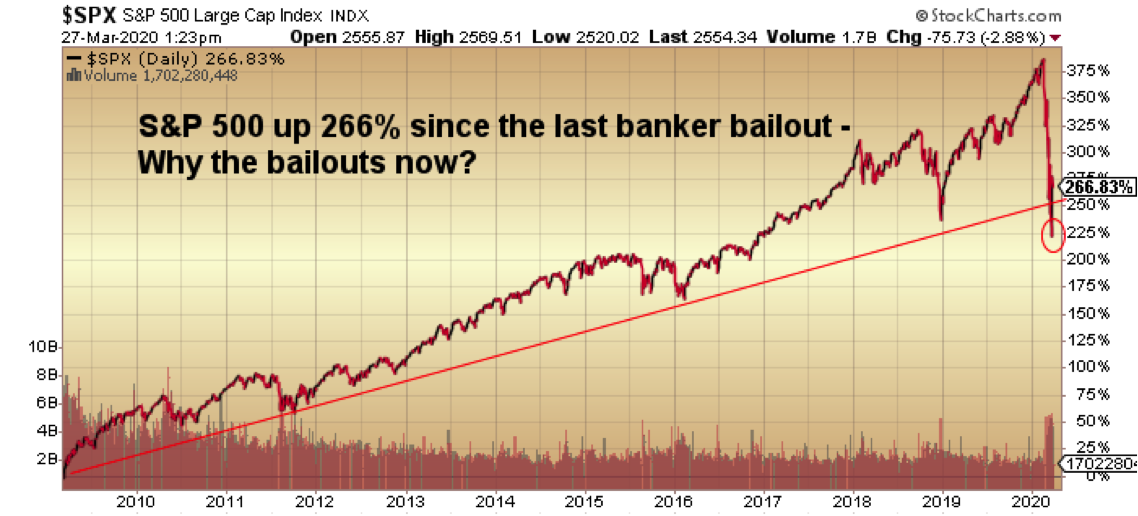
The stock market has bounced, but as I have preached for years, there is always a retest. If one looks back to 2009–2011, the bailouts occurred three months before the actual bottom, so I post the above chart not to frighten anyone but more as a reminder that the impact of this lockdown upon the global economy might be mild. But it might also be severe, and anyone who makes a prediction on his or her blog is only making a guess, because nobody has a clue, least of all me, as to the outcome.

From the chart shown above, I think that as far as the precious metals and their publicly traded brethren are concerned, we are somewhere between “fear” and “capitulation.” However, will a deflationary wave swamp the golden vessel, or will the hyperinflationary policy moves be a surfer’s dream? Only time will tell.

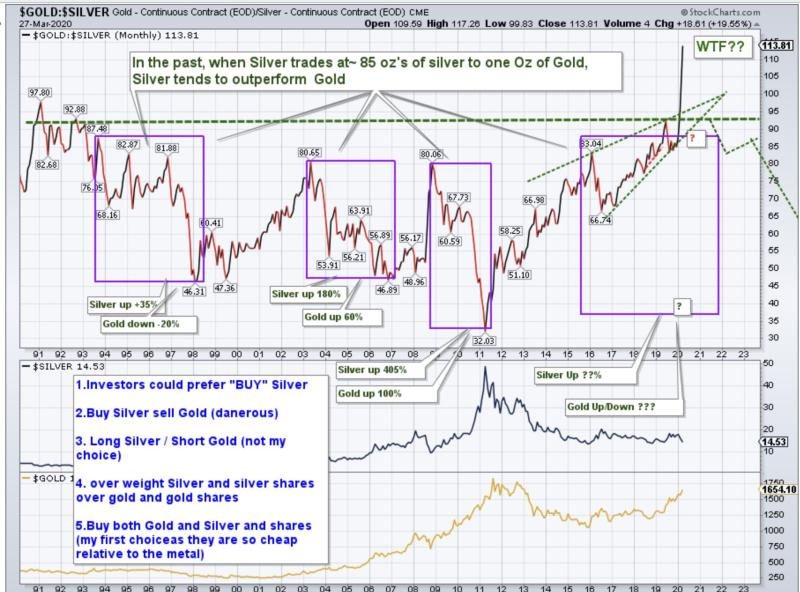
As for silver, the biggest question that I get from subscribers and followers constantly is why the GSR (gold-to-silver ratio) exploded to 130 when all the rocket scientist “analysts” have pounded the table in abject certainty that silver is in “shortage.” How can something in shortage be allowed to trade at US$14.50 in one market and $24.50 in another? How can retail websites be quoting one-ounce silver buffaloes at US$24.23? That is where the title of today’s missive comes in; this is “a tale of two markets.”

Years ago, I was at the Tinka Resources Ltd. (TK:TSX.V; TLD:FSE; TKRFF:OTCPK) booth and ran into a Glencore International Plc (GLEN:LSE) executive, and started to pitch him on TK’s Colquipucro silver deposit in Peru. The gentlemen listened to me patiently while I gave my version of “power close 101,” and why this 30-million-ounce open pit could be Glencore’s for the bargain basement price of CA$0.50 per share. After I finished yapping, he looked me and said, “All due respect, we really don’t have interest in your deposit. You see, we have slag heaps sitting idle from our copper-zinc operations that have five times that amount of silver.” The extent to which I was dumbfounded was exceeded only by the extent to which I was embarrassed and as I skulked away in near-mortal sheepishness, I thought to myself that I would never forget that conversation when thinking and talking about silver—which brings me to the point.

One look at the charts of copper and zinc and you can’t help but see a global economy under stress. You just know that with the prices of copper and zinc so depressed (and that was before COVID-19 showed up), the CEOs of these base metal giants must be under huge pressure to augment and enhance their forward guidance any way possible. Why then would a Glencore or a BHP Billiton Ltd. not mobilize those mountains of idle, slag-heap silver in order to bolster cash flow? There comes a point in any mining operation where the credit from byproduct ore becomes meaningful, and that is either from a spike in the value of the byproduct or a crash in the primary metal price.

I offer this as an opinion only. If JPMorgan are to be vilified as the manipulators of the silver price, the question remains whether they are acting on behalf of their prop desk (trading for the “house” account) or whether they are acting on behalf of one (or more) of these big base metal miners, whose eye sockets and nasal passages are bleeding from a dire cash flow deficiency.

Lastly, from the Dickens book, here is a passage most relevant to the demise of the average working man or woman:

“Repression is the only lasting philosophy. The dark deference of fear and slavery, my friend,” observed the Marquis, “will keep the dogs obedient to the whip, as long as this roof,” (looking up to it), “shuts out the sky.”

I would ask that you carefully consider those bolded words when you read or listen to the promises of these corporately compromised politicians who are throwing trillions of dollars of taxpayer confetti around like rice at an Italian wedding. They have seized upon this crisis in a manner no different than did Hank Paulson over a decade ago, under the guise of possible collapse of the financial system.

What we now know is that the only “collapse” that would have occurred was in the shareholders’ equity of the offending banks. Just as new growth springs back in burned-out forests, new equity would have rushed in to create new banks with little or no disruption to employment or “the system.”

So, as you see the line of imprudently run companies grunting and snorting up to the taxpayer trough this week, remember that this is all about the “two market” system. There is one market for the politically connected and another market for the politically insignificant, just as there is one market for buyers of actual gold and silver and another for the floggers of paper gold and silver.

Stated another way, there is nothing wrong with using the paper markets to try to increase the number of fiat dollars or euros or yen you own, because bills are paid in fiat and rarely in metal. However, if it is your intent to augment and protect your wealth—the fruits of years of labor and saving and prudence—then the only market you want to be in is the one that delivers physical gold and silver, because anything else is just an imposter.

There has never been a time in history when that shunning the imposters carried more urgency.

Article written on March 28.

Follow Michael Ballanger on Twitter @MiningJunkie.

Originally trained during the inflationary 1970s, Michael Ballanger is a graduate of Saint Louis University where he earned a Bachelor of Science in finance and a Bachelor of Art in marketing before completing post-graduate work at the Wharton School of Finance. With more than 30 years of experience as a junior mining and exploration specialist, as well as a solid background in corporate finance, Ballanger’s adherence to the concept of “Hard Assets” allows him to focus the practice on selecting opportunities in the global resource sector with emphasis on the precious metals exploration and development sector. Ballanger takes great pleasure in visiting mineral properties around the globe in the never-ending hunt for early-stage opportunities.

Sign up for our FREE newsletter at: www.streetwisereports.com/get-news

Disclosure:
1) Statements and opinions expressed are the opinions of Michael Ballanger and not of Streetwise Reports or its officers. Michael Ballanger is wholly responsible for the validity of the statements. Streetwise Reports was not involved in any aspect of the article preparation. Michael Ballanger was not paid by Streetwise Reports LLC for this article. Streetwise Reports was not paid by the author to publish or syndicate this article.
2) This article does not constitute investment advice. Each reader is encouraged to consult with his or her individual financial professional and any action a reader takes as a result of information presented here is his or her own responsibility. By opening this page, each reader accepts and agrees to Streetwise Reports’ terms of use and full legal disclaimer. This article is not a solicitation for investment. Streetwise Reports does not render general or specific investment advice and the information on Streetwise Reports should not be considered a recommendation to buy or sell any security. Streetwise Reports does not endorse or recommend the business, products, services or securities of any company mentioned on Streetwise Reports.
3) From time to time, Streetwise Reports LLC and its directors, officers, employees or members of their families, as well as persons interviewed for articles and interviews on the site, may have a long or short position in securities mentioned. Directors, officers, employees or members of their immediate families are prohibited from making purchases and/or sales of those securities in the open market or otherwise from the time of the interview or the decision to write an article until three business days after the publication of the interview or article. The foregoing prohibition does not apply to articles that in substance only restate previously published company releases.

Charts provided by the author.

Michael Ballanger Disclaimer:
This letter makes no guarantee or warranty on the accuracy or completeness of the data provided. Nothing contained herein is intended or shall be deemed to be investment advice, implied or otherwise. This letter represents my views and replicates trades that I am making but nothing more than that. Always consult your registered advisor to assist you with your investments. I accept no liability for any loss arising from the use of the data contained on this letter. Options and junior mining stocks contain a high level of risk that may result in the loss of part or all invested capital and therefore are suitable for experienced and professional investors and traders only. One should be familiar with the risks involved in junior mining and options trading and we recommend consulting a financial adviser if you feel you do not understand the risks involved.

Categories
Gold

Could the US Become Another Weimar Republic?

Source: Rudi Fronk and Jim Anthony for Streetwise Reports   03/30/2020

Rudi Fronk and Jim Anthony, cofounders of Seabridge Gold, discuss the potential ramifications of current U.S. fiscal and monetary policy.

The U.S. monetary and fiscal authorities are shoveling trillions of dollars into the U.S. economy to prevent a collapse of the economy and the financial system. Will this money be repaid or otherwise withdrawn from the system? If not, what consequences can we anticipate?

We know under TARP the loans and preference share funding provided to various companies in 2008/9 was largely repaid. We expect most large companies will repay the loans they receive this time also, but the terms will be very easy and they will be made easier if needed. Money for state governments, hospitals and other emergency health-related expenditures is not coming back. Most of the money to smaller companies will likely be in the form of grants if they keep employees on salary. Money directly to individuals will not be repaid.

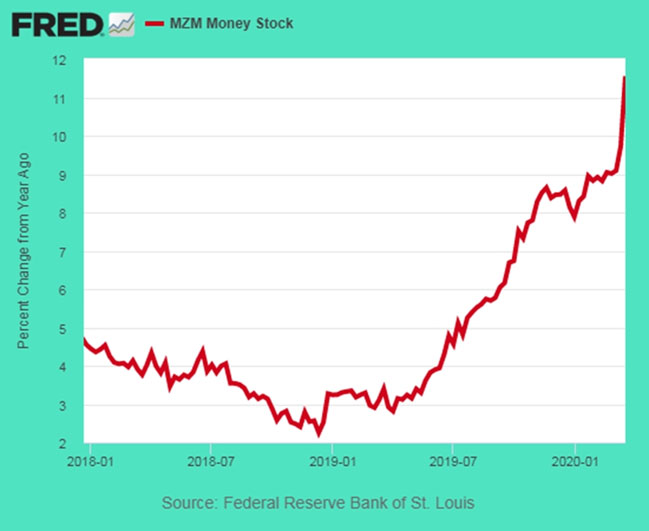
When loans are repaid, the newly created cash is terminated but most of the trillions from the Fed and Treasury will remain in the system. We therefore expect to see an abrupt increase in money supply and that’s already evident (see below). Whatever happens, nothing will be allowed to reduce dollar liquidity or bank reserves. Attempts to reduce the Fed balance sheet in 2018 went very badly and will not be repeated. Also, in the U.S. there is no trust that the programs will not be abused and we expect they will be abused, angering ordinary citizens who are likely to feel that the least worthy have benefited most.

In the Weimar Republic, the strains put on the financial system were too extreme…especially the war reparations on top of all the expenditures required to recover from the First World War. Their currency, once the strongest in Europe, became worthless. And now we have talk of fighting the coronavirus as if it is a war. The effects may be thought of as similar…too much demanded from the central authorities and met in the same way, by extreme money printing.

Will U.S. fiscal and monetary policies destroy confidence in the dollar? We think this is likely. Eventually, too many demands are met with too many dollars, investors begin to avoid holding the currency and we begin to see backwardation in the dollar and gold futures. That will be a very negative sign for the conventional monetary system and a spectacular boost to gold. Meanwhile, the Fed has certainly figured out how to jam money supply higher. Is this sort of growth possible on an ongoing basis without loss of confidence in the currency and a large increase in inflation? We don’t think so.

MZM Money Stock

This article is the collaboration of Rudi Fronk and Jim Anthony, cofounders of Seabridge Gold, and reflects the thinking that has helped make them successful gold investors. Rudi is the current Chairman and CEO of Seabridge and Jim is one of its largest shareholders.

Disclaimer: The authors are not registered or accredited as investment advisors. Information contained herein has been obtained from sources believed reliable but is not necessarily complete and accuracy is not guaranteed. Any securities mentioned on this site are not to be construed as investment or trading recommendations specifically for you. You must consult your own advisor for investment or trading advice. This article is for informational purposes only.

Sign up for our FREE newsletter at: www.streetwisereports.com/get-news

Disclosures:
1) Statements and opinions expressed are the opinions of Rudi Fronk and Jim Anthony and not of Streetwise Reports or its officers. The authors are wholly responsible for the validity of the statements. Streetwise Reports was not involved in any aspect of the content preparation. The authors were not paid by Streetwise Reports for this article. Streetwise Reports was not paid by the authors to publish or syndicate this article. The information provided above is for informational purposes only and is not a recommendation to buy or sell any security. Streetwise Reports requires contributing authors to disclose any shareholdings in, or economic relationships with, companies that they write about. Streetwise Reports relies upon the authors to accurately provide this information and Streetwise Reports has no means of verifying its accuracy.
2) Rudi Fronk and Jim Anthony: we, or members of our immediate household or family, own shares of the following companies mentioned in this article: Seabridge Gold. We personally are, or members of our immediate household or family are, paid by the following companies mentioned in this article: Seabridge Gold.
3) Seabridge Gold is a billboard sponsor of Streetwise Reports. Click here for important disclosures about sponsor fees.
4) This article does not constitute investment advice. Each reader is encouraged to consult with his or her individual financial professional and any action a reader takes as a result of information presented here is his or her own responsibility. By opening this page, each reader accepts and agrees to Streetwise Reports’ terms of use and full legal disclaimer. This article is not a solicitation for investment. Streetwise Reports does not render general or specific investment advice and the information on Streetwise Reports should not be considered a recommendation to buy or sell any security. Streetwise Reports does not endorse or recommend the business, products, services or securities of any company mentioned on Streetwise Reports.
5) From time to time, Streetwise Reports LLC and its directors, officers, employees or members of their families, as well as persons interviewed for articles and interviews on the site, may have a long or short position in securities mentioned. Directors, officers, employees or members of their immediate families are prohibited from making purchases and/or sales of those securities in the open market or otherwise from the time of the interview or the decision to write an article until three business days after the publication of the interview or article. The foregoing prohibition does not apply to articles that in substance only restate previously published company releases.

Categories
Gold

A Historical Perspective on Silver

Source: John Newell for Streetwise Reports   03/30/2020

Technical analyst John Newell looks back at the gold to silver ratio through history.

When we don’t understand the present, we can turn to the past. It is believed the natural ratio in the earth’s crust is ~10 ounces of silver for one ounce of gold.

Back in 3000 BC in Mesopotamia (modern day Turkey, Iraq, Iran), silver and gold were used to enable trade at a rate of 5 ounces of silver to 1 ounce of gold. For about 2,000 years, from 1670 B.C. to 432 AD, the rate was between a low of 9 to 1 in 59-44 BC to a high of 18 to 1 in 422 AD.

For the next 1,000 years from 527 to1453, the price was roughly 15 to 1. For the next three centuries the ratio was a low of 10.75 to 1 to a high of 15.52 to 1.

When the United States passed its first coinage law in 1792, the ratio was fixed at 15 to 1 but at that rate gold was considered undervalued and disappeared from circulation, so to correct the situation Congress moved the ratio to 16 to 1 in 1834.

At that rate gold was slightly overvalued and silver undervalued and silver coins began to disappear and were dropped from the list of coins by the Act of February 12, 1873, or the “Crisis of 1873,” and so thereafter the U.S. was on the Gold Standard, which became law in the Gold Act of March 14, 1900. (Hint: two 60 year cycles to today).

In 1919 the ratio was 15.20 to 1; by 1932 the ratio was up to 72.27 to 1 or about five times.

Silver chart

John Newell is a portfolio manager at Fieldhouse Capital Management and president and CEO of Golden Sky Minerals Corp. He has 38 years of experience in the investment industry acting as an officer, director, portfolio manager and investment advisor with some of the largest investment firms in Canada. Newell is a specialist in precious metal equities and related commodities and is a registered portfolio manager in Canada (advising representative).

Sign up for our FREE newsletter at: www.streetwisereports.com/get-news

Disclosure:
1) Statements and opinions expressed are the opinions of John Newell and not of Streetwise Reports or its officers. John Newell is wholly responsible for the validity of the statements. Streetwise Reports was not involved in the content preparation. John Newell was not paid by Streetwise Reports LLC for this article. Streetwise Reports was not paid by the author to publish or syndicate this article.
2) This article does not constitute investment advice. Each reader is encouraged to consult with his or her individual financial professional and any action a reader takes as a result of information presented here is his or her own responsibility. By opening this page, each reader accepts and agrees to Streetwise Reports’ terms of use and full legal disclaimer. This article is not a solicitation for investment. Streetwise Reports does not render general or specific investment advice and the information on Streetwise Reports should not be considered a recommendation to buy or sell any security. Streetwise Reports does not endorse or recommend the business, products, services or securities of any company mentioned on Streetwise Reports.
3) From time to time, Streetwise Reports LLC and its directors, officers, employees or members of their families, as well as persons interviewed for articles and interviews on the site, may have a long or short position in securities mentioned. Directors, officers, employees or members of their immediate families are prohibited from making purchases and/or sales of those securities in the open market or otherwise from the time of the interview or the decision to write an article until three business days after the publication of the interview or article. The foregoing prohibition does not apply to articles that in substance only restate previously published company releases.

Additional Disclosures and Disclaimer from John Newell, Fieldhouse Capital Management

Legal Notice / Disclaimer:

This document is not and should not be construed as an offer to sell or the solicitation of an offer to purchase or subscribe for any investment.

John Newell has based this document on information obtained from sources he believes to be reliable, but which has not been independently verified.

John Newell makes no guarantee, representation or warranty and accepts no responsibility or liability as to its accuracy or completeness. Expressions of opinion are those of John Newell only and are subject to change without notice. John Newell assumes no warranty, liability or guarantee for the current relevance, correctness or completeness of any information provided within this Report and will not be held liable for the consequence of reliance upon any opinion or statement contained herein or any omission.

Furthermore, I, John Newell, assume no liability for any direct or indirect loss or damage or for lost profit, which you may incur because of the use and existence of the information provided within this Report.

It should not be assumed that the methods, techniques, or indicators presented in these pages will be profitable or that they will not result in losses. Past results are not necessarily indicative of future results. Examples presented on these pages are for educational purposes only. These set-ups are not solicitations of any order to buy or sell. The authors, the publisher, and all affiliates assume no responsibility for your trading results. There is a high degree of risk in trading.
Hypothetical and historical performance results have many inherent limitations, some of which are described below. No representation is being made that any account will or is likely to achieve profits or losses similar to those shown. In fact, there are frequently sharp differences between hypothetical and historical performance results and the actual results subsequently achieved by any trading program. One of the limitations of hypothetical and historical performance results is that they are generally presented with the benefit of hindsight. In addition, hypothetical and historical trading may not present the financial risks and returns for future trading. For example, the ability to withstand losses or to adhere to a particular trading program in spite of trading losses are material points which can also adversely affect trading results. There are numerous other factors related to the markets in general or to the implementation of any specific trading program which cannot be fully accounted for in the preparation of hypothetical performance results and all which can adversely affect actual trading results.
Disclaimer: This Publication is protected by Canadian and International Copyright laws. All rights reserved. No license is granted to the user except for the user’s personal use. No part of this publication or its contents may be copied, downloaded, stored in a retrieval system, further transmitted, or otherwise reproduced, stored, disseminated, transferred, or used, in any form or by any means without prior written permission. This publication is proprietary.
Neither the information, nor any opinion expressed constitutes a solicitation for the purchase of an investment program.

Chart provided by the author.

Categories
Gold

Fremont Gears Up to Drill for Discovery in Nevada

Source: James Kwantes for Streetwise Reports   03/30/2020

James Kwantes of Resource Opportunities profiles a company that is financed to drill the Griffon project this year in the southern Cortez Trend.

Nevada is known as “The Silver State,” a nod to the 1859 discovery of the Comstock Lode. That rich silver endowment led to Nevada’s statehood, and profits from silver mining helped the North come out on top in the American Civil War.

But the discovery of the state’s rich gold districts, including the Carlin and Cortez trends, a century later quickly made Nevada one of the world’s premier gold mining jurisdictions. Those two districts alone have a combined gold endowment of more than 250 million ounces (production + reserves). And gold is the precious metal that remains Nevada’s largest export by dollar value.

However, U.S. Census Bureau statistics show that Nevada’s gold output is slipping. Gold exports of about $4.9 billion in 2018 dropped to $2.7 billion last year, a 45% decrease.

And Nevada is not the only gold-rich jurisdiction with a declining production profile. New discoveries are needed to replace the ounces being mined. And one of the best places to look for gold is on projects that have been orphaned by larger companies or by exploration companies that have shifted their focus elsewhere.

The latter is the story with the past-producing Griffon project at the southern end of Nevada’s Cortez trend. Fremont Gold Ltd. (FRE:TSX.V; USTDF:OTCBB) purchased Griffon and its 89 unpatented mining claims from Liberty Gold (LGD-T) in December 2019, then raised $1.48 million to drill it. The project was orphaned in Liberty (formerly Pilot Gold), which is drilling out its Black Pine oxide gold project in Idaho. Griffon is southeast of Fiore Gold’s (F-V) Pan mine and Contact Gold’s (C-V) past-producing Green Springs heap-leach gold mine.

Fremont plans to drill 2,000 meters at Griffon, beginning in June. Twenty-six drill sites are currently permitted and the project is bonded. Fremont plans to drill a number of untested targets in the hopes of making a new discovery at Griffon.

Griffon was first drilled in 1988. By 1997 two oxide gold deposits had been delineated, at Discovery Ridge and Hammer Ridge. Over the next three years, Alta operated as a small producer, mining oxide gold from those deposits at average grades of 1.03 g/t in a heap-leach operation. That’s well above average grades of 0.6 to 0.7 g/t being heap-leach mined at typical Nevada oxide gold operations.

Alta’s focus was production, not exploration. The company did not thoroughly explore the property and almost all of the holes they drilled were less than 100 meters deep. Fremont has assembled a crack team of geologists to narrow down targets at Griffon:

  • Clay Newton, Fremont’s VP Exploration and a Ph.D. structural geologist who brings fresh eyes to the project;
  • Andy Wallace, Ph.D., a Carlin expert and co-discoverer of five Nevada gold mines as a principal of Cordex;
  • Jamie Robertson, Ph.D., Alta’s former exploration manager and a regional expert on Nevada’s southern Cortez trend.

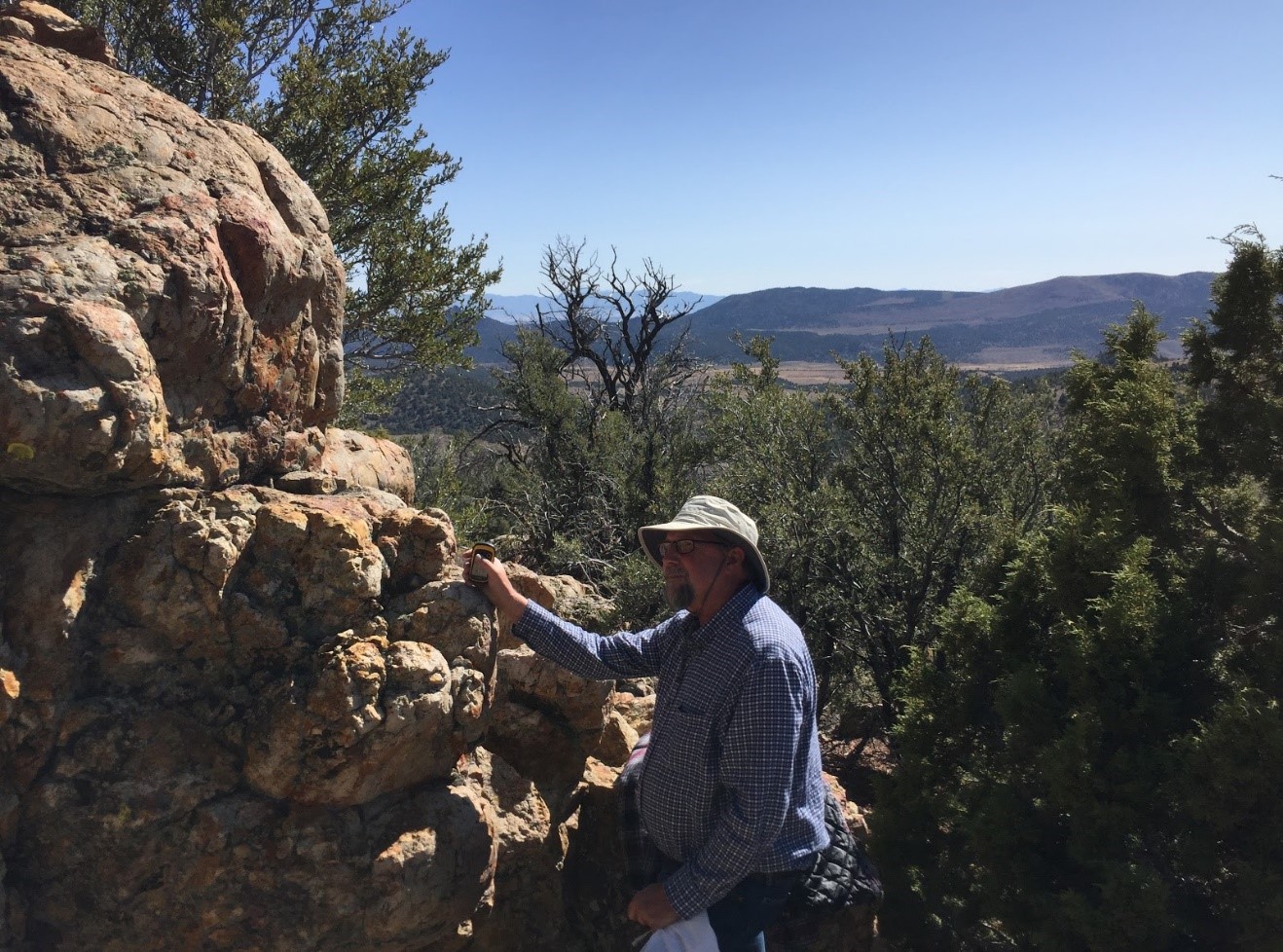
Clay Newton
Clay Newton, Fremont Gold’s VP Exploration, checks out a jasperoid outcrop, an alteration type associated with Carlin gold mineralization, at Fremont’s Griffon property in Nevada’s Cortez Trend.

Target areas at Griffon include the untested three-kilometer long Blackrock fault to the east of the Hammer Ridge deposit (one of the two deposits mined by Alta Gold Corp.), the Pilot Shale horizon, and a number of geochemical anomalies. In addition, potential remains in and around the two past producing open pits.

Drilling by Alta in an area southwest of Hammer Ridge hints at the property’s potential. Alta hit near-surface gold mineralization in many holes, including 57.9 meters of 0.86 g/t gold. Other drill holes in this area—all of them within 100 meters of surface—included:

  • 25.9 meters of 1.1 g/t
  • 36.6m of 0.93 g/t
  • 24.4m of 0.79 g/t

Last summer, Fremont sold its Gold Canyon project to McEwen Mining for 300,000 McEwen common shares in order to focus on securing more advanced-stage assets. The company’s first move was to option Cobb Creek from Contact Gold. Located in Elko County, Nevada, Cobb Creek is an advanced project with a historical gold resource that hasn’t been drilled since 1992. Although Cobb is an intriguing exploration project, Fremont plans to focus on Griffon this exploration season. The company also has the North Carlin, Hurricane and Goldrun projects in Nevada.

Gold is holding steady around US$1,650 an ounce and doing its job as a safe haven. The precious metal is also, increasingly, a buttress against the impending waves of money-printing as governments globally respond to economic paralysis caused by the COVID-19 pandemic.

Gold producers continue to rely on exploration companies to find the next economic ore bodies. That increases the appeal of well-managed juniors poised to create shareholder value with the drill. Fremont Gold fits the bill as it prepares to drill for discovery at Griffon. Insiders have been adding to their stakes, in both the public market and private placements. I have also been buying shares at these price levels.

Fremont Gold (FRE:TSX.V; USTDF:OTCBB)
Price: CA$0.06
Shares out: 81.5 million (121.2M f-d)
Market cap: $4.9 million

James Kwantes is the editor of Resource Opportunities, a subscriber supported junior mining investment publication. Kwantes has two decades of journalism experience and was the mining reporter at Vancouver Sun, the city’s paper of record.

Sign up for our FREE newsletter at: www.streetwisereports.com/get-news

Disclosure: I own Fremont Gold shares and Fremont is one of three Resource Opportunities sponsor companies. Fremont Gold is a speculative, high-risk exploration stock that may not be suitable for all investors. This article is not intended as financial advice and all investors should conduct their own due diligence and/or consult an investment advisor.

Streetwise Disclosure:
1) James Kwantes’ disclosures are listed above.
2) The following companies mentioned in this article are billboard sponsors of Streetwise Reports: Liberty Gold. Click here for important disclosures about sponsor fees. The information provided above is for informational purposes only and is not a recommendation to buy or sell any security.
3) Statements and opinions expressed are the opinions of the author and not of Streetwise Reports or its officers. The author is wholly responsible for the validity of the statements. The author was not paid by Streetwise Reports for this article. Streetwise Reports was not paid by the author to publish or syndicate this article. Streetwise Reports requires contributing authors to disclose any shareholdings in, or economic relationships with, companies that they write about. Streetwise Reports relies upon the authors to accurately provide this information and Streetwise Reports has no means of verifying its accuracy.
4) The article does not constitute investment advice. Each reader is encouraged to consult with his or her individual financial professional and any action a reader takes as a result of information presented here is his or her own responsibility. By opening this page, each reader accepts and agrees to Streetwise Reports’ terms of use and full legal disclaimer. This article is not a solicitation for investment. Streetwise Reports does not render general or specific investment advice and the information on Streetwise Reports should not be considered a recommendation to buy or sell any security. Streetwise Reports does not endorse or recommend the business, products, services or securities of any company mentioned on Streetwise Reports.
5) From time to time, Streetwise Reports LLC and its directors, officers, employees or members of their families, as well as persons interviewed for articles and interviews on the site, may have a long or short position in securities mentioned. Directors, officers, employees or members of their immediate families are prohibited from making purchases and/or sales of those securities in the open market or otherwise from the time of the interview or the decision to write an article until three business days after the publication of the interview or article. The foregoing prohibition does not apply to articles that in substance only restate previously published company releases. As of the date of this interview, officers and/or employees of Streetwise Reports LLC (including members of their household) own securities of Liberty Gold, a company mentioned in this article.

Resource Opportunities Disclaimer: Readers are advised that this article is solely for information purposes. Readers are encouraged to conduct their own research and due diligence, and/or obtain professional advice. The information is based on sources which the publisher believes to be reliable, but is not guaranteed to be accurate, and does not purport to be a complete statement or summary of the available data.

( Companies Mentioned: FRE:TSX.V; USTDF:OTCBB,
)

Categories
Gold

Mickey Fulp: ‘Never Let a Good Crisis Go to Waste’

Source: Maurice Jackson for Streetwise Reports   03/30/2020

In discussion with Maurice Jackson of Proven and Probable, the Mercenary Geologist offers his take on the coronavirus pandemic, its impacts on economic policy and what he’s buying (or not buying) right now.

Maurice: Today we will find out if we are at risk of losing our liberty to the coronavirus, along with buying opportunities for your investment portfolio. Joining us for a conversation is Mickey Fulp, the world-renowned Mercenary Geologist.

Absolute delight to speak with you sir. Mickey, you are the Mercenary Geologist, but you’re equally regarded highly for your views on philosophy and politics, and every time we speak my neurons expand. You and I have shared concerns regarding the erosion of liberty as the federal government and municipalities have been perniciously increasing their influence over the years, and in particular in the response to the coronavirus. Sir, what concerns should we have regarding our liberties that many people are not considering due to the government’s response to the coronavirus?

Mickey: Well, I think it really comes from state and local governments now, and rightly so. The state and local governments are responsible ultimately, not the federal government, for instituting policies regarding what I prefer to call the Wuhan flu, but they are increasingly infringing on our basic freedoms as expounded in the Bill of Rights to assemble peacefully, to move about freely, the separation of church and state. You have governments outlawing people’s right to congregate and practice their religion, confiscate property without due process.

California now has emergency regulations that allow them to commandeer private property to set up emergency hospitals, and now there are number of euphemisms such as, social distancing, self-isolation, shelter in place. I thought that’s what your snowflake generation did when they went to their parents’ basement as a safe space. Quarantines, curfews, checkpoints, lockdowns, containment zones. . .what I fear is this will progress to some euphemism for martial law.

Maurice: Truly, truly concerning. Let’s discuss the economic policy response. Are you as surprised on how much emphasis the Fed and Congress has placed on the economy rather than on providing supplies toward the hospitals and the true heroes, who are the healthcare workers making so many selfless sacrifices?

Mickey: I think this is a media- [and] government-created economic recession in response to a medical event. There’s a saying—never let a good crisis go to waste—and the media and the government have instilled first fear, then panic, then irrationality, now approaching hysteria. That’s not to belittle the impact of the Wuhan flu, but let’s just step back and put this in perspective. So far, I think as of Friday afternoon, March 27, there are approximately 95,000 confirmed cases in the U.S. and around 1,300 deaths, so do the math.

That’s about 1.4%, but that’s from the number of people that tested positive. That does not imply the number of people that have had the virus with no symptoms or mild symptoms; these are the people that are extremely ill to begin with. Here’s some perspective, according to the Centers for Disease Control and Prevention (CDC), as of March 21, for the 2019–2020 flu season so far, 39 million cases, 400,000 hospitalizations and 24,000 deaths.

I’m a bit of a numbers wonk, and let’s just do a little thought experiment. We have 95,000 cases, but those are people that are ill enough to get tested. Let’s just suppose that those 95,000 cases are even upward of 10x that, with people walking around not even know they have it. They’ve got a cold, because it is a virus very similar to the common cold. If we assume that 10 times that number actually have been exposed and have antibodies to the virus, then that’s 950,000 cases right there.

Then let’s go back and do the math on that. That gives us a mortality rate of about 0.1%, which is just about the average of the common flu season that kills on average 36,000 Americans every year.

Maurice: Now, that’s truly unfortunate for the victims and the families. But, as you stated, if cooler heads prevail and you put it into perspective—because the opposite response from all the mainstream media is hysteria—I believe we should be proactive in trying to prevent the spread of the disease. But you stated it correctly: “Never let a good crisis go to waste.”

Mickey: I’m going to say something fairly radical in today’s environment. When it’s all said and done, I think that this is going to be a serious illness, a serious flu. I think we will develop a vaccine for it quicker than usual. In retrospect, we will look back at this and say, well, was it as bad as the swine flu in 2009–2010? Was it as bad as 86,000 people, if memory serves, killed during that flu season? What’s the ultimate outcome? That remains to be seen, but that’s my position right now, and I’m sticking to it.

Maurice: Let’s focus back on the economic response here. Our currency is being inflated at an unprecedented rate in the past couple of weeks. What are your thoughts on the economic policy response and the potential ramifications?

Mickey: Simply put, I think if the government—and I include the Federal Reserve as the fourth branch of the United States of America’s government—creates $6 trillion on a keyboard to fend off economic recession/depression, which is defined as deflation, then an inflating U.S. dollar must be the result.

Maurice: What ramifications do you foresee on globally on supply and demand of goods and services?

Mickey: We have severe demand destruction. Look at the oil business right now. We have an oil price somewhere between $20 and $25 [per barrel]. It’s about $22 as we speak, and that’s because of demand destruction. We’re producing, on average, 20 million barrels of oil worldwide more than demand, and are simply awash in oil. Carry that on out, and we will be, until supply goes away because of low prices. This demand destruction is going to lead to oversupply and falling prices.

Maurice: That will lead to some buying opportunities, potentially, that we’ll get to later on in this conversation. Let me ask you this, is government rewarding bad behavior and if so, how?

Mickey: Well, you can argue that. Let’s look at this $2 trillion stimulus package, which includes $75 million for the National Endowment for the Arts; $75 million for the Corporation for Progressive Broadcasting—what I like to refer to it as; $25 million for the Kennedy Center after it was remodeled a couple of years ago at a price of $250 million, so lots of waste there.

Going on with that thought, that bill is rewarding bad behavior because it’s giving $1,200 to every American that earns less than a $100,000 a year. Just going to write them a check or probably deposit in your bank account—I don’t think they write checks anymore for those sorts of things. This has severely affected a portion of people in this country because they’ve never saved.

In addition to a usual state where you’re able to collect unemployment for a period of six months, some portion of that, they’ve extended unemployment benefits at 100% for another four months. In New Mexico—and I’m not sure if other states or not—you don’t even have to look for a job during that period of time. The idea that people who do not accumulate nest-eggs, who are deeply in debt, who live hand-to-mouth, from paycheck to paycheck, they’re certainly going to be adversely affected.

But here comes Uncle Sam, with all these reasons not to work. So someone gets unemployment for six months and they’ve got another four months of unemployment. If they’re minimum wage, what incentive do they have to go back to work?

Maurice: Which leads to my next question, once citizens receive their first stimulus payments for not working, what are the chances of more checks and increased amounts on the horizon by the government?

Mickey: Well, I think everybody has already said in government that this is a start—this $2 trillion plus the $4 trillion the Feds created on a keyboard. There’ll be another bailout package, or there’ll be another stimulus package, or whatever euphemism they choose to call it. It’s not good. The ultimate result of this is we’ll default on our debt once again; we’ve done that twice since 1930.

Maurice: Somewhat counterproductive. You correct me if I’m wrong: If you inflate your currency, the result is higher prices. Well, why are so many people, especially those that advocate for a minimum wage increase, stating that the cost of living is so high, right? There’s your culprit. It’s the Federal Reserve. It’s expansion of our currency.

Mickey: Absolutely.

Maurice: They look at the short term as, I want this paycheck. And now multitrillion-dollar question: Who is going to pay for this; when and how?

Mickey: We ultimately do, as citizens of the United States of America. And I’ve already said this: It’s going to result in a default on the debt, and demise of not only the US dollar—the world’s reserve currency, as this is happening all over the world—ultimately, it will result in a demise of all the world’s fiat currencies, and that’s the natural order of things. Every fiat currency since the Roman Empire, and perhaps longer than that, has inflated itself and resulted in default. I just can’t tell you when that’s going to happen.

Maurice: If you, Mickey Fulp, were a member of Congress, what would you recommend as an appropriate economic response?

Mickey: Well, I’m going to call that an inappropriate question because I consider myself an honest and forthright man.

Maurice: I think we can read between the lines on what the response would be, and I would echo that I second that emotion, sir.

Mickey: I think there are a couple of honest politicians: Dr. Ron Paul, when he served in the U.S. Congress and his son, Dr. Rand Paul. Those are honest, forthright men that I admire.

Maurice: Mickey, who is ultimately responsible for the decline and degradation of the United States?

Mickey: It’s the politicians that we, the people, voted in. But most importantly, I think it’s the Deep State bureaucrats who actually run the government. They are entrenched in jobs for their entire careers, and they answer to no one except the ephemeral bosses that are appointed by one set of politicians or the other that we have elected.

Maurice: Switching gears, do you have any buying opportunities at the moment that you would like to share with us?

Mickey: I think it’s not too late to buy gold. That’s assuming you can find someone who is selling gold and delivering it promptly, and that’s a problem right now.

Maurice: Besides gold, are there any other precious metals that would peak your interest at this time or just gold?

Mickey: Just gold for me.

Maurice: Mickey, how does owning physical precious metals fit into today’s discussion?

Mickey: Maurice, I think it’s the key ingredient in any recipe to ensure financial security for you and yours.

Maurice: May I ask what are you buying and why?

Mickey: I’m not buying anything this week because gold is up $140 bucks, and it’s even more than that, with really huge premiums coming in at this point because of its physical scarcity.

Maurice: Just to caveat to what you’re sharing, I had a discussion with Bob Moriarty of 321gold recently. I think he stated: “Anyone who does not own gold is financially ignorant.”

Mickey: I would agree with that take, and specifically gold, because gold is the only real money.

Maurice: In closing, sir, what keeps you up at night that we don’t know about?

Mickey: Right now, I would say it’s the next good novel I’m reading about yet another dystopian society.

Maurice: All right, Mr. Fulp, last question: What did I forget to ask?

Mickey: My website and my Twitter feed: www.mercenarygeologist.com; and my Twitter feed is @mercenarygeo.

Maurice: Before you make your next bullion purchase, be sure you call me. I mean licensed representative for Miles Franklin Precious Metals Investments, where we provide a number of options to expand your precious metals portfolio from physical delivery, offshore depositories, precious metal IRAs and private blockchain distributed ledger technology.

Call me directly at (855) 505-1900, or you may e-mail maurice@milesfranklin.com. Last but not least, please subscribe to www.provenandprobable.com for mining insights and bullion sales.

Mickey Fulp, the Mercenary Geologist, thank you for joining us today on Proven and Probable.

Maurice Jackson is the founder of Proven and Probable, a site that aims to enrich its subscribers through education in precious metals and junior mining companies that will enrich the world.

Sign up for our FREE newsletter at: www.streetwisereports.com/get-news

Disclosure:
1) Statements and opinions expressed are the opinions of Maurice Jackson and not of Streetwise Reports or its officers. Maurice Jackson is wholly responsible for the validity of the statements. Streetwise Reports was not involved in any aspect of the article preparation. Maurice Jackson was not paid by Streetwise Reports LLC for this article. Streetwise Reports was not paid by the author to publish or syndicate this article.
2) This article does not constitute investment advice. Each reader is encouraged to consult with his or her individual financial professional and any action a reader takes as a result of information presented here is his or her own responsibility. By opening this page, each reader accepts and agrees to Streetwise Reports’ terms of use and full legal disclaimer. This article is not a solicitation for investment. Streetwise Reports does not render general or specific investment advice and the information on Streetwise Reports should not be considered a recommendation to buy or sell any security. Streetwise Reports does not endorse or recommend the business, products, services or securities of any company mentioned on Streetwise Reports.
3) From time to time, Streetwise Reports LLC and its directors, officers, employees or members of their families, as well as persons interviewed for articles and interviews on the site, may have a long or short position in securities mentioned. Directors, officers, employees or members of their immediate families are prohibited from making purchases and/or sales of those securities in the open market or otherwise from the time of the interview or the decision to write an article until three business days after the publication of the interview or article. The foregoing prohibition does not apply to articles that in substance only restate previously published company releases.

Proven and Probable LLC receives financial compensation from its sponsors. The compensation is used is to fund both sponsor-specific activities and general report activities, website, and general and administrative costs. Sponsor-specific activities may include aggregating content and publishing that content on the Proven and Probable website, creating and maintaining company landing pages, interviewing key management, posting a banner/billboard, and/or issuing press releases. The fees also cover the costs for Proven and Probable to publish sector-specific information on our site, and also to create content by interviewing experts in the sector. Monthly sponsorship fees range from $1,000 to $4,000 per month. Proven and Probable LLC does accept stock for payment of sponsorship fees. Sponsor pages may be considered advertising for the purposes of 18 U.S.C. 1734.

The Information presented in Proven and Probable is provided for educational and informational purposes only, without any express or implied warranty of any kind, including warranties of accuracy, completeness, or fitness for any particular purpose. The Information contained in or provided from or through this forum is not intended to be and does not constitute financial advice, investment advice, trading advice or any other advice. The Information on this forum and provided from or through this forum is general in nature and is not specific to you the User or anyone else. You should not make any decision, financial, investments, trading or otherwise, based on any of the information presented on this forum without undertaking independent due diligence and consultation with a professional broker or competent financial advisor. You understand that you are using any and all Information available on or through this forum at your own risk.

Categories
Gold

The Myth of the Non-Essential Business

As the coronavirus-induced economic lockdowns have tightened across the US, we’ve seen the emergence of a government-inspired fantasy – the myth of the nonessential business. Government officials across the country have forced the closure of these so-called non-essential businesses while allowing “essential” enterprises to soldier on. Politicians and bureaucrats have developed arbitrary criteria to determine […]
Categories
Gold

Currency Wars: The Rise of Hyperinflation (Video)

The evil Empire has the ultimate weapon – the printing press. This diabolical machine is capable of bringing death to the dollar and destroying the entire economy. Watch the drama unfold as Peter Schiff and his rag-tag band of Austrian School economists fights the evil empire and tries to save the Republic from the Keynesian […]
Categories
Gold

Wear a mask not just to protect against COVID-19, but to protect against government surveillance

Indeed, wearing a mask is a revolutionary, grass-roots act! by JD Heyes via Natural News (Natural News) Former NSA contractor-turned-whistleblower Edward Snowden warned this week that governments including the United […]

The post Wear a mask not just to protect against COVID-19, but to protect against government surveillance appeared first on Silver Doctors.

Categories
Gold

Rick Rule: Mines Shutting Down, COMEX To Settle In Cash?

The coronavirus is not only ravaging our personal lives, but impacting businesses globally while financial crisis interventions motivate people to seek shelter in the safe havens… Rick Rule interviewed by […]

The post Rick Rule: Mines Shutting Down, COMEX To Settle In Cash? appeared first on Silver Doctors.

Categories
Gold

It’s Not a Recession—It’s a Government-Imposed Shutdown of the Private Sector

We are about to enter a production slowdown, a collapse really, not because businesses miscalculated their investments, but because government intervened… by Hunter Hastings via Mises Wire Economists and Wall […]

The post It’s Not a Recession—It’s a Government-Imposed Shutdown of the Private Sector appeared first on Silver Doctors.