Categories
Silver

Silver technical update: stuck within a wide band (video)

Snippet: 
Market was a lot about margin calls. Gold-Silver Ratio EXPLODED. I have been adamant this week, silver is not acting like a precious metals, it is an industrial metal and it acted more like that this week. Silver is down over 10% this week. Silver has no trend, went from a high to a low within a broad band..
Source: 

Ira Epstein

Market was a lot about margin calls. Gold-Silver Ratio EXPLODED. I have been adamant this week, silver is not acting like a precious metals, it is an industrial metal and it acted more like that this week.  Silver is down over 10% this week. Silver has no trend, went from a high to a low within a broad band..

Categories
Gold

The only gold price question Scotiabank is asking is how sharp is the uptrend – Kitco NEWS

The only gold price question Scotiabank is asking is how sharp is the uptrend  Kitco NEWS
Categories
Gold

Gold price needs Fed cuts to go higher and it will get them – Kitco NEWS

Gold price needs Fed cuts to go higher and it will get them  Kitco NEWS
Categories
Gold

Calibre Has Some Safety in the Storm

Source: Bob Moriarty for Streetwise Reports   03/01/2020

Bob Moriarty of 321gold discusses a company he sees as a safe haven amid economic chaos.

Last week provided a glimpse into the future of the stock market. Only a glimpse. It is going to get a whole lot worse.

On January 1, I said in an article I titled Beware the Stock Market, “As the Everything Bubble pops, the financial system will destroy most investors because they are unprepared.” Lest my readers misconstrue what I meant, I followed that up with another article on January 27 where I repeated, “Now would be a great time to be prepared for a disaster bigger than any in history.”

The two biggest measures of metals stocks would be the XAU and HUI. Both peaked on the 24th of February and began to tumble. I wrote another piece a couple of days later and said, “The Greatest Depression is going to have negative effects on everyone. No one will escape entirely no matter how well prepared you are.”

When the metals shares fell out of bed I got fifty emails essentially asking why I hadn’t warned my readers.

Sigh!!

One of the smartest people I follow thinks the stock market is going to drop by 50%. I like David Collum a lot but this time he’s dead wrong. Another very bright financial investor named John Hussman believes not only that the Fed is powerless, he says the stock market is going to collapse by 67%. Both predictions are interesting but basically absurd.

Those guys are way too optimistic.

The Dow topped on September 3rd, 1929, at 381.17 before starting to tumble. The decline continued until July 8, 1932, when the Dow measured at 41.22. That’s in excess of an 89% decline. On January 21st, 1980 silver touched $50.25 an ounce on the Comex. By early February of 1993 the price of the metal touched $3.53, a fall of 93% in thirteen years.

Do I believe the stock market will drop by 50% or 67%?

Yes.

On the way down to the bottom that will be far lower.

Readers should remember back to 2008 when gold was up $100 one day after being down $150 the day before. These are the most dangerous markets I have ever seen and most investors are going to screw it up by listening to the people who tell them what they want to hear.

I’ve written two books and hundreds of articles about what I see in progress. And I’ll say I get it right a lot more often than I get it wrong. If you haven’t spent the $12 or so each costs, you are being penny-wise and pound-foolish. Would you spend a few cents to make dollars?

They are great books filled with important advice. We are in totally uncharted waters. The Fed is clueless. Their chance of fixing the problem is zero; they caused the greatest bubble in world history. The Chinese just nuked the Everything Bubble and if you believe it’s because of the coronavirus, you are missing what is right in front of you.

In the best case, a bad flu season might last 4-6 months into the summer when they usually die off naturally. If we are exceptionally lucky, this virus will do the same. That’s a giant IF. While it continues, the Just in Time manufacturing just stopped for the 4-6 months minimum to get over the virus. Everything in China just stopped. We in the West are but a month behind China. Auto manufacturing is stopping. The cruise industry just died. Airline crews are refusing to fly. Shortages of medicines using 90% of their ingredients from China are happening already. The world’s economy is dying.

China is going to lose more people to starvation than to the virus and the world’s economy just came to a screeching halt. I don’t know how many other people than me see that so far. They will in another month or so.

There are some safe havens. Or relatively safe havens.

While so far the baby has been tossed out with the bathwater as margin clerks sharpened their quills, mining and resource stocks will lead the way out at the end of the carnage. The safest now and most resilient will be the producers.

I wrote of a young company that picked up two gold mines from B2 in November. That would be Calibre Mining Corp. (CXB:TSX.V; CXBMF:OTC.MKTS). Read what I wrote then. It was a brilliant move on the part of B2 to hand the mines over and it was brilliant of Calibre to pick them up.

But Calibre just announced another giant step forward. It’s no secret that the majors have been consuming their young and each year have less in reserve. And it’s not secret that they have stopped exploration almost entirely.

Well, Rio Tinto sees the potential in Nicaragua as well as in Calibre. On the 24th of February the two announced a partnership in the country to the benefit of both. Rio entered into a deal with Calibre where Rio will invest as much as $45 million to partner with Calibre in their Borosi gold project in the Northeast of Nicaragua. The venture will also include a strategic exploration alliance where the two companies will work together to identify and acquire concessions in the country.

I see this as the near term future for mining. Newmont is doing something similar with Irving in Japan. Barrick is partnering with Japan Gold as well.

The investing horizon is the most dangerous I have seen in my lifetime. Banks are at risk; the entire financial structure may well come tumbling down. Resources are a form of safe haven but investors must learn to buy cheap and sell dear. The prices of rhodium and palladium went supernova in the past month as gold open interest blew past all the records yet most investors refused to take profits while they could. I can write all the good advice in the world, if investors have no sense, they will have no cents.

Gold production stories offer safe haven and Calibre has both excellent management and projects. I bought shares in the private placement (the one with zero warrants) and they are an advertiser. Please take responsibility for your own investment decisions, it’s your money, after all.

Calibre Mining Corp.
CXB-T $0.83 (Feb 28, 2020)
CXBMF-OTCBB 310.3 million shares
Calibre Mining website.

Bob Moriarty founded 321gold.com, with his late wife, Barbara Moriarty, more than 16 years ago. They later added 321energy.com to cover oil, natural gas, gasoline, coal, solar, wind and nuclear energy. Both sites feature articles, editorial opinions, pricing figures and updates on current events affecting both sectors. Previously, Moriarty was a Marine F-4B and O-1 pilot with more than 832 missions in Vietnam. He holds 14 international aviation records.

Sign up for our FREE newsletter at: www.streetwisereports.com/get-news

Disclosure:
1) Bob Moriarty: I, or members of my immediate household or family, own shares of the following companies mentioned in this article: Calibre Mining and Irving Resources. My company has a financial relationship with the following companies mentioned in this article: Calibre Mining and Irving Resources are advertisers on 321 Gold. I determined which companies would be included in this article based on my research and understanding of the sector.
2) The following companies mentioned are billboard sponsors of Streetwise Reports: None. Click here for important disclosures about sponsor fees.
3) Statements and opinions expressed are the opinions of the author and not of Streetwise Reports or its officers. The author is wholly responsible for the validity of the statements. The author was not paid by Streetwise Reports for this article. Streetwise Reports was not paid by the author to publish or syndicate this article. The information provided above is for informational purposes only and is not a recommendation to buy or sell any security. Streetwise Reports requires contributing authors to disclose any shareholdings in, or economic relationships with, companies that they write about. Streetwise Reports relies upon the authors to accurately provide this information and Streetwise Reports has no means of verifying its accuracy.
4) The article does not constitute investment advice. Each reader is encouraged to consult with his or her individual financial professional and any action a reader takes as a result of information presented here is his or her own responsibility. By opening this page, each reader accepts and agrees to Streetwise Reports’ terms of use and full legal disclaimer. This article is not a solicitation for investment. Streetwise Reports does not render general or specific investment advice and the information on Streetwise Reports should not be considered a recommendation to buy or sell any security. Streetwise Reports does not endorse or recommend the business, products, services or securities of any company mentioned on Streetwise Reports.
5) From time to time, Streetwise Reports LLC and its directors, officers, employees or members of their families, as well as persons interviewed for articles and interviews on the site, may have a long or short position in securities mentioned. Directors, officers, employees or members of their immediate families are prohibited from making purchases and/or sales of those securities in the open market or otherwise from the time of the interview or the decision to write an article until three business days after the publication of the interview or article. The foregoing prohibition does not apply to articles that in substance only restate previously published company releases. As of the date of this article, officers and/or employees of Streetwise Reports LLC (including members of their household) own securities of Irving Resources and Newmont Goldcorp, companies mentioned in this article.

( Companies Mentioned: CXB:TSX.V; CXBMF:OTC.MKTS,
)

Categories
Gold

All About Private Placements: Check Off the Boxes to Protect Your Investment

Source: Maurice Jackson for Streetwise Reports   03/01/2020

Proven and Probable’s Maurice Jackson and Sprott USA financial advisor Tekoa Da Silva discuss the common mistakes investors make in securing private placements.

Maurice Jackson: This is one interview in a special four-part series entitled All About Private Placements. Joining us for conversation is Tekoa Da Silva. He is an accomplished licensed financial advisor for Sprott USA, the preeminent name in the natural resource base. Full disclosure, the following is not a Sprott USA-endorsed product, and it is for educational purposes only.

Tekoa, what are the most common mistakes you see when people buy private placements?

Tekoa Da Silva: Boy, what a wonderful question. The first one that comes to mind is buying a private placement when an individual’s legally, technically, not qualified to be able to do so. What comes to mind is a young man that I spoke with once who was looking for someone to assist him with depositing his private placement securities. There is contract that you have to complete in order to buy the private placement. We discussed his net worth and I found that he was not an accredited investor. And I asked him how he was able to buy those securities not being an accredited investor, because the issuers, at least from a North American context—these natural resource mining share companies—in most instances [have] to verify in the subscription agreement there. The issuing company asks you to check off all the boxes indicating that you’re an accredited investor. And if you don’t check off those boxes, they don’t sell you these securities. They don’t sell you the private placement.

But somehow this young gentleman—he had these securities. So I thought that somewhere in the process, maybe the issuer made a mistake or maybe he made a mistake, but he somehow bought these things not being accredited. And my understanding was that he couldn’t find any broker—any specialist, a resource broker who could do your private placement deposits—who could help him. So he was trapped. His money was stuck inside the security because he was unaccredited.

So that’s the first mistake, I would say. Confirm with the issuer. Do we have to be accredited? And if they say yes and someone’s thinking, “Well, what proof needs to be provided indicating that I’m an accredited investor?”

Do you need bank statements? Do you need any proof? The issuer says, “No,” and the person may think, “Oh well,” maybe fudging the documents or something like that just to be able to buy it. Don’t do it. Don’t do it. Tell the truth, because you don’t want your capital to get stuck inside of security that can’t be liquidated. So always confirm and don’t make that mistake.

The next mistake that I would say is pretty common that a person could make is buying into a private placement, obtaining a. . .physical security, without first having a destination, a home with which to deposit the security. I came across a gentleman who is based in a country, a wonderful country that I’ve traveled in and visited; it’s a great place. But from a banking standpoint, there are some North American clearing firms or broker dealers that don’t want to do business with certain regions or residents in those regions.

And so this gentleman said, “Hey, I’ve got this private placement security, can you deposit it for me?” I said, “Well, I can’t; maybe another broker can.” Not because I don’t want to, but because the clearing firm doesn’t want to because that country is not within their grouping of accepted jurisdictions.

So you want to double check with the broker that you use. After you open the account, say, “Hey, I’m a resident of this country. Is there going to be any problem?” Double check this before you put your money up to buy the security. So that’s the second most common mistake that I’ve seen.

The next common mistake that I’ve seen [happens when] they really like a company, and they want to support it multiple times by private placement over the course of a couple of years. So let’s just say that they keep their shares. They don’t deposit them in a broker dealer account every time they do the private placement, but they just keep them at home in a safe deposit box or something like this. They do multiple product placements, and in each of the product placements, they buy the exact same share count.

So, let’s say you do three private placements in the company. Let’s say an individual bought their private placement there three times, and every time they bought 50,000 shares. That’s wonderful. They’ve got a great position of 150,000 shares and hopefully 150,000 warrants. But what happens is, if a person rushes then to go deposit all three of those private placements at the exact same time with their broker dealer, the administrative staff—they get these three deposits all matching of 50,000 shares. And what they need to do is they need to build a legal case for every single one of them. They have to find the proof of purchase, they have to have copies of the original subscription agreements. And if every single one of these has matching share accounts, the administrative staff cannot easily identify between all three of the private placements without reading out long numbers of saying something like yes, private placement number one, which is the security number XQZTY5000, and that’s having to communicate with each other all day long.

So I would suggest instead of doing three private placements for 50,000 shares each, do three private placements and number them this way: 50,100 shares, 50,200 shares, 50,300 shares, so the administrative staff can quickly identify amongst each. Because they’ll have three to four employees at each of the layers—each of the financial organization layers are going to be touching this thing and communicating with each other. If you number them that way, they can say, “Oh yeah, placement that’s marked number 150,100.” Boom. They can pull up all the old paperwork and help you faster, because the last thing you want is administrative staff in some part of the processing, saying “You know what, this is just. . .I’ve got to push this aside and do some other work right now.”

Maurice Jackson: Well, it also raises eyebrows, does it not? Because it could be there’s a question of, is this an illegal certificate I’m receiving, is this something counterfeit? And you referenced something else I don’t think we’ve covered so far. And that is you do have to have proof of purchase?

Tekoa Da Silva: Your broker dealer can walk you through the legal package that you need to assemble every time you deposit private placement, obtaining security. And just for reference, that’s going to be your subscription agreement. It’s going to be your proof of purchase and it’s going to be the access security itself along with anything else that they have, that they ask for.

Maurice Jackson: We’ve covered companies predominantly on the Toronto Stock Exchange that are public companies. Are we able to participate in private placements through companies that are pre-IPO?

Tekoa Da Silva: I would say that this is an extension of that question of what are some of the worst mistakes the person can make when participating in a private placement. . .still assuming natural resource exploration, development-stage companies, [and that is] participating in a private or pre-IPO entity and being a nonprofessional, or participating in a company in which you don’t have a high level of assurance from the issuer or from the broker that this company is actually going to go public someday. If a person is a busy professional, and they’re not working with real pros in terms of the issuer that they’re working with, like skilled entrepreneurs, where they’re good for their word. And then also, a broker dealer [is] the same way, where they know how to handle private and pre-IPO private placements.

If they don’t have those two things involved and someone solicits them with an opportunity like that, I would say be very careful. Because if they don’t go public, you may never get your capital out back from that security; it’s stranded on an island. And then also, it could take longer than expected.

One example comes to mind of a company that I observed in 2014 that said, “We’re going to be going IPO public sometime soon, when we get a little bit of recovery in the market.” That same company—now it’s five years later and they’re still private. And the person that participated in that private placement, along with others that I’ve seen, is still waiting. And then, in the meantime, anything could be going on with that company. Personnel could be coming and going, their financial situation could be deteriorating. And then the person who owns the stock certificate bought by the private placement could have changes going on in their own personal life.

The next common mistake that I see people make—this one is so huge—and that is, losing your supporting documents that you obtained when you did your private placement at the beginning. Your supporting documents [are] your [copies] of the executed subscription agreement—that 30- to 40-page document that you filled out. It’s going to have your signatures and information on here, and [it’s] going to have the company’s, the issuing company’s signature on there, too. You can’t lose that document. Because these days, if you lose that document, you may have a broker say, “Well, according to anti-money laundering laws, we can’t deposit this from you, because we don’t know that this came from a legitimate source.

And in the same thing, if a proof of purchase—if you can’t prove that you got a bank statement or a wire receipt, some other transference of money documented by a real bank—the broker dealer could say, “Well, we can’t document or we can’t prove to our compliance department that you didn’t pay for this private placement with a suitcase full of cash obtained from some strange circumstances.”

So. . .never lose your supporting documents. . .Keep a scanned copy in your records, keep a physical copy if you need to. And then if there’s a third party, such as your broker, you could e-mail them copies of all the information, and they’ll have archived email records. At least they should, which will keep a permanent copy in your records to see you don’t lose them.

Another common mistake here too is losing your security certificate or your stock certificate, your debenture, your warrant certificate. You want to try not to lose those things. It’s not the end of the world if you do, but guess what? Getting a new copy, it’s a hassle. It could take anywhere [up] to 10 weeks dealing with the issuer and with the transfer agent, getting that security reproduced. And it could cost you money. . .though the $600 is a good budget for third-party administrative fees.

But in the meantime, through that 4 to 10 week process, anything could be going on with the stock. It could be exploding, it could be collapsing, there could be all types of things going on, and you just don’t want to do that to yourself. So make sure to keep the certificate in a safe place. If you’re going to keep it in your possession, I would suggest having a pretty good system in place for possession of those, or immediately get them to your broker dealer. Because they’ll have a bolting system, or at least they should, with their clearing firm keep them really safe and secure.

The next common mistake that I see people make in private placements is buying in a registration name that is different from a brokerage account name that they may use after broker. Okay: What does the registration name? Registration name or registrant, that’s simply the name that gets printed on your security. So if you’ve got a security, Maurice, in let’s say Novo Resources Corp. (NVO:TSX.V; NSRPF:OTCQX), a private placement says Maurice Jackson, the registration name is Maurice Jackson. But if a different name is printed on that security. . .

Maurice Jackson: Let’s use Proven and Probable. . .

Tekoa Da Silva: Proven and Probable. . .that’s a different registrant. It’s legally a different party. So if we were to talk to a broker about it, with a brokerage account that matched your personal name or my personal name or the name of a business, they may say, “Whoa, we understand that you own both, but they’re not compatible with each other.”

So, in order for a person to deposit the private placement security that’s in your name or the business into the vice versa brokerage account they have, they may say, “Well, we could do it for you, but first you’re going to have to send that placement security back to the transfer agent and you get it reissued, get everything printed, and get the opposing name printed on the certificate.” And then someone says, “Okay, sure, it sounds nice and easy. How long is that going to take?” Four to six weeks. So two weeks sending it both directions. It’s four to six weeks, reprinting it and then another, potentially—who knows how long—two to four, six weeks of a deposit process that the brokerage account, the broker firm, may have redepositing that security again.

So be careful. Check with your broker first. What’s the exact legal name of my brokerage account? Does my private placement, my registration name for the private placement, need to match exactly and precisely? I just want to have this confirmed before I do it. That way you can avoid costly time errors that come in down the road.

Maurice Jackson: And another option would be—which is not one that people really want, because you don’t want open up a second account—but the other option may be then just open up a personal name account with that broker and a business name. And then you can toggle between the two, whichever is appropriate for the name on the actual share certificate.

Tekoa Da Silva: Yes, sir. That’s another route that a person could take. But I’ll tell you, in some crazy market conditions, and resource markets, they can oftentimes can be exploded, or they can be completely dead. But when you’re moving in a period of explosive market conditions, if you’re working with a small, specialist, resource firm, all their staff [is] inundated with paperwork, with phone calls, with just things going haywire. And you don’t want to be caught in a situation like that unprepared, with having a wrong account. So way in advance, doing what you just said, having an extra account already created if needed—I think it’s a very good idea.

Maurice Jackson: So timing and being prepared are the two components here that are intangible, [and] really you’re sharing words of wisdom, the experience you’ve been there. You’ve seen it; you’ve heard the profanity on the other end of the line, I’m sure. Do you have another example for us?

Tekoa Da Silva: Oftentimes the junior resource space companies are going through mergers and acquisitions, or need changes, or the share structure changes, where there may be a 10-for-1 rollback or a 100-for-1 rollback. And if you’ve got that share certificate in your possession—the name of the company and the number of shares or security, a quantity on a certificate—it can’t immediately be produced for you unless the company takes it on their own to send you a new certificate immediately in the mail.

So what happens is, the change happens but your certificate stays the same and your broker may say, “Oh well, you could send it in when it’s convenient for you, and we’ll just make that adjustment when it gets here.” But what happens if six months down the line, the company makes another change, another share structure adjustment, or another M&A, and then another and then another.

Maurice Jackson: These do happen. This is a realistic scenario that you’re providing here.

Tekoa Da Silva: Yeah. You know, we saw this happen with a very successful company and successful management team. I think it was Equinox Gold in its early years; I believe it was Trek Mining, and then JDL Gold. So they had multiple changes down the road. And I, just off the top of my head, can’t recall if they had share structure changes along the way, too.

What I’m saying is when you see that name change or the share structure change, get that security deposited and update it as fast as you possibly can. Because if it’s two, three and four changes down the road, the administrative staff, the legal review department, what they’re going to do is they’re going to say, “You know what, in order for us to verify all this, it may take a month or longer.” So they may just say, “Hey, we’ll get it done when we get it done.” And it could just be a much more time-consuming process than it otherwise could be the case if you immediately moved when you saw that change happen.

Maurice Jackson: And if I can interject here, but then you miss out on what could potentially be an arbitrage opportunity. And they’re not long, but you have to be prepared, and that’s something we’re emphasizing here. It’s timing and being prepared and having a plan.

Tekoa Da Silva: Another common mistake that I see made during private placements is if a person is of the opinion that at some time in the future they may be passing on their securities to their heirs, that that time has come, and they own physical certificates of companies. I think that could be a smart idea, in consultation with their managers, to consider getting those securities deposited and put in a digital format in the individual’s name or in the name of a trust or whatever entity is in question. Because if a person passes away and the securities are still in that person’s name that passed away, you have a period of time where that can be so fairly quickly handled and I think one wants to move quickly in that circumstance.

Because what happens if one doesn’t move quickly? Well, you may have an M&A, you may have a restructuring change, you may have another change with any structure of errors, or another manager coming in to manage the estate, or simply time passes. I saw circumstance where a person had securities decades old and the various people that I talked to in that circumstance, simply had no idea how to assist that individual. And various industry people that I spoke to with circumstances like that say, “Well, you may have had people out there who own securities from the ’30s, the ’40s, the ’50s. And what happens is, you have to research the ownership chain, all the entities that came and went throughout that process, in order to recover that money.

And if you don’t have a person or a group that’s willing to go through the legal history review, the capital could be permanently lost. . .I see is if you have a change in the living parties, or the heirs share certificates. If you see that’s coming, immediately get them deposited, put into a digital format, maybe convert them into cash or something like that so you can conveniently pass along those assets to the heirs so that you can avoid them being permanently lost.

Maurice Jackson: These are wonderful gems that you’re sharing with us. I should say, golden nuggets of wisdom, because it really makes a difference for someone if they’re not aware in thinking the entire process out.

And you have to respect the process because it is a process. The market doesn’t move when we want it to move. And when I say the market, it’s not just the prices of shares, but it’s also behind the scenes. What we’re discussing here in this format is the process to take it from that certificate format to direct registration to street name. It is a process and if you don’t respect the process, you will get stressed out. You will be upset, and if you understand what’s coming before you, you can be better prepared. And that’s exactly what we’re trying to do here.

And again, this is not legal advice. This is not financial advice. This is simply an education format that we want to provide to you regarding the value proposition of private placements. Did you have another one for us, sir?

Tekoa Da Silva: No worries. Those I would say pretty much cover the most common mistakes that I’ve seen in regards to private placements.

Maurice Jackson: Well, Tekoa, we’ve covered a lot of material here. What are your closing thoughts or words of wisdom that you’d like to share with anyone regarding private placements?

Tekoa Da Silva: Well, I’d think about it very carefully before doing it. I think understanding that the process of participation is probably a one- to three-year commitment. Going about thinking of trying it out for one to three months to see if it fits may not be too helpful. Within the one- to three-year period, one really needs to find the right people to work with. Find the best sources of information for the pipeline of opportunities, the best people to work with in terms of depositing the securities and handling the cash—people who are competent at that and who can also help you vet those deals that you may find on their own.

Those individuals, from an administrative standpoint, can really help you, step-by-step guide you through the process, to help protect you from losing your money. I think that’s what I would say. Definitely [don’t] not be shy about mapping out the entire process and talking to all those parties, talking to multiple sources within those different groups, so that you can have the whole thing [thought] out, even if you decide not to do it. I think that’s probably the best advice that I would suggest.

Maurice Jackson: Ladies and gentlemen, this concludes our series All About Private Placements. If you wish to have a conversation with Mr. Da Silva, e-mail tdasilva@sprottglobal.com. If you want to find out which private placements have our attention at Proven and Probable, simply visit www.provenandprobable.com. Place your correspondence in the subscribe box and let us know that you are accredited. Subscription is free and we do not share your correspondence with third parties.

Maurice Jackson is the founder of Proven and Probable, a site that aims to enrich its subscribers through education in precious metals and junior mining companies that will enrich the world.

Sign up for our FREE newsletter at: www.streetwisereports.com/get-news

Disclosure:
1) Maurice Jackson: I, or members of my immediate household or family, own shares of the following companies mentioned in this article: Novo Resources. I personally am, or members of my immediate household or family are, paid by the following companies mentioned in this article: None. My company has a financial relationship with the following companies mentioned in this article: Novo Resources. Proven and Probable disclosures are listed below.
2) The following companies mentioned in this article are billboard sponsors of Streetwise Reports: None. Click here for important disclosures about sponsor fees.
3) Statements and opinions expressed are the opinions of the author and not of Streetwise Reports or its officers. The author is wholly responsible for the validity of the statements. The author was not paid by Streetwise Reports for this article. Streetwise Reports was not paid by the author to publish or syndicate this article. The information provided above is for informational purposes only and is not a recommendation to buy or sell any security. Streetwise Reports requires contributing authors to disclose any shareholdings in, or economic relationships with, companies that they write about. Streetwise Reports relies upon the authors to accurately provide this information and Streetwise Reports has no means of verifying its accuracy.
4) This article does not constitute investment advice. Each reader is encouraged to consult with his or her individual financial professional and any action a reader takes as a result of information presented here is his or her own responsibility. By opening this page, each reader accepts and agrees to Streetwise Reports’ terms of use and full legal disclaimer. This article is not a solicitation for investment. Streetwise Reports does not render general or specific investment advice and the information on Streetwise Reports should not be considered a recommendation to buy or sell any security. Streetwise Reports does not endorse or recommend the business, products, services or securities of any company mentioned on Streetwise Reports.
5) From time to time, Streetwise Reports LLC and its directors, officers, employees or members of their families, as well as persons interviewed for articles and interviews on the site, may have a long or short position in securities mentioned. Directors, officers, employees or members of their immediate families are prohibited from making purchases and/or sales of those securities in the open market or otherwise from the time of the interview or the decision to write an article until three business days after the publication of the interview or article. The foregoing prohibition does not apply to articles that in substance only restate previously published company releases.

Proven and Probable LLC receives financial compensation from its sponsors. The compensation is used is to fund both sponsor-specific activities and general report activities, website, and general and administrative costs. Sponsor-specific activities may include aggregating content and publishing that content on the Proven and Probable website, creating and maintaining company landing pages, interviewing key management, posting a banner/billboard, and/or issuing press releases. The fees also cover the costs for Proven and Probable to publish sector-specific information on our site, and also to create content by interviewing experts in the sector. Monthly sponsorship fees range from $1,000 to $4,000 per month. Proven and Probable LLC does accept stock for payment of sponsorship fees. Sponsor pages may be considered advertising for the purposes of 18 U.S.C. 1734.

The Information presented in Proven and Probable is provided for educational and informational purposes only, without any express or implied warranty of any kind, including warranties of accuracy, completeness, or fitness for any particular purpose. The Information contained in or provided from or through this forum is not intended to be and does not constitute financial advice, investment advice, trading advice or any other advice. The Information on this forum and provided from or through this forum is general in nature and is not specific to you the User or anyone else. You should not make any decision, financial, investments, trading or otherwise, based on any of the information presented on this forum without undertaking independent due diligence and consultation with a professional broker or competent financial adviser. You understand that you are using any and all Information available on or through this forum at your own risk.

Categories
Gold

Genesis Metals: Discovery Group Icons John Robins and Jim Paterson Taking a New Look at Chevrier

Source: The Critical Investor for Streetwise Reports   02/29/2020

In this Critical Investor guest post, Resource Maven Gwen Preston discusses developments with the company and its Quebec project.

This article by Gwen Preston was originally published December 12, 2019, at Resource Maven.

All pictures are company material, unless stated otherwise.

Genesis Metals Corp. (GIS:TSX.V; GGISF:OTC) has been around for a decade. Over that time, it worked and dropped a few projects, but more importantly it found two projects that the team really liked. The bear market made it hard to raise capital so work programs were limited. The work that was done returned good results, good enough that a strong technical team took an interest in the company early this year.

I should clarify: a few key people asked the technical team to take a look at the Chevrier project. Those people were John Robins and Jim Paterson, founders of the Discovery Group (Great Bear, Kaminak, Bluestone, Northern Empire, Fireweed, etc.). Genesis had long been associated with the Discovery Group because President Jeff Sundar has supported several of the group’s companies through a board position or similar, but GIS had not officially been part of the group until early 2019 when Paterson decided to rotate his Northern Empire winnings into the stock.

Paterson cleaned up the market (i.e., bought up lots of the stock available for sale) and joined as an advisor. With him came a few other advisors and board members who strengthened the deal. And Paterson asked Rob Carpenter and his consulting group, Vector Geoscience, to dive into Chevrier.

Carpenter led the discovery of the Coffee deposits (that propelled Kaminak to a $520-million takeover by Goldcorp). He’s an experienced geologist with a strong eye for projects with real potential.

Carpenter first looked at Chevrier because Paterson asked him to do so, but kept going because he liked what he saw. In short order he and the two other geologists at Vector reanalyzed the known data, planned and executed a summer exploration program (till sampling, prospecting and mapping), and generated a host of ideas for a land package where they saw:

  • Consistent gold endowment—multiple strong till anomalies and gold across all major lithologies (rock types)
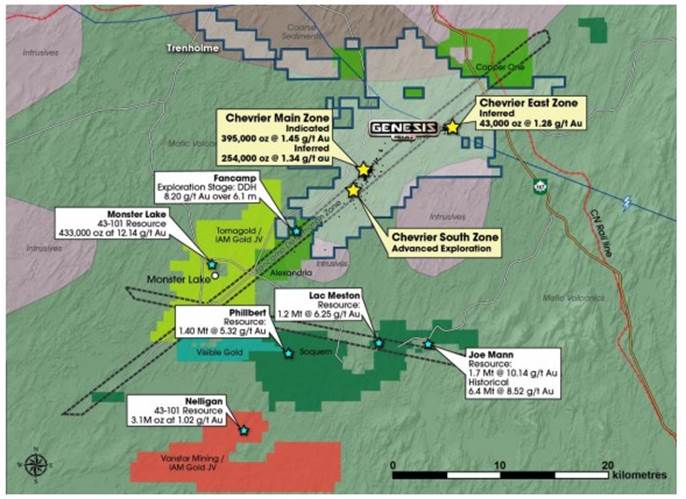
  • Regional gold endowment—there are six gold deposits within 20 km, including the high-grade Monster Lake deposit (433,000 oz at 12.1 g/t gold) and the large, low-grade Nelligan deposit (3.1 Moz at 1.02 g/t gold)
  • Insufficient focus on grade—the existing resource averages 1 g/t but includes multiple high-grade hits. Orogenic gold deposits always have raking shoots of high-grade gold; those have not been identified let alone targeted yet at Chevrier
  • Prime location—Chevrier has a highway, power line and rail line running through it. It’s right beside the mining town of Chibougamau

Most recently, Genesis found a new president and CEO in David Terry. Terry is a PhD geologist with a laudable track record. As Terry put it to me, “I saw Genesis as a company that was trading like a shell but that has a good gold resource with a great address and really strong exploration potential with multiple untested targets.”

Now, with a strong team of people and a plan of attack for Chevrier, Genesis is relaunching. They are rolling back the share structure 5 for 1 and raising $3.5 million by selling units for $0.225. Each unit comprises a share and half a warrant; full warrants are exercisable at $0.35 for two years.

There are no guarantees in exploration. Work to date plus the Vector team’s re-interpretation have revealed some intriguing potential at Chevrier, starting with growing the known zones and boosting the grades and continuing with testing a host of new targets. Evidence and regional endowment suggest good odds of success.

One important consideration, though, is that Genesis is now a Discovery Group company with a very strong set of people on its board and management, a tight share structure, and access to capital (this raise is oversubscribed). That means the vehicle will find a new route if Chevrier doesn’t work. The Discovery Group office is among the first door that prospectors and juniors with good projects for sale knock on, which means they see all kinds of interesting assets and opportunities.

At this point investing in GIS is a bet on a relaunched explorer with capital, a tight structure, and a project in a prime jurisdiction with a host of new, drill-ready targets. Since exploration is an adventure (for better or worse), I appreciate that GIS also has backing from the Discovery Group, which gives me confidence the company would come up with another good opportunity if Chevrier doesn’t work out.

The Chevrier Project

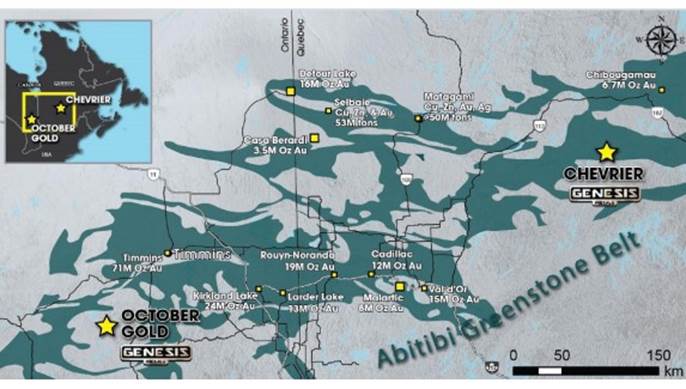
The Abitibi is an incredible gold camp. It has produced 170 million ounces already, from an outlined endowment of 270 million ounces. After working projects around the world Terry is happy to be in the Abitibi where, he jokes, “If you were to drill a hole at any gas station here, you’d have a better chance of making a gold discovery than at most exploration projects in the world.”

GIS 1.jpg

Chevrier is at the east end of the Abitibi, near the town of Chibougamau. There are five gold deposits within 20 km of the project. The closest are Monster Lake, a high-grade deposit 15 km southwest 3 along strike from Chevrier Main, and Nelligan, a large low-grade deposit 10 km south of Monster Lake.

GIS 2.jpg

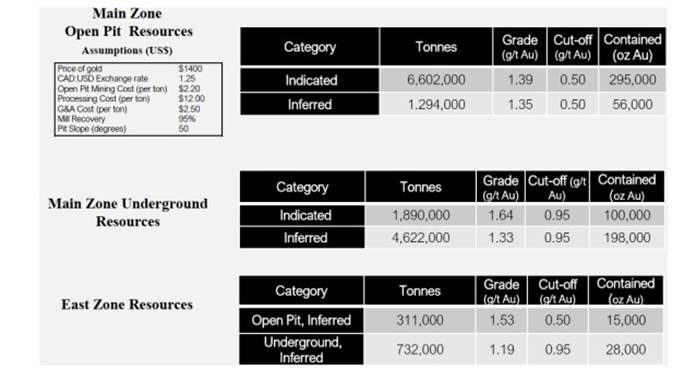
Chevrier itself hosts two defined deposits, at the Main and East zones. The two zones and their indicated and inferred counts add up to about 600,000 oz. The defined ounces are a start, though the known deposits are nothing that the market will care about in their current state. The count is too small and half of the Main zone ounces are an underground resource averaging only about 1.5 g/t gold.

GIS 3.jpg

Carpenter and his geo partners Alan Wainwright and Daniel MacNeil wouldn’t have been interested in those numbers. But technical teams don’t just believe other people’s data compilations—they start with the raw data and drawn their own conclusions. “One of the first things we look at is the distribution of gold and grade across the property,” MacNeil told me in a call. “If we see a range of grades and gold occurring across multiple rock types, we have confidence there is a good overall endowment. At Chevrier, we have gold just all over the place.”

“And the existing deposits add to that by showing at least two places with a critical mass of mineralization that’s continuous enough to define a resource. That adds to the endowment argument.” Talking about endowment, though, is like talking about potential: it’s good but the market isn’t going to care unless it generates exciting numbers.

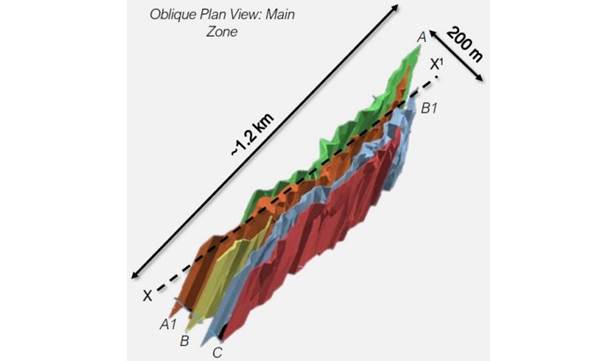
Genesis’ two-phase drill program in 2017 shows that opportunity exists too. The first phase of drilling returned results in line with the resource grades. The second phase returned much higher grades, including 8.7 g/t gold over 21 meters, 5.06 g/t gold over 8.5 meters, and 4.5 g/t gold over 12.5 meters. Higher-grade hits like that are scattered through the resource model, which for the Main zone comprises four steeply dipping lenses.

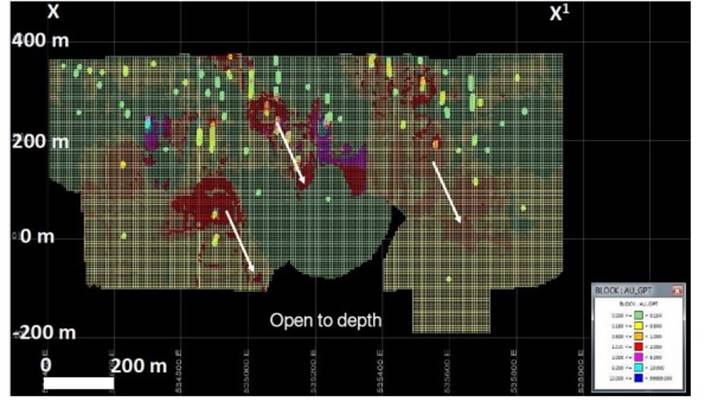
GIS 4.jpg

Looking at a long section from X to X’, we start to see two things:

  • The raking shoots of higher-grade gold (marked by the white arrows) have not been delineated
  • The deposit is very thinly drilled, especially below 150 meters

Orogenic gold deposits like Chevrier always have shoots of high-grade mineralization. Understanding the controls on and extents of those shoots is often key to unlocking the value in these deposits. And that work has not been done at all at Chevrier.

GIS 5.jpg

So this is the first plank of the new exploration plan at Chevrier: to figure out and follow the high grade within the known zones. Success would boost the grade and grow the count. By how much? Time, also known as exploration success, will tell.

The second plank considers the rest of the property. It’s a big land position and lack of funds in the past means it hadn’t been systematically reviewed. Team Carpenter started with magnetics data to track prospective corridors. They then completed a till sampling program in the summer. Till sampling here meant using track-mounted excavators to take soil samples that were analyzed for gold grains. Gold grains give information in two ways—more grains are better, to start, but the shape of gold grains also gives information about how far they have traveled. Rounded grains have moved a fair distance, rolled and rubbed in soils being pulled along by glaciers, while gold grains with irregular shapes are close to their hard rock origins.

Genesis has not actually released the results of the till sampling work. They say the work outlined multiple targets, many of which are stronger than those around the known deposits. That’s certainly good and immediately raises the question of whether the best is yet to come. The hesitation around announcing the results is that several of the best targets are near the property boundary. As such Genesis is working to expand its land position, and wants to do so before others know what its till sampling program revealed. “It’s always good when invested money makes a project better, especially when the money tested new areas and ideas” is how Terry summarized the situation.

The Plan

The Carpenter-MacNeil-Wainwright team has taken the entire geologic model back to data. That work has outlined targets for immediate drilling to expand the known deposits and target those high-grade shoots. That work will get underway immediately; drill pads are already being built. The till anomalies are not ready to be drilled. As soon as the snow melts the team will shrink the anomalies to drill target size via prospecting, mapping, and trenching. Those targets should be ready for drilling later in the summer.

With the $3.5 million in this raise Genesis should be able to complete up to 10,000 meters of drilling. Also: the share structure will be rolled back on Monday 5-for-1. Pro-forma (assuming the financing closes full) the company will have roughly 40 million shares outstanding. At $0.225 that means a market capitalization of $9 million, with $3.5 million in the bank.

GIS 6.jpg

THE RESOURCE MAVEN EDITORIAL POLICY AND COPYRIGHT: Companies are selected based solely on merit; fees are not paid. This document is protected by copyright laws and may not be reproduced in any form for other than personal use without prior written consent from the publisher.

DISCLAIMER: The information in this publication is not intended to be, nor shall constitute, an offer to sell or solicit any offer to buy any security. The information presented on this website is subject to change without notice, and neither Resource Maven (Maven) nor its affiliates assume any responsibility to update this information. Maven is not registered as a securities broker-dealer or an investment adviser in any jurisdiction. Additionally, it is not intended to be a complete description of the securities, markets, or developments referred to in the material. Maven cannot and does not assess, verify or guarantee the adequacy, accuracy or completeness of any information, the suitability or profitability of any particular investment, or the potential value of any investment or informational source. Additionally, Maven in no way warrants the solvency, financial condition, or investment advisability of any of the securities mentioned. Furthermore, Maven accepts no liability whatsoever for any direct or consequential loss arising from any use of our product, website, or other content. The reader bears responsibility for his/her own investment research and decisions and should seek the advice of a qualified investment advisor and investigate and fully understand any and all risks before investing. Information and statistical data contained in this website were obtained or derived from sources believed to be reliable. However, Maven does not represent that any such information, opinion or statistical data is accurate or complete and should not be relied upon as such. This publication may provide addresses of, or contain hyperlinks to, Internet websites. Maven has not reviewed the Internet website of any third party and takes no responsibility for the contents thereof. Each such address or hyperlink is provided solely for the convenience and information of this website’s users, and the content of linked third-party websites is not in any way incorporated into this website. Those who choose to access such third-party websites or follow such hyperlinks do so at their own risk. The publisher, owner, writer or their affiliates may own securities of or may have participated in the financings of some or all of the companies mentioned in this publication.

This concludes the guest post by Gwen Preston about Genesis Metals.

With almost a decade of junior resource-focused journalism under her belt, Gwen Preston launched Resource Maven. Preston watches the wires, talks to her network and analyzes economics to identify resource news that matters and figure out how to profit. She focuses on early-stage exploration and development stories. Preston has been interviewed on CBC and in Financial Post.

I hope you will find this article interesting and useful, and will have further interest in upcoming articles on mining. To never miss a thing, please subscribe to The Critical Investor’s free newsletter, http://www.criticalinvestor.eu, in order to get an email notice of my new articles soon after they are published.

The Critical Investor is a newsletter and comprehensive junior mining platform, providing analysis, blog and newsfeed and all sorts of information about junior mining. The editor is an avid and critical junior mining stock investor from The Netherlands, with an MSc background in construction/project management. Number cruncher at project economics, looking for high quality companies, mostly growth/turnaround/catalyst-driven to avoid too much dependence/influence of long-term commodity pricing/market sentiments, and often looking for long-term deep value. Getting burned in the past himself at junior mining investments by following overly positive sources that more often than not avoided to mention (hidden) risks or critical flaws, The Critical Investor learned his lesson well, and goes a few steps further ever since, providing a fresh, more in-depth, and critical vision on things, hence the name.

Sign up for our FREE newsletter at: www.streetwisereports.com/get-news

The Critical Investor is not a registered investment advisor, currently has no position in this stock, and Genesis Metals is a syndication sponsoring company. The Critical Investor is compensated for the syndication of this article by Genesis Metals. All facts are to be checked by the reader. For more information go to www.genesismetalscorp.com and read the company’s profile and official documents on www.sedar.com, also for important risk disclosures. This article is provided for information purposes only, and is not intended to be investment advice of any kind, and all readers are encouraged to do their own due diligence, and talk to their own licensed investment advisors prior to making any investment decisions.

Streetwise Reports Disclosure:
1) The Resource Maven and The Critical Investor’s disclosures are listed above.
2) The following companies mentioned in the article are sponsors of Streetwise Reports: Great Bear Resources. Click here for important disclosures about sponsor fees. The information provided above is for informational purposes only and is not a recommendation to buy or sell any security.
3) Statements and opinions expressed are the opinions of the author and not of Streetwise Reports or its officers. The author is wholly responsible for the validity of the statements. The author was not paid by Streetwise Reports for this article. Streetwise Reports was not paid by the author to publish or syndicate this article. Streetwise Reports requires contributing authors to disclose any shareholdings in, or economic relationships with, companies that they write about. Streetwise Reports relies upon the authors to accurately provide this information and Streetwise Reports has no means of verifying its accuracy.

4) The article does not constitute investment advice. Each reader is encouraged to consult with his or her individual financial professional and any action a reader takes as a result of information presented here is his or her own responsibility. By opening this page, each reader accepts and agrees to Streetwise Reports’ terms of use and full legal disclaimer. This article is not a solicitation for investment. Streetwise Reports does not render general or specific investment advice and the information on Streetwise Reports should not be considered a recommendation to buy or sell any security. Streetwise Reports does not endorse or recommend the business, products, services or securities of any company mentioned on Streetwise Reports.
5) From time to time, Streetwise Reports LLC and its directors, officers, employees or members of their families, as well as persons interviewed for articles and interviews on the site, may have a long or short position in securities mentioned. Directors, officers, employees or members of their immediate families are prohibited from making purchases and/or sales of those securities in the open market or otherwise from the time of the interview or the decision to write an article until three business days after the publication of the interview or article. The foregoing prohibition does not apply to articles that in substance only restate previously published company releases. As of the date of this article, officers and/or employees of Streetwise Reports LLC (including members of their household) own securities of Newmont Goldcorp, a company mentioned in this article.

Graphics provided by the author.

( Companies Mentioned: GIS:TSX.V; GGISF:OTC,
)

Categories
Gold

Credit Game Over – Debt Cannot Be Paid – Buy Gold

“once the credit markets break, distribution will not happen and then it is credit game over.” Bill Holter interviewed by Greg Hunter on USA Watchdog Holter predicts, “I think in […]

The post Credit Game Over – Debt Cannot Be Paid – Buy Gold appeared first on Silver Doctors.

Categories
Gold

Coronavirus Czar And Minister Of Propaganda Mike Pence Says 15,000 Test Kits “Have Been Released”

He went out of his way to repeat “15,000 kits”, but we don’t really know since the government says it will lie and deceive us during this pandemic… (Silver Doctors Editors) Mike […]

The post Coronavirus Czar And Minister Of Propaganda Mike Pence Says 15,000 Test Kits “Have Been Released” appeared first on Silver Doctors.

Categories
Gold

Gold Seasonality: The Slump Into Mid-March And Gold’s Spring Rally

Unfortunately this year’s potential spring rally is more clouded than usual… by Adam Hamilton of Zeal LLC Before their recent surge on gold regaining $1600, the gold stocks spent much of […]

The post Gold Seasonality: The Slump Into Mid-March And Gold’s Spring Rally appeared first on Silver Doctors.

Categories
Gold

Orange County Declares State Of Emergency, Los Angeles FLIGHT ATTENDANT TESTS POSITIVE For Covid-19

International flights typically carry 300+ passengers on each flight. Mike Adams explains… by Mike Adams of Natural News (Natural News) Following San Francisco’s state of emergency declaration yesterday, now Orange […]

The post Orange County Declares State Of Emergency, Los Angeles FLIGHT ATTENDANT TESTS POSITIVE For Covid-19 appeared first on Silver Doctors.