Categories
Uncategorized

Brent Cook: Investors Should Get Boots on the Ground

Source: Maurice Jackson for Streetwise Reports   01/08/2020

In this interview with Maurice Jackson of Proven and Probable, Exploration Insights’ Brent Cook discusses the value of site visits to determining the potential of a prospect, and offers insights into various metals markets.

Maurice Jackson: Joining us for conversation is Brent Cook. He’s the founder of the highly regarded Exploration Insights. Mr. Cook, you’re one of the most trusted, highly regarded names in the natural resource space, so it’s a real pleasure to be speaking with you today sir.

Today we will address the positives and negatives for the mining sector in 2020. Sir, from a macro perspective, please share with us what is your view on the current state of the mining sector?

Brent Cook: For my colleague Joe Mazumdar and me, the overriding issue that the mining sector faces is they’re just not finding enough economic metal deposits to replace what’s been mined. To put that into terms that might make sense, we are producing on a global scale, 90 million ounces a year, which is about what’s come out of the Carlin Trend in Nevada since 1980. We’re not finding 90 million ounces a year. Ditto for copper. We’re burning through one Bingham Canyon deposit just outside of Salt Lake a year. We’re not putting in production one of those a year. So that’s the real issue they face. It’s real positive for those of us in the exploration sector.

Maurice Jackson: Speaking of positives, are there any catalysts that you see that will enhance the value propositions of companies in 2020?

Brent Cook: Well, certainly metal prices. We expect gold to do well, platinum, palladium, nickel—but the lack of production we really see as the catalyst for the metal prices.

Maurice Jackson: And where do you see the best value propositions in 2020? Is it the precious metals or is it the base metals?

Brent Cook: We’re going with precious metals for a lot of reasons, from a shortage of deposits, to global geopolitical risks that keep increasing with every threat, to global debt. There’s just so much going on that I think gold is going to act as a safe haven more and more.

Maurice Jackson: And regarding base metals, which base metals have your attention and why?

Brent Cook: Copper for the future is certainly something that’s going to be in deficit—the demand for copper with the increase with electric vehicles, electrification, green energy, etc. So copper, further down the road. Right now, probably the one base metal we’re most interested in is nickel. Fortunately or unfortunately, there’re not many decent nickel plays out there, so nickel is a good one. Palladium, I think, is also going to do well again this year. So those are the base metals we’re sticking with. Zinc, lithium, lead; sort of so-so on those.

Maurice Jackson: I’d be remiss if I didn’t ask you about uranium.

Brent Cook: Not keen on the uranium price, per se. I started off the business in the uranium industry, working in the Colorado Plateau, and I’ve done work in Australia and Africa as well. There is no shortage of uranium out there. It’s just waiting on an increase in the price. So I don’t see uranium as a good investment.

Although, having said that, we recently purchased Energy Fuels (NYSE: UUUU), just based on the potential for the U.S. to start stockpiling uranium bought from U.S. uranium producers, which requires about a $50–60 a pound price for them to even break even or make money. So there’s that play, but that’s not really a play on uranium. It’s more a play on a political event.

Maurice Jackson: Speaking of that political event—Section 232? Do you think it will pass?

Brent Cook: I honestly, give it a 50/50 chance. I think it’s a dumb idea. There’s no shortage of uranium in the world, and it doesn’t make sense for the U.S. government to subsidize industries like that. Having said that, anything could happen.

Maurice Jackson: Moving on to physical precious metals: You alluded to gold earlier, and palladium. What are your thoughts on platinum, and silver, and rhodium?

Brent Cook: Platinum is not used as much as palladium, so I don’t think it’s got that much of an upside to it. Rhodium is such a small market, we don’t even consider it. I think the price is great, but there’s no rhodium deposits. It all comes with the platinum group metal mining anyway. I mean, there’s no way to play, in my mind, rhodium.

Maurice Jackson: And if you don’t mind me asking, because readers like to follow your work. . .what are you buying at the moment, as far as physical precious metals? Or are you buying anything at all?

Brent Cook: I’ve got some physical gold—coins, basically, I store in a safe deposit box in two countries, just in case. And I don’t own a lot of precious metals, personally.

Maurice Jackson: Moving onto Exploration Insights. Sir, you run one of the most successful newsletters in the space. For someone not familiar with your work, please introduce us to Exploration Insights.

Brent Cook: Love to. I bought Exploration Insights from Paul Van Eaton back in early 2009, as everything was collapsing, and I switched over. His was more of a macro picture sort of thing. And I did the geology forum, so I rebranded it Exploration Insights. The letter’s basically about what. . .I was buying and selling and seeing in the metals exploration market.

Recently, I brought on Joe Mazumdar, who is an extremely smart economic geologist who worked and studied in Australia, Argentina—basically all over the world, including Canada and the U.S. It’s now his letter, and so he writes almost all of the letter. He and I communicate back and forth. I’m sort of a senior advisor there. The letter is about what he is buying, selling and seeing in the exploration industry.

We make no money from companies. Everything we make is based on subscriptions and how we do in terms of our purchases. And it’s pretty technical. That’s a positive and a negative, because sometimes we get pretty far in the weeds explaining what exactly is happening in terms of the geology, the metallurgy, the geopolitics, all that sort of thing. We get pretty heavy into the weeds, but it’s our money, so we don’t want to make any mistakes, or as few as possible.

Maurice Jackson: Prior to this interview, you shared with me that if you’re going to be in the space, the importance of attending site visits, specifically on early-stage exploration and development projects. Please share why access to site visits are paramount for speculators in the natural resource space.

Brent Cook: You go to the shows or you sit down with a company’s investor relations person, and you go through the, “It all looks great. Here’s the geology. This looks just like this deposit over here, which is a $1 billion company. We’ve got this project that looks the same, it just hasn’t been drilled. We’re going to drill it and we’re going to find a billion-dollar deposit,” or something like that. But the reality is only maybe 1 in 10,000 prospects turns into an economic mine.

It’s important to realize that an economic deposit is a unique geological event, and to go there and see it with knowledgeable eyes. I’ve been doing this for almost 35, 40 years, and Joe has been doing it for 30, all over the world. To go and look at these projects with your eyes and experience that you’ve gotten from previous work you’ve done, you see things that you might not see in those flip books.

For instance, I remember one project in Mexico—great trench, I think it was like, 40 meters of six grams. Looked fantastic on paper. You get there and the things sits in the bottom of a canyon, and there’s no way it’ll ever be a mine.

I can think of a lot of examples like that, where you get there and go, “Wait a minute, this isn’t going to work.” We were in Colombia, another project; sounded really good. Got there, and there was this beautiful, little, white church sitting on top of the hill that they want to mine. Well, that isn’t going to happen.

On site visits you are able to see things like that. I’ll give you one more. I was in Peru—again, a high-sulphidation epithermal discovery. The theory was that a later, volcanic rock had covered up the deposit, and all what we were seeing was a small window into what was below. Sounded great. Went and looked at it—actually, what happened was that they had misinterpreted, and the small window was in fact a small crack, and the rest of the rock was the same rock that hadn’t been altered. It’s about just those things you see on the ground that you don’t necessarily get on the website or out of the flipbook.

Maurice Jackson: On average, how many site visits do you attend?

Brent Cook: I think last year Joe and I visited 33 projects. So quite a few. We’re trying to slow down, but you know how it goes.

Maurice Jackson: So if I, as a speculator, don’t have access to site visits, I can gain access through Exploration Insights?

Brent Cook: Most definitely. I mean, again, I think if mining and exploration is not your expertise, it really is critical, especially in the early-stage exploration stuff, to have someone that you trust and can give you insights into the companies. Now, this could be a broker that you trust, or a relative who’s in the industry, that sort of thing—or a newsletter. I personally think ours is one of the best in terms of technical detail and that—I mean, you’ve got two economic geologists writing it. So I really think it’s a big help to have expert advice if this isn’t your area of expertise.

But the rewards are huge. I mean, as you know, you can take a $0.20 stock to two bucks within a couple of weeks with a discovery, or vice versa. You can take a $2 stock to $0.20 if something goes wrong. And that’s the key. We spend a lot of time looking for that fatal flaw ahead of the market.

Maurice Jackson: And you have a proven pedigree of success. In closing, sir, what keeps you up at night that we don’t know about?

Brent Cook: Someone’s tweets (laughter).

Maurice Jackson: Someone, huh? No particular name there (laughter).

Brent Cook: It’s pretty crazy out there. And I guess in terms of the mineral industry and mining, that is it. I mean, one geopolitical event can just trash the market—the larger markets or the smaller markets—or make them go up. I mean, just this week we’ve seen gold jump $50–60 bucks? And who would’ve thought that was going to happen last week?

So it’s those sorts of things. . .It’s the unforeseeables, the black swans that hit you that you really can’t know. And I think the best way to avoid that—what we try and do—is if we’re into a project or a company that has a legitimate play, a legitimate deposit that we think will make money, at least we’ve got some founding, some basis for owning it, as opposed to just betting on the metal price or betting on what’s the greater fool theory. We prefer to sell to someone smarter than us than someone dumber than us. I guess that’s our game plan, which means we try and get into projects that a major mining company will buy.

Maurice Jackson: Last question, sir. What did I forget to ask?

Brent Cook: You’ve covered everything pretty well. . .our website is explorationinsights.com.

One more thing, Maurice. Joe just finished our year-in New Year review, and he’s putting together an article, I guess, if you will, that would be free to any of the readers. Just go to our website, www.explorationinsights.com, and contact us and we’ll send that along for free.

Maurice Jackson: Before you make your next bullion purchase, make sure you call me. I’m a licensed representative for Miles Franklin Precious Metals Investments, where we provide a number of options to expand your precious metals portfolio, from physical delivery, offshore depositories, precious metal IRAs, and private blockchain-distributed ledger technology. Call me directly at (855) 505-1900, or you may e-mail maurice@milesfranklin.com. Last but not least, please subscribe to www.provenandprobable.com for mining insights and bullion sales.

Brent Cook of Exploration Insights, thank you for joining us today on Proven and Probable.

Maurice Jackson is the founder of Proven and Probable, a site that aims to enrich its subscribers through education in precious metals and junior mining companies that will enrich the world.

Sign up for our FREE newsletter at: www.streetwisereports.com/get-news

Disclosure:
1) Statements and opinions expressed are the opinions of Maurice Jackson and not of Streetwise Reports or its officers. Maurice Jackson is wholly responsible for the validity of the statements. Streetwise Reports was not involved in the content preparation. Maurice Jackson was not paid by Streetwise Reports LLC for this article. Streetwise Reports was not paid by the author to publish or syndicate this article.
2) This article does not constitute investment advice. Each reader is encouraged to consult with his or her individual financial professional and any action a reader takes as a result of information presented here is his or her own responsibility. By opening this page, each reader accepts and agrees to Streetwise Reports’ terms of use and full legal disclaimer. This article is not a solicitation for investment. Streetwise Reports does not render general or specific investment advice and the information on Streetwise Reports should not be considered a recommendation to buy or sell any security. Streetwise Reports does not endorse or recommend the business, products, services or securities of any company mentioned on Streetwise Reports.
3) From time to time, Streetwise Reports LLC and its directors, officers, employees or members of their families, as well as persons interviewed for articles and interviews on the site, may have a long or short position in securities mentioned. Directors, officers, employees or members of their immediate families are prohibited from making purchases and/or sales of those securities in the open market or otherwise from the time of the interview or the decision to write an article until three business days after the publication of the interview or article. The foregoing prohibition does not apply to articles that in substance only restate previously published company releases.

Proven and Probable LLC receives financial compensation from its sponsors. The compensation is used is to fund both sponsor-specific activities and general report activities, website, and general and administrative costs. Sponsor-specific activities may include aggregating content and publishing that content on the Proven and Probable website, creating and maintaining company landing pages, interviewing key management, posting a banner/billboard, and/or issuing press releases. The fees also cover the costs for Proven and Probable to publish sector-specific information on our site, and also to create content by interviewing experts in the sector. Monthly sponsorship fees range from $1,000 to $4,000 per month. Proven and Probable LLC does accept stock for payment of sponsorship fees. Sponsor pages may be considered advertising for the purposes of 18 U.S.C. 1734.

The Information presented in Proven and Probable is provided for educational and informational purposes only, without any express or implied warranty of any kind, including warranties of accuracy, completeness, or fitness for any particular purpose. The Information contained in or provided from or through this forum is not intended to be and does not constitute financial advice, investment advice, trading advice or any other advice. The Information on this forum and provided from or through this forum is general in nature and is not specific to you the User or anyone else. You should not make any decision, financial, investments, trading or otherwise, based on any of the information presented on this forum without undertaking independent due diligence and consultation with a professional broker or competent financial advisor. You understand that you are using any and all Information available on or through this forum at your own risk.

Categories
Uncategorized

Scottie Resources, a Golden Triangle Gold Junior, Reports Blockbuster Drill Results

Source: Peter Epstein for Streetwise Reports   01/07/2020

Peter Epstein of Epstein Research profiles this explorer and explains why he believes it could be a take-out target.

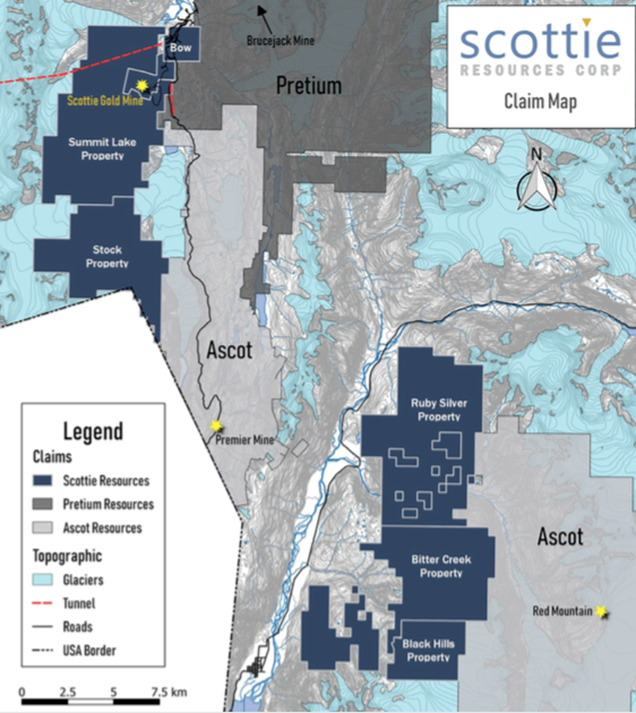
Strong drill results have confirmed and expanded the Bend Vein target on Scottie Resources Corp.’s (SCOT:TSX.V) 100%-controlled Bow property. During September, the company completed 878 meters of diamond drilling, 2 km NE of the 100%-owned past-producing Scottie Gold Mine located in the Golden Triangle (GT) of northwest British Columbia, Canada.

Readers are reminded that Scottie Resources owns or controls 18,500 hectares, all in the GT, across seven properties, contained in two groups of contiguous parcels. Some properties border Ascot Resources (between Ascot’s Premier Mine and Red Mountain projects), others border Pretium Resources’ property south of the world-class, high-grade, operating Brucejack mine. Pretium’s enterprise value (EV) is $3.3 billion.

Very high-grade gold at Bow, Scottie Gold & Summit Lake properties

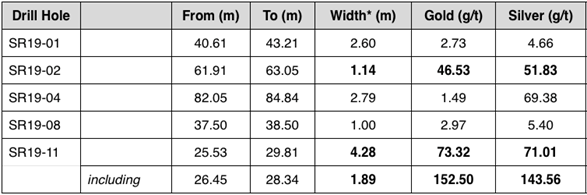
Drill hole SR19-11 hit an interval of 73.3 g/t gold (Au) and 71.0 g/t silver (Ag) (or 74+ g/t Au Eq) over 4.3 m, (true width 80%–90%). That blockbuster interval included 1.9 m of 152.5 g/t Au plus 143.6 g/t Ag, equal to 154+ g/t Au Eq. Additional drill results are expected as soon as this week. Importantly, all of the reported intervals to date are near-surface, between 25 and 85 meters in depth. The best intercept in this latest batch is between 25.5 and 30 meters.

According to Scottie’s CEO & president Bradley Rourke,

“These new assays confirm the superb results of previous studies and demonstrate a truly under-explored high-grade gold and silver target. Past drilling on the Bend Vein only probed to a vertical depth of ~55 m. Our drilling this season proves that the mineralized structure extends deeper. We substantially increased the strike length of known mineralization. Drilling in the 2020 season will allow us to further prove the scale of this structurally-controlled, high-grade vein deposit.”

Scottie’s technical team integrated historical and recent (2018–2019) exploration work into new structural models to better understand the geometry of mineralization. Prior to the company’s 2019 drill program, Bow’s Bend Vein had only 1,525 meters of drilling on it. No exploration-style drilling had been done to test along the Bend fault structure to assess the potential of a bigger system.

Management is thrilled that drilling in 2019 substantiated the very high grades contained in the historically known ore block, and extended the structure both at depth and along strike. The drill campaign (so far) has already shown gold mineralization expanding east an additional 375 meters. 2020 is off to a great start! Over the past year, management has achieved excellent bang for their exploration buck, with more results any day now.

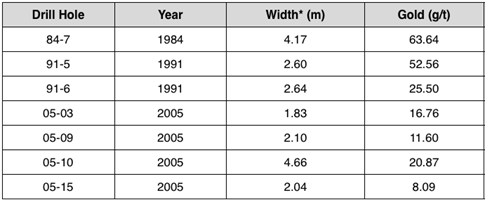
Previous drilling on the Bend Vein returned the following select high-grade assays:

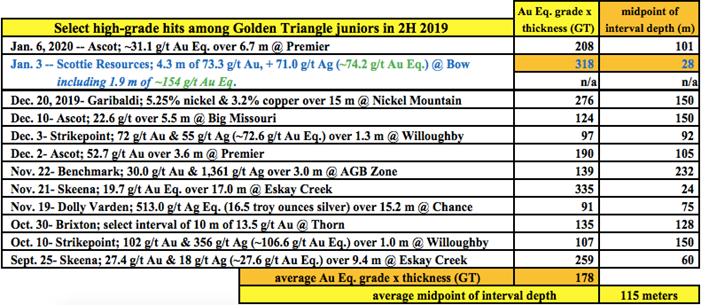
Notice that drill hole SR19-11, mentioned above, had a [grade x thickness] of 318. Compare that to these other [high-grade] intervals in the GT in 2019. Also, the midpoint of each interval’s depth is provided. Scottie’s blockbuster interval was found at 28 meters. The average depth of peer intervals is 115 meters.

Surface grab samples at Summit Lake look very promising….

CEO Rourke and VP exploration Thomas Mumford, PhD, are ecstatic over the latest drill results, and also recent surface samples from the much larger Summit Lake property.

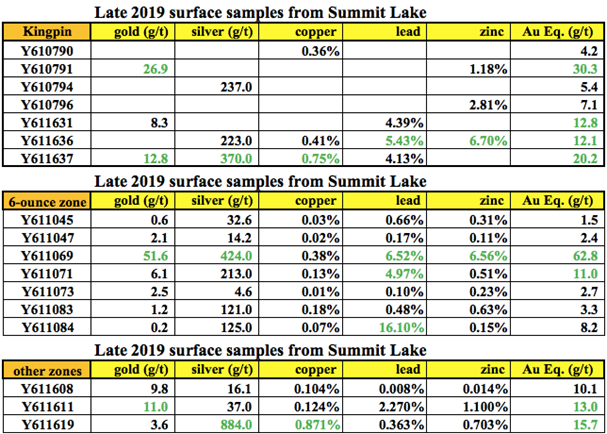
The above surface (grab) samples were reported three weeks ago. The best eight (in green) range from 11.0 to 62.8 g/t Au Eq, and average 22.2 g/t Au Eq. There are high-grade showings of copper, lead, zinc and silver, (884 g/t = 28.4 troy oz./t Ag). Summit Lake, Bow and the past-producing Scottie Gold mine total 5,672 hectares. As can be seen in the map above, the top half of this three-property contiguous block borders Pretium.

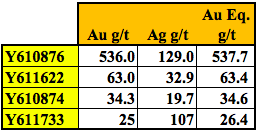
These impressive Summit Lake samples were reported about a month after even more exciting samples were announced on November 14th. The best four samples are listed below. They come from the newly discovered Domino zone on the 100%-owned Scottie Gold mine property.

Referring to the Domino zone, VP of Exploration Dr. Thomas Mumford commented,

“These initial sample results are exciting, their distribution and high-grade nature fit spectacularly well with our working geological model. This mineralized structure will be a high-priority drill target for the 2020 field season. The potential that it may connect to the Scottie Gold Mine mineralizing system make this an exceptional discovery. Sampling of many of these sites was only possible due to significant glacial retreat in recent years. We are eager to get back on the ground to find and delineate additional drill targets.”

Scottie Gold mine property hosts past-producing mine

We already know for certain that the Scottie Gold mine property hosts high-grade mineralization, from 1981-1985 it produced over 95,000 ounces of gold at a tremendous average grade of 16.2 g/t. That’s a much higher grade than Pretium’s world famous Brucejack mine is currently producing at ~9 g/t.

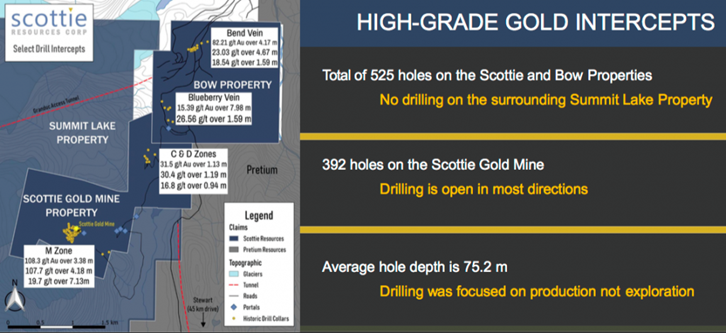
In addition to high-grade production records, there are some outstanding historical drill results at the Scottie Gold mine project as well. How about 108.3 g/t Au over 3.4 meters, or 107.7 g/t Au over 4.2 meters? Not bad at all! All known mineralization on Bow and Scottie Gold, from a total of 525 drill holes, is found at shallow depths. I find it encouraging that these blockbuster grades were found across 3.4 and 4.2 meters, not merely half-meter, one-hit wonders.

Mining M&A in N. America & the gold price making big moves!

Three big gold deals were announced in 4Q 2019 alone, including Kirkland Lake’s plans to acquire Detour Gold. If Detour is taken out, Pretium would be one of the last single-asset gold companies in Canada. Brucejack, situated less than 50 km from Scottie, is one of North America’s lowest-cost, highest-margin producers.

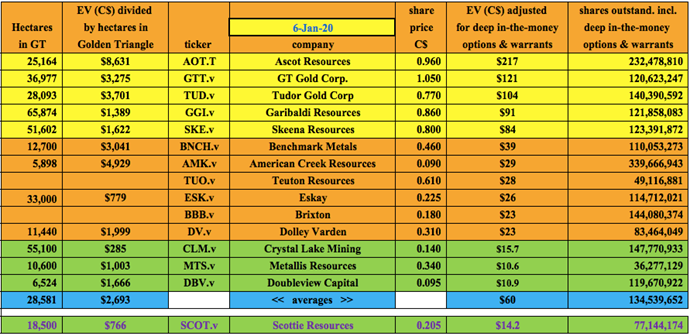
Pretium is 234x the size of Scottie Resources. If it’s not acquired, it might try to acquire one or more GT juniors like Ascot, GT Gold, Skeena Resources, Tudor Gold or Garibaldi Resources. As an aside, Seabridge Gold is also a potential acquirer. Those companies, with EVs ranging from $84 to $217 million, could in turn look to buy a company like Scottie Resources, with an EV of $14 million.

I don’t mean to overplay a takeout thesis, but, the gold price is now at US$ 1,576/oz, up ~US$ 112/oz since U.S. impeachment proceedings and Iran / North Korea troubles commenced, and up ~US$ 300/oz from the low of 2019. Gold in $USD is the highest it’s been in 80 months. Furthermore, 2019 was reportedly the biggest year for gold mining M&A in North America since 2010.

Neighboring Pretium and Ascot valuations bullish for Scottie

Looking at the map, it’s clear why Pretium might want to acquire Scottie Resources. Or, at least move to control the three properties where Pretium and Scottie share a border. Scottie’s valuation is so low relative to Pretium’s that it might be cheaper to pursue Scottie’s properties than to drill virgin areas on Pretium’s existing footprint.

Perhaps more likely—look at the map again—Ascot certainly has a compelling reason to care about Scottie, and the company’s digestible EV of $14 million is right in Ascot’s sweet spot. Ascot has multiple projects and properties, but only one with evidence of very high-grade mineralization like that of Scottie’s Bow (new drill results), Scottie Gold mine (past production + historical drill results + new surface samples) and Summit Lake (new grab samples).

Ascot’s EV of $210 million is 15x that of Scottie, and its share price is up 85% in the past two months alone, resulting in Ascot trading at $8,631/ha vs. $766/ha for Scottie. While Ascot’s Red Mountain and Premier projects have substantially more drill holes on them, both have lower gold grades, and high-grade mineralization starting roughly 100 meters deeper than that of Scottie’s near-surface deposits.

Tudor & GT Gold have giant intercepts of sub 1.0 to 1.5 g/t Au Eq as thick as one kilometer or more. Grade x thickness readings for these assays are quite good, but drilling and mining through 1,000+ meters of rock can be costly and time consuming, especially if the projects are far from critical infrastructure.

Garibaldi’s assets in Canada are base metal (especially nickel + copper) heavy. Diversification into high-grade gold and silver could be an attractive option. With an EV of $96 million, it too could comfortably afford to make a run at Scottie. After 2020’s drill results (I believe Scottie is thinking about 5,000 meters of drilling, subject to adequate funding), the company will be well more advanced.

Soon after 2020 drill results, one or more resource estimates likely

Within 12–18 months, management should be able to deliver a robust NI 43-101 compliant resource estimate from one or both of the Scottie Gold and Bow properties. In 2H 2021, shareholders might receive a third-party Preliminary Economic Assessments (PEA). In my opinion, Scottie could secure a JV or farm-in partner as soon as next year, upon which time funding requirements would drop dramatically.

Located at the southern end of the GT, Scottie’s properties are an easy drive of about an hour, on paved roads, from Stewart, BC. For the most part, infrastructure in the southern portion of the GT is significantly better than the middle and northern regions.

Conclusion

With gold prices and M&A activity up substantially, all eyes are on the Golden Triangle. However, not all of the GT juniors have had recent drilling success. Not all are focused on shallow, high-to-ultra-high-grade gold deposits. Not all have good infrastructure. Not all own or control 100% of sizable land packages. Not all have enterprise values of $14 million or less.

Scottie Resources (TSX-V: SCOT) is blessed with many positive attributes and has successfully advanced its flagship properties very nicely in 2018–19 with limited capital expenditures. There have been three major initiatives over the past several months, and three fantastic outcomes.

1] great new drill results on January 3rd at Bow, 2] excellent surface samples on the Scottie Gold mine property and 3] great grab samples at Summit Lake. This is a company to watch closely in 2020. In fact, watch closely the rest of January, as further drill results are imminent.

Peter Epstein is the founder of Epstein Research. His background is in company and financial analysis. He holds an MBA degree in financial analysis from New York University’s Stern School of Business.

Sign up for our FREE newsletter at: www.streetwisereports.com/get-news

Disclosures: The content of this article is for information only. Readers fully understand and agree that nothing contained herein, written by Peter Epstein of Epstein Research [ER], (together, [ER]) about Scottie Resources, including but not limited to, commentary, opinions, views, assumptions, reported facts, calculations, etc. is not to be considered implicit or explicit investment advice. Nothing contained herein is a recommendation or solicitation to buy or sell any security. [ER] is not responsible under any circumstances for investment actions taken by the reader. [ER] has never been, and is not currently, a registered or licensed financial advisor or broker/dealer, investment advisor, stockbroker, trader, money manager, compliance or legal officer, and does not perform market making activities. [ER] is not directly employed by any company, group, organization, party or person. The shares of Scottie Resources are highly speculative, not suitable for all investors. It is assumed and agreed upon by readers that they will consult with their own licensed or registered financial advisors before making any investment decisions.

At the time this article was posted, Peter Epstein owned shares of Scottie Resources and the Company was an advertiser on [ER].

Readers understand and agree that they must conduct their own due diligence above and beyond reading this article. While the author believes he’s diligent in screening out companies that, for any reasons, are unattractive investment opportunities, he cannot guarantee that his efforts will (or have been) successful. [ER] is not responsible for any perceived, or actual, errors including, but not limited to, commentary, opinions, views, assumptions, reported facts, financial calculations, etc., or for the completeness of this interview or future content. [ER] is not expected or required to subsequently follow or cover events & news, or write about any particular company. [ER] is not an expert in any company, industry sector or investment topic.

Streetwise Reports Disclosure:
1) Peter Epstein’s disclosures are listed above.
2) The following companies mentioned in the article are billboard sponsors of Streetwise Reports: Pretium Resources and Seabridge Gold. Click here for important disclosures about sponsor fees. The information provided above is for informational purposes only and is not a recommendation to buy or sell any security.
3) Statements and opinions expressed are the opinions of the author and not of Streetwise Reports or its officers. The author is wholly responsible for the validity of the statements. The author was not paid by Streetwise Reports for this article. Streetwise Reports was not paid by the author to publish or syndicate this article. Streetwise Reports requires contributing authors to disclose any shareholdings in, or economic relationships with, companies that they write about. Streetwise Reports relies upon the authors to accurately provide this information and Streetwise Reports has no means of verifying its accuracy.

4) The article does not constitute investment advice. Each reader is encouraged to consult with his or her individual financial professional and any action a reader takes as a result of information presented here is his or her own responsibility. By opening this page, each reader accepts and agrees to Streetwise Reports’ terms of use and full legal disclaimer. This article is not a solicitation for investment. Streetwise Reports does not render general or specific investment advice and the information on Streetwise Reports should not be considered a recommendation to buy or sell any security. Streetwise Reports does not endorse or recommend the business, products, services or securities of any company mentioned on Streetwise Reports.
5) From time to time, Streetwise Reports LLC and its directors, officers, employees or members of their families, as well as persons interviewed for articles and interviews on the site, may have a long or short position in securities mentioned. Directors, officers, employees or members of their immediate families are prohibited from making purchases and/or sales of those securities in the open market or otherwise from the time of the interview or the decision to write an article until three business days after the publication of the interview or article. The foregoing prohibition does not apply to articles that in substance only restate previously published company releases. As of the date of this article, officers and/or employees of Streetwise Reports LLC (including members of their household) own securities of Pretium Resources, a company mentioned in this article.

( Companies Mentioned: SCOT:TSX.V,
)

Categories
Uncategorized

Precious Metals Producers Make Progress, But Costs Are a Constant Struggle

Source: Adrian Day for Streetwise Reports   01/07/2020

Fund manager Adrian Day reviews recent developments with precious metals producers in his portfolio.

Newmont Goldcorp Corp. (NEM:NYSE, $42.83) is in our portfolio because Newmont acquired Goldcorp. Over the past eight months, it has been active with major sales, including 50% of Kalgoorlie in Australia—Barrick also sold the other 50% just a little before—and Red Lake (which came with Goldcorp), both sold to Australia companies. It has also sold its stake in Continental Gold. Together, the dispositions have raised $1.48 billion ($800 million from Kalgoorlie), reaching the upper end of its targeted sales.

However, we believe it is likely that Newmont will make several more smaller dispositions, mostly assets acquired in the Goldcorp purchase that don’t fit the company’s hurdle rate or profile.

These sales have dramatically improved the balance sheet, now with $4.4 billion of cash, net debt down to $2.8 billion. Newmont has also initiated a $1 billion share repurchase program.

Costs, though low, are increasing

In its recent “Outlook 2020 and Beyond,” Newmont guided for reduced production (largely because of the sale of producing assets), and with it a reduction in sustaining capital requirements. Costs are estimated to increase, however, though at cash costs of $750/ounce and “All-In Sustaining Costs” of $975, they remain low.

So, an improved balance sheet and low costs, as well as strong political-risk profile, are all positive for Newmont. The modest growth profile as well as the slow integration with Goldcorp (including alleged cost savings) offset that, at least in the near term. The valuation is high, given the lack of growth. But in a strong gold market, Newmont will be a beneficiary, both from index buying and retail investment as a well-known name. We are holding.

Turnaround underway at Yamana

Yamana Gold Inc. (YRI:TSX; AUY:NYSE; YAU:LSE, NY, $3.83) appears to be slowing turning around, though it has seemed that way before. The balance sheet has improved after last year’s sales, with a current $100 million in cash. Debt remains high, however, with debt-to-equity of 44% and a “quick ratio” of just 0.2x. It’s not a great balance sheet, but the company appears to be out of the danger zone.

There are also several opportunities for growth in the year ahead and beyond. Cerro Moro, the major deposit in Argentina, continues to expand, now with drilling on new zones. Jacobina and Malartic both have major expansions underway. And drilling at El Penon suggests that profitable mine can be expanded.

With its current valuations reasonable—price-to-cash flow of 8.5x and less than book (though price-to-free cash flow is less satisfactory 36x)—we are holding for now.

Fortuna’s new mine: Almost there

Fortuna Silver Mines Inc. (FSM:NYSE; FVI:TSX; FVI:BVL; F4S:FSE, NY, $4.03) reported improved production at its two existing mines, but costs continue to be high. However, the company is maintaining full-year guidance, though at the upper end of its cost range.

The major news, of course, is in Argentina, where its large Lindero gold mine is nearing completion. The company failed to meet its goal of putting ore on the pad in 2019, but that will occur any time now, with ore processing in mid-January. Under new regulations, mining companies have to convert their dollars to pesos and hold them a year before exporting dollars, and the potential for further declines in the peso could significantly affect earnings. Fortuna is looking at its options, though hedging is too expensive.

Fortuna has cash of $72 million. A successful start to operations will see the stock advance nicely, though it may take a couple of quarters for the market to be convinced. Developments in Argentina, outside the company’s control, could hurt (or help) the stock. It has already advanced from the below $3 in November to over $4 as the mine gets closer to completion. With that, the short interest in the stock fell, though it remains high, so a successful ramp-up and the stock rally could be leveraged. The stock remains undervalued against other silver stocks. We are holding for now, but ready to buy on any set back.

Osisko plans caught market offguard

Osisko Gold Royalties Ltd. (OR:TSX; OR:NYSE, NY, $9.64) is not a producer, of course, but we are including it in this report since it is exposed to production, development and exploration at its “incubator” companies more than pure royalty companies. It is a hybrid royalty, and trades deservedly at a lower valuation because of the higher risk. It was severely punished recently for going too far, and buying an entire exploration company, Barkerville, as we discussed recently. It also announced a new initiative, Northern Spirit, a “project development program…the next step in the evolution of our accelerator business.” The lack of details also hurt the stock. Osisko also had another black eye; following the bankruptcy of Stornaway, now Lydian, on whose project in Armenia it holds a stream, has sought protection from creditors. The impression, fair or not, is of a company a little too aggressive in spending its money. However, we think the stock is oversold; Osisko will not be building Barkerville’s mine itself, and we hope there will be more details on Northern Spirit and Osisko’s role in it soon. Meanwhile, two of its major units, Osisko Mining and OIII, are continuing to advance their projects, the former more advanced than the latter.

More clarity on its plans, as well as a major success at one of its main investments, will certainly help the stock recover. Selling at 20x free cash flow, and 12x book, Osisko stock is significantly undervalued relative to the pure royalty peers. It is in the midst of a major stock repurchase program, which has been the stock recovery from its post-Bakerville low under $8.50, and has another 13 million plus shares to go. Osisko is a buy at the current level.

In our next report, we will briefly review some of the non-resource companies on our list.

BEST BUYS at current prices include, in addition to above: Midland Exploration Inc. (MD:TSX.V, 0.94), Kingsmen Creatives Ltd. (KMEN:SI, Singapore, S$0.42), Lara Exploration Ltd. (LRA:TSX.V, $0.59), Ares Capital Corp. (ARCC:NASDAQ, $18.66), and Evrim Resources Corp. (EVM:TSX.V, $0.325).

Adrian Day, London-born and a graduate of the London School of Economics, heads the money management firm Adrian Day Asset Management, where he manages discretionary accounts in both global and resource areas. Day is also sub-adviser to the EuroPacific Gold Fund (EPGFX). His latest book is “Investing in Resources: How to Profit from the Outsized Potential and Avoid the Risks.”

Sign up for our FREE newsletter at: www.streetwisereports.com/get-news

Disclosure:
1) Adrian Day: I, or members of my immediate household or family, own shares of the following companies mentioned in this article: Evrim Resources, Midland Exploration and Lara Exploration. I personally am, or members of my immediate household or family are, paid by the following companies mentioned in this article: None. My company has a financial relationship with the following companies mentioned in this article: None. Funds controlled by Adrian Day Asset Management hold shares of the following companies mentioned in this article: Newmont Goldcorp, Yamana Gold, Fortuna Silver, Osisko Gold Royalties, Midland Exploration, Kingsmen Creatives, Lara Exploration, Evrim Resources and Ares Capital. I determined which companies would be included in this article based on my research and understanding of the sector.
2) The following companies mentioned in this article are billboard sponsors of Streetwise Reports: None. Click here for important disclosures about sponsor fees. The information provided above is for informational purposes only and is not a recommendation to buy or sell any security.
3) Statements and opinions expressed are the opinions of the author and not of Streetwise Reports or its officers. The author is wholly responsible for the validity of the statements. The author was not paid by Streetwise Reports for this article. Streetwise Reports was not paid by the author to publish or syndicate this article. Streetwise Reports requires contributing authors to disclose any shareholdings in, or economic relationships with, companies that they write about. Streetwise Reports relies upon the authors to accurately provide this information and Streetwise Reports has no means of verifying its accuracy.
4) This article does not constitute investment advice. Each reader is encouraged to consult with his or her individual financial professional and any action a reader takes as a result of information presented here is his or her own responsibility. By opening this page, each reader accepts and agrees to Streetwise Reports’ terms of use and full legal disclaimer. This article is not a solicitation for investment. Streetwise Reports does not render general or specific investment advice and the information on Streetwise Reports should not be considered a recommendation to buy or sell any security. Streetwise Reports does not endorse or recommend the business, products, services or securities of any company mentioned on Streetwise Reports.
5) From time to time, Streetwise Reports and its directors, officers, employees or members of their families, as well as persons interviewed for articles and interviews on the site, may have a long or short position in securities mentioned. Directors, officers, employees or members of their immediate families are prohibited from making purchases and/or sales of those securities in the open market or otherwise from the time of the interview or the decision to write an article until three business days after the publication of the interview or article. The foregoing prohibition does not apply to articles that in substance only restate previously published company releases. As of the date of this article, officers and/or employees of Streetwise Reports LLC (including members of their household) own securities of Newmont Goldcorp, Osisko Gold, Evrim Resources, Midland Exploration and Lara Exploration, companies mentioned in this article.

Adrian Day’s disclosures: Adrian Day’s Global Analyst is distributed for $990 per year by Investment Consultants International, Ltd., P.O. Box 6644, Annapolis, MD 21401. (410) 224-8885. Publisher: Adrian Day. Owner: Investment Consultants International, Ltd. Staff may have positions in securities discussed herein. Adrian Day is also President of Global Strategic Management (GSM), a registered investment advisor, and a separate company from this service. In his capacity as GSM president, Adrian Day may be buying or selling for clients securities recommended herein concurrently, before or after recommendations herein, and may be acting for clients in a manner contrary to recommendations herein. This is not a solicitation for GSM. Views herein are the editor’s opinion and not fact. All information is believed to be correct, but its accuracy cannot be guaranteed. The owner and editor are not responsible for errors and omissions. © 2019. Adrian Day’s Global Analyst. Information and advice herein are intended purely for the subscriber’s own account. Under no circumstances may any part of a Global Analyst fax or e-mail be copied or distributed without prior written permission of the editor. Given the nature of this service, we will pursue any violations aggressively.

( Companies Mentioned: FSM:NYSE; FVI:TSX; FVI:BVL; F4S:FSE,
NEM:NYSE,
OR:TSX; OR:NYSE,
YRI:TSX; AUY:NYSE; YAU:LSE,
)

Categories
Uncategorized

Jayant Bhandari: A Contrarian View of Common Western Virtues

Source: Maurice Jackson for Streetwise Reports   01/07/2020

Maurice Jackson of Proven and Probable and Jayant Bhandari of Capitalism and Morality talk about the dangers posed by education, prosperity and democracy to economic stability and the accumulation of wealth.

Maurice Jackson: Joining us for conversation is Jayant Bhandari, the founder of Capitalism and Morality and highly sought-out advisor to institutional investors. Mr. Bhandari, welcome to the show, sir. Always a pleasure to speak with you. For the reader of today’s discussion members, we will be addressing global unrest, arbitrage opportunities for your natural resource portfolio, and the value proposition of precious metals.

Jayant, when we last spoke, we were addressing global civil unrest and the vices of education, prosperity, and democracy. I want to begin our conversation with the latter. Jayant, most people view education and prosperity and democracy as a virtue. Why do you believe this is a sophism?

Jayant Bhandari: Maurice, education, prosperity and democracy, put together, has been a complete disaster for the Third World, and we continue to think that the more we educate, the more prosperous these Third World countries become, the better it will be for the world. We continue to believe that the more democracy spreads, the more stable the world will become. The reality is actually completely contrary to the conventional wisdom.

Let’s look at prosperity. What happens when a lottery winner gets his money in the U.S.? He gets his millions of dollars, he leaves his job, he marries a stripper, he takes on drugs, and in a few years’ time he will have lost everything that he made from the lottery, and he would be much worse off than where he started before he won his lottery. Exactly the same thing is happening in the Third World. People in the Third World have become rich before becoming enlightened, before becoming rational, before becoming open-minded. They have become pompous and noisy. They have polluted the planet. And the end result is that they have become extremely materialistic.

Now, Maurice, I’m not a religious person, but we all should have a higher calling in life. We should aim for bigger things in life. Pleasure-centric life does not satisfy us. But people who haven’t become enlightened, people who don’t have families, and these days more and more people don’t have families. People just are pleasure-centric, and they are decadent in a lot of these Third World countries. And prosperity is working against them.

Maurice Jackson: How is democracy impacting the situation?

Jayant Bhandari: Now democracy is creating a very similar problem as well. The key thing is that education should have made people enlightened and rational. What education is doing is that it is telling us to become entitled. We go for all these liberal arts studies, gender studies, and we gain a sense of entitlements in the universities. We learn bad habits. We learn bad characteristics into our personality in these universities. Democracy means that everyone has a vote. Whether you understand public policy, whether you have a character or not, you still have a vote.

Masses don’t have a character. Masses are interested in materialism. And as time has gone by, character of the masses has come to be reflected in our politics in the Third World countries. Third World countries were much better off as dictators. In fact, democracy in any country, even in an enlightened country, will result in degradation of the institutions, because the level of democracy, the character of the masses, will reflect in the institutions. And institutions will fall to the level of the masses. And that’s why democracy is degrading the society as well.

Maurice Jackson: Yeah, I often run into or had discussions with people where they say everyone’s entitled to their opinion and I agree with them. They are entitled to their opinions, but everyone’s opinion doesn’t count. And I was given the example of if you needed a surgery and five people had an opinion on your surgery, four of them are doctors and one’s a janitor. Does everyone’s opinion count? And then it makes sense to them.

Jayant Bhandari: Absolutely. And that is why if you don’t understand public policy, you should not have the vote. You have no business participating in the political system if you don’t understand what is happening. And this is a big problem even in a relatively enlightened country like the U.S. or in Scandinavia. Even in such countries, more than 50% people want free stuff from the government and they can’t really understand that free stuff is not free stuff because you have to take it away from the wallets of someone else.

And these people, because of the fact that they vote, they have created institutions that are welfare-state institutions. They give free money to you and take away money from people who generate wealth. And because these people don’t generate, [and] they don’t understand public policy, they should not have had a vote. But because they have a vote, they have corrupted the institutions in the Western countries. And the corruption of institutions in the Third World countries have been absolutely horrendous.

Maurice Jackson: How does education, prosperity and democracy fit into the narrative of the former, as we’re witnessing an unprecedented number of protests currently throughout the world?

Jayant Bhandari: It boils down to one simple thing. Our institutions around the world in the First World countries and in the Third World countries have degraded with time. Democracy has destroyed our institutions. Our institutions have become less and less rational with time, because they’re not for governance. And to maintain the rule of law, they are there as nanny states today.

So our institutions have become worse, and at the same time our people, our society, has become infantilized around the world. Because of democracy, people have this sense of entitlements, and have become increasingly naive particularly in urban centers—and, of course, in the Third World countries, because they have got this sense of entitlement and they vote for free stuff.

Now, [with] this combination degradation of the institutions and infantilization of the society, you have protests and extremely unstable societies around the world. The good place in my view, is East Asia—China, Taiwan, Korea, Singapore, Hong Kong and Japan—where the sense of entitlement does not exist. Democracy has not set its roots very deep in those countries, and as a result East Asia in my view is the only stable and improving part of the world.

Maurice Jackson: Speaking of Hong Kong, you recently wrote a musing regarding the situation there. For someone not familiar with the situation and the potential contagion that may occur, can you provide us with an update?

Jayant Bhandari: I have been to Hong Kong twice in the last six months, and I absolutely love Hong Kong. It is my favorite country. I have spent most of my time interacting with the protesters. I know where protests are going to happen next so I go to the protests. I watch the police and protestors fighting it out. It is an extremely difficult situation. I don’t even know which side I should take. I like that China is not interfering in Hong Kong, despite the fact that the media is sort of claiming that China is influencing events in Hong Kong. My guess is they are not. Police [are] shown to be very brutal on the television and I have seen police and protestors fighting it out, but when police [are] shown to be brutal, the media does not show the context of that brutality. In my view, police [have] been extremely calm and sober in Hong Kong, and they have a very limited police force in Hong Kong.

At the same time, I’m also on the side of protesters. Protesters have been extremely, extremely good. They have been very sober. They have not created a chaos in the city. Of course, they are trying to protest so they create chaos enough to trouble the police and the government, but they are not destroying the cities, they’re not breaking the shops. They are not stealing anything from the shops.

Despite that I favor all the three sides, I don’t know which side to take. My problem is that I don’t see a solution to this problem because all the three sides will continue to fight with each other and there is no solution to the Hong Kong problem. I feel sad about it, but at the same time, I walk around in Hong Kong, I feel completely safe. There [are] no police policing the city anymore because the police [are] all focused on protesters. And that makes me feel very good being with people who are so civilized.

Maurice Jackson: And let’s expand on that for a moment. You noted in your last musing, entitled Hong Kong Inexpensive Luxury. . .that Hong Kong is starting to exemplify what a non-status society can look like. Can you expand on that for us?

Jayant Bhandari: Hong Kong did not have much police to start with because Hong Kong has an extremely low crime rate. When you go to these protests, you realize something very interesting, something that never happens anywhere else in the world. Protesters and police fight it out, but as spectator you can just watch things and no one bothers you. In fact, protesters would come to me and tell me to go back a bit if they think that the police would be firing tear gas or police would be attacking the protesters. So protestors try to protect you if you’re a tourist. Women and old people and tourists and normal people just walk around their business unaffected by the protests.

Now, because the police is all focused on dealing with protesters, the city pretty much has no police in my view—the rest of the city—and there’s no crime in the city. There’s no theft going on. Girls walk around without any problem. So that shows you that a relatively enlightened society does not need the government. You don’t need the policing system because people police themselves. And I’m reasonably sure if a crime has started to happen people in Hong Kong would just stand up against it. So you don’t really need the police in a society like Hong Kong.

Maurice Jackson: You travel frequently between China and Hong Kong. What is the general sentiment like in China regarding the situation in Hong Kong?

Jayant Bhandari: Well, firstly, I don’t really necessarily interact with people in China when I’m traveling in China, in terms of interacting with the local people. The thing is that the news of Hong Kong in China is relatively censored, so you don’t really get much news on it. I don’t think people really have much political views in China anyway. So even if they had much news on Hong Kong, the Chinese don’t necessarily discuss much in politics.

Now I am on two sides on this issue. I think political activists expecting people to have an opinion on politics is too romanticized in the Western society. We think in the West that discussion on politics is about political freedom. But as I said earlier, most people haven’t a clue what is happening and the discussion that they get into in terms of politics is all about how I can get more free stuff. The Chinese are less politically minded, which is a great thing because it keeps the society stable. It keeps people away from things that they don’t really have influence on. So as such, Chinese are not so involved in what is happening in Hong Kong.

Maurice Jackson: Let’s move east and discuss the current situation in India. What is occurring there that has your attention?

Jayant Bhandari: This country saddens me to no end. This country has destroyed its institutions over the last 70 years, since the end of the British rule on this country. The institutions are just continuing to crumble and fall apart. You and I have discussed this issue several times in the past. India is imploding. . .the economy is stagnant. I understand that the international media continues to portray India as the next China. India will never, ever, be the next China. China is five times richer than India is already, and Indian economy is stagnant, whereas the Chinese economy’s growing at a nice pace.

So I am extremely sad about this country. My guess is that India will not exist as a country within the next few decades. There is no social cohesion. They are focused on all emotional reasons, things that come from envy and hatred, and a spirit to fight and demean other people. And I’m talking about all sides—Hindu, Muslims, Buddhists, different linguistic elements. They all hate each other for no good reason and they’re not focused on what can bring the society together and what can develop this country economically. And that’s not happening.

Maurice Jackson: Sometimes we receive some comments regarding your views on India versus China, and I simply have to share with those that comment and disagree with you: When you look at what is being manufactured—when you look at your household goods—most of them, at least in the United States [are] made in China. I can’t really think of anything that’s manufactured in India. So that kind of squashes that disagreement, if you have it with Mr. Bhandari.

Jayant Bhandari: The funny thing is that when you go to shops in India, most of the things you see in the shops are made in China as well, which is such a sorry thing for India. India should be manufacturing those things within its own borders because the labor cost is so cheap in this country. The problem is people have no skills in this country, and that is the fundamental problem of this country. People cannot be trained. And you can’t even get a simple plumbing job done in this country properly. That is really the cornerstone problem of India. This problem is not going to go away even in several generations. And that is a disastrous situation for 1.4 billion people. A lot of them still go hungry and a lot of increasing number of these peoples don’t have jobs.

Maurice Jackson: Has the situation in Kashmir diffused since we last spoke in November?

Jayant Bhandari: The situation in Kashmir has certainly improved, from what I have seen. There is a lockdown in Kashmir, and the Indian military has a massive presence in Kashmir. Kashmir has been fully incorporated into the country. It used to be a self-governing jurisdiction within the country; now it is not anymore. I have to be supportive of Narendra Modi, and I don’t like Narendra Modi. He is a Hindu fanatic. He’s taking the country in a wrong direction, but I think he’s doing the right thing in Kashmir, because the problem in Kashmir is that Pakistan has been supplying money and support to terrorism in Kashmir, and this had to stop. And Modi is doing a few very good things to stop that problem. That said, the problem with India is much bigger than just the problem of Kashmir. That is why, despite these few good steps that Modi has taken, . . .the direction of India is backward. It is regressing to its medieval past, not moving forward.

Maurice Jackson: Speaking of Prime Minister Modi, did he not recently pass a referendum in regarding citizenship, and it’s caused a lot of turmoil there?

Jayant Bhandari: Yeah. That should not have really caused a turmoil. He passed that legislation because he wanted to cater—pander—to the Hindu fanatic element, but most people should have just ignored it. That legislation only helps about 25,000 people; 25,000 people in the scheme of India is nothing. It’s not even a drop in the ocean. Indian population increases by much more than 25,000 people per day.

Now there is also a legitimate problem to do with Christians, Hindus and Sikhs in Bangladesh and Pakistan. These people—the girls are kidnapped, they are raped, they are forcibly converted into Islam, and then married off to Muslim men. So there’s a legitimate problem with Christians, Sikhs and Hindus.

I can fully understand why India might want to give a preferential refugee status for these minorities and from Bangladesh and Pakistan, because Pakistan is a Islamic country. Within their constitution, minorities have a second-class status. And in fact, Maurice, all you have to do is to look at the visa application for Pakistan. They ask you strange questions on Islam. If you’re a Muslim, you have to sign a document, which basically says something about Islam. . .there’s only one God, and something to do with Koran. . .that’s how fanatic that country has become.

Maurice Jackson: Interesting. Moving from geopolitics, let’s discuss junior money companies. Which companies have your attention at the moment and why?

Jayant Bhandari: Maurice, a very good thing is that over the last six weeks, junior mining industry share prices have done very well. They have gone up by about 15%, which means that I have been able to sell a lot of garbage I had accumulated. A lot of good companies have gone up as well. We were talking about Irving Resources Inc. (IRV:CSE; IRVRF:OTCBB), which has done extremely well. It’s a company I’m very well invested in. What gets my attention is always a company, however, which the market is not paying attention to. I can talk about three companies, Maurice, that continue to be the ones that I want to buy at this point of time.

One company is O3 Mining Inc. (OIII:TSX.V). I have talked with you about this company previously. This company is now trading at $2.80/share. It has gone up quite a bit, but remember they did IPO financing at $3.88/share. By any kind of valuation, I get about 50% to 100% upside in owning this company.

Another company that I like is Maritime Resources Corp. (MAE:TSX.V), and it’s trading at ~$0.07. This company has been forgotten by the market. This company hasn’t really moved up over the last six weeks. That is something that makes me interested in this company, because it should have moved up and it hasn’t.

The last company I want to mention, which I want to buy more of, is a company called Core Gold Inc. (CGLD:TSX.V; CGLDF:OTCQX). This is an arbitrage opportunity. Core Gold has a hostile takeover offer, which pretty much gives you a premium of 100% over the current share price of $0.22. Now, this is a very complicated, hostile takeover situation. Core Gold has not accepted the hostile takeover offer. They have offers from some other companies, but all the offers are between $0.33 to $0.50 cents per share of Core Gold, and Core Gold is trading at $0..22. So I don’t really care what ends up happening so much. My view is that my downside risk is limited, and my upside can be as much as 50% to 100% in owning Core Gold.

Maurice Jackson: Moving onto precious metals, Mr. Bhandari, we’re entering a new decade. Where do you foresee precious metal prices in the next five to 10 years and why?

Jayant Bhandari: I see a very unstable future of the Third World countries. I think once Trump is gone, the United States will become extremely unstable. United States will go extremely leftward once Trump has gone. Without the United States, the world will become an extremely unstable place.

So you have a couple of things here. You have a social degradation happening in the world anyway. Institutions around the world will become unstable. Economies will become very unstable because taxes and regulations are going up everywhere. Governments, because of democracy and because of the sense of entitlement of the masses, are stealing more and more of the cash of the wealth-generating population of the world, which means that the economies will not do very well and you will have very limited ways to protect your capital.

There are two things that I can think of 10 years from now that I would want to be invested in. One is I want to be invested in East Asia because those are the stable societies. But apart from that, what should I do with my money? And that is gold and silver, because they are something I can control with my own hands. I can keep them in my own possession and that will happen increasingly as time goes by, which in my view means that not only buying of these precious metals will improve, their pricing should improve going forward, and that’s what you have exactly seen over the last one year or so.

Maurice Jackson: Jayant, many precious metal investors are not aware of the watershed moment that occurred last year with the Bank of International Settlements, which is the central bank of central banks. Basel III was a referendum passed that upgraded gold from a tier three asset to a tier one asset. How much of an impact do you believe that Basel III will have on the price of gold?

Jayant Bhandari: I don’t necessarily think that just because banks and financial institutions can buy more gold and provide lower risk factor on ownership of gold means much for the future of gold. What affects the gold price is the interest of the normal retail investor in gold because he wants to preserve his wealth. He has extremely limited options in terms of where he can keep his money. He cannot buy stocks in Hong Kong necessarily, he does not understand those companies. His option is to just buy physical gold and silver. That is what really improves and supports the volume and that’s what improves the price as well. His psychology is what will dominate the future of gold and silver.

Maurice Jackson: What precious metals are you buying right now and why?

Jayant Bhandari: Both silver and gold are very interesting to me. Gold is something that carries a lot of value in a very limited volume. That is what a lot of people, particularly with wealth, will be interested in. They keep a lot of their gold in their personal possessions, but they also keep it with companies who can hold gold for them.

Silver is also very interesting to me because a lot of silver actually gets used up for industrial purposes and new technology, which means that the silver price is always going to be supported by industrial demand. So in a way I can be more interested in silver. My problem is that for personal purposes, I don’t like to own silver because the volume of silver tends to be higher.

But then, I also, as I said earlier, the other option for people is to keep their money in East Asia. And I understand the stock market in East Asia. I invest my money in East Asia.

Maurice Jackson: For the person at home right now that does not own physical precious metals, what words of wisdom would you like to share with them?

Jayant Bhandari: Well, what options do most people have? They can buy properties. Properties are extremely expensive. They don’t necessarily understand the stock market, totally don’t understand what’s happening outside their own jurisdiction. So what options does a normal common guy have? And his option is to buy something that he can keep in his own pocket and away from the eyes of the government and away from the eyes of thieves basically, and that ends up being mostly gold and silver. And I’m sure there are other things, but gold and silver is something very important. People should pay attention to it.

Maurice Jackson: For [readers], we’re proud to share that we’re licensed to buy and sell precious metals through Miles Franklin Precious Metals Investments. To have a conversation with me is simple. Call (855) 505-1900, or you may e-mail maurice@milesfranklin.com.

I believe that having an allocation in precious metals is paramount for one’s portfolio, as it has been time-tested to serve as a medium of exchange, is a prudent savings account, and precious metals are the ultimate insurance to government currency debasement.

Moving on to philosophy. Mr. Bhandari, you’re the founder of a philosophical forum focused on reason, argumentation and liberty. Sir, please introduce us to Capitalism and Morality.

Jayant Bhandari: I have been running this philosophy seminar in Vancouver, Canada, for the last 11 years, Maurice. The next one will be held on the third of August this year. It will be held very likely at the Fairmont Hotel in downtown. People like Doug Casey, Rick Rule, Adrian Day speak at this seminar. It has grown [into] something that I’m very proud of. It’s a seminar in which I want to convey to people how important Western civilization is, how important the concept of reason is, how important rational institutions are for the future of humanity.

Maurice Jackson: For someone [who] hasn’t attended, Capitalism and Morality is remarkable. It’s intellectually enlightening. I love attending it, and it coincides with a symposium you and I both like, which is the Sprott Natural Resource Symposium. You’re in Vancouver. The weather is amazing. Very culinary little place to be if you’ve never been to Vancouver.

Mr. Bhandari, last question—and that is what did I forget to ask?

Jayant Bhandari: There’s something that I forgot to respond to and that is to do with how education is corrupting the people around the world. What is happening, is that most important thing for any society is to make its people rational. People have to learn to think objectively and rationally. What is happening in the Third World, and what is happening also in the First World, is that if people are educated without becoming rational, it burdens their mind, because the so-called education sits in their minds unassimilated with the general understanding of the world. It actually burdens their mind, makes them actually more superstitious and more ritualistic.

And as a result, it is among the so-called educated people that ritualistic religion is becoming a big problem in the Third World countries. Nationalism and religion are increasing in the Middle East and Africa, in South Asia. And that will not be a pleasant thing to face in the future.

Maurice Jackson: Jayant, there’s one more thing I noted there that you said, which was there’s a difference between Third World and emerging economies. Make that distinction for us please.

Jayant Bhandari: Well, the reality is that there’s only one emerging market, and that is China. Everything else is a Third World country and those Third World countries will implode and fall apart eventually. Those Third World countries are incapable of running themselves without Western support, without Western technology and without Western money. China is the only emerging market and it will continue to be an emerging market. China dominates the world’s growth. Without China world’s growth would fall drastically. That is truly the big difference for me between an emerging market, which is China, and the rest of the Third World.

Latin American countries, Africa, the Middle East, the Indian subcontinent: These countries will basically implode. My guess is—and this is very sad thing to say—but Malthus was completely right. [It’s been] delayed because of technology and industrial revolution, but Malthusian equilibrium will kick in at some point of time. Hundreds of millions of people will perish in the Third World countries because these people have grown in numbers without actually growing in the capacity to generate wealth.

Maurice Jackson: Truly unfortunate and disturbing. Jayant, for someone listening that wants to get more information about your work and Capitalism and Morality, please share the website address.

Jayant Bhandari: Everything I do goes on my website. It’s www.jayantbhandari.com and there’s a tab on my front page called Capitalism and Morality, which gives videos of all the past seminars and also gives you information about the next seminar.

Maurice Jackson: Before you make your next bullion purchase make sure you call me. I’m a licensed representative for Miles Franklin Precious Metals Investments, where we provide a number of options to expand your precious metals portfolio, from physical delivery, offshore depositories, precious metal IRAs, and private blockchain distributed ledger technology. Call me directly at (855) 505-1900, or you may e-mail maurice@milesfranklin.com.

Last but not least, please subscribe to www.provenandprobable.com for mining insights and bullion sales. Jayant Bhandari, the founder of Capitalism and Morality, thank you for joining us today on Proven and Probable.

Maurice Jackson is the founder of Proven and Probable, a site that aims to enrich its subscribers through education in precious metals and junior mining companies that will enrich the world.

Sign up for our FREE newsletter at: www.streetwisereports.com/get-news

Disclosure:
1) Maurice Jackson: I, or members of my immediate household or family, own shares of the following companies mentioned in this article: Irving Resources. I personally am, or members of my immediate household or family are, paid by the following companies mentioned in this article: None. My company has a financial relationship with the following companies mentioned in this article: Irving Resources is a sponsor of Proven and Probable. Proven and Probable disclosures are listed below.
2) Jayant Bandhari: I, or members of my immediate household or family, own shares of the following companies mentioned in this article: All. I personally am, or members of my immediate household or family are, paid by the following companies mentioned in this article: None. My company has a financial relationship with the following companies mentioned in this article: None.
3) The following companies mentioned in this article are billboard sponsors of Streetwise Reports: None. Click here for important disclosures about sponsor fees.
4) Statements and opinions expressed are the opinions of the author and not of Streetwise Reports or its officers. The author is wholly responsible for the validity of the statements. The author was not paid by Streetwise Reports for this article. Streetwise Reports was not paid by the author to publish or syndicate this article. The information provided above is for informational purposes only and is not a recommendation to buy or sell any security. Streetwise Reports requires contributing authors to disclose any shareholdings in, or economic relationships with, companies that they write about. Streetwise Reports relies upon the authors to accurately provide this information and Streetwise Reports has no means of verifying its accuracy.
5) This article does not constitute investment advice. Each reader is encouraged to consult with his or her individual financial professional and any action a reader takes as a result of information presented here is his or her own responsibility. By opening this page, each reader accepts and agrees to Streetwise Reports’ terms of use and full legal disclaimer. This article is not a solicitation for investment. Streetwise Reports does not render general or specific investment advice and the information on Streetwise Reports should not be considered a recommendation to buy or sell any security. Streetwise Reports does not endorse or recommend the business, products, services or securities of any company mentioned on Streetwise Reports.
6) From time to time, Streetwise Reports LLC and its directors, officers, employees or members of their families, as well as persons interviewed for articles and interviews on the site, may have a long or short position in securities mentioned. Directors, officers, employees or members of their immediate families are prohibited from making purchases and/or sales of those securities in the open market or otherwise from the time of the interview or the decision to write an article until three business days after the publication of the interview or article. The foregoing prohibition does not apply to articles that in substance only restate previously published company releases. As of the date of this article, officers and/or employees of Streetwise Reports LLC (including members of their household) own shares of Irving Resources, a company mentioned in this article.

Proven and Probable LLC receives financial compensation from its sponsors. The compensation is used is to fund both sponsor-specific activities and general report activities, website, and general and administrative costs. Sponsor-specific activities may include aggregating content and publishing that content on the Proven and Probable website, creating and maintaining company landing pages, interviewing key management, posting a banner/billboard, and/or issuing press releases. The fees also cover the costs for Proven and Probable to publish sector-specific information on our site, and also to create content by interviewing experts in the sector. Monthly sponsorship fees range from $1,000 to $4,000 per month. Proven and Probable LLC does accept stock for payment of sponsorship fees. Sponsor pages may be considered advertising for the purposes of 18 U.S.C. 1734.

The Information presented in Proven and Probable is provided for educational and informational purposes only, without any express or implied warranty of any kind, including warranties of accuracy, completeness, or fitness for any particular purpose. The Information contained in or provided from or through this forum is not intended to be and does not constitute financial advice, investment advice, trading advice or any other advice. The Information on this forum and provided from or through this forum is general in nature and is not specific to you the User or anyone else. You should not make any decision, financial, investments, trading or otherwise, based on any of the information presented on this forum without undertaking independent due diligence and consultation with a professional broker or competent financial advisor. You understand that you are using any and all Information available on or through this forum at your own risk.

( Companies Mentioned: CGLD:TSX.V; CGLDF:OTCQX,
IRV:CSE; IRVRF:OTCBB,
MAE:TSX.V,
OIII:TSX.V,
)

Categories
Uncategorized

Fun on Friday: If It Sounds too Good to Be True…

Have you ever had one of those experiences where you knew something was too good to be true, but you were still disappointed when you found out it really was too good to be true? When I was a kid – maybe 10-years-old or so, Pepsi ran one of those bottle cap games. Underneath the […]

The post Fun on Friday: If It Sounds too Good to Be True… appeared first on SchiffGold.com.

Categories
Uncategorized

War Drums! SchiffGold Friday Gold Wrap Jan. 10, 2020

The sound of war drums dominated this week. After Iran launched missiles at US bases in Iraq in retaliation for an airstrike that killed an Iranian general, gold spiked to over $1,600 an ounce — an eight-year high. But tensions seem to have eased and the price of gold with it, as the war drums […]

The post War Drums! SchiffGold Friday Gold Wrap Jan. 10, 2020 appeared first on SchiffGold.com.

Categories
Uncategorized

Holdings in Gold-Backed ETFs Grew 14% in 2019, Hit All-Time Highs

Net inflows of gold into gold-backed ETFs came in at 400.3 tons in 2019, according to data released by the World Gold Council. ETF gold holdings grew by 14% last year and finished at 2881.2 tons. Overall, global gold-backed assets under management grew by 37% in US dollars due to positive demand and an 18% […]

The post Holdings in Gold-Backed ETFs Grew 14% in 2019, Hit All-Time Highs appeared first on SchiffGold.com.

Categories
Uncategorized

Central Banks Continue “Remarkable” Gold-Buying Spree

Central banks continued their remarkable gold-buying spree in November and remain on pace to eclipse 2018’s near-record purchases. According to the latest numbers from the World Gold Council, central banks added 27.9 tons on a net-basis to official gold reserves in November. That brings the yearly total for 2018 with one month left to calculate […]

The post Central Banks Continue “Remarkable” Gold-Buying Spree appeared first on SchiffGold.com.

Categories
Uncategorized

Peter Schiff: As a Hedge, I Favor Gold

Gold has been surging since a US airstrike killed a prominent Iranian general. After Iran retaliated with missile strikes on US bases in Iraq, gold briefly pushed about $1,600 per ounce — an eight-year high. Peter Schiff appeared on RT Boom Bust along with Bubba Horwitz on Monday to talk about the current geopolitical situation and […]

The post Peter Schiff: As a Hedge, I Favor Gold appeared first on SchiffGold.com.

Categories
Uncategorized

David Morgan: Are Gold’s Gains War Dependent?

Gold usually does well during geopolitical crisis and turmoil. David explains that and more in this week’s update… by David Morgan of The Morgan Report Gold usually does well during […]

The post David Morgan: Are Gold’s Gains War Dependent? appeared first on Silver Doctors.