Equinox Gold Stock: One Of The Few Strong Buys Left In Gold Mining (NYSE:EQX) Seeking Alpha
Author: Gold News Club
Gold Miners Surge as ETFs Sell — And Why It’s Still Bullish Investing.com
- Gold falls over 1% on firm dollar, reduced rate cut bets Reuters
- Gold Slips as Traders Assess Fading US Interest Rate Cut Outlook Yahoo Finance
- Beware the scorching gold rally The Economist
India’s goods trade deficit in October shatters records, beating estimates, as gold imports surge 200% CNBC
Australia’s Wealth Fund Boosts Gold, Stock Pickers as Risks Rise Bloomberg.com
Categories
Is Volatility Bullish For Miners?
Source: Stewart Thomson 11/14/2025
Newsletter writer Stewart Thomson addresses the question: Is volatility bullish for the miners? He also shares some stocks you might want to look into.
In a recent update, I said a big gold price rally (short-term, basis the daily chart) was imminent, and of course, that rally promptly occurred and is now over basis the double top in silver and key senior miners like Barrick Mining Corp. (ABX:TSX; B:NYSE) and IAMGOLD Corp. (IMG:TSX; IAG:NYSE).
I’ve also been suggesting that investors need to be open to “several months of time in the consolidation hopper” before the next super-sized surge begins, a surge that could take gold to somewhere between $6,000-$9,000.
Gold isn’t a hot mining stock even though it comes from mines. It’s a currency (the ultimate currency) and so a move of 100%+ (like has occurred over the past two years) needs to be consolidated before there can be much more glorious upside action against vile government fiats.
Here’s a look at a key daily chart for gold:
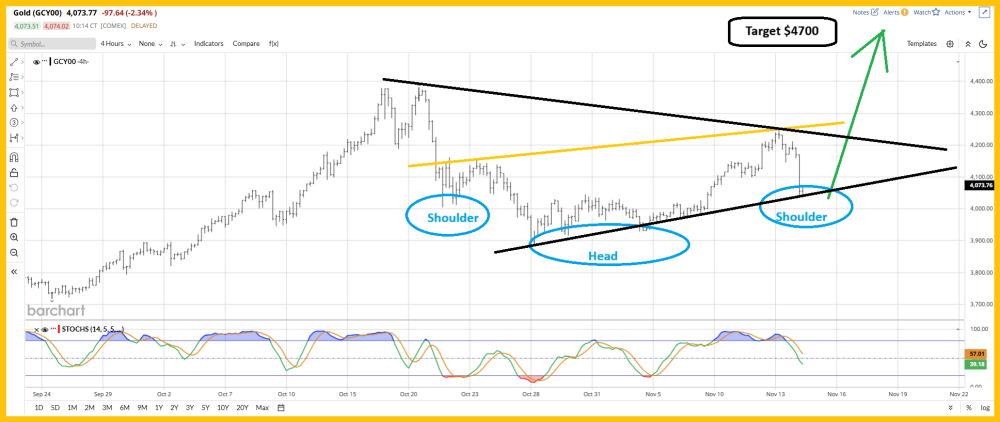
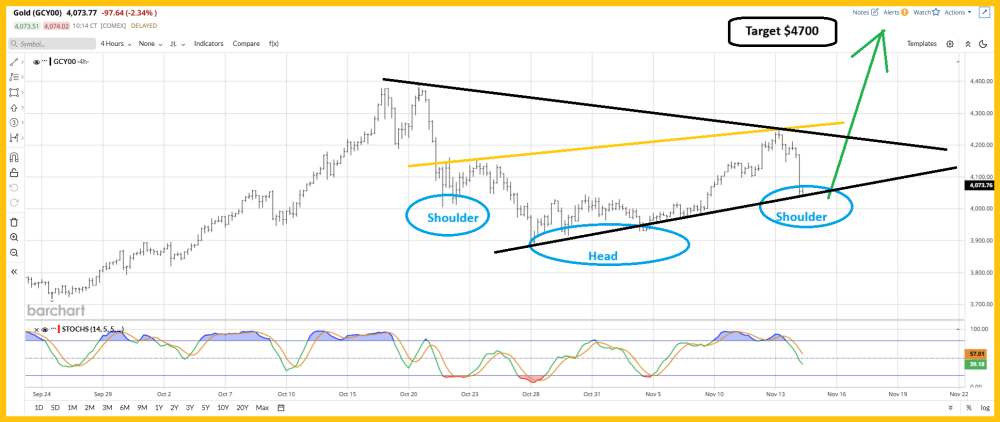
The good news is that every one of these scary dips is making the chart even more bullish!
Note the inverse H&S pattern and the bull triangle. These are both positive for gold, and both target the $4700 zone.
Bull moves for gold generally involve debt and inflation. What makes the current market particularly exciting is the global loss of confidence in U.S. government debt, and by extension, the dollar.
Governments and central banks are now leery of buying U.S. government debt because they fear they could be blackmailed or have their holdings frozen . . . or even confiscated.
Because other governments also have huge debt and spending problems, they are turning to gold.
This is a “here to stay” theme, and it means that while corrections in the price will continue to happen, they will tend to be more short-lived than in the dollar-dominated past.
What about the miners? Well, here’s the GDXJ chart:
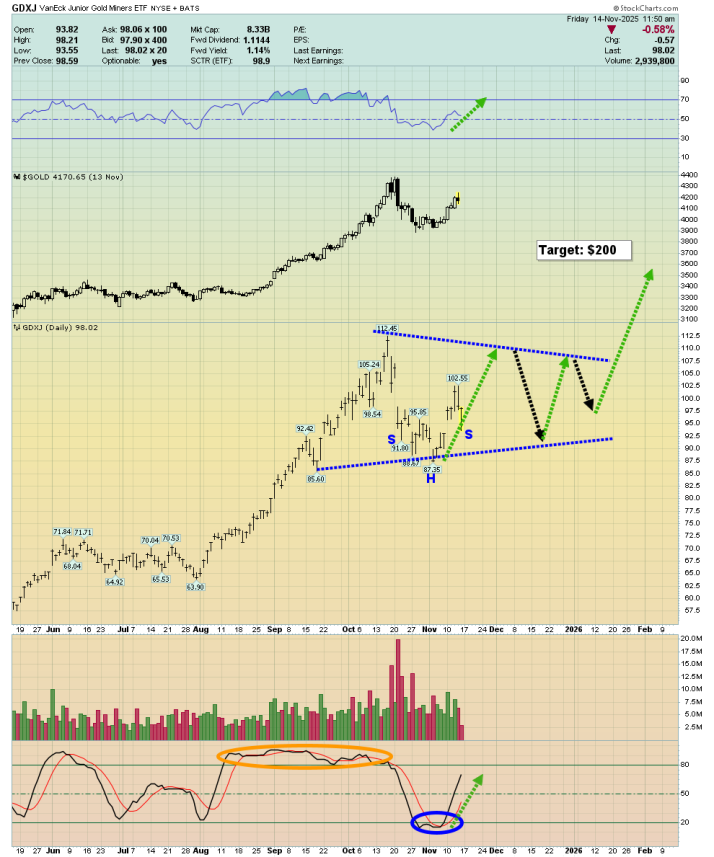
As with gold, the technical action is all positive. There’s a lot of volatility, but none of it has damaged the overall bullishness of the chart.
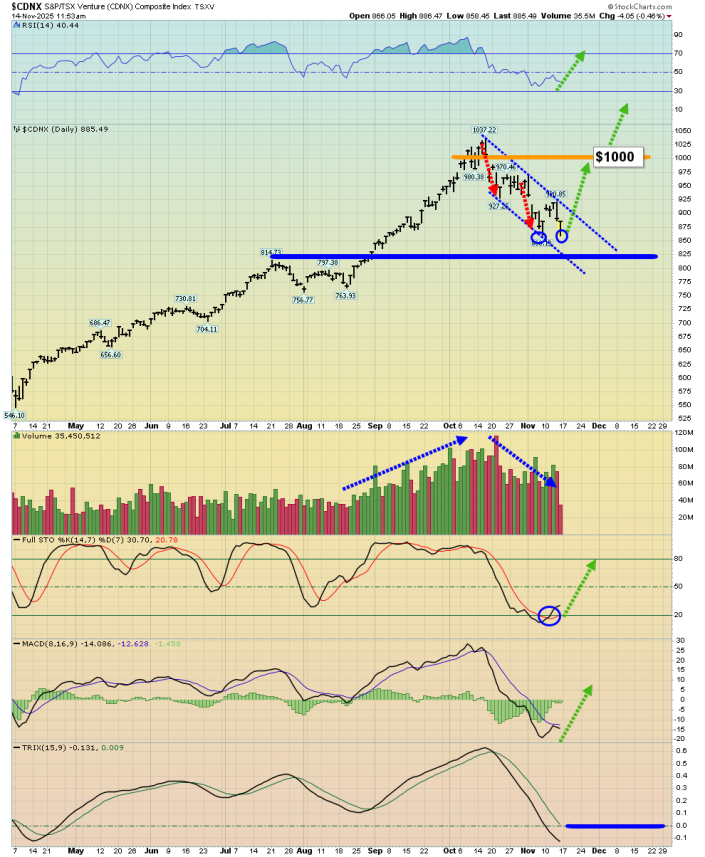
Here’s the CDNX:
Individual “hotties“? Here’s a snapshot of Omai Gold Mines (OMG:TSXV; OMGGF:OTC), which I’ve highlighted numerous times:
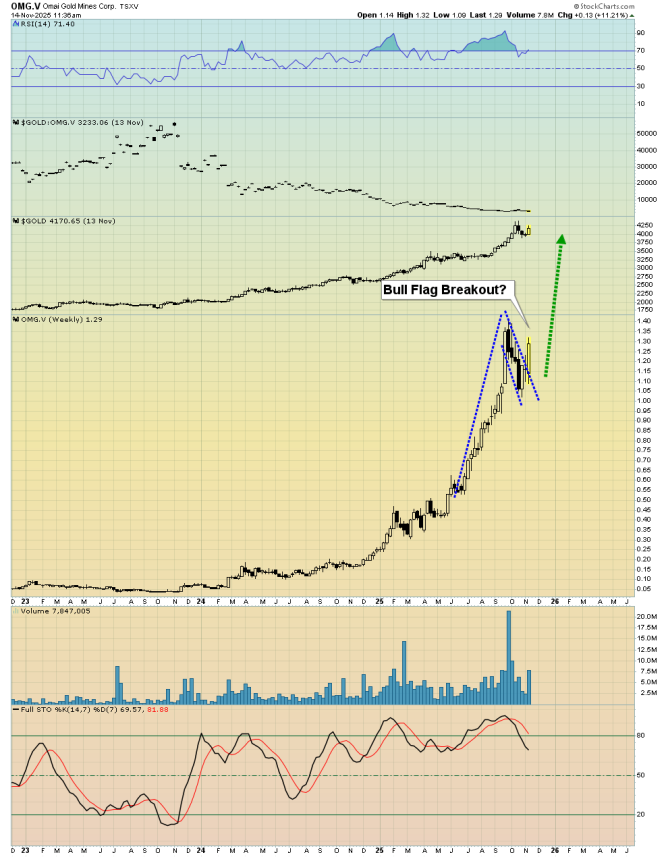
Guyana is a pretty stable jurisdiction, even though it’s basically second world, economically.
Here’s a technical look at it:
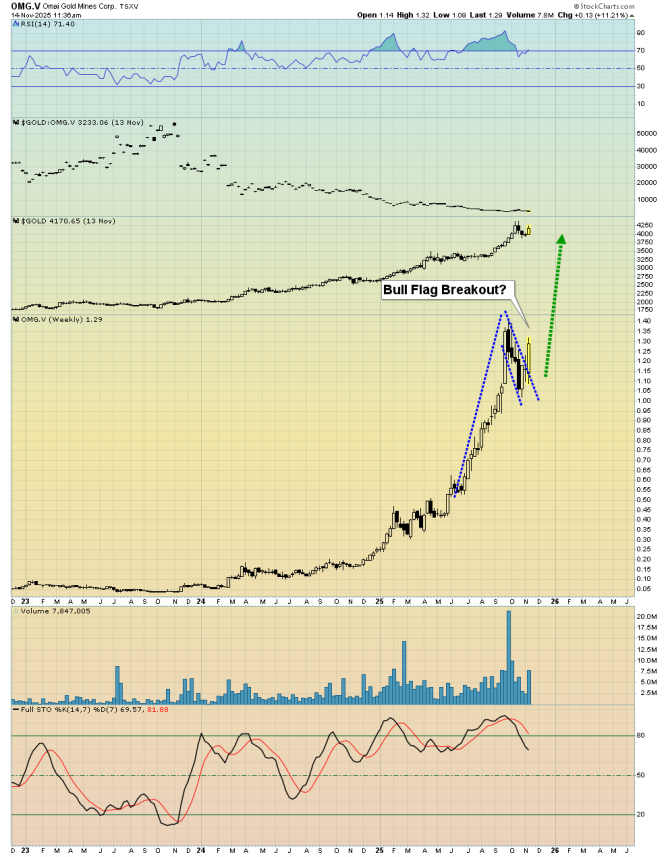
There could be, not only a massive bull flag, but a breakout from it now in play on this weekly chart.
The implications for investors who bought my earlier buy alerts for the stock? Very positive indeed!
Here’s a look at another junior-priced stock of interest, Bear Creek Mining Corp. (BCM:TSX.V):
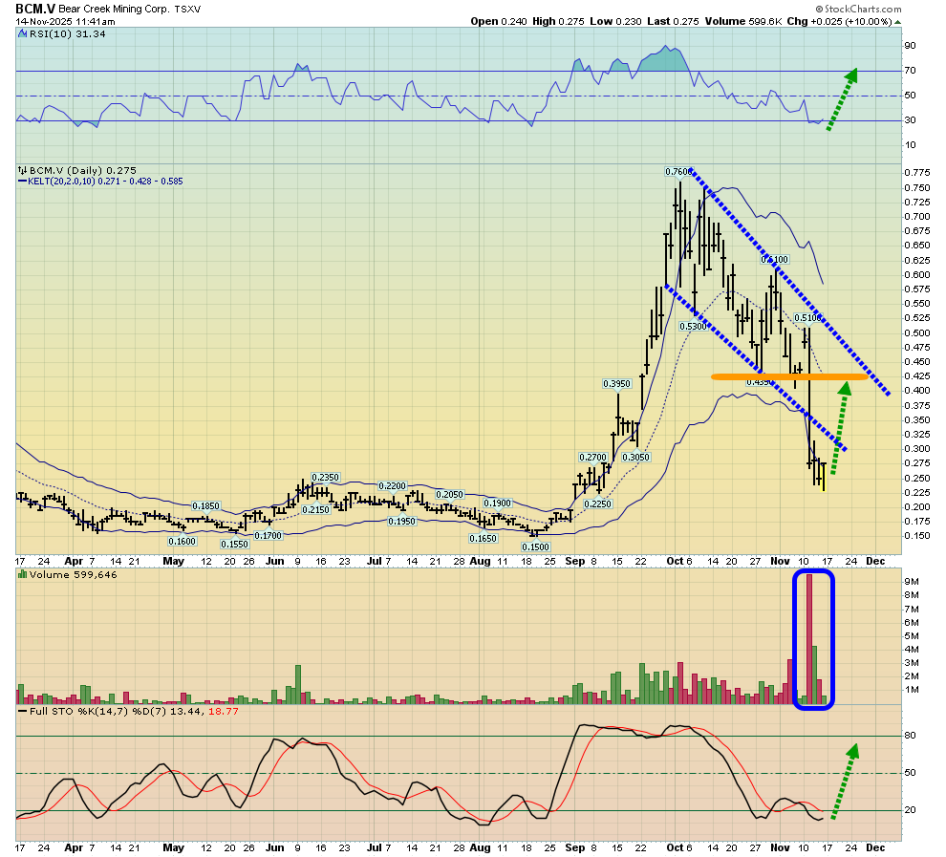
The company has an operation in North America and South America, and a move to the middle of the channel on the chart at 40 cents seems imminent.
Note the volume! Anytime there’s a huge volume bar on a CDNX stock after a big decline, it warrants investor attention. A fast 50% gain is often what happens soon after volume appears.
In a nutshell, junior mine stock investors should expect the current gold market volatility not only to continue, but to increase. Excitingly, each bout of new volatile price action is making the charts even more bullish than they already are.
Here’s a great chart for investors to peruse as they begin the weekend:

It is of course the fabulous weekly CDNX chart, featuring the massive inverse H&S pattern. The expected recoil at the neckline zone is in play, and when that line is taken out, it will up, up, up, and junior mine stocks away!
Special Offer for Streetwise Readers: Please send me an Email to freereports@galacticupdates.com and I’ll send you my free “CDNX: The Next Ten Baggers!” report. I highlight some of the most exciting component stocks in this incredible index, with winning buy and sell tactics included for investors! Junior mine stock investing isn’t for everyone, especially with size, but as this gargantuan gold bull era rollout continues, these miners look set to outperform everything! I write my junior resource stocks newsletter 2-3 times a week, and at just $199/12mths it’s an investor favourite. I’m doing a special pricing this week of $169 for 14mths. Click this link or send me an email if you want the offer and I’ll get you onboard. Thank-you!
Sign up for our FREE newsletter at: www.streetwisereports.com/get-news
Important Disclosures:
Important Disclosures:
- As of the date of this article, officers, contractors, shareholders, and/or employees of Streetwise Reports LLC (including members of their household) own securities of Barrick Mining Corp.
- Stewart Thomson: I, or members of my immediate household or family, own securities of: GDX. My company has a financial relationship with: None. My company has purchased stocks mentioned in this article for my management clients: None. I determined which companies would be included in this article based on my research and understanding of the sector.
- Statements and opinions expressed are the opinions of the author and not of Streetwise Reports, Street Smart, or their officers. The author is wholly responsible for the accuracy of the statements. Streetwise Reports was not paid by the author to publish or syndicate this article. Streetwise Reports requires contributing authors to disclose any shareholdings in, or economic relationships with, companies that they write about. Any disclosures from the author can be found below. Streetwise Reports relies upon the authors to accurately provide this information and Streetwise Reports has no means of verifying its accuracy.
- This article does not constitute investment advice and is not a solicitation for any investment. Streetwise Reports does not render general or specific investment advice and the information on Streetwise Reports should not be considered a recommendation to buy or sell any security. Each reader is encouraged to consult with his or her personal financial adviser and perform their own comprehensive investment research. By opening this page, each reader accepts and agrees to Streetwise Reports’ terms of use and full legal disclaimer. Streetwise Reports does not endorse or recommend the business, products, services or securities of any company.
For additional disclosures, please click here.
Stewart Thomson Disclosures
Stewart Thomson is no longer an investment advisor. The information provided by Stewart and Graceland Updates is for general information purposes only. Before taking any action on any investment, it is imperative that you consult with multiple properly licensed, experienced and qualified investment advisors and get numerous opinions before taking any action. Your minimum risk on any investment in the world is: 100% loss of all your money. You may be taking or preparing to take leveraged positions in investments and not know it, exposing yourself to unlimited risks. This is highly concerning if you are an investor in any derivatives products. There is an approx $700 trillion OTC Derivatives Iceberg with a tiny portion written off officially. The bottom line:
Are You Prepared?

Source: Lauren McConnell 11/14/2025
Liberty Gold Corp. (LGD:TSX; LGDTF:OTCQX) is using the same group of professionals who contributed to the prefeasibility study of this very project, Black Pine, noted a Paradigm Capital report.
Liberty Gold Corp. (LGD:TSX; LGDTF:OTCQX) formal began feasibility study (FS) engineering for its flagship Black Pine oxide gold project in Idaho, reported Paradigm Capital Analyst Lauren McConnell in a November 12 research note.
“Today’s announcement signals Liberty’s transition from study refinement to full feasibility execution, providing investors with clear visibility toward derisking and construction readiness by late 2026,” McConnell wrote.
Experts on Board
Liberty engaged M3 Engineering & Technology Corp., which was the lead consultant on the prefeasibility study (PFS), to be the lead coordinator on the FS. M3 is responsible for overall project integration and design of processing facilities and site infrastructure, McConnell reported.
Also, Liberty secured as specialist partners the same Qualified Persons under NI 43-101 who contributed to the PFS. Using the same professionals as before ensures continuity as well as continued technical efficiency and rigor in this next study phase.
These are the partner companies and their area of focus in the Black Pine FS:
- SLR Consulting Ltd.: Mineral resource
- AGP Mining Consultants Inc.: Mine design, pit optimization and mineral reserve
- Knight Piésold Ltd.: Geotechnical analysis
- Forte Dynamics Inc.: Heap-leach modeling and optimization
- NewFields Inc.: Heap-leach facility and infrastructure
- Piteau Associates Ltd.: Hydrology and hydrogeology
Targets for Completion
Resource conversion drilling and metallurgical work continue at Black Pine’s Rangefront and Discovery, and Liberty is on track to release an upgraded, FS-level, mineral resource estimate for Black Pine this quarter.
With the above team of experts, Liberty’s own technical staff and a strong financial position, thanks in large part to Centerra’s CA$28 million strategic investment and now 9.9% stake, the company is well set to complete the FS on time, in Q4/26.
McConnell highlighted that the updated resource estimate and the FS will be “key catalysts that could drive a rerating from developer to preconstruction status.”
Stock at a Glance
Currently, Liberty is trading at 0.10x price:net asset value at US$4,000 per ounce gold, the analyst noted. This is consistent with the peer median in Paradigm Capital’s Takeover Twenty, among which LGD is No. 1. The company’s stock has been doing well, up 17% on a one-month basis compared to peers’ stock, down 5%.
Sign up for our FREE newsletter at: www.streetwisereports.com/get-news
Important Disclosures:
- Liberty Gold Corp. is a billboard sponsor of Streetwise Reports and pays SWR a monthly sponsorship fee between US$3,000 and US$5,000.
- Doresa Banning wrote this article for Streetwise Reports LLC and provides services to Streetwise Reports as an independent contractor.
- This article does not constitute investment advice and is not a solicitation for any investment. Streetwise Reports does not render general or specific investment advice and the information on Streetwise Reports should not be considered a recommendation to buy or sell any security. Each reader is encouraged to consult with his or her personal financial adviser and perform their own comprehensive investment research. By opening this page, each reader accepts and agrees to Streetwise Reports’ terms of use and full legal disclaimer. Streetwise Reports does not endorse or recommend the business, products, services or securities of any company.
For additional disclosures, please click here.
Disclosures for Paradigm Capital, Liberty Gold Corp., November 12, 2025
Purpose
This Relationship Disclosure Information (“RDI”) is designed to help retail investors of Paradigm Capital Inc. (“Paradigm”) clearly understand the nature of the services that can be provided by their Paradigm advisor, and the necessary elements to ensure a satisfactory ongoing relationship. This document reflects the Client Focused Reforms (“CFR”)1 that came into effect in 2021 (Link).
Delivery
Paradigm uses its website www.paradigmcap.com as its repository for its RDI. All new and existing customers of Paradigm who have accepted electronic delivery method of materials, including RDI, can rely on its delivery via the Paradigm website, as per Section 14.2 of National Instrument 31-103. Effective June 30, 2021.
Compliance Contact Information
This document will explain the nature of the roles and responsibilities that both the client and advisor should follow to maintain a successful relationship. Please direct any questions about this document to Paradigm’s Chief Compliance Officer at compliance@paradigmcap.com. Information Contained Within Document
• Know Your Client (KYC)
• Services
• Account types
• Products
• Investment risks
• Investment Suitability
• Client Focused Reforms (“CFR”)
• Conflict of interest management
• Account fees and charges
• Client transaction and account reporting
• Complaint Handling Procedures
• Agreements & Disclosures
Paradigm predominantly has institutional customers. The few retail customer accounts are either Paradigm employee accounts or accredited investors who were introduced to Paradigm by corporate clients with whom Paradigm has an investment banking relationship. Consequently, the Paradigm retail accounts usually do not reflect the entire portfolio of the client, and the clients are not looking to Paradigm to provide investment or portfolio advice. Typically, these clients are accredited investors with sufficient capital, risk tolerance and time horizon to invest in new issues offered by Paradigm.
It is paramount that the information provided by clients be accurate and kept up to date to ensure that all investments made in their accounts are suitable. As such, clients must immediately keep Paradigm apprised of any significant changes that could impact the operation of their account(s), including changes to marital status, employment income, or other changes. Paradigm will contact clients on a periodic basis to ensure that any changes are noted on file, and any relevant changes are made, if necessary.
Services
Paradigm only offers advisory accounts to retail investors. In an advisory account the client is ultimately responsible for investment decisions, although the client can rely on advice given by the advisor. The advisor is responsible for any advice given. In providing this advice, an advisor must meet an appropriate standard of care, give suitable investment recommendations, and present unbiased investment advice, consistent with the KYC information provided by the client.
Account Types
Depending on which of the accounts below is right for a particular retail client, the client may be able to open one or more of the following: Cash Accounts: involve standard cash settlement of transactions, where cash or securities must be delivered two trading days after the day of trade execution. Margin Accounts: offer some level of borrowing capacity, secured by the prescribed loan value of the securities held in the account; this loan value is prescribed by the more stringent of either both the Canadian Investment Regulatory Organization (“CIRO”) or by the credit policies of Paradigm and its Carrying Broker, National Bank Independent Network (“NBIN”). Cash-On-Delivery (“COD”) Accounts: the settlement of these trades takes place between Paradigm and the client’s designated custodian on a Delivery Versus Payment (“DVP”) basis.
Registered Retirement Savings Plan (“RRSP”) accounts are intended to hold eligible retirement savings investments and assets, with appropriate contributions, in accordance with the regulations and restrictions on their operation, as prescribed in the Canadian Income Tax Act.
Registered Retirement Income Fund (“RRIF”) accounts are intended to hold eligible retirement savings investments and assets, with appropriate withdrawals, in accordance with the regulations and restrictions on their operation, as prescribed in the Canadian Income Tax Act.
Registered Education Savings Plan (“RESP”) accounts are intended to hold eligible savings investments and assets, with appropriate contributions and withdrawals, intended to help a family member pay for post-secondary education, in accordance with the regulations and restrictions on their operation, as prescribed in the Canadian Income Tax Act.
Tax-Free Savings Accounts (“TFSA”) allow clients to hold eligible savings investments and assets where the related income and capital gains are earned on a tax-free basis, in accordance with the regulations and restrictions on their operation, as prescribed in the Canadian Income Tax Act.
First Home Savings Accounts (“FHSA”) allow clients to hold eligible savings investments and assets, with appropriate contributions and withdrawals, intended to help first-time home buyers pay for their first home, in accordance with the regulations and restrictions on their operation, as prescribed in the Canadian Income Tax Act.
For more information on how the various account types operate, the client should consult an advisor. For more information on tax matters, the client should consult a licensed tax advisor.
Know Your Product
Products Available through Paradigm
Paradigm predominantly trades Canadian and US listed equities on behalf of its clients. Paradigm does not currently offer fixed income products, bonds, government debt, money market or securities traded outside the US or Canada to its retail clients. For a comprehensive list of the various products the firm offers a client should speak to their advisor.
Products may change from time to time. Clients should talk to their advisor or visit the firm’s website.
Risks
Investment Risks Understanding risk and knowing an individual’s comfort with risk is an important part of investing. Risk may be defined as the measurable possibility of a future investment loss or gain, including the prospect of losing some or all of the original investment in addition to any funds borrowed on margin and the associated interest costs. Risk is a common indicator of the volatility of the value of a security or market. Volatility is a measure of the rate or degree that the price of a security or investment fluctuates over time. Risk Profile:
An individual’s risk profile encompasses both risk tolerance, willingness to accept risk, and risk capacity, ability to sustain a loss.
Risk Versus Return:
It is unrealistic to expect to receive a high return without incurring any risk. In reality, risk and return are related. To seek higher returns, investors can choose investments with higher risk profiles, but must understand they can lose all their capital. The amount of risk that a client is comfortable with is their risk tolerance. How a client feels about risking their capital will drive many of the investment decisions. The risk comfort scale extends from very conservative low risk, where the client does not want to risk losing a penny regardless of how little their investment earns, to the very aggressive high-risk client who is willing to risk all of their investment for the possibility that it will grow considerably.
Risk Tolerance:
An individual’s risk tolerance may be affected by a number of factors including:
• Age
• Family situation
o marital status
o number and ages of dependants
o education
• Net worth
o Assets
o Liabilities
• Investment Income needs and expectations
• Income sources and amounts
• Investment time horizon
• Insurance coverage and cash reserves
Risk Capacity:
A person’s financial situation including their assets, debt, and the amount and stability of their income are all important when determining how much risk they can take with their investments. In addition, the larger the portion of a client’s total assets they are investing, the more conservative they may wish to be with this portion of their portfolio.
Paradigm assigns a risk capacity score at account opening based on a client’s answers to various questions regarding their ability to sustain loss. This helps determine which investments are suitable for the account, based on a client’s unique situation.
Careful discussions with one’s advisor to identify their own personal risk tolerance and capacity is essential.
Common Risks
Generally speaking, risks can be classified as market-related or security-specific.
Market-Related Risks
Risk factors that every investor is subject to irrespective of specific investment holdings include:
Market risk — Most investments are subject to the risk of a general market decline in response to changing conditions in the domestic or global economy. These market-wide changes can be unpredictable and beyond anyone’s ability to forecast.
Inflation risk — Inflation reduces an individual’s future purchasing power and their real investment returns.
Interest rate risk — Interest rates changes affect the value of fixed income securities. An increase in interest rates will result in a drop in the market value of a fixed income security.
Foreign exchange risk — Foreign exchange rate changes affect the value of investments that are traded in a foreign currency.
Security-Specific Risks
Risk factors which can affect the value of a specific investment holding include:
Product risk — Stocks generally carry a higher level of risk than bonds. Short-term government debt securities are essentially risk-free, with the degree of risk increasing with longer-term government
bonds, investment grade corporate bonds and other corporate bonds.
Concentration risk – a high concentration of assets in a single or small number of issuers may reduce diversification and liquidity within a portfolio and increase its volatility.
Liquidity Risk – some securities may be illiquid because of legal restrictions, the nature of the investment itself, settlement terms, a shortage of buyers, or other reasons. In general, investments with lower liquidity tend to have more dramatic price changes and may subject the investor to losses or additional costs.
Business risk — Business specific risk factors can affect a company’s profitability. The failure of a new product, labour difficulties, high debt levels and the performance of competing firms are some of the specific risk factors which may contribute to a particular company’s level of business risk.
Sector risk – certain sectors might be more volatile, or speculative, and thus have differing risk profiles.
Credit Risk – the riskiness of an issuer due to its debt obligations and ability to repay outstanding debt.
Foreign exchange risk — Foreign exchange rate changes affect the value of investments in companies that buy and sell products / services in foreign countries.
Reducing security specific risk
Security specific risks can be reduced by holding a well diversified portfolio of investments. A diversified portfolio starts by allocating a client’s investments between debt and equity products. It can also factor in diversification across sectors, and specifically to avoid over concentration in any security or sector.
The debt portion of the portfolio can be further diversified by purchasing debt of different terms and of different issuers, although all issuers should have an acceptable credit rating. The equity portion of the portfolio can be further diversified by buying shares of companies in different business sectors or based in different countries. If the client does not have a large amount of money to invest, they can diversify by investing in a pooled investment like mutual funds or exchange traded funds. Paradigm clients must decide their own asset allocation and specific security concentration. If they need full-service advice, such clients should seek a full-service retail representative at another firm.
CIPF Protection from firm insolvency risk
The cash and security assets in the client’s account are covered by the Canadian Investor Protection Fund (“CIPF”), details of these limits can be found at www.cipf.ca. Should the firm become insolvent. CIPF provides coverage up to CAD $1 million in cash per customer for securities in the account in the event a firm becomes insolvent. Note that registered accounts are treated as separate accounts.
6CIPF coverage does not insure against market losses due to volatile markets, product suitability, or insolvency of an actual security in an account.
Your Personal Investor Risk Profile
An advisor can help a client determine their comfort level with risk based on the information the client provides.
• For a LOW RISK investor -The firm will recommend investments that generally display a lower volatility and risk profile. Although returns generated by such products are generally lower, they may be more certain.
• For a MEDIUM RISK investor –In addition to lower risk products, the firm may propose investments that include securities that may exhibit moderate volatility and a medium risk profile. While potential returns are higher, return volatility and risk also increase.
• For a HIGH-RISK investor –In addition to lower and medium risk products, the firm may suggest investments that may be unpredictable and speculative in nature. Such products may be subject to a greater risk of loss with a greater potential for returns.
• For a COMBINATION OF RISK LEVELS – A client may have a combination of the risk levels depending on the types of accounts they have. For example, a client may be high risk investor in their margin account and a low risk investor in their RRSP account. Given the product offering at Paradigm, all retail clients must be high risk investors. Investment Suitability
Suitability assessment
CIRO member firms are required to use due diligence to evaluate the suitability of any order the firm accepts or recommendation the firm makes based on factors including a client’s financial circumstances, investment knowledge, investment objectives, risk tolerance and time horizon. The firm will conduct a suitability assessment whenever:
• A trade is proposed by a client;
• A trade is recommended by a client;
• Securities are received or delivered into a client account by way of deposit or transfer;
• We become aware of a significant change in a security in a client account that could result
in the account not meeting suitability requirements;
• There is a change to the Investment Advisor on the account
• There is a material change in a client’s KYC information
The suitability of the investments held in a client’s account will not be reviewed in the case of triggering events not described above and, in particular, in the event of significant market fluctuations. While an Investment Advisor may make recommendations with respect to suitable investments, the responsibility for all investment decisions lie with the client.
Client Focused Reforms (“CFR”)
The Canadian Securities Administrators (“CSA”) mandated the CFR which supplement the Registration Requirements, Exemptions and Ongoing Registrant Obligations found in National Instrument 31-103. Paradigm recognizes that most, if not all, retail accounts will not form the whole portfolio of holdings by its clients.
Client must provide Paradigm with updates:
Paradigm will ask clients to provide at account opening and to be updated on the total Assets Under Management (“AUM”) and sector breakdown of their entire portfolio. However, as the CSA recognizes, sometimes clients may not provide a full picture, or keep Paradigm informed of all portfolio changes.
Unsolicited Orders:
Paradigm will use its business judgment whether an order, even if unsolicited, as per section 13.3(2.1) of NI 31-103, is suitable for the customer. If the registrant deems the order to be unsuitable, it may ask the client to provide updated information to substantiate the suitability of the unsolicited order.
If the advisor determines that a transaction proposed by the client is unsuitable, they will advise the client of their assessment prior to executing the trade. Moreover, a firm will reserve the right not to accept an order to purchase a security if it is not in keeping with the client’s investment or risk objectives.
Paradigm mostly covers speculative investments, and thus its retail clients should have a high tolerance for risk, as well as the ability to absorb any resultant losses.
Paradigm corporate-related accounts typically hold a higher-than-normal concentration of the issuer for whom the customer is an employee. This can result from a stock-option plan and / or an issuer financial transaction in which this issuer-related employee participated. In either event, the account will likely be over-concentrated in the issuer, and the customer will have account(s) elsewhere which overall provide for a more balanced portfolio.
Referral Arrangements:
Occasionally customers will be referred to Paradigm. Should there be any referral fee attached to this referral, as per Section 13 of NI 31-103, there shall be both a referral arrangement made between Paradigm and the referring party, and a referral disclosure document sent to the underlying client who was referred to Paradigm.
Best Interests Standard:
The CSA has guided that Best Interest is dependent upon facts and circumstances, in which the materiality of a potential conflict must consider materiality, reasonability and professional judgment.
Management of Conflicts of Interest
Conflicts of interest may arise at account opening or while a client’s account is held at the firm. Management of conflicts is carried out through disclosure.
Introduction
CFR requires Paradigm to take reasonable steps to identify and respond to actual and potential material conflicts of interest, and to provide clients with information about these conflicts; and where appropriate obtain prior client consent before engaging in certain types of transactions. This document contains important information clients should read carefully about the key conflicts of interest we have identified.
In situations where Paradigm is providing services in which a conflict of interest might occur between the interests of Paradigm and the client, Paradigm will fully inform clients of these conflicts in a fair, equitable and transparent manner, consistent with the best interest of our clients.
Paradigm is an employee-owned commercial enterprise that has a responsibility to maximize the returns for its shareholders and customers alike. Paradigm earns compensation for investment banking services and trading commissions, in return for investment banking work, research services, and trade execution. Customers should be aware of these fees, which are outlined below in this document.
Paradigm provides these fee/trade-based services to meet the interests and needs of customers, as expected under corporate and securities laws. Paradigm provides trusted advice and seeks to protect client and investor interests by addressing conflicts of interest.
Regulators:
The Canadian Securities Administrators (“CSA”) and the Canadian Investment Regulatory Organization (“CIRO”) stipulate that material conflicts of interest must be identified, addressed and disclosed appropriately.
Description of Paradigm
Paradigm is an independent, research-driven investment dealer, and a member of CIRO. Paradigm sales and trading focuses on companies that Paradigm covers via research services. Our investment banking team provides advisory and corporate finance services, mainly to Canadian corporate issuers. Paradigm espouses teamwork and long-term relationships that are the key to exceptional success and growth.
Paradigm believes in a dynamic work culture, and a high standard of ethics.
Paradigm’s principal clients are institutional money managers and corporate issuers; the Firm has limited number of retail client accounts, which are usually employees of either Paradigm or corporate issuers. Importantly, Paradigm does not provide the full range of services of a traditional retail member. The Firm will often act as an agent between both buyers and sellers or issuers and try to act in the best interests of all parties. Occasionally, we may also act as a principal in a Bought Deal financing or a trade in the marketplace to facilitate a client order. Consequently, some of our business activities may lead to conflicts of interest, should we represent both sides of a transaction.
National Bank Investment Network (“NBIN”)
Paradigm is a Type 2 Introducing Broker that uses NBIN as its Carrying Broker. NBIN provides many administrative services for Paradigm and its clients, which are outlined in the NBIN Account and Services Agreements and Disclosures found at www.paradigmcap.com
Managing Conflicts of Interest
Under CIRO’s rules, all existing or potential material conflicts of interest between a Dealer Member and a client must be addressed “in a fair, equitable and transparent manner, and considering the best interest of the client or clients”. In applying this requirement, it is recognized that it is not always possible or practical for us to address all conflicts of interest in the best interests of each client when the conflict of interest involves multiple clients and competing interests. The most common types of conflicts of interest that can occur are:
• Conflicts of interest between Paradigm and a client;
• Conflicts of interest between clients; and
• Conflicts of interest between Paradigm and our related or associated companies
Paradigm manages material conflicts of interest in three ways:
• Avoidance: Paradigm avoids conflicts of interest that are prohibited by law, as well as any conflicts that cannot be effectively addressed other than by not engaging in the activity that would give rise to the conflict.
• Control: When, in the Firm’s judgment, the conflict of interest can be successfully managed Paradigm will do so by restricting access to information and/or separating business functions.
Clients may also be provided with alternative solutions to best manage the conflict.
• Disclosure: When the Firm is unable to avoid or control the conflict, Paradigm will disclose the conflict to clients appropriately. Clients can then independently assess the significance of the conflict in light of the services offered by Paradigm, and determine with Paradigm whether and how to proceed accordingly. Outlined below are the various services offered by Paradigm, the potential conflicts to consider, and how the Firm addresses these conflicts.
Paradigm Services and Relationships:
Research:
Potential Conflict of Interest How Conflicts Will Be Addressed Paradigm provides investment research on securities of issuer companies that it may recommend to paying customers. These issuers may also have other business relationships with us, including investment banking activity.
Our Research is subject to extensive and detailed regulatory requirements and internal standards. This includes the controls over communications between the investment banking department and the research department.
Paradigm is also required to disclose within our research reports conflicts that a client should review in assessing whether these conflicts are important. These include:
• Compensation received related to both investment banking and non- investment banking services
• Ownership by the firm or analyst,
• Compensation of analysts,
• Rating systems and distributions, including where corporate finance services have been provided
• Site visits conducted by research analysts as part of the due diligence for their investment report
Sales & Trade Execution:
Potential Conflict of Interest How Conflicts Will Be Addressed
Paradigm earns compensation by selling products and services to paying clients Paradigm will inform clients of fees, commissions and other compensation so clients are aware of what they will be paying in advance of any transaction. Paradigm earns brokerage commissions on trades executed for clients which are negotiated directly between the client and the investment advisor.
All commissions are disclosed on trade confirmations. Fees for other services is documented in a fee schedule provided to retail clients at the time of account opening, as well as any time there is a change in the fees related to any services.
This includes service fees as offered by NBIN, the Carrying Broker for Paradigm. Paradigm is required to make “suitable” investment recommendations, in line with client’s investment objectives and risk tolerances, as well as the information available to investment advisors about the recommended investment. Paradigm may need to select which clients will be offered certain securities if availability is limited in the event of a New Issue being over-subscribed.
The syndication group will make a fair determination of the appropriate allocation of securities based on individual client relationships and other trade-related considerations including suitability, timing, and order size. Due to investment banking business relationships with issuers of securities, certain employees may know confidential or Material Non-Public Information (“MNPI”). As per the Tipping Provisions of Section 5 of the Securities Act (Ontario), Paradigm cannot disclose such Paradigm’s investment banking department operates as a separate business unit from both the sales and trading department and the research department. Any information obtained from issuer clients is kept confidential and not divulged to other information to clients, even if the information might lead us to not recommend a trade in those securities departments. Paradigm’s internal information barriers are designed to ensure compliance with securities regulations to ensure MNPI does not go beyond investment banking and compliance.
While the majority of trades executed are ‘Agency’ trades, Paradigm may occasionally act as ‘Principal’, trading with its own capital or securities against client orders which may result in a profit to the Firm Paradigm will obtain client consent when required and disclose on the client trade confirmation whether the Firm acted as Agent or as Principal for each transaction.
Notwithstanding the Agent/Principal nature, Paradigm will always seek to achieve Best Execution, as is found in Paradigm’s Best Execution and Order Handling Document found at www.paradigmcap.com. Paradigm may sell sedscurities of companies that are related or connected to the Firm.
Paradigm will disclose this fact to the customer at the time of the trade.
Investment Banking:
Potential Conflict of Interest How Conflicts Will Be Addressed Paradigm is paid by issuers of securities when we advise on or underwrite a new issue which we may recommend to clients. In these instances, Paradigm is acting for the issuer that wants to obtain the highest reasonable price to raise funds for the Issuer’s enterprise, while recommending the investment to purchasers who are interested in obtaining the lowest reasonable price.
Paradigm has structurally segregated the investment banking department from the rest of the advisory business. This prevents the sharing of non-public information.
The Firm’s investment banking department appropriately evaluates the reasonableness of pricing new issues and takes into consideration factors such as market conditions, market value, and the specific securities being offered. This evaluation is performed separately from the considerations of the equity sales group. In all instances, investments must be suitable for the client and in line with the client’s stated investment objectives and risk tolerance.
While institutional customers are suitability exempt, Paradigm reserves the right to not sell certain new issue securities to retail customers if it is determined that the investment is unsuitable.
The offering documents provide full disclosure of all relationships Paradigm may have with the issuer, including compensation arrangements related to the transaction.
Related or Associated Companies
Potential Conflict of Interest How Conflicts Will Be Addressed Merchant Banking Activities:
From time to time one or more companies affiliated with Paradigm may undertake merchant banking activities. Individuals involved with Paradigm in various capacities may also be involved in such merchant banking activities. Such merchant banking activity may involve an issuer to which, or about which, Paradigm provides one or more of the above listed Paradigm services. These merchant banking activities may be, or may reasonably be perceived to be, of direct or indirect benefit to Paradigm. These types of potential conflicts are covered in Paradigm’s internal policies, and the activities are supervised and monitored internally. Appropriate disclosure will be provided to clients as determined in the context of each conflict of interest.
Other Potential Conflicts of Interest
As well as the potential conflicts of interest we have set out above there are a number of other potentially relevant conflicts that may arise: Potential Conflict of Interest How Conflicts Will Be Addressed Individuals may serve on the board of directors of issuer companies or other organizations Employees may act as directors or officers of public companies in rare instances. Any employee looking to serve on the board of directors of a public company must first seek the approval of both compliance, as well as the Board of Directors to ensure all conflicts of interest are accounted for.
For employees looking to serve on the board of private companies, compliance pre-approval is required.
Employees may receive or give gifts, gratuities, or entertainment opportunities due to their relationship with clients
Paradigm has strict Policies and Procedures to limit what are acceptable gift and entertainment practices. All gifts are reviewed.
Other Outside Activities by employees of the firm All employees must disclose upon hiring and at least annually, whether they engage in outside activities for which they expect to receive compensation (including indirect payment), consideration or other benefit received or expected. If required, these activities may be added to the National Registration Database (NRD).
These activities must be preapproved by the compliance department to mitigate the risk of client confusion and/or conflicts of interest in advance, consider the best interests of the client, and approval will only be granted in cases where effective controls, and qualified supervisory personnel are in place. Employees are prohibited from engaging in outside activities that would interfere or create conflict with their duties.
Fees and Services Charges
Commissions
Commissions are transaction related fees paid to the firm at the time of sale or shortly thereafter and which are shared by the dealer with the advisor. Paradigm charges a minimum of $25 per trade for retail accounts and may negotiate a mutually agreeable fee with the client based on the number of shares purchased and/or the value of each share.
Fees
As part of the account opening process, all retail clients are provided with a Fee Schedule which details the fees Paradigm charges, including costs to:
• Trade
• Hold accounts at the Firm
• Send money via wire transfers
• Transfer accounts out of the firm
Account Reporting
Transaction and Statement Reporting
The client will receive written confirmation of all transactions in their account. The client will also receive account statements when there is a transaction during the month and on a quarterly basis regardless of account activity. We do not currently provide clients with the percentage return of their accounts on account statements.
Paradigm does not offer Portfolio Management services.
These client account statements are provided by our carrying broker NBIN and are in accordance with regulatory requirements.
Annual Portfolio Review
We are responsible for sending each client an annual account report for the previous calendar year which will be provided by our carrying broker NBIN. The report will provide information regarding how client’s investments performed over the last year and a list of charges and payments paid by the client over the same time period.
If the client chooses to have an annual portfolio review with their advisor, the client can discuss the performance of the account holdings and investment strategy.
Performance Benchmarks
Investment benchmarks are a standard against which the performance of a security, mutual fund or portfolio can be measured. Generally, broad market stock and bond indices are used for this purpose. There are dozens of indices that be used to gauge the performance of any given investment including the S&P/TSX Composite, the S&P 500 and the Dow Jones Industrial Average.
When evaluating the performance of investments, it is important for customers to compare returns against a pre-selected and appropriate benchmark.
Given the importance of having the correct comparison and the diverse nature of its client portfolios, Paradigm will not include benchmarks on the monthly client statements.
Client Responsibilities
A firm needs the client’s help to ensure that the relationship with their advisor is positive and results in the services that the client needs and wants. The client has a responsibility to help achieve this outcome. To this effect, the client should:
• Provide a full and accurate description of their financial situation, investment objectives risk tolerance, risk capacity and time horizon to their advisor to assist him/her in meeting the client’s investment goals.
• Promptly inform their advisor of any material changes to their life circumstances or investment objectives. A “material change” is a change to any information that could reasonably result in changes to the types of investments appropriate for a client, such as income level, investment objectives, risk tolerance, time horizon or net worth. Examples of such changes would include changes in employment, marital status or retirement plans.
• Review all account documentation, sales literature, trade confirmations, statements and other documents provided by the advisor or Firm.
• Understand all costs and fees associated with the services a client will be provided.
• Be proactive – ask questions and request information to resolve any questions about the account, specific transactions or investments or the client’s relationship with their advisor.
• Be cognizant of potential risks and returns on investments.
• Communicate in writing expectations for the advisor and/or firm.
• Contact the Chief Compliance Officer if displeased with answers or explanations from the advisor: compliance@paradigmcap.com
• Ensure payment for transactions is made by the settlement date.
• Review account/portfolio holdings on a regular basis and discuss them with the advisor.
• Consult a professional such as a tax accountant or a lawyer for professional advice.
Complaint Handling Procedures
Written client complaints can be submitted either via email to compliance@paradigmcap.com or via mail to the Designated Complaints Officer (“DCO”) of Paradigm Capital Inc.
General Counsel
95 Wellington Street West, Suite 2101
Toronto, Ontario M5J 2N7
The DCO may also be reached by phone at 416 361 9892.
Within five (5) business days of the receipt of a complaint, the client will be sent an acknowledgment letter. In this acknowledgement letter, Paradigm may request additional information in order to investigate the complaint. Paradigm will also send the client the following CIRO brochures: How To Make a Complaint (Link to brochure) and How CIRO Protects Investors (Link to brochure).
The client will also receive these brochures at the time of account opening. Within ninety (90) calendar days of the receipt of a complaint, Paradigm will provide the client with a substantive response. If Paradigm is unable to respond to the complaint within the above time frame, the client will be provided a written explanation as to why.
In the final decision letter, Paradigm will provide the client with a summary of their complaint, the results of the investigation, an explanation of the final decision, and the other options available for seeking compensation, should the client not be satisfied with the response.
If any client is dissatisfied with Paradigm’s final response, they may contact the following organizations: Ombudsman for Banking Services and Investment (“OBSI”), Canadian Investment Regulatory Organization (“CIRO”), or they may choose to go to arbitration or pursue legal action.
Agreements and Disclosures:
The following agreements, some of which may be found at www.paradigmcap.com, may be entered into depending on the type of account(s) the client opens:
• Joint Account Agreement
• Margin Agreement, to be obtained before a margin account is opened
• Consent to electronic delivery of documents
• Trading Authority Agreements
The following disclosures are provided via www.paradigmcap.com to the client by Paradigm:
• Research Rating System
• Research Distribution Policy
• Best Execution and Order Handling
• Privacy Policy and Agreement
• Relationship Disclosure Information
• NBIN Account & Services Agreements & Disclosures
• NI 24-101 Trade Matching Statement
• CIRO Know Your Advisor: Advisor Report
The remaining disclosures below are provided to the client via email at the time of account opening:
• Introducing/Carrying Broker Disclosure Statement
• Paradigm’s Fee Schedule
• CIPF Brochure
• OBSI Brochure
• How CIRO Protects Investors Brochure
• CIRO Complaints Brochure
• Paradigm’s Business Continuity Plan

( Companies Mentioned: LGD:TSX; LGDTF:OTCQX,
)
Source: Ralph Profiti 11/14/2025
Stifel raises its long-term copper price 18% and its long-term uranium price 14%, the firm noted in a commodities report.
Stifel increased its copper and uranium price forecasts based on market vulnerability to supply shocks, Managing Director Ralph Profiti wrote in a Q3/25 Industrial Metals Results Preview dated October 21.
Here’s a look at Stifel’s new and previous price estimates for both metals:
| METAL | PERIOD | NEW ESTIMATE | OLD ESTIMATE | % CHANGE |
| Copper | 2025 | US$4.45/lb | US$4.34/lb | +2 |
| Copper | 2026 | US$4.85/lb | US$4.40/lb | +10 |
| Copper | 2027-2028 | US$5.00/lb | US$4.25/lb | +18 |
| Copper | Long term | US$4.50/lb | US$4.25/lb | +6 |
| Uranium | Long term | US$120/lb | US$105/lb | +14 |
Effects of Supply Disruptions
Recent copper supply disruptions at various mines, including Grasberg Block Cave (GBC), Kamoa-Kakula, Quebrada Blanca and Constancia) will account for 1,100,000 fewer tons of the red metal on the market over the next three years (through 2027), Stifel estimated. This bears out Stifel’s long-held believe that the market is vulnerable to unanticipated supply shocks. The timing of the shocks exacerbates the supply problem; they came after a decade of underinvestment in new mines, prices remaining below incentive levels and relatively low inventories.
Stifel’s long-term copper price forecast of US$4.50/lb is conservative against the current spot price of US$4.97/lb, Profiti wrote. It is consistent, though, with pricing assumptions to be used for long-term capital allocation decisions by copper producers and Stifel’s long-term incentive price estimate of US$5.04/lb.
Consensus long-term copper prices are low, noted Profiti, when one takes into account the structurally higher all-in costs of building new capacity, higher operating costs, risk of construction delays, higher royalties and taxation, and increased permitting and social license risks at emerging supply centers. All of these factors support Stifel’s view that long-term copper prices above spot prices are justified.
Stifel’s preferred industrial metals picks are Cameco Corp. (CCO:TSX; CCJ:NYSE), Capstone Copper Mining Corp. (CS:TSX), Foran Mining Corp. (FOM:TSX.V), HudBay Minerals Inc. (HBM:TSX; HBM:NYSE), IsoEnergy Ltd. (ISO:TSX), Lundin Mining Corp. (LUN:TSX; LUNMF:OTCMKTS), Taseko Mines Ltd. (TKO:TSX; TGB:NYSE.MKT) and Western Copper and Gold Corp. (WRN:TSX; WRN:NYSE.MKT).
Uranium Supply Constrained
As for uranium, Stifel predicts market deficits through 2029, Profiti wrote. Drivers are moderate growth of mine production and execution risk linked to several key projects.
Stifel’s Top Pick in uranium is NexGen Energy Ltd. (NXE:TSX; NXE:NYSE.MKT).
“Once fully permitted, we believe Rook 1 will hold strategic significance as a construction-ready, high-margin, long-life, technically derisked asset in a premier mining jurisdiction that should attract mergers and acquisitions interest from competing uranium producers as well as nuclear value chain participants that should command a premium valuation,” Profiti wrote.
Sign up for our FREE newsletter at: www.streetwisereports.com/get-news
Important Disclosures:
- Doresa Banning wrote this article for Streetwise Reports LLC and provides services to Streetwise Reports as an independent contractor.
- This article does not constitute investment advice and is not a solicitation for any investment. Streetwise Reports does not render general or specific investment advice and the information on Streetwise Reports should not be considered a recommendation to buy or sell any security. Each reader is encouraged to consult with his or her personal financial adviser and perform their own comprehensive investment research. By opening this page, each reader accepts and agrees to Streetwise Reports’ terms of use and full legal disclaimer. Streetwise Reports does not endorse or recommend the business, products, services or securities of any company.
For additional disclosures, please click here.
Disclosures for Stifel, October 21, 2025
Investment Thesis Arizona Metals Corp. (AMC CN) High-grade historical resource a head start for exploration at Kay. Kay hosts a historical non-NI 43-101 compliant high-grade (approximately 6% CuEq) resource of 5.8MMt by Exxon from 1982. Proven district. There are 60 past-producing VMS mines within 150km of Kay. Freeport and Grupo Mexico have significant vertical infrastructure close by. Tier 1 jurisdiction. Kay is on private or BLM land, with no royalties. The property is also not close to the National Forests. Arizona produces the majority of the U.S.’s copper. Property-wide exploration at Kay leaves the door open for a ‘beachhead’ development strategy. Two high-priority targets exist to the west of Kay, with strongly similar surficial geochemical and geophysical signatures to Kay. AMC is in the process of proving up its “accordion folding thesis” that intimates that mineralization at Kay is repeated at these two targets. Arizona Sonoran Copper Company Inc. (ASCU CN) Arizona Sonoran’s Cactus Project is a low-risk, conventional open-pit mining project with a straightforward development path that can translate into quick time to market. Located on a brownfield site with access to requisite infrastructure, Cactus requires only state permits, avoiding the lengthier federal process. A JV agreement for Cactus signed with Rio Tinto lends industry confidence and financial muscle to the project, while Rio’s Nuton technology could provide material upside beyond our base case by unlocking the potential of the primary sulphide resource. Strategic tension for Cactus should remain strong given project scale and possible synergistic integration with the neighbouring Santa Cruz copper project. ATEX Resources Inc. (ATX CN) Big getting bigger and better. Giant PCDs occur in geologic Belts down the spine of the Andes at structural intersections. Valeriano’s 1-2 punch of favourable structure and duration of mineralization intimate potential for both a sizable porphyry system and high grade starter breccia system, which drive asset critical mass as well as competitive tension. Right time to own. Efficiently adding metal via discovery is paramount to value creation. ATEX’s discovery rate is 3.5x that of other porphyry explorcos, providing investors with torque to an efficient drill bit. District consolidation potential. Copper deposits are increasingly becoming lower grade and deeper, driving consolidation to diversify risk, with ABX/ANTO’s El Encierro JV outlining +$100MM in exploration spend next door. Cameco Corp. (CCO CN) We believe Cameco is well-positioned for improved financial performance driven by our forecasts of rising uranium prices, exposure to market-related contract terms and the benefits of growth opportunities amid vertical integration in the Uranium and Fuel Services businesses through its 49% stake in the Westinghouse Electric Co. (WEC – private) – which we view as the most undervalued part of the business. Increased interest from traditional resource investors, energy investors, clean energy investors, infrastructure investors and generalists reinforces our view of peak-uranium valuation. Capstone Copper (CS CN) Capstone is a mid-tier base metals producer offering investors one of the highest exposures to copper within our peer group of our diversified miners. Capstone’s path from 185Kt to 260Kt of annualized copper production will be driven by full MVDP ramp-up and MV-Optimized and incremental growth to 400+Kt driven by Santo Domingo startup (2029) and other low-risk/capital-efficient expansions at Mantos Blancos (Phase II) and Mantoverde (MV-SD Cobalt and MV-Phase II). Near-term run-rate annualized copper production growth to 260Kt would rank Capstone around #20 globally, which in our view, is ideally positioned for “mid-tier appeal” and a lack of complexity given 70% of NAV resides in Chile, marks Capstone as one of our top copper M&A target picks. Ero Copper (ERO CN) Ero Copper offers investors exposure to a high-margin, growth-oriented copper-gold producer with a strategic focus on Brazil and mid-tier target M&A appeal, while we anticipate a slower production ramp-up in H2/25 and 2026. Ero is positioned to deliver meaningful production growth through stabilized Caraíba operations post its mill expansion completed in Dec-2023 as well as Tucumã ramp-up which achieved commercial production on July 3, 2025. We expect Ero to prioritize stronger cash flow generation towards balance sheet deleveraging and transformational drilling at Furnas in partnership with Vale Base Metals (VBM) where 40,000m of drilling planned for 2025 will support a Phase 1 Scoping Study (PEA) in H1/26 and Phase 2 Pre-feasibility Study with ongoing exploration and technical studies aiming to define a new long-life, high-grade underground mine. We anticipate a slower production ramp-up in H2/25 and 2026, while we believe Ero is still well positioned to achieve higher copper production 2026 and 2027 with annual copper production growth of 85–95Kt (vs. 40.6Kt in 2024), which underpins our view of Ero as a consolidation play in the mid-tier copper sector. Freeport-McMoRan Inc. (FCX) We believe Freeport is one of the best-positioned miners globally for copper and gold exposure with large-scale production of copper, gold and molybdenum, a highly qualified and experienced team with a proven track record of operational execution, disciplined capital allocation and outsized shareholder returns. Freeport boasts an attractive portfolio of organic growth opportunities anchored with a strong balance sheet including its proprietary leaching technology that unlocks significant value from existing stockpiles at a very low capital intensity, which we value at $6+/share, including Q1/25 extraction of 40Mln lbs of copper from leaching initiatives that has demonstrated early success with technological viability that leverages data analytics and optimized processes (leach kinetics and proprietary reagents) to target low-grade ores, potentially 38Bln lbs in copper stockpiles, into profitable output. Freeport’s target run-rate of 300Mln lbs/year by YE25 and 300-400Mln lbs/year in 2026, and 800Mln lbs/year by 2030 at an estimated cash cost of $1.50-2.00/lb is equivalent to a Tier One copper asset. Firefly Metals Ltd. (FFM CN) We see a dual-track of value creation potential for Firefly based on a) De-risking their flagship Green Bay Project in Newfoundland’s Baie Verte peninsula, which enjoys a significant head-start thanks to established infrastructure centred around the past-producing Ming Mine and b) continued exploration at Ming and across a 326 sq km regional land package that contains several historical mines. First Quantum Minerals (FM CN) We believe our copper price forecasts drive an opportunistic relative risk:reward ratio of how Cobre Panama is priced into the shares, which we view as undervalues considering restart potential. FM continues to target resolution by YE25 and maintains a public outreach program to ensure transparency and stakeholder engagement. First Quantum has a strong track record and technical expertise with large copper porphyry deposits affords significant opportunities to achieve value accretion in the long-term through risk reduction efforts such as advancing permitting, potential for streaming agreements, progressing to feasibility study status, and execution to better define scope and scale. Foran Mining Corporation (FOM CN) World-class VMS belt keeps on giving. The Flin Flon Greenstone Belt is one of the most well-endowed VMS belts in Canada, having produced over 320MMt of Cu-Zn (±Au, Ag, Pb) ore from over 29 deposits. FOM controls the western front and has already proved up the third-largest resource in the belt at ~45MMt. First-mover geology without first-mover costs. FOM has the competitive advantage of controlling the under-exploited western front of the Flin Flon Greenstone Belt, with a large amount of sunk capital in the form of infrastructure already paid for by HudBay. Not all tonnes produced & financed equally – green copper. Foran is planning to rewrite the book on value creation in the mining industry by becoming the world’s first carbon-neutral mine on day one. This is good for the environment, and good for shareholders, as it helps to drive down the cost of capital. Long list of backers keeps growing. We believe Foran’s management is aligned with shareholders. Management, Pierre Lassonde and Fairfax own greater than 40% of the company. The strong institutional ownership and interest are only growing, in our view. HudBay Minerals (HBM CN) HudBay is a growth-oriented mid-tier base metals producer high leverage to copper and one of the most undervalued names in our peer group of diversified miners, with significant leverage to gold and zinc. We forecast stronger FCF in 2026 driven by strong Manitoba performance, operational sustainability at Copper Mountain and higher production potential at Constancia, positions the balance sheet favourably ahead of a construction decision at Copper World in Q1/26. The Peru Government’s approved regulatory change to allow mining companies to increase mill throughput by up to 10% above permitted levels allows Constancia to potentially increase production by 2026 and is not currently in our estimates. IsoEnergy Ltd. (ISO CN) IsoEnergy’s asset base offers investors a rare blend of near-term U.S. production and high-grade Canadian exploration upside. In the U.S., the fully permitted Tony M. Mine postions the company to capitalize on increasing energy security and on-shoring policy momentum. With low capex and near-term production potential we view Tony M as a uniquely attractive – and underappreciated for its reduced permitting and execution risk in a structurally under-supplied domestic U.S. uranium market. In Canada, IsoEnergy’s flagship Hurricane deposit ranks amoung the highest-grade undeveloped uranium assets globally. Strategically located in the Athabasca basin, Hurricane sits adjacent to heavyweight neighbours, and with growing relevance in the next wave of Athabasca uranium development, we see opportunity for a re-rate driven by regional consolidation pressure. IsoEnergy’s disciplined yet aggressive approach to exploration adds further upside opportunity, positioning the company well to unlock blue-sky value creation through the drill bit. Ivanhoe Mines Ltd. (IVN CN) We believe Ivanhoe’s cash flow transition from more capex-intensive build-out and expansion to significant production growth with high-margin value capture has been deferred due to the temporary suspension at Kakula underground. Long-term objectives and deliverables are still preserved and represent a compelling risk-reward trade-off on medium-term value, and we still consider Kamoa-Kakula as having multi-stage expansion and optimization potential. Ivanhoe’s asset base is distinguished by its high-grade, long-life deposits and substantial infrastructure already in place. Platreef is an ultra-scale, high-margin polymetallic orebody standing out with a combination of grade, thickness, geometry, scale and potential for significant byproduct credits as Phase 1 begins commissioning in Q4/25 and Kipushi that reintroduces a highest-grade zinc supply. Together with an underappreciated brownfield and greenfield exploration portfolio (Western Forelands), Ivanhoe’s assets offer a visible multi-year growth pipeline with scale. National Atomic Company Kazatomprom JSC (KAP LI) We believe KAP will maintain its global market leadership in uranium production and grow its contracted volumes under long-term relationships with utilities. Despite consensus estimates and market valuations continuing to absorb the impacts of sulphuric acid availability on supply chains and production capability rates, construction delay challenges on wellfield development, the potential impacts to 2025 production guidance due to the temporary production suspension at JV Inkai and the impact of the newly introduced Mineral Extraction Tax (MET), we believe the shares offer a compelling risk:reward trade-off in the context of relative valuation vs the historical range, supportive trends in our uranium spot and term price forecasts and the potential for outsized dividends in 2025 and 2026. Lundin Mining (LUN CN) Lundin Mining is a diversified base metal growth story increasingly anchored in the Andean region of South America following the sale of its European assets. Lundin’s two operating Chilean copper mines (Candelaria & Caserones) account for 70% of our estimated net asset value, with Josemaria/ Vicuña District accounting for 20%. We believe Lundin ‘s joint offer to acquire Filo Mining and form a 50/50 JV to progress the Filo del Sol and Josemaria projects illustrates our view of high-quality, large-scale, undeveloped copper projects that are not already owned by majors holds strategic importance in the next copper cycle. The transaction and JV follows compelling strategic rationale that facilitates development optionality of the Vicuña District and the proximity of the Filo del Sol and Josemaria projects allows for the potential of shared infrastructure (primarily port and desalination capacity) with greater economies of scale and increased optionality for staged expansions, as well as the incorporation of exploration potential. We see a path towards accelerated development that leverages the advanced stage of engineering and permitting at Josemaria that progress a combined Filo del Sol and Josemaria on a phased development timeline. NexGen Energy Ltd. (NXE CN) Steady run-rate production at the Rook 1 project on a stand-alone basis is expected to rival Cameco’s entire Canadian production profile on an attributable basis, marking the project as one of the most important supply catalysts and strategic source of uncommitted production in the 2030-2036 period that is expected to be sought by U.S. utilities as future U.S. domestic uranium production cannot meet requirements and where reliable, scalable sources of new supply are expected to remain very scarce. We further believe Rook 1 holds strategic significance as a constructionready (once fully permitted), high-margin, long-life, technically de-risked asset in a premier mining jurisdiction that should attract M&A interest from competing uranium producers as well as nuclear value chain participants and should command a premium valuation. Teck Resources (TECK/B CN) We believe a long-term focus is necessary in positioning Teck shares as it navigates short-term copper growth projects at San Nicolas and Zafranal and longer-dated copper growth optionality at NewRange, Galore Creek, NuevaUnión, Schaft Creek, that in our view, will be more challenged to execute positive risk-adjusted IRRs and reinforces the relative merits of our “buy vs. build” thesis in the copper sector. We believe strongly that Teck’s Capital Allocation Framework strikes the proper balance between debt reduction, retaining significant cash for copper growth, ensuring maintenance of a strong balance sheet, and providing cash returns to shareholders while reinforcing mgmt.’s core competencies and should be the focus for long-term oriented investors. We see Teck as a viable consolidator in the copper sector based on its strong balance sheet and above-peer range market multiples. Taseko Mines (TKO CN) Proven operational viability, world-class jurisdictions, readily available funds to start construction and a strong copper market backdrop ideally position Taseko to propel its growth trajectory by moving Florence into production. With permits and funding secured, we see 2025 production start-up as achievable, ultimately resulting in Taseko’s consolidated copper production increasing to nearly 200 Mlb by 2027. Uranium Energy Corp. (UEC) Uranium Energy Corp. (UEC) is rapidly growing its production caliber in the United States, offering near-term production growth from the development of several US in-situ assets while providing exploration upside opportunities from its assets in the world-renowned Athabasca Basin. Management has a track record of execution and through a series of opportunistic M&A transactions has increased scale and near-term production optionality over the past five years, supporting the asset portfolio with accretive transactions, which supports our belief that UEC will be able to deliver the next phase of growth, as the company transitions to junior producer status. With a business model focused on maintaining 100% unhedged exposure to uranium prices, UEC has peer-leading trading liquidity and a significant US investor following. Western Copper & Gold Corp. (WRN CN) Casino is a key development asset in an emerging mining district and a strategic pillar to Canada’s nation-building framework. The Casino Project, located in the Whitehorse Mining District in west-central Yukon (Canada), hosts one of the world’s largest undeveloped copper-gold deposits. We believe Casino’s development optionality as a large-scale, open-pit copper porphyry in a Tier One jurisdiction, with a low-strip ratio and low cash costs owing to significant gold credits, ideally positions WRN for a continued re-rating against a backdrop of project de-risking catalysts (permitting, power and partnerships) and our forecasted increasing copper market deficits beginning in 2028 and our estimated startup in 2032. Large-scale, high-quality, undeveloped copper-gold projects in favourable jurisdictions should command strategic importance and premium valuations in the next copper cycle due to their scarcity, size and suitability for conventional mining. Casino is well-positioned as an M&A target, offering exposure to a high-grade porphyry with district-scale potential and improving infrastructure access expected to enhance project economics. Target Price Methodology/Risks Arizona Metals Corp. (AMC CN) Via a 0.80x NAV multiple used to reflect the resource definition stage of the project, our target price is C$2.50/sh. Market risk/gold price – Profitability and cash flow will be directly impacted by changes in gold prices. A material decline in gold/metal prices would adversely affect profitability, cash flow and may also render certain projects uneconomical. Price and cost instability – In addition to gold/metal prices, foreign currency rates and the costs of various input materials associated with mining can fluctuate substantially, resulting in a negative impact on the company’s profitability. Technical risk and economic viability – Mining operations/projects can be exposed to various operational risks that could impact cash flow and a company’s ability to secure future liquidity. Geopolitical risk – Mining operations/projects in higher geopolitical risk countries can be exposed to changes in government policies, such as permitting policies, licenses and tax laws, which can negatively impact the mining companies. Exploration – Exploration success cannot guarantee an increase in a mine’s/project’s resource base or conversion to mineral reserves. Arizona Sonoran Copper Company Inc. (ASCU CN) We calculate our NAV using a discount rate of 10% on the Cactus Project, then apply a 0.80x multiple to arrive at a TP of C$4.00/share. Risks: Commodity Price Risk: Any material decline in metal commodity prices from our estimates would negatively impact the profitability of projects and may also render them uneconomical. Operating Risk: There are several risks to which an operating company is exposed, including, but not limited to, cost escalations, equipment downtimes, labour unavailability and adverse climate, each of which could potentially render the operations unprofitable leading to NAV depletion.
Exploration/Resource Risk: Any issues with resource delineation or definition could adversely affect the profitability of the projects. Financing Risk: The execution of projects will be dependent on the company’s ability to fully fund the projects and advance them to a positive final investment decision. Execution Risk: There is the possibility that projects will not be able to advance into the mine phase. Construction Risk: A project during construction is subject to some engineering risks that might create unforeseen cost and schedule overruns, thus impacting economics. Company-Specific Risks: Several assumptions in our valuation are made, including estimates on mine life, throughput, metal recoveries, and unit costs. Such assumptions are subject to change as more project-specific information is available, which could adversely affect valuations. Jurisdictional Risk: Every asset is subject to varying types of risks depending on location. Such risks include government policies, taxation, import/export regulation, title rights, environmental regulations, complex permitting procedures and social challenges. ATEX Resources Inc. (ATX CN) We calculate our NAV using a discount rate of 10% on our HGBRX mine, and a $0.04/lb CuEq in situ multiple on the 2025 MRE porphyry resource, then apply a 0.65x multiple to arrive at a target price of C$4.50/share. Commodity Price Risk: any material decline in metal commodity prices from our estimates would negatively impact the profitability of projects and may also render them uneconomical. Operating Risk: there are a number of risks to which an operating company is exposed, including but not limited to, cost escalations, equipment downtimes, labour unavailability and adverse climate, each of which have the potential to render the operations unprofitable leading to NAV depletion. Exploration/Resource Risk: any issues with resource delineation or definition could adversely affect the profitability of the projects. Financing Risk: the execution of projects will be dependent on the company’s ability to fully fund the projects and advance them to a positive final investment decision. Execution Risk: there is the possibility that projects will not be able to advance into the mine phase. Construction Risks: a project during construction is subject to a number of engineering risks that might create unforeseen cost and schedule overruns, thus impacting economics. Company Specific Risk: several assumptions in our valuation are made, including estimates on mine life, throughput, metal recoveries and unit costs. Such assumptions are subject to change as more project specific information is available, which could adversely affect valuations. Jurisdictional Risk: every asset is subject to varying types of risks depending on its location. Such risks include government policies, taxation, import/export regulation, title rights, environmental regulations, complex permitting procedures and social challenges. Cameco Corp. (CCO CN) Our TP of C$150 is based on a sum-of-the parts value including 1.75x P/NPV on the Uranium Business reflecting historical peak P/NAV multiple during uranium “bull markets” of 1.6-1.8x and 20x FY30 EV/EBITDA on the WEC business. Market risk/metal prices: profitability will be directly impacted by changes in uranium prices. A material decline in uranium prices would adversely affect profitability and cash flow and may also render certain projects uneconomical. Counterparty risk, technical risk, and economic viability: mining projects can be exposed to various operational risks and external factors outside a company’s control that may alter the viability of a project’s timelines and costs. These risks may also render certain projects uneconomical. Geopolitical risk: mining projects in higher geopolitical risk countries can be exposed to changes in government policies such as permitting policies, licenses and tax laws, which can negatively impact mining companies. Development risk: positive feasibility studies cannot guarantee successful development of a project. Development projects can be exposed to various risks that may significantly increase the cost of projects. Additionally, development project timelines can be subject to delays related to equipment, staffing, dewatering and other various items that may significantly alter a project’s schedule and timeline to completion. Exploration: Exploration success cannot guarantee an increase in a mine or project’s resource base, or conversion to mineral reserves. Capstone Copper (CS CN) Our target price of C$17.00 is derived using a blended multiple of 1.1x P/NAV at 8% discount rate and 6x FY27E EV/EBITDA. Commodity Price Risk: Any material decline in metal commodity prices from our estimates would negatively impact the profitability of projects and may also render them uneconomical. Operating Risk: There are several risks to which an operating company is exposed, including, but not limited to, cost escalations, equipment downtimes, labour unavailability and adverse climate, each of which could potentially render the operations unprofitable leading to NAV depletion. Exploration/Resource Risk: Any issues with resource delineation or definition could adversely affect the profitability of the projects. Financing Risk: The execution of projects will be dependent on the company’s ability to fully fund the projects and advance them to a positive final investment decision. Execution Risk: There is the possibility that projects will not be able to advance into the mine phase. Construction Risks: A project during construction is subject to some engineering risks that might create unforeseen cost and schedule overruns, thus impacting economics. Company-Specific Risk: Several assumptions in our valuation are made, including estimates on mine life, throughput, metal recoveries, and unit costs. Such assumptions are subject to change as more project-specific information is available, which could adversely affect valuations.
Jurisdictional Risk: Every asset is subject to varying types of risks depending on location. Such risks include government policies, taxation, import/ export regulation, title rights, environmental regulations, complex permitting procedures and social challenges. Ero Copper (ERO CN) Our TP of C$37.00 is based on a blended weighting of 1.0x on P/NAV and 5.0x our FY26/27E EV/EBITDA estimates based on a premium to 3Yr trailing average multiples due to stronger execution and improved balance sheet. Market risk/commodity price: profitability may be directly impacted by the changes in commodity prices in the product mix. Cost instability: fluctuations in foreign currency exchange rates and the costs of various input materials and consumables associated with mining activities can significantly impact the company’s profitability. Operating Risk: an operating company is exposed to multiple risks including, but not limited to, cost escalations, equipment downtime, labour shortages and adverse weather conditions, each of which could potentially render operations unprofitable and lead to a depletion of net asset value (NAV). Execution/ Construction Risk: for developers, project execution is not guaranteed, and some projects may not advance to the mining phase. Exploration/Resource Risk: exploration success does not guarantee an increase in a mines or projects’ resource base, nor its conversion to mineral reserves. Financing Risk: the execution of projects in the exploration or construction stage will depend on the company’s liquidity to fund the development and advance them toward a positive final investment decision. Geopolitical / jurisdictional risk: mining operations/projects in higher geopolitical risk countries can be exposed to uncertainties related to government policies including but not limited to permitting, licensing, taxation, import/export regulations, title rights, environmental laws and social challenges. Freeport-McMoRan Inc. (FCX) Our TP of US$52.00 is based on a blended weighting of 1.0x P/NAV and 6.0x our FY27/28E EV/EBITDA estimates based on 3Yr trailing average multiples. Market risk/commodity price: profitability may be directly impacted by the changes in commodity prices in the product mix. Cost instability: fluctuations in foreign currency exchange rates and the costs of various input materials and consumables associated with mining activities can significantly impact the company’s profitability. Operating Risk: an operating company is exposed to multiple risks including, but not limited to, cost escalations, equipment downtimes, labour shortages and adverse weather conditions, each of which could potentially render operations unprofitable and lead to a depletion of net asset value (NAV). Execution/ Construction Risk: for developers, project execution is not guaranteed and some projects may not advance to the mining phase. Exploration/Resource Risk: exploration success does not guarantee an increase in a mines or projects’ resource base, nor its conversion to mineral reserves. Financing Risk: the execution of projects in the exploration or construction stage will depend on the company’s liquidity to fund the development and advance them toward a positive final investment decision. Geopolitical / jurisdictional risk: mining operations/projects in higher geopolitical risk countries can be exposed to uncertainties related to government policies including but not limited to permitting, licensing, taxation, import/export regulations, title rights, environmental laws and social challenges. Firefly Metals Ltd. (FFM CN) We calculate our NAV using a discount rate of 8% on the Green Bay, a $50/oz in-situ value for Pickle Crow, then apply a 0.85x multiple to arrive at a TP of C$2.00/share. Commodity Price Risk: any material decline in metal commodity prices from our estimates would negatively impact the profitability of projects and may also render them uneconomical. Operating Risk: there are a number of risks to which an operating company is exposed, including but not limited to, cost escalations, equipment downtimes, labour unavailability and adverse climate, each of which have the potential to render the operations unprofitable leading to NAV depletion. Exploration/Resource Risk: any issues with resource delineation or definition could adversely affect the profitability of the projects. Financing Risk: the execution of projects will be dependent on the company’s ability to fully fund the projects and advance them to a positive final investment decision. Execution Risk: there is the possibility that projects will not be able to advance into the mine phase. Construction Risks: a project during construction is subject to a number of engineering risks that might create unforeseen cost and schedule overruns, thus impacting economics. Company Specific Risk: several assumptions in our valuation are made, including estimates on mine life, throughput, metal recoveries and unit costs. Such assumptions are subject to change as more project specific information is available, which could adversely affect valuations. Jurisdictional Risk: every asset is subject to varying types of risks depending on its location. Such risks include government policies, taxation, import/export regulation, title rights, environmental regulations, complex permitting procedures and social challenges. First Quantum Minerals (FM CN) Our target price of C$38.00 is derived using a 1.0x P/NAV and 5.5x our FY28/29/30E EV/EBITDA estimates based on 3Yr trailing average multiples.
Commodity Price Risk: Any material decline in metal commodity prices from our estimates would negatively impact the profitability of projects and may also render them uneconomical. Operating Risk: There are a number of risks to which an operating company is exposed, including, but not limited to, cost escalations, equipment downtimes, labour unavailability and adverse climate, each of which has the potential to render the operations unprofitable leading to NAV depletion. Exploration/Resource Risk: Any issues with resource delineation or definition could adversely affect the profitability of the projects. Financing Risk: The execution of projects will be dependent on the company’s ability to fully fund the projects and advance them to a positive final investment decision. Execution Risk: There is the possibility that projects will be unable to advance into the mine phase. Construction Risks: A project during construction is subject to a number of engineering risks that might create unforeseen costs and schedule overruns, impacting economics. Company-Specific Risk: Assumptions include estimates on mine life, throughput, metal recoveries and unit costs. Assumptions are subject to change as more project-specific information is available, potentially affecting valuations. Jurisdictional Risk: Every asset is subject to varying types of risks depending on its location. Risks include government policies, taxation, import/ export regulation, title rights, environmental regulations, complex permitting procedures and social challenges. Foran Mining Corporation (FOM CN) We use an 8% discount on our DCF valuation to reflect the pre-development stage of the project. We use a 0.95x multiple to reflect the lack of jurisdictional risk, competitive land package and lack of high-grade, quality base metal projects in Canada. Via a 0.95x NAV multiple, and long-term USD:CAD FX of 0.71, our target price is C$5.50/sh. Risks Market risk/gold price – Profitability and cash flow will be directly impacted by changes in gold prices. A material decline in gold/metal prices would adversely affect profitability, cash flow and may also render certain projects uneconomical. Price and cost instability – In addition to gold/metal prices, foreign currency rates and the costs of various input materials associated with mining can fluctuate substantially, resulting in a negative impact on the company’s profitability. Technical risk and economic viability – Mining operations/projects can be exposed to various operational risks that could impact cash flow and a company’s ability to secure future liquidity. Geopolitical risk – Mining operations/projects in higher geopolitical risk countries can be exposed to changes in government policies, such as permitting policies, licenses and tax laws, which can negatively impact the mining companies. Exploration – Exploration success cannot guarantee an increase in a mine’s/project’s resource base or conversion to mineral reserves. HudBay Minerals (HBM CN) Our target price of C$28.00 is derived using a blended multiple of 1.1x P/NAV at 8% discount rate(9% for Copper World project) and 6x FY27/28E EV/EBITDA. Commodity Price Risk: Any material decline in metal commodity prices from our estimates would negatively impact the profitability of projects and may also render them uneconomical. Operating Risk: There are a number of risks to which an operating company is exposed, including, but not limited to, cost escalations, equipment downtimes, labour unavailability and adverse climate, each of which has the potential to render the operations unprofitable leading to NAV depletion. Exploration/Resource Risk: Any issues with resource delineation or definition could adversely affect the profitability of the projects. Financing Risk: The execution of projects will be dependent on the company’s ability to fully fund the projects and advance them to a positive final investment decision. Execution Risk: There is the possibility that projects will not be able to advance into the mine phase. Construction Risks: A project during construction is subject to a number of engineering risks that might create unforeseen costs and schedule overruns, thus impacting economics. Company Specific Risk: Assumptions include estimates on mine life, throughput, metal recoveries, and unit costs. Such assumptions are subject to change as more project-specific information is available, which could adversely affect valuations. Jurisdictional Risk: Every asset is subject to varying types of risks depending on its location. Such risks include government policies, taxation, import/export regulation, title rights, environmental regulations, complex permitting procedures and social challenges. IsoEnergy Ltd. (ISO CN) Our target price of C$25.00 is derived using a multiple of 0.9x P/NAV to our NAVPS at 8% discount rate (10% for Larocque East project), reflecting historical peak P/NAV multiple during uranium “bull markets”. Key Risks: Market risk/metal prices: profitability will be directly impacted by changes in uranium prices. A material decline in uranium prices would adversely affect profitability and cash flow and may also render certain projects uneconomical. Counterparty risk, technical risk and economic viability: mining projects can be exposed to various operational risks and external factors outside of a company’s control that may alter the viability of a project’s timelines and costs. These risks can/may also render certain projects uneconomical.
Geopolitical risk: mining projects in higher geopolitical risk countries can be exposed to changes in government policies such as permitting policies, licenses and tax laws, which can negatively impact the mining companies. Development risk: technical studies cannot guarantee successful development of a project. Development projects can be exposed to various risks that may significantly increase the cost of a project. Additionally, development project timelines can be subject to delays related to equipment, staffing, dewatering and other various items that may significantly alter a project’s schedule and timeline to completion Exploration risk: exploration success cannot guarantee an increase in a mine or project’s resource base or conversion to mineral reserves. Ivanhoe Mines Ltd. (IVN CN) Our TP of C$18.00 is based on a blended weighting of 1.0x on P/NAV and 8.0x our FY28/29E EV/EBITDA estimates. Market risk/commodity price: profitability may be directly impacted by the changes in commodity prices in the product mix. Cost instability: fluctuations in foreign currency exchange rates and the costs of various input materials and consumables associated with mining activities can significantly impact the company’s profitability. Operating Risk: an operating company is exposed to multiple risks including, but not limited to, cost escalations, equipment downtimes, labour shortages and adverse weather conditions, each of which could potentially render operations unprofitable and lead to a depletion of net asset value (NAV). Execution/ Construction Risk: for developers, project execution is not guaranteed and some projects may not advance to the mining phase. Exploration/Resource Risk: exploration success does not guarantee an increase in a mines or projects’ resource base, nor its conversion to mineral reserves. Financing Risk: the execution of projects in the exploration or construction stage will depend on the company’s liquidity to fund the development and advance them toward a positive final investment decision. Geopolitical / jurisdictional risk: mining operations/projects in higher geopolitical risk countries can be exposed to uncertainties related to government policies including but not limited to permitting, licensing, taxation, import/export regulations, title rights, environmental laws and social challenges. National Atomic Company Kazatomprom JSC (KAP LI) Our TP of US$70.00 is based on 1.2x P/NAV at 10% discount rate, reflecting 3Yrs trailing historical trading multiples. Market risk/metal prices: profitability will be directly impacted by changes in uranium prices. A material decline in uranium prices would adversely affect profitability and cash flow and may also render certain projects uneconomical. Counterparty risk, technical risk, and economic viability: Mining projects can be exposed to various operational risks and external factors outside of a company’s control that may alter the viability of a project’s timelines and costs. These risks may also render certain projects uneconomical. Geopolitical risk: mining projects in higher geopolitical risk countries can be exposed to changes in government policies, such as permitting policies, licenses, and tax laws, which can negatively impact mining companies. Development risk: positive feasibility studies cannot guarantee successful development of a project. Development projects can be exposed to various risks that may significantly increase the cost of projects. Additionally, development project timelines can be subject to delays related to equipment, staffing, dewatering and other various items that may significantly alter a project’s schedule and timeline to completion. Exploration risk: Exploration success cannot guarantee an increase in a mine or project’s resource base, or conversion to mineral reserves. Lundin Mining (LUN CN) We derive our target price of C$26.00 using a blended multiple of 1.1x P/NAV at 8% discount rate (10% for Vicuña District) and 7x FY26/27E EV/ EBITDA. Commodity Price Risk: Any material decline in metal commodity prices from our estimates would negatively impact the profitability of projects and may also render them uneconomical. Operating Risk: There are a number of risks to which an operating company is exposed, including, but not limited to, cost escalations, equipment downtimes, labour unavailability and adverse climate, each of which has the potential to render the operations unprofitable, leading to NAV depletion. Exploration/Resource Risk: Any issues with resource delineation or definition could adversely affect the profitability of the projects. Financing Risk: The execution of projects will depend on the company’s ability to fully fund the projects and advance them to a positive final investment decision. Execution Risk: There is the possibility that projects will not be able to advance into the mine phase. Construction Risks: A project during construction is subject to a number of engineering risks that might create unforeseen costs and schedule overruns, thus impacting economics. Company-Specific Risk: Assumptions include estimates on mine life, throughput, metal recoveries, and unit costs. Such assumptions are subject to change as more project-specific information is available, which could adversely affect valuations. Jurisdictional Risk: Every asset is subject to varying types of risks depending on its location. Such risks include government policies, taxation, import/export regulation, title rights, environmental regulations, complex permitting procedures and social challenges. NexGen Energy Ltd. (NXE CN) Our target price of C$20.00 is based on a 1.30x P/NAV reflecting our fully funded base-case NAVPS at 10% discount rate.
Market risk/metal prices: profitability will be directly impacted by changes in uranium prices. A material decline in uranium prices would adversely affect profitability and cash flow and may also render certain projects uneconomical. Counterparty risk, technical risk and economic viability: mining projects can be exposed to various operational risks and external factors, outside of a company’s control that may alter the viability of a project’s timelines and costs. These risks may also render certain projects uneconomical. Geopolitical risk: mining projects in higher geopolitical risk countries can be exposed to changes in government policies, such as permitting policies, licenses, and tax laws, which can negatively impact mining companies. Development risk: positive feasibility studies cannot guarantee successful development of a project. Development projects can be exposed to various risks that may significantly increase the cost of projects. Additionally, development project timelines can be subject to delays related to equipment, staffing, dewatering and other various items that may significantly alter a project’s schedule and timeline to completion. Exploration risk: exploration success cannot guarantee an increase in a mine or project’s resource base, or conversion to mineral reserves. Teck Resources (TECK/B CN) Our target price of C$65.00 is based on a blended weighting of 1.1x P/NAV and 6.0x our FY26/27/28 EV/EBITDA estimates based on 3Yr trailing average multiples. Market risk/commodity price: profitability may be directly impacted by the changes in commodity prices in the product mix. Cost instability: fluctuations in foreign currency exchange rates and the costs of various input materials and consumables associated with mining activities can significantly impact the company’s profitability. Operating Risk: an operating company is exposed to multiple risks including, but not limited to, cost escalations, equipment downtimes, labour shortages and adverse weather conditions, each of which could potentially render operations unprofitable and lead to a depletion of net asset value (NAV). Execution/ Construction Risk: for developers, project execution is not guaranteed and some projects may not advance to the mining phase. Exploration/Resource Risk: exploration success does not guarantee an increase in a mines or projects’ resource base, nor its conversion to mineral reserves. Financing Risk: the execution of projects in the exploration or construction stage will depend on the company’s liquidity to fund the development and advance them toward a positive final investment decision. Geopolitical / jurisdictional risk: mining operations/projects in higher geopolitical risk countries can be exposed to uncertainties related to government policies including but not limited to permitting, licensing, taxation, import/export regulations, title rights, environmental laws and social challenges. Taseko Mines (TKO CN) Our C$7.25 target price is derived from a 50/50 P/NAV and EV/EBITDA valuation, on 6x EV/EBITDA applied to FY26-28 forward EBITDA and 1.0x P/NAV to our NAV8% based on DCF of company assets (Florence discounted at 12%). Commodity Price Risk: Any material decline in metal commodity prices from our estimates would negatively impact the profitability of projects and may also render them uneconomical. Operating Risk: There are a number of risks to which an operating company is exposed, including, but not limited to, cost escalations, equipment downtimes, labour unavailability and adverse climate, each of which has the potential to render the operations unprofitable leading to NAV depletion. Exploration/Resource Risk: Any issues with resource delineation or definition could adversely affect the profitability of the projects. Financing Risk: The execution of projects will be dependent on the company’s ability to fully fund the projects and advance them to a positive final investment decision. Execution Risk: There is the possibility that projects will not be able to advance into the mine phase. Construction Risks: A project during construction is subject to a number of engineering risks that might create unforeseen costs and schedule overruns, thus impacting economics. Company Specific Risk: Assumptions include estimates on mine life, throughput, metal recoveries, and unit costs. Such assumptions are subject to change as more project-specific information is available, which could adversely affect valuations. Jurisdictional Risk: Every asset is subject to varying types of risks depending on its location. Such risks include government policies, taxation, import/export regulation, title rights, environmental regulations, complex permitting procedures and social challenges. Uranium Energy Corp. (UEC) Our US$19.00 target price is based on a 1.60x target P/NAV at 11% discount rate, reflecting historical peak P/NAV multiple during uranium “bull markets”. Key Risks: Market risk/metal prices: profitability will be directly impacted by changes in uranium prices. A material decline in uranium prices would adversely affect profitability and cash flow and may also render certain projects uneconomical. Counterparty risk, technical risk and economic viability: mining projects can be exposed to various operational risks and external factors outside of a company’s control that may alter the viability of a project’s timelines and costs. These risks may also render certain projects uneconomical. Geopolitical risk: mining projects in higher geopolitical risk countries can be exposed to changes in government policies such as permitting policies, licenses and tax laws, which can negatively impact the mining companies. Uranium Energy Corp. operates in the United States (Texas, Wyoming) and has development and exploration projects in Canada (Saskatchewan), which have traditionally been stable jurisdictions; however, permitting processes can be lengthy in both the United States and Canada. Development risk: positive feasibility studies cannot guarantee successful development of a project. Development projects can be exposed to various risks that may significantly increase the cost of the project. Additionally, development project timelines can be subject to delays related to equipment, staffing and other various items that may significantly alter a project’s schedule and timeline to completion. Exploration risk: exploration success cannot guarantee an increase in a mine or project’s resource base or conversion to mineral reserves. Western Copper & Gold Corp. (WRN CN) Our TP of C$6.00/share is based on a 0.50x P/NAV multiple on our fully-funded 30/70 JV sell-down scenario NAVPS (9%) which was derived from our inflation and risk-adjusted Feasibility Study (2022) mine plan, on our long-term copper and gold price forecasts. No defined resources/exploration risk: WRN is an early-stage exploration and development company with all properties in the exploration stage. Management has not defined or delineated any resources or reserves on any properties. Exploration and development risk: the exploration and development of mineral deposits involve significant risk. Substantial expenditures are required to establish reserves through drilling, to develop processes to extract the resources and in the case of new properties, to develop the extraction and processing facilities and infrastructure at any site chosen for extraction. Liquidity and financing risk: WRN has approximately C$10M in cash and cash equivalents. Due to the nature of high capital expenditures in the extractive resources industry, there is no guarantee that WRN will receive the appropriate financing to continue business operations, including exploration, construction and production of natural resources in the foreseeable future. Permitting risk: WRN’s mineral exploration and development activities are subject to receiving and maintaining licenses, permits and approvals from appropriate governmental authorities. Commodity price risk: WRN may be materially adversely impacted by declines in the price of gold, antimony and other saleable metals. Key management/personnel risk: WRN will further be dependent on the performance of its Board of Directors and its senior management team. The loss of the services of these people would have a materially adverse effect on WRN’s business and prospects.

Diamond Father Daughter Necklace for Women 925 Sterling Silver Heart Pendant Necklaces with Lab Grown Diamond Jewelry Gifts for Daughters The San Joaquin Valley Sun
Diamond Dangle Earrings for Women Silver/Gold Plated Crystal Rhinestone Birthstone Drop Dangling Teardrop Earring Set Wedding Costume Jewelry Gift for Women The San Joaquin Valley Sun