Categories
Gold

About that Spike in the Silver Price…

The price of silver has just spiked up about $2.00—that’s about 10%.

All the usual suspects have been calling for silver to skyrocket. With some amusement, we have been watching ads from a guy known for savvy junior mining stock investments, who has been calling for gold to go up for a while. And recently, silver.

Anyways, the silver trend is obvious. Coming after a long bear market, with many bull traps aka short-lived spikes in the price, and now with central banks committing more Acts of Printing than ever before, and with gold already having gone up near its high in USD and breaking out to new highs in many other currencies, a bull market in silver would seem to make sense.

The technicals for silver look good, too.

Finally, it should be noted that the gold-silver ratio recently made an all-time (as in forever) high well over 120 to 1. This is an all-time low in the price of silver, as measured in gold (the proper way to measure it, really). So it is logical that silver should move up.

So what does Monetary Metals have to say? We could say, well, if a stock picker is going to publish macroeconomic calls, then perhaps we publishing our junior mining stock picks?

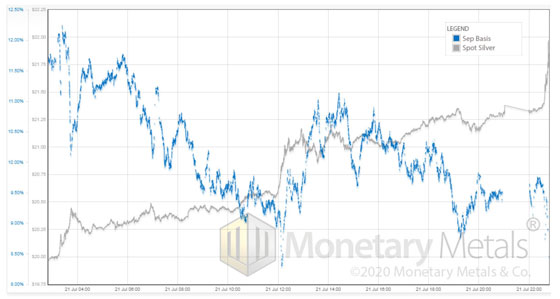
Or, instead of that, we should just show the chart that everyone wants to see. The high-resolution picture of the silver price overlaid with the silver basis.

Silver Price Chart (Monetary Metals)

This is a rare sighting. Perhaps not as rare as Sasquatch or Nessie. But rare nonetheless.

We refer to a day with rising price and falling basis. That means as the price increased, the basis decreased. As silver went from $20 to $22, the basis went from 11.6% to 8.5%.

Basis = Future(bid) – Spot(ask)

Leaving aside all of our fancy theory as to why this indicates falling abundance—that is, there was less silver metal available to the market at the end of the day at $22 than there was at the start of the day at $20—this action shows something simpler and obviouser.

The price of spot moved up closer to the price of the futures contract (the futures price is still quite a bit higher than the spot price). This tells us that the buying which drove the price up so much was…

…buying of physical metal.

It is worth mentioning that, with the market makers still notable by their absence, the basis is very high and the move down was very big. This does not alter the above conclusion, that the buying was buying of physical metal. It just means that the absolute numbers of basis and change in basis should not be taken to mean the same thing as they would if they had occurred a few years ago.

This is a pretty good signal that a bull market may be returning to silver. Let’s watch the basis and price action closely and see how it develops, before we join the pack by taking a straight edge to a price chart starting at March and drawing a line up and to the right, to pick a price target.

Nomination for the Board of Governors of the Federal Reserve

We read the news today that Judy Shelton has been approved by the Senate Banking Committee. This means that the full Senate can vote whether or not to approve her.

She is not liked in many quarters in Washington. Unlike President Trump’s pick for the other vacant seat (Christopher Waller), the vote on Dr. Shelton fell along strict party lines.

The reason for the antipathy is that she has promoted heretical ideas, dangerous ideas. Ideas about gold, and about a gold-backed Treasury bond. She has said that the US should return to a gold standard (though, alas, she has more recently called for the Fed to cut interest rates).

Given the entire theory developed by Keith Weiner, and our very raison d’etre, we feel we should comment on the prospect of Shelton joining the Fed. We should also disclose that Keith knows Judy, and has discussed gold bonds with her.

The Friedmanites and Keynesians who populate the Fed have the same stale, old ideas. We have remarked many times that their only debate is whether to centrally plan our economy based on discretion or whether to centrally plan our economy based on rules. And within the latter camp, the choice of rules is limited to targeting one or more of: inflation, unemployment, GDP, and the quantity of dollars.

Our opinion is that Dr. Shelton has some new and better ideas.

We make no prediction as to the politics she may encounter at the Fed. But there is a more fundamental problem. The Fed is a central planning agency. Its nature cannot be changed. And there is no good way to do central planning. There is no such thing as a good central plan.

We will not join the chorus cheering for her appointment. This is not because we don’t like her. If a person with a reputation for good ideas joins an organization with a reputation for central planning, it is the latter reputation that will survive.

Some might criticize us, and demand if we don’t care to minimize the harm inflicted by the Fed. Isn’t it better to have good people at the Fed, than bad?

To which we reply: we trust the Fed well enough to keep working towards its true purpose. Forget GDP and inflation and unemployment. The job of the central bank is to enable the government and its cronies to borrow more, more cheaply.

And this includes keeping them solvent. We trust the Fed will do what it needs to do to the quantity of dollars and the interest rate. And to buy whatever securities it needs to buy, to stave off the insolvency of any financial intermediary it cares about.

In other words, it will keep the capital-consuming machine going as long as it can, heedless of the consumption of capital. This will hold true with or without Dr. Shelton.

We wish her the best, but this does not alter our view of the Fed one iota. Or our mission to revive the gold standard, by paying interest on gold and silver to everyone.

       
Categories
Gold

How High Will Silver Go? – Money Metals Exchange

The torrid rally in the silver market reached a major milestone this morning as prices hit $21/oz.

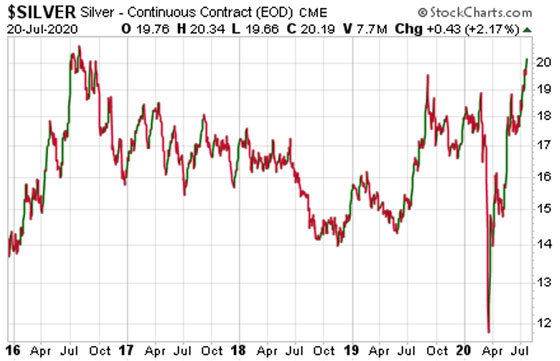
On Monday, the silver spot price tracked by Money Metals Exchange closed at $20.12 (the futures market price settled at $20.19).

That marks the first above-$20 close for silver since 2016.

The white-hot silver market is busting through some resistance levels that should clear the way for higher highs ahead. Silver prices traded up Tuesday morning to $21.21 oz.

How high will silver ultimately go?

Silver Price Chart (July 20, 2020)

Technical traders believe that a decisive break above $21 will send silver zooming up to $26 over a relatively short period of time. If silver breaks above $26, then prior highs come into play, including the all-time high around $49.

In terms of U.S. dollars, there is no particular upper limit since the currency is under a continuous devaluation campaign. The value of the dollar might only depreciate at about 2% per year as “targeted” by the Federal Reserve.

Or it could at some point begin to depreciate a much more rapid pace, sending silver and other hard assets much higher in nominal terms.

Silver could, however, become overvalued in real terms – that is, too expensive relative to other assets including gold, copper, real estate, and stocks. It could happen down the road… but not anytime soon.

It was only four months ago that silver was fetching a historically cheap price in real terms. It traded its largest discount to gold on record and its lowest level relative to the stock market in a generation.

Since then, silver has shot up 75% – from just under $12/oz to $21. That near-vertical rate of ascent can’t be sustained in perpetuity. The market will eventually have to pull back and cool off before re-launching into a new upleg.

However, investors who are hoping to be able to accumulate more silver at lower prices won’t necessarily get that opportunity. The market could well spike to $26/oz on momentum buying before suffering any significant retracement.

When silver crossed above $20/oz four years ago, it didn’t stay up there for long. Some additional back-and-forth between bulls and bears could be in the cards before sub-$20 silver is finally a thing of the past.

Silver Bull

The good news for bulls is that there appears to now be strong support within the former resistance zone of $18.50-$19.75/oz.

When that range is viewed from the perspective of downside potential versus a long-term upside target at the former all-time high of $49.50/oz, buying silver in the low $20s still represents a favorable risk/reward opportunity.

Of course, many silver bugs are eying triple-digit prices in the bull market ahead. Silver could conceivably hit $100, $150, or even higher levels on fears of physical shortages or a currency crisis.

One thing that is guaranteed in the silver market is volatility. Riding out swings in silver prices is like saddling up on a wild, untamed horse. It will try to throw you off at every turn.

The classic TV series “The Lone Ranger” featured a hero who rode on “the thundering hoofbeats of the great horse Silver.” Famously, the Lone Ranger would intone, “Come on, Silver! Let’s go, big fellow! Hi-yo, Silver! Away!”

Silver investors who are able to hang on to their position – and add to it when opportunities present – will be saying “Hi-yo, Silver!” too as prices move to higher highs.

The Lone Ranger carried actual silver bullets as symbols of his steadfast pursuit of justice against evildoers. Similarly, gold and silver coins are symbols of the justice of sound money against the evils perpetuated by politicians and bankers who control the fiat monetary regime.

Unfortunately, justice in real life is complicated and often elusive. The bad guys aren’t always punished, and the good guys don’t always win.

What will win out ultimately is economic reality. The forces of supply and demand are much like the immutable laws of nature.

They exert pressure on prices regardless of our wishes or moral considerations.

Some investors will benefit while others will get hurt from the price trends ahead. If unprecedented levels of government stimulus and Federal Reserve currency creation begin to produce higher rates of price inflation without generating real economic growth, then stagflation could be a portfolio killer for conventional stock and bond allocations.

If stagflation contributes to rising safe-haven demand for precious metals – which are currently facing supply challenges thanks to COVID-related shutdowns of mines and refineries – then physical silver could prove to be an ideal portfolio diversifier.

We’ve already seen some of silver’s explosive price potential exhibited this year. Even bigger moves are likely still to come.

       
Categories
Gold

Genesis Metals Builds High-Grade Ounces at Chevrier

Source: James Kwantes for Streetwise Reports   07/21/2020

James Kwantes of Resource Opportunities profiles a company with a project in Quebec’s Abitibi Greenstone Belt.

Genesis Metals Corp. (GIS:TSX.V; GGISF:OTC) is building ounces and grade at its Chevrier project in Quebec’s Abitibi Greenstone Belt, as Phase 1 drill results outline growing zones of higher-grade material within the existing Main Zone deposit. The drill results are changing the profile of the deposit, which hosts current indicated mineral resources of 395,000 ounces (8.5 Mt averaging 1.45 g/t gold; cutoffs 0.5 g/t open pit and 0.95 g/t underground) and inferred mineral resources of 254,000 ounces (5.9 Mt averaging 1.33 g/t gold; cutoffs 0.5 g/t open pit and 0.95 g/t underground).

The latest drill intercepts are well above those average grades, with highlights including:

  • GM20-63: 9.71 g/t Au over 3.65 meters (within 76 meters of 1.93 g/t)
  • GM20-64: 9.73 g/t Au over 4.5 meters (within 84 meters of 1.65 g/t)
  • GM20-64: 9.64 g/t Au over 2.3 meters
  • GM20-64: 14.4 g/t Au over 2.2 meters
  • GM20-65: 5.57 g/t Au over 3.2 meters

Those intercepts were part of the second and final batch of assays from the 2,500-meter drill program at Chevrier that focused on southwest and northeast portions of the Main Zone. Most of the current resource estimate is contained within the Main Zone, with the East Zone hosting a small Inferred resource. Genesis used a new 3D model to better understand distribution and controls on high-grade gold mineralization.

Genesis CEO David Terry and his team are now reviewing the drill hole data as they evaluate the best targets for follow-up drilling, which is fully funded. The next drill program will likely take place in late summer or early fall; a further 5,500 meters of drilling is planned for the remainder of 2020.

Each of the Phase 2 intercepts above starts within 200 meters of surface, and holes 63 and 64 hit high-grade within wider mineralized envelopes. That bodes well for future inclusion in the pit-constrained resource once Genesis updates the Chevrier resource estimate. Hole 65 also hit deeper gold mineralization: 5.14 g/t Au over 3.95 meters from 213.3 meters downhole, and 7.88 g/t Au over 3.1 meters from 227.5 meters downhole.

Those assays followed Phase 1 drill results from Chevrier announced on June 2 that included:

  • 8.92 g/t Au over 1.0 meters (within 1.79 g/t over 7.35 meters)
  • 3.99 g/t Au over 3.0 meters
  • 10.2 g/t Au over 1.15 meters (within 1.36 g/t over 19.7 meters)

“We look forward to additional drilling to better define this new high-grade component of the deposit, and to results from the ongoing surface exploration program focused on advancing priority targets elsewhere on the large Chevrier project,” Terry stated.

Likely targets include further definition of higher-grade shoots within and below the existing Main Zone deposit, as well as several high-priority targets elsewhere at Chevrier identified through last year’s property-wide glacial till survey. Ground prospecting to further refine those targets continues.

The biggest beneficiaries in this emerging gold bull market are juniors that can hit meaningful drill results containing high-grade gold. The Phase 1 drill program has delivered that for Genesis, with several hits that are multiples of average grades at the existing deposit. The company’s $15-million valuation—less than many pre-drill juniors—is backstopped by Chevrier’s existing gold resource and now, growing higher-grade zones.

The widths and grades of Genesis’s Phase 1 drill program compare favorably to the mineralization at well-known Canadian gold deposits including SSR Mining’s Seabee underground gold mining operation in northern Saskatchewan. Seabee’s average reserve grades are just above 10 g/t gold and the company is underground mining widths of 1-2 meters.

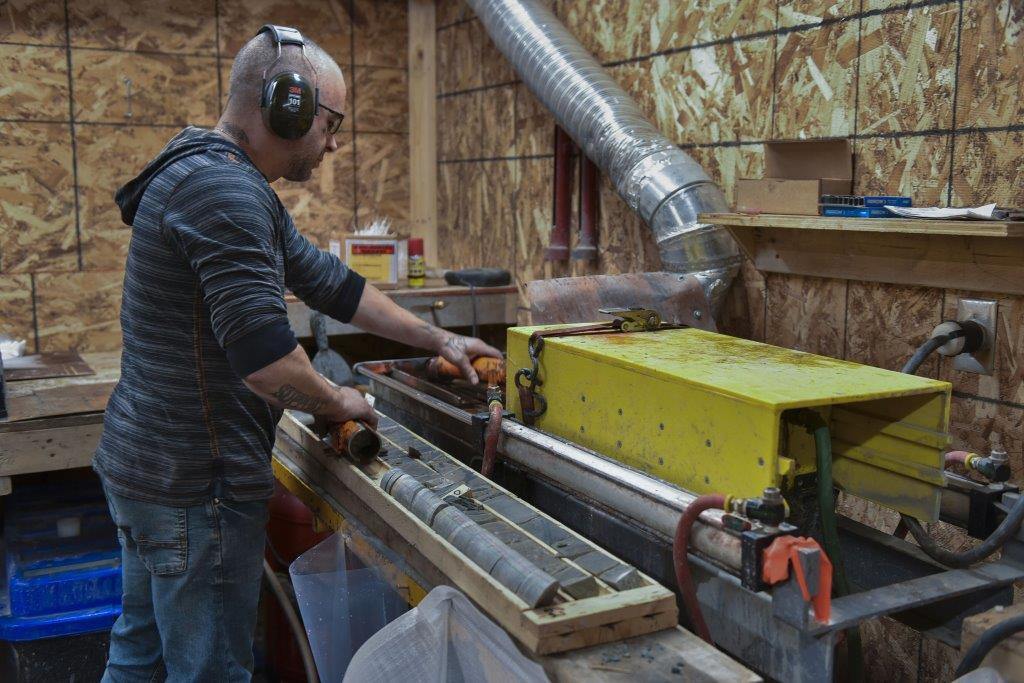
GIS drill core
Chevrier Drill Core

Genesis, of course, is an earlier-stage play. But the company’s shares remain under the radar, with the stock trading at or below where it spent most of 2019. That’s despite the developing high-grade zones as well as these positive features:

  • Backing of the serially successful Discovery Group;
  • Located on a highway and near rail lines in the eastern Abitibi greenstone belt in a thriving mining district (Chibougamau) with other high-grade discoveries;
  • More than $2 million in the treasury for further drilling later this year.
  • Fresh approach under the leadership of Dr. David Terry and property-wide investigation and analysis, starting with soils.

Chibougamau is a rich gold mining district of high-grade discoveries and historical mines. More than 6.7 million ounces of gold has been mined in the area and there are plenty more ounces in the ground—including at high grades. Just southwest of Chevrier is the Monster Lake JV, where IAMGOLD and JV partner TomaGold have delineated 433,300 ounces of gold at 12.14 g/t Au.

Team, backers, project and neighborhood—it all matters. So does price of entry. There’s a lot of money chasing a small number of hot junior stocks that have been running hard. But the big money is made positioning in promising plays that have yet to move. Genesis’s current valuation may spell opportunity for investors confident that this top team will identify more high-grade gold, both within the existing deposit and through discoveries elsewhere on the 290-sq-km property.

James Kwantes is the editor of Resource Opportunities, a subscriber supported junior mining investment publication. Kwantes has two decades of journalism experience and was the mining reporter at Vancouver Sun, the city’s paper of record.

Sign up for our FREE newsletter at: www.streetwisereports.com/get-news

Disclosure: Genesis Metals is one of three Resource Opportunities sponsor companies and James Kwantes owns Genesis Metals shares, which makes him biased. This article is presented for information purposes and is not investment advice. All investors need to do their own due diligence.

Streetwise Disclosure:
1) James Kwantes’ disclosures are listed above.
2) The following companies mentioned in this article are billboard sponsors of Streetwise Reports: None. Click here for important disclosures about sponsor fees. The information provided above is for informational purposes only and is not a recommendation to buy or sell any security.
3) Statements and opinions expressed are the opinions of the author and not of Streetwise Reports or its officers. The author is wholly responsible for the validity of the statements. The author was not paid by Streetwise Reports for this article. Streetwise Reports was not paid by the author to publish or syndicate this article. Streetwise Reports requires contributing authors to disclose any shareholdings in, or economic relationships with, companies that they write about. Streetwise Reports relies upon the authors to accurately provide this information and Streetwise Reports has no means of verifying its accuracy.
4) The article does not constitute investment advice. Each reader is encouraged to consult with his or her individual financial professional and any action a reader takes as a result of information presented here is his or her own responsibility. By opening this page, each reader accepts and agrees to Streetwise Reports’ terms of use and full legal disclaimer. This article is not a solicitation for investment. Streetwise Reports does not render general or specific investment advice and the information on Streetwise Reports should not be considered a recommendation to buy or sell any security. Streetwise Reports does not endorse or recommend the business, products, services or securities of any company mentioned on Streetwise Reports.
5) From time to time, Streetwise Reports LLC and its directors, officers, employees or members of their families, as well as persons interviewed for articles and interviews on the site, may have a long or short position in securities mentioned. Directors, officers, employees or members of their immediate families are prohibited from making purchases and/or sales of those securities in the open market or otherwise from the time of the interview or the decision to write an article until three business days after the publication of the interview or article. The foregoing prohibition does not apply to articles that in substance only restate previously published company releases.

Resource Opportunities Disclaimer: Readers are advised that this article is solely for information purposes. Readers are encouraged to conduct their own research and due diligence, and/or obtain professional advice. The information is based on sources which the publisher believes to be reliable, but is not guaranteed to be accurate, and does not purport to be a complete statement or summary of the available data.

( Companies Mentioned: GIS:TSX.V; GGISF:OTC,
)

Categories
Gold

Blackrock Hits Bigly Silver in Nevada

Source: Bob Moriarty for Streetwise Reports   07/21/2020

Bob Moriarty discusses the company’s off-the-charts drill results at its Nevada silver project.

Blackrock Gold Corp. (BRC:TSX.V; BKRRF:OTCMKTS) announced the first drill results from their latest program at their 100% controlled Tonopah West silver project in Nevada.

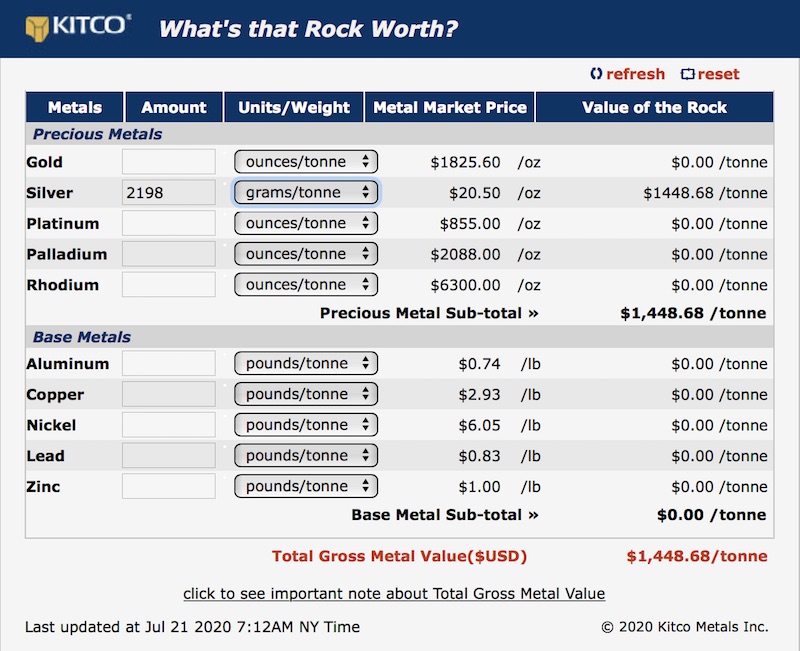
Hole TW20-001 showed two massive silver intercepts. The highest grade was the 2,198 g/t Ag over 3.04 meters.

Silver

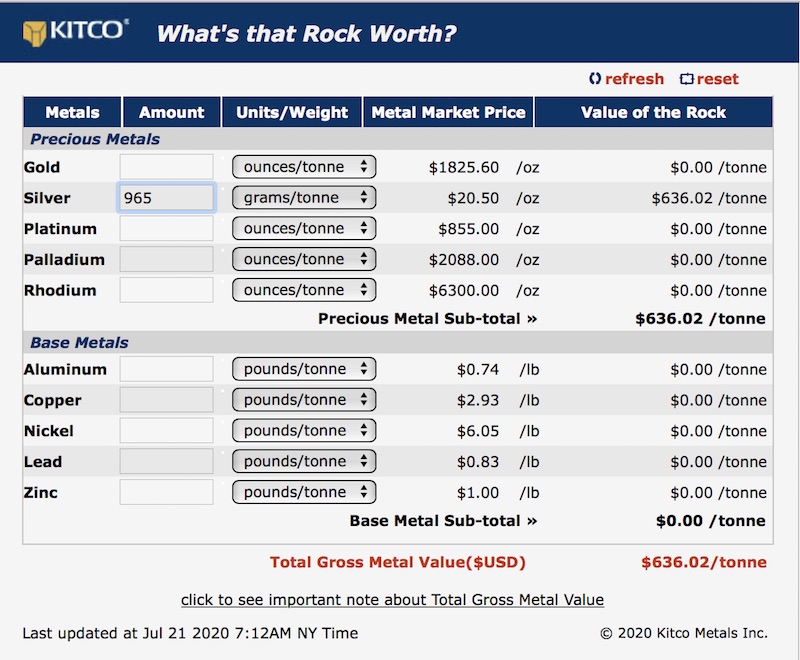
Another layer that was the actual target of the drill hole reported 29 meters of 965 g/t Ag where it intersected the Victor silver vein.

Silver

No wonder the shares were up 102% on the day.

The company has about 20 million warrants outstanding with an average exercise price of $0.25 and some warrants can be forced so the company can count on having another $5 million brought it.

It might be time to change the name of the company from Blackrock Gold to Blackrock Silver because they just brought the Tonopah silver district back to life in a bigly way.

Blackrock is an advertiser. I have participated in several private placements so naturally I am biased. Their website is pretty good and presentation excellent.

Blackrock Gold Corp
BRC-V $0.87 (Jul 20, 2020)
BKRRF-OTCBB 69.4 million shares
Blackrock Gold website

Bob Moriarty
President: 321gold
Archives
321gold

Bob Moriarty founded 321gold.com, with his late wife, Barbara Moriarty, more than 16 years ago. They later added 321energy.com to cover oil, natural gas, gasoline, coal, solar, wind and nuclear energy. Both sites feature articles, editorial opinions, pricing figures and updates on current events affecting both sectors. Previously, Moriarty was a Marine F-4B and O-1 pilot with more than 832 missions in Vietnam. He holds 14 international aviation records.

Sign up for our FREE newsletter at: www.streetwisereports.com/get-news

Disclosure:
1) Bob Moriarty: I, or members of my immediate household or family, own shares of the following companies mentioned in this article: Blackrock Gold. Blackrock Gold is an advertiser on 321 Gold. I determined which companies would be included in this article based on my research and understanding of the sector.
2) The following companies mentioned are billboard sponsors of Streetwise Reports: None. Click here for important disclosures about sponsor fees.
3) Statements and opinions expressed are the opinions of the author and not of Streetwise Reports or its officers. The author is wholly responsible for the validity of the statements. The author was not paid by Streetwise Reports for this article. Streetwise Reports was not paid by the author to publish or syndicate this article. The information provided above is for informational purposes only and is not a recommendation to buy or sell any security. Streetwise Reports requires contributing authors to disclose any shareholdings in, or economic relationships with, companies that they write about. Streetwise Reports relies upon the authors to accurately provide this information and Streetwise Reports has no means of verifying its accuracy.
4) The article does not constitute investment advice. Each reader is encouraged to consult with his or her individual financial professional and any action a reader takes as a result of information presented here is his or her own responsibility. By opening this page, each reader accepts and agrees to Streetwise Reports’ terms of use and full legal disclaimer. This article is not a solicitation for investment. Streetwise Reports does not render general or specific investment advice and the information on Streetwise Reports should not be considered a recommendation to buy or sell any security. Streetwise Reports does not endorse or recommend the business, products, services or securities of any company mentioned on Streetwise Reports.
5) From time to time, Streetwise Reports LLC and its directors, officers, employees or members of their families, as well as persons interviewed for articles and interviews on the site, may have a long or short position in securities mentioned. Directors, officers, employees or members of their immediate families are prohibited from making purchases and/or sales of those securities in the open market or otherwise from the time of the interview or the decision to write an article until three business days after the publication of the interview or article. The foregoing prohibition does not apply to articles that in substance only restate previously published company releases.

( Companies Mentioned: BRC:TSX.V; BKRRF:OTCMKTS,
)

Categories
Gold

Stocks Disconnect from Economy, Gold Responds

Source: Adrian Day for Streetwise Reports   07/21/2020

Given the current uncertainties and recent market moves, money manager Adrian Day offers some thoughts on the macroeconomic environment.

Global stock markets zooming ahead amid historic unemployment and economic contraction is surreal. Half of the U.S. has been locked down, with economies virtually shut, a second virus wave appears underway and yet the stock market is almost back to February’s all-time highs.

And this is not only in the U.S.; stock markets have rallied strongly around the world. We know that central bank money creation is the primary cause, but this dichotomy cannot continue indefinitely, at least without a meaningful correction. Meanwhile, gold—for sounder reasons than stocks—has outperformed and, notwithstanding anticipated volatility, will, we think, continue to do so.

The economic outlook is uncertain

The keyword for the economic outlook is uncertainty. The economy cannot resume the level of January after months of closures, not in anything like the near term. Some sectors will do well, but others will be very slow to recover—office space, for example, or malls. Many small businesses, such as restaurants, will try to do the job with fewer people.

Real unemployment is probably higher than the headline numbers suggest, as furloughed workers are counted as “employed.” And it will get worse as restrictions from layoffs in the government payroll protection loans end. There’s uncertainty about a second wave of the virus and potentially resumed restrictions on businesses. Already, over half of the U.S. population is seeing announced reopenings on hold or reversed.

There is as much uncertainty on the supply side of the equation as the demand. Both will shrink, which is why I do not think we shall see deep and sustained deflation as much as a shrinking economy, with the possibility of inflation later.

Fed policy will destroy the capitalist economy and more

One cannot discuss the economic outlook without discussing the Federal Reserve and other central banks. The dramatic decline in short-term interest rates; the huge explosion in the Fed’s balance sheet, moving from $3.8 trillion to $7.1 trillion over the past year; and the moves by the Fed in rapid succession to buying investment-grade bond funds, then junk bond funds, then individual bonds, raise the question of what comes next. Are negative rates ahead on the next downturn? Where does QE (quantitative easing) Infinity take us? And is the Fed going to start buying equities next? And then we shall start to see selective “debt jubilees,” with the government forcing different lenders to forgive certain types of debt.

The Federal Reserve is buying bonds of companies such as Coca Cola, Apple and Berkshire Hathaway. Why does the government need to lower Warren Buffett’s cost of capital? And they are buying bonds of some foreign companies, including Daimler. Why? This unprecedented—and illegal, by the way—move by an arm of the government into the private financial markets is not receiving sufficient attention, in my view. It is the beginning of a very slippery and dangerous slope indeed.

More and more credit needed to sustain the boom

As with the drug addict who needs ongoing and increased injections to keep the high going, so too with a market dependent on easy money. The longer this continues the more devastating will be the consequences. Fed apologists will say the epidemic was unforeseen and they had to respond. But the truth is that the Fed was already boosting credit recklessly when Corona was just a Mexican beer. From September to February, Fed credit was growing at the fastest rate ever. We would have reached the current state eventually. When thinking of the Fed, one is put in mind of nothing as much as the saying, “When you are a hammer, everything looks like a nail.”

Each Fed easing, never cut back in the good times, leads to the next crisis. The housing bubble was fueled by the easy money of the early 2000s, just as surely as the easy money policy following the credit crisis—and the failure to pull back after the recovery—led to the bubble in bonds and equities that greeted the start of the year. It was a bubble in search of a pin, and had the virus not come to these shores, there surely would have been another crisis and the Fed would surely have reacted similarly.

And if the Fed was unable (or unwilling) to return to normal after the dot-com bust, and despite pledges as early as 2014 to “return to normal,” pitifully unable to do anything like that after QE1, 2 and 3, how can we possibly think they will do so after QE Infinity, and after buying bond funds and junk bonds, without causing massive distortions if they tried?

MMT fuels unrest and leads to chaos

All of this has dramatic effects not only on the economy and investments, but on society itself. It will lead to reduced economic activity and eventual inflation; further erosion of the value of the dollar and destruction of savings; a further explosion in debt. More and more the economy will be dependent on government spending, and individuals on government transfers. Monetary policy will distort prices, and therefore distort asset allocation, lead to excess risk taking and further debt. It increases government power, and with it the tendency to abuse that power, and reduces individual freedoms.

And it will, as it has in the decade after the credit crisis, further exacerbate the wealth gap, leaving behind a growing underclass and destroying the middle class, leading to protest, radicalized politics and social unrest. “Modern Monetary Theory”—not modern, not purely monetary, and not much of a theory—which is now firmly ensconced as government and Fed policy, leads ultimately to social division, violence and chaos. In extreme cases, it ends in war—either a war of aggression, or (by so weakening a society) by invasion, or (by so dividing a society) by civil war. Extreme debasement of the currency always, and everywhere throughout history, has done so, from the last Roman emperors, to the Jin Dynasty, the Stuart Kings and the aftermath of the Weimar Republic.

Reduced economic activity everywhere

The U.S. is not alone. Around the world, economies have experienced reduced economic activity on the different restrictive measures introduced. East Asia generally has fared better than the rest of the world. In Europe, the impact of the virus has varied widely among countries; Europe has the weakest banking sector of any major region while the single-currency Eurozone reduces flexibility. In Latin America, where different countries have their own problems, the virus has been particularly virulent.

In most countries, governments have responded with aggressive monetary and fiscal stimulus. Programs differ, but everywhere governments have introduced measures that are extreme by that country’s standards.

Why are stocks ignoring the economic damage?

The market (per S&P) had the fastest 30% drop in history, followed by the strongest 50-day move ever, back very close to all-time highs. The dichotomy between a contracting economy—with high unemployment and business closings—and the zooming stock markets around the world is stark. The reasons are clear:

  • With interest rates so low around the world, traditional places to put money for safety and income, such as bank CDs and bonds, do not look attractive; stocks benefit.
  • Some are looking ahead and see a recovering economy. They think the worst is behind us. Stocks are forward looking.
  • And most importantly, when central banks create excess liquidity (by definition, liquidity in excess of the requirements of the economy) that money must go somewhere; there is excess liquidity beyond the wildest dreams of Greenspan and Bernanke. It has gone largely into equities.

Arguing against higher stock prices are two simple related issues. We will see weak economic news for the second quarter, and the economy, particularly employment, may not recover to where it was at the start of the year any time soon.

And stock market valuations are high. They were already high in February, but, despite reduced analysts’ expectations, the U.S. market (per S&P) is selling at 26 times forward earnings. That would be a high number in the strongest of economies, but now, with sharp declines likely to be reported in coming weeks, with sluggishness for the next several months and with a great deal of uncertainty, that number is extreme.

The market decline we saw in March, though rapid, is mild compared with declines in periods of economic contraction in the past. And even at the March lows, the market was by no means cheap. It is possible that central bank liquidity trumps all other considerations. That may be true over the medium term. But it is almost inconceivable to think that the decline we saw in mid-March is all we are going to experience.

We agree with Mohamed El-Erian, astute chief economist for Allianz, who says, referring to central bank money printing, “I don’t feel comfortable investing on that basis.”

Near-term volatility expected

The truth is that the market has been very dependent on Fed stimulus for years now, both expecting and demanding it. Each attempt, however timid, at tightening has been met by a market hissy fit and more stimulus. In the near term, second-quarter corporate earnings season, coming soon to a theater near you, could produce some shocks and provoke a sell-off in stocks. At minimum, we expect individual stocks to be hit hard, and we anticipate volatility over this period.

And further out, we would not be surprised to see further, more protracted declines to new lows, perhaps after a year or more. This is not an unusual pattern after very sharp short-term rallies, as experienced most notably following the 1929 crash.

Resources have been hurt by shutdowns

Not surprisingly, most resources took it on the chin from the contraction in economic activity following the lockdowns and restrictions. Oil was the most hard hit, as demand was slashed amid a glut in production. Copper, “the metal with a PhD in economics,” has not been as weak as one might have thought looking only at the economy. Prices did drop to their lowest level in three years, but for the year to date are down only 3%. The main reason has been the significant supply interruptions, particularly from Chile.

Gold, however, is a different story. Completing a seventh consecutive quarterly gain, concluding with the best quarter in four years, gold is above $1,800 for the first time since 2012.

Gold is undervalued—relative to the money supply, and relative to financial assets—and it is underowned. Given that gold is a very small market relative to global stocks and bonds, even a small move by investors into gold will have a significant effect on the price. That is what we are beginning to see now, with emphasis on “beginning.” As more and more investors, small individual investors and large institutions alike, decide to put a part of their assets into gold, the price will move up significantly.

Gold stocks are still cheap; corrections are to be bought

As gold is undervalued, gold shares are undervalued against gold itself. And, despite the recent strong rally, they remain in the lowest 25 percentile in terms of price and valuations. As gold moves up, especially in an environment of low oil prices and generally low currencies (the two largest cost inputs in a mining operation), much of that increase flows to the bottom line. Mining companies, with a newfound discipline and a more favorable environment, are generating free cash flow for the first time in many, many years.

We remain somewhat concerned about the possibility of a pullback in the price of gold. I do not anticipate that such a correction would be particularly deep or long-lasting, but a pullback in gold itself would see meaningful corrections in the mining stocks, particularly after such strong short-term appreciation.

Will gold stocks fall if the broad market does?

Certainly, if we see a broad stock market decline in coming weeks, the gold stocks could initially fall with the market. Generally, gold stocks have been more vulnerable when the following conditions are present: the market drops sharply in a short period of time; there is a liquidity panic; gold drops; and the stocks are expensive entering the correction.

Generally, gold stocks have been less vulnerable when the broad market decline is slow and protracted; when it is more selective; when gold does not decline; and when gold stocks are not overvalued.

Based on those criteria, we may see a relatively short and shallow pullback, but it will be neither a crash nor the start of a long period of lower prices. Our list of “Current Recommendations” already emphasizes gold and silver stocks, but we would use any near-term pullback to add to positions.

Buy now? Sell now? It all depends

A newsletter provides one-size-fits-all recommendations: “buy this”; “sell this”. (We try to differentiate by saying X is appropriate for conservative investors, Z for speculators.) But money management is not like that, whether you have an outside manager or are doing it yourself. One investor might say he has sufficient exposure to gold and silver even if there never is the opportunity to buy any more, whereas another investor, new to the sector, should step up now and at least take initial positions.

Buying this week

This week we are buying very little. For investors who do not own, we would buy Lara Exploration Ltd. (LRA:TSX.V) (0.76), which has corrected after a very strong move; and Kingsmen Creatives Ltd. (KMEN:SI) (0.205), which remains inexpensive. Some of the stocks on our list are expensive and ahead of themselves, such as Franco-Nevada Corp. (FNV:TSX; FNV:NYSE), but we are not going to try to be clever and trade our position. An investor, however, will take many factors into consideration: the allocation to any single stock, whether it is held in a tax-exempt account (if he has a lot of tax losses) and so on.

Originally posted on July 19, 2020.

Adrian Day, London-born and a graduate of the London School of Economics, heads the money management firm Adrian Day Asset Management, where he manages discretionary accounts in both global and resource areas. Day is also sub-adviser to the EuroPacific Gold Fund (EPGFX). His latest book is “Investing in Resources: How to Profit from the Outsized Potential and Avoid the Risks.”

Sign up for our FREE newsletter at: www.streetwisereports.com/get-news

Disclosure:
1) Adrian Day: I, or members of my immediate household or family, own securities of the following companies mentioned in this article: Lara Exploration, Kingsmen Creatives, Franco-Nevada. I personally am, or members of my immediate household or family are, paid by the following companies mentioned in this article: None. My company has a financial relationship with the following companies mentioned in this article: None. Funds controlled by Adrian Day Asset Management hold shares of the following companies mentioned in this article: All. I determined which companies would be included in this article based on my research and understanding of the sector.
2) The following companies mentioned in this article are billboard sponsors of Streetwise Reports: None. Click here for important disclosures about sponsor fees. The information provided above is for informational purposes only and is not a recommendation to buy or sell any security.
3) Statements and opinions expressed are the opinions of the author and not of Streetwise Reports or its officers. The author is wholly responsible for the validity of the statements. The author was not paid by Streetwise Reports for this article. Streetwise Reports was not paid by the author to publish or syndicate this article. Streetwise Reports requires contributing authors to disclose any shareholdings in, or economic relationships with, companies that they write about. Streetwise Reports relies upon the authors to accurately provide this information and Streetwise Reports has no means of verifying its accuracy.
4) This article does not constitute investment advice. Each reader is encouraged to consult with his or her individual financial professional and any action a reader takes as a result of information presented here is his or her own responsibility. By opening this page, each reader accepts and agrees to Streetwise Reports’ terms of use and full legal disclaimer. This article is not a solicitation for investment. Streetwise Reports does not render general or specific investment advice and the information on Streetwise Reports should not be considered a recommendation to buy or sell any security. Streetwise Reports does not endorse or recommend the business, products, services or securities of any company mentioned on Streetwise Reports.
5) From time to time, Streetwise Reports and its directors, officers, employees or members of their families, as well as persons interviewed for articles and interviews on the site, may have a long or short position in securities mentioned. Directors, officers, employees or members of their immediate families are prohibited from making purchases and/or sales of those securities in the open market or otherwise from the time of the interview or the decision to write an article until three business days after the publication of the interview or article. The foregoing prohibition does not apply to articles that in substance only restate previously published company releases. As of the date of this article, officers and/or employees of Streetwise Reports LLC (including members of their household) own securities of Lara Exploration and Franco-Nevada, companies mentioned in this article.

Adrian Day’s Global Analyst disclosures: Staff may have positions in securities discussed herein. Adrian Day is also President of Global Strategic Management (GSM), a registered investment advisor, and a separate company from this service. In his capacity as GSM president, Adrian Day may be buying or selling for clients securities recommended herein concurrently, before or after recommendations herein, and may be acting for clients in a manner contrary to recommendations herein. This is not a solicitation for GSM. Views herein are the editor’s opinion and not fact. All information is believed to be correct, but its accuracy cannot be guaranteed. The owner and editor are not responsible for errors and omissions. © 2020.

( Companies Mentioned: FNV:TSX; FNV:NYSE,
LRA:TSX.V,
)

Categories
Gold

Debt Is Neither Free Nor Irrelevant

The world is drowning in debt. And central bank policies globally are encouraging even more borrowing. Most people don’t seem to care. “This is necessary during this time of crisis,” has become the mantra. But the ugly truth is the world was already drowning in debt before the coronavirus pandemic. The government response to COVID-19 […]
Categories
Gold

Peter Schiff: Silver Has a Long Way to Go

On July 21,  we reported that silver had powered above $20 an ounce and was at a six-year high. The very next day, the white metal blasted through $21 an ounce and was approaching $22. So what does silver’s breakout really mean? Peter Schiff talked about it in his podcast. Peter opened up the show […]
Categories
Gold

Inflation/Deflation: The Economy Is an Elephant

Different parts of the economy might experience sharp deflation while other parts are experiencing rapid inflation. What each household…  by Charles Hugh Smith via Of Two Minds July 22, 2020 […]

The post Inflation/Deflation: The Economy Is an Elephant appeared first on Silver Doctors.

Categories
Gold

US Expels China From Houston Consulate: Is Pompeo Pushing To Spark China War?

In an incredible escalation, the US State Department has demanded that China evacuate its consulate in Houston… by Daniel McAdams and Ron Paul of Ron Paul Liberty Report US Secretary […]

The post US Expels China From Houston Consulate: Is Pompeo Pushing To Spark China War? appeared first on Silver Doctors.

Categories
Gold

GOVERNMENT PUSHES FORWARD THE FED’S PLAN: STIMULUS PACKAGE TO FOCUS ON “KIDS, JOBS, & VACCINES”

President Donald Trump’s administration is helping the Federal Reserve push through their plans for the New World Order…  by Mac Slavo of SHTFplan President Donald Trump’s administration is helping the […]

The post GOVERNMENT PUSHES FORWARD THE FED’S PLAN: STIMULUS PACKAGE TO FOCUS ON “KIDS, JOBS, & VACCINES” appeared first on Silver Doctors.