Categories
Gold

The Great White North of Debt: What Canada’s Monetary Policies Mean

Source: Michael Ballanger for Streetwise Reports   06/29/2020

Sector expert Michael Ballanger breaks down the Canadian government’s monetary policies, and offers an anecdote drawing correlations between positioning in gold now and positioning in gold in the 1970s, before the commodity’s “parabolic” ascent.

As I sit here on a Thursday evening, contemplating the logic behind my most recent additions to a highly tentative short position on the SPY:US (the exchange-traded fund [ETF] tracking the S&P 500), I am doing everything in my power to not take my quote machine and project it into the watery abyss of lovely Lake Scugog.

If there were a number of politicians or central bankers lined up on the shoreline, I would not hesitate to fire off a volley of quote machines, cellular phones, portable chargers, paperweights, ash trays and medicine balls all in a concerted effort to decapitate the singular most useless collection of heads ever assembled on any shoreline, notwithstanding the fact that the bodies would only float on a one-inch layer of water, while the weeds, algae and flotsam exist in the four feet to the lake bottom (not that anyone can see it after June 10).
The venerable Justin Trudeau, son of Pierre, the current prime minister of Canada and the son of the most treasonous politician in Canada’s history, has now officially assumed the role as the most incompetent human being ever to have been elected to public office in any jurisdiction north of the 49th Parallel. Not only is he the most incompetent, he is arguably the most malleable elected official in the history of post-Magna Carta politics, kowtowing to every liberal cause that surfaces while carefully turning a blind eye to corporate malfeasance in order to protect donations.

Under the stewardship of Monsieur Trudeau, Canada has finally forfeited its AAA rating by the bond market handicappers. Layer upon layer of government debt has been added to the already burgeoning household debt figures, and thanks to the Canadian banking industry’s shameless practice of laundering illicit Asian money in order to pump up the real estate bubble, young citizens are taking on massive mortgage exposure just to get a roof over their heads close to the workplace.

Canada is now rated alongside Portugal, Italy and Greece in terms of credit “worthiness.” This is not because it is without natural resources or a sophisticated, educated labor force; the country is rated like a banana republic for two reasons. The first is the sub-par quality of its leadership and the second is its educators, the incredibly powerful Canadian Teachers Federation, is actively promoting the idea that liberal is “good,” conservative is “bad,” and that “Modern Monetary Theory” can be implemented to remove all financial responsibility as an obligation of success.

Job losses due to shrinking global trade are replaced with government paychecks because, after all, it was not the fault of the worker loading pallets onto trucks that the employer could not afford to use him anymore. Justin and his band of spendthrifts throw money at the unemployed pallet loader and then backstop the employer’s junk bond issue with yet another bailout, thus covering both ends of the voting spectrum with money printed in a manner most popular with Federal Reserve Chairman Jerome Powell—digitally.
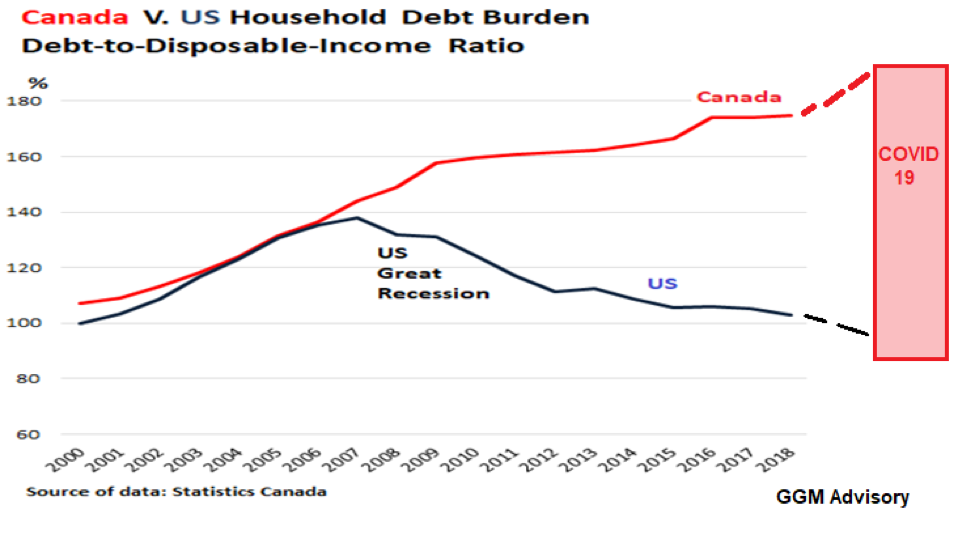
The percentage of household debt to disposable income is today approaching 180%, and that is a meaningless number to most until one sees that at the peak of the U.S. housing bubble in 2007, that number peaked at 140%. The U.S. is certainly no ideal model of sound money practices either, at the household or the federal level, but one can see that the trend in the U.S. is down while Canada (at least as of two years ago) was accelerating. With the insanity of the liberal government reaction to the pandemic and economic collapse, the Canadian numbers are certainly no better today.

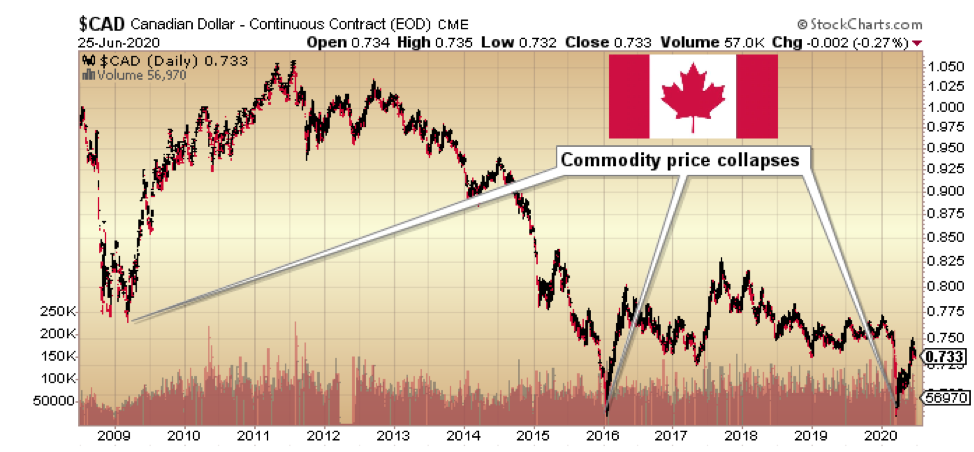
The Canadian currency has been on a roller coaster ride since the lows of 2009, and has been almost perfectly correlated to oil prices. But for Canadians, the significance of the CAD/USD relationship lies in how gold has responded since 2009, in light of the fact that neither the Bank of Canada nor the Canadian treasury owns as much as a single ounce of gold.
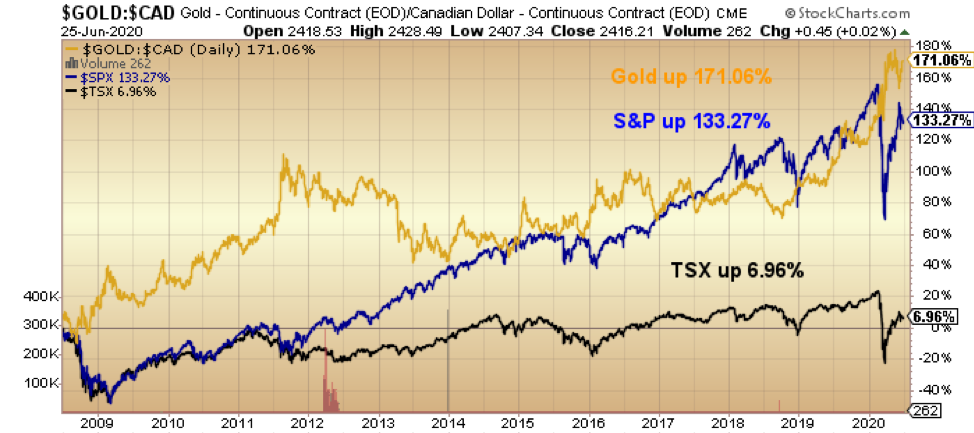
At the lows of Q1/2009, had the average Canadian sold all bonds and stocks and simply bought gold, he/she would be ahead 171.06% in that time frame. In the same period, the TSX is up a hair below 7%. The S&P 500 is up 133.27% in U.S. dollar terms, but a striking 215% when the currency gain is calculated.

Nevertheless, the point I make is that for a country that has just seen its credit rating slashed and whose household finances are, on a per capita basis, simply dreadful, its citizens have an urgency to place a significant portion of their investible net worth into gold. Currencies of countries that get downgraded tend to experience sustained and significant drawdowns in purchasing power, so Canadians that are ten to twenty years from retirement should not be relying on traditional sources of capital (like one’s residence) to make up the shortfall.

Foreign investors need not worry about Canadian markets as long as they stick to precious metals producers and developers, because any domestic currency risk will be offset by the domestic hedge that Canadian gold producer/developers hold through ounces in the ground. In fact, valuations could be accentuated because of rising cash-flows and increased dividend payouts.

As we approach the end of June and move into the seasonally strong period of August-to-May for precious metals, I deem it important to relate a story from the 1970s, when I was a trainee for a big Canadian brokerage firm (McLeod Young Weir Ltd.).

There was an Irishman named “Jimmy” who, in the early ’70s, before gold exploded, was one of the “marginal” producers in the Toronto branch. He came in every morning with a brown paper bag full of sandwiches and a cookie and quietly went about his business of calling his clients and discussing his strategy for the next five years. Not too many people paid any attention to Jimmy because he had little to say about stocks and nothing to say about bonds; he never bought any of McLeod’s underwritings and he never read any McLeod research.

Many around me wondered why he was still employed but somewhere around 1977 (shortly after I entered the training program), I got to know him because he would give me these European reports on a group of companies called the “South African golds,” and they absolutely fascinated me. Why, I thought, was this man accumulating all these 10-cent and six-cent and 15-cent South African gold miners? Was South Africa not a risky place to do business? Was apartheid not attracting the scorn of the world with increasing frequency?

One afternoon in 1978, I saw the brokerage rankings for the firm, and Jimmy had inexplicably vaulted from back-of-the-pack to the Top Five in the entire firm. I raced over to congratulate him and asked him how he did it. The story he told me changed my life for many years.

He began to doubt the U.S. dollar’s role as the world’s reserve currency after listening to a 1969 European speech by former French President Charles De Gaulle, in which he told a group of French business leaders that France would no longer accept American dollars as payment for bonds that were maturing. Instead, they would choose to receive gold, because back then the U.S. dollar was exchangeable for gold at a predefined ratio.

As this trend accelerated due to Vietnam War costs and other profligate spending by the U.S., it became apparent to President Nixon that if it continued, Fort Knox would be stripped of its gold. Shortly thereafter, the gold exchange “window” was closed, and the Bretton Woods agreement was shelved, thus allowing the gold price to freely float as opposed to the U.S.-imposed “peg” at US$35 per ounce.

Jimmy saw this and started to put all clients into a group of South African gold miners (“ADRs”), but his top pick was a stock called “Vaal Reefs,” which he was buying at around US$1.00 per share. He explained to me that it had a dividend at $0.20 per annum, so while other brokers were buying the Canadian banks at 5% yields and long Canadas at 8% yields, Irish Jimmy was buying this obscure gold miner at a 20% yield, with gold then at US$200 per ounce.

By 1979, gold had moved from US$200 to $500, but what turned out to be “the wonder of commodity price leverage” was that Vaal Reefs management, in keeping with their dividend payout policy, had been steadily increasing that dividend. By the time gold started its parabolic ascent to US$857 in 1980, that $0.20 dividend had grown to $1.00, which was the original price Jimmy had paid for his shares! Needless to say, by 1980, Vaal Reefs had something like a $2 dividend and traded north of US$30.

Jimmy had started his career in the investment business in 1968 with a $5 million book of clients, but by 1980, his wizardry during the Great Inflation of the Seventies, focusing on the leverage of rising dividends during a commodity boom, grew his book to over $300 million. After that, he sold all positions in the South Africans, sent his clients all of their money, and promptly retired.

That is precisely what I envision in the coming months and years, as a direct result not of “profligate wartime spending,” as in 1968, but of the total disrespect by central banks the world over for the sanctity of currency purchasing power. I urge all of you to remember the story of Irish Jimmy, who placed faith and trust in gold as a bastion of financial prudence and was rewarded by clients and the fates for his efforts.

We are in the early stages of a Seventies-style enrichment event, and the vehicle of delivery is gold. I see another month of sideways action, and then all hell is going to break loose.

You want to be positioned.

Originally published June 26, 2020.

Follow Michael Ballanger on Twitter @MiningJunkie.

Originally trained during the inflationary 1970s, Michael Ballanger is a graduate of Saint Louis University where he earned a Bachelor of Science in finance and a Bachelor of Art in marketing before completing post-graduate work at the Wharton School of Finance. With more than 30 years of experience as a junior mining and exploration specialist, as well as a solid background in corporate finance, Ballanger’s adherence to the concept of “Hard Assets” allows him to focus the practice on selecting opportunities in the global resource sector with emphasis on the precious metals exploration and development sector. Ballanger takes great pleasure in visiting mineral properties around the globe in the never-ending hunt for early-stage opportunities.

Sign up for our FREE newsletter at: www.streetwisereports.com/get-news

Disclosure:
1) Statements and opinions expressed are the opinions of Michael Ballanger and not of Streetwise Reports or its officers. Michael Ballanger is wholly responsible for the validity of the statements. Streetwise Reports was not involved in any aspect of the article preparation. Michael Ballanger was not paid by Streetwise Reports LLC for this article. Streetwise Reports was not paid by the author to publish or syndicate this article.
2) This article does not constitute investment advice. Each reader is encouraged to consult with his or her individual financial professional and any action a reader takes as a result of information presented here is his or her own responsibility. By opening this page, each reader accepts and agrees to Streetwise Reports’ terms of use and full legal disclaimer. This article is not a solicitation for investment. Streetwise Reports does not render general or specific investment advice and the information on Streetwise Reports should not be considered a recommendation to buy or sell any security. Streetwise Reports does not endorse or recommend the business, products, services or securities of any company mentioned on Streetwise Reports.
3) From time to time, Streetwise Reports LLC and its directors, officers, employees or members of their families, as well as persons interviewed for articles and interviews on the site, may have a long or short position in securities mentioned. Directors, officers, employees or members of their immediate families are prohibited from making purchases and/or sales of those securities in the open market or otherwise from the time of the interview or the decision to write an article until three business days after the publication of the interview or article. The foregoing prohibition does not apply to articles that in substance only restate previously published company releases.

Michael Ballanger Disclaimer:
This letter makes no guarantee or warranty on the accuracy or completeness of the data provided. Nothing contained herein is intended or shall be deemed to be investment advice, implied or otherwise. This letter represents my views and replicates trades that I am making but nothing more than that. Always consult your registered advisor to assist you with your investments. I accept no liability for any loss arising from the use of the data contained on this letter. Options and junior mining stocks contain a high level of risk that may result in the loss of part or all invested capital and therefore are suitable for experienced and professional investors and traders only. One should be familiar with the risks involved in junior mining and options trading and we recommend consulting a financial adviser if you feel you do not understand the risks involved.

Categories
Gold

Technical Analyst: Gold Bull Market Well Established in Many Currencies

Source: Clive Maund for Streetwise Reports   06/29/2020

Technical analyst Clive Maund discusses the price of gold in various currencies and what he believes is ahead for gold, the U.S. dollar and the stock markets.

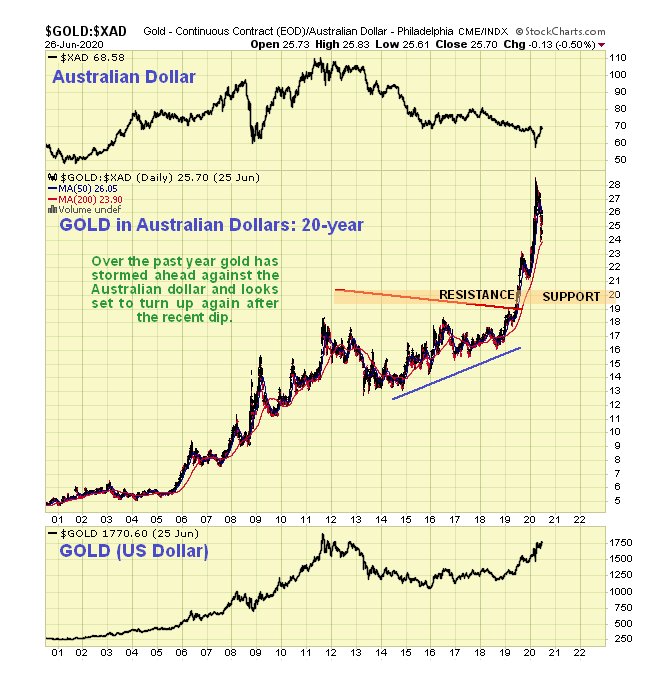
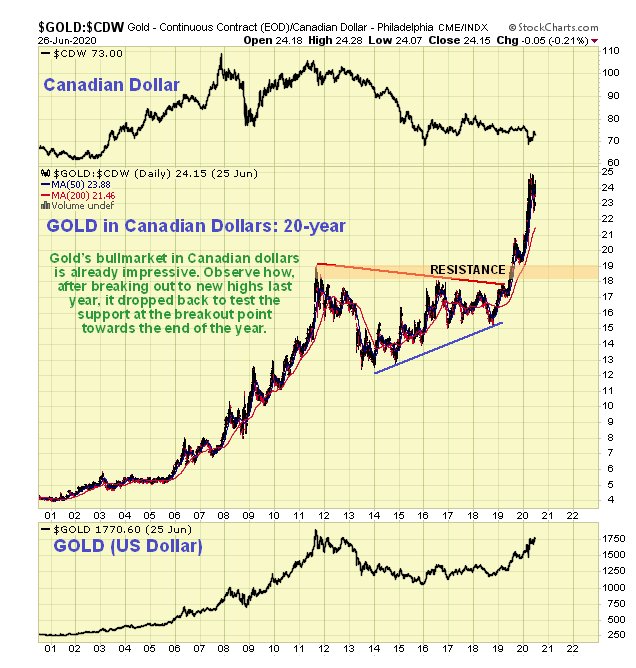
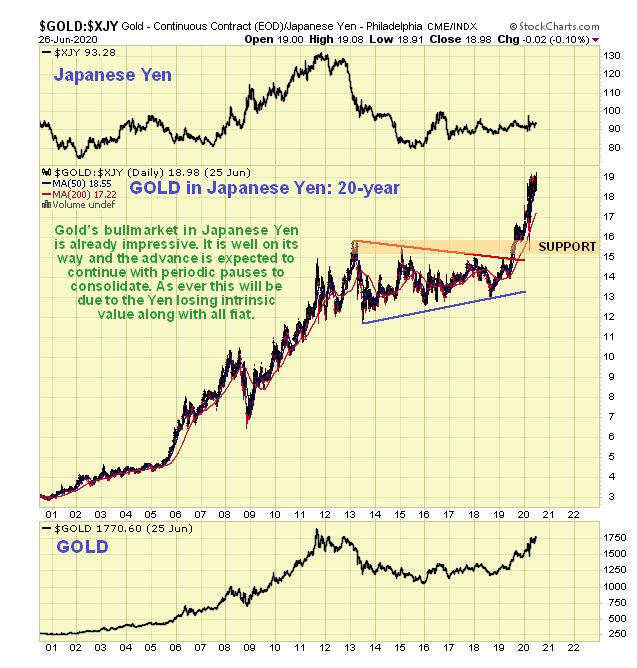
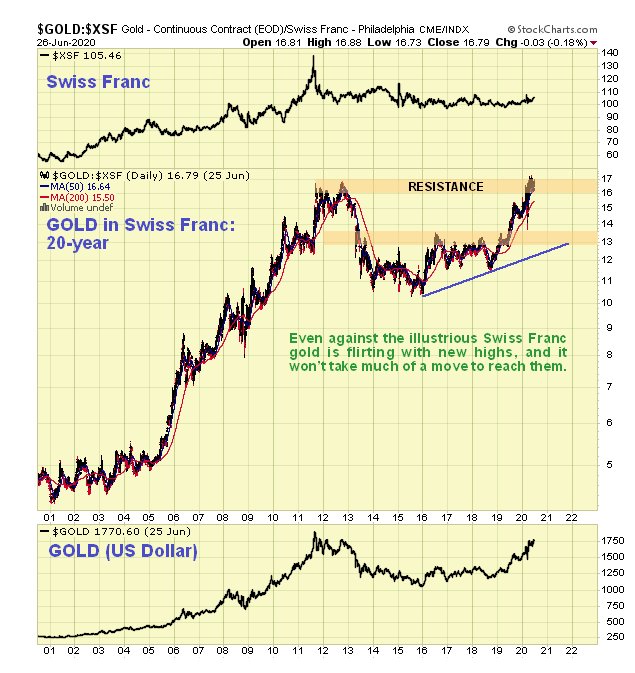
We will start this update by looking at gold’s price measured against various important currencies. These long-term charts quickly make clear that gold is in a major bull market, which is another way of saying that these currencies are losing purchasing power.

Gold in Australian dollars…

Gold in Canadian dollars…

Gold in Japanese Yen…

Gold in Swiss Francs…

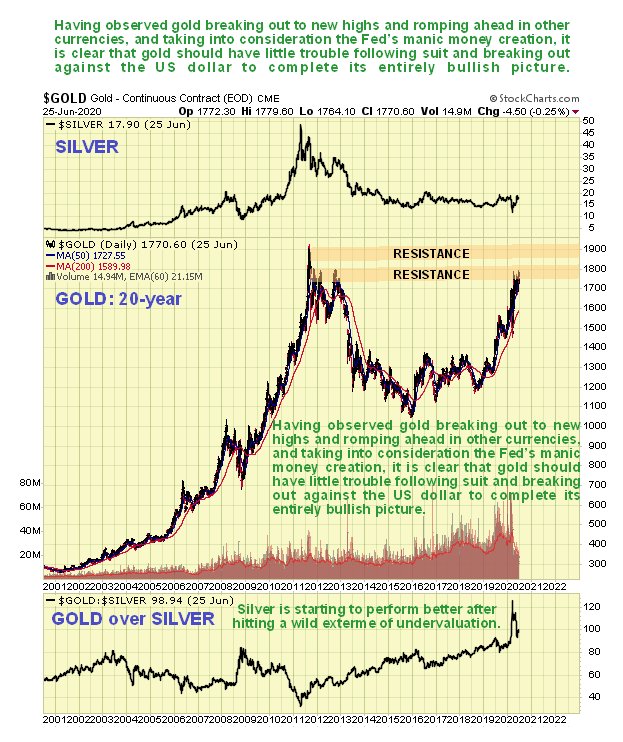
So we should clearly not allow ourselves to be fooled by gold not breaking out to new high against the U.S. dollar, especially given the Fed’s recent extreme profligacy involving the creation of trillions of dollars for the purpose of backstopping the credit markets, bailing out favored crony corporations, and paying countless millions of newly unemployed people to sit at home twiddling their thumbs, none of which can be classified as productive use of the money. All this extra money means that eventually there will be a lot more money chasing the same, or rather a reduced supply of goods and services, now that the economy is a lot less productive thanks to lockdowns and closures, etc. The only reason that the Fed has been able to get away with it so far without rampant inflation is because the economy is dead, so there is no money velocity, but this money will find its way out eventually and when it does we will be looking at robust inflation trending towards hyperinflation. Needless to say this will lead to gold appreciating dramatically against the dollar, as the dollar’s purchasing power shrinks.

Bearing all the above in mind it is thus interesting to observe that even though gold has not (yet) broken out to new highs against the U.S. dollar, it has also done well in this currency over the past two years and is getting close to doing so. Therefore it is not too difficult to deduce that with the creation of new dollars ramping up exponentially, it is only a matter of time, and not too much at that, before gold does go on to make new highs against the dollar, a development that will usher in a period of accelerated advance.

Gold in U.S. dollars…

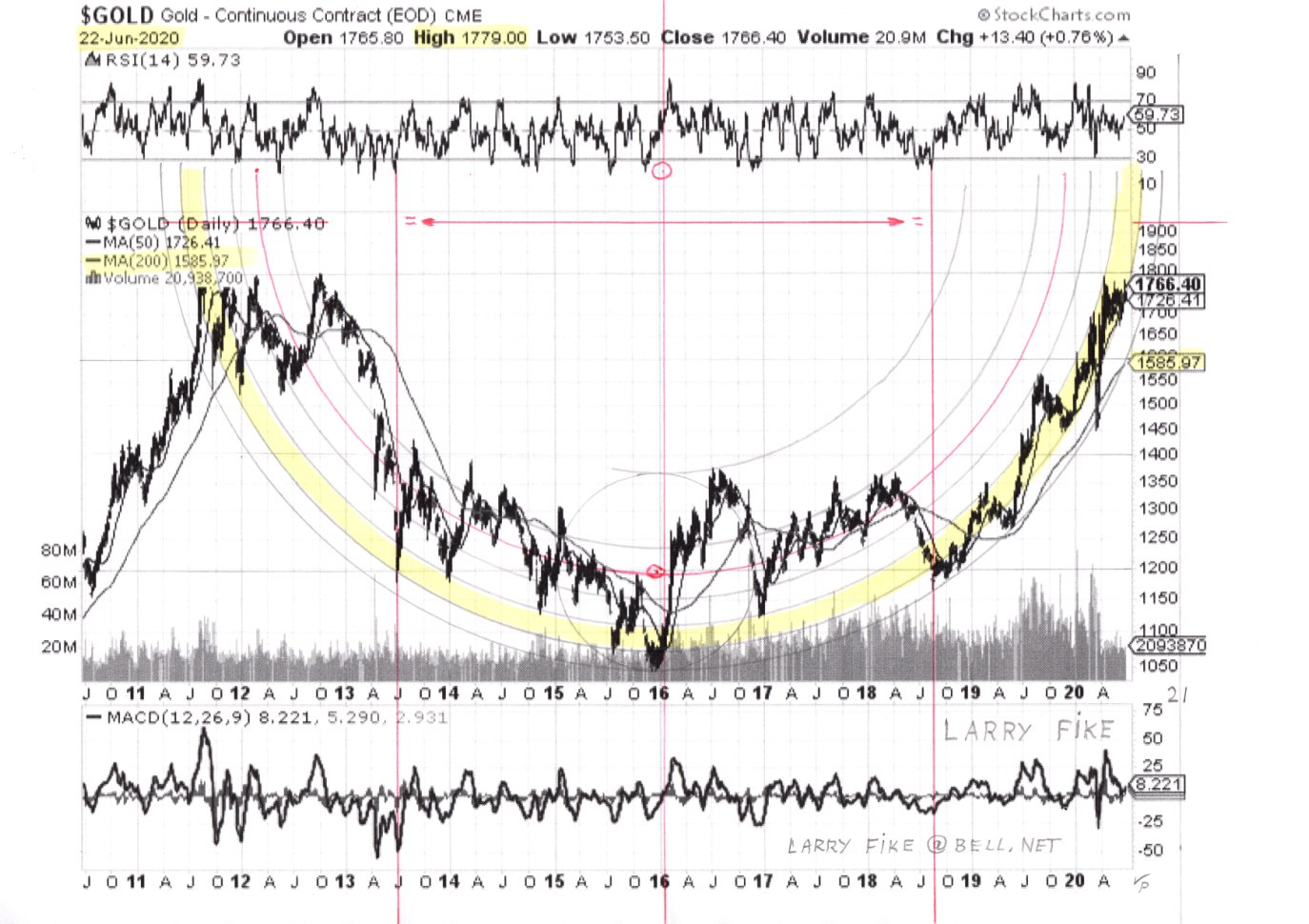
This is a good point to add Larry’s latest gold chart showing the gigantic Cup pattern, which points to an explosive move up soon, even if we see a brief break lower before it. As Larry himself points out: “A Cup & Handle formation will need to carve out a Handle to be complete,” however, the way things are deteriorating it is hard to imagine gold hanging around for more than a short time marking out a Handle to complement this Cup. If you want to send feedback to Larry about this, his email address is on the chart.

The Great Gold Cup…

To those who say “old will never go up much because ‘they’ will not allow it to, because it reveals their fiat money scam to be increasingly defunct, and they will suppress it with paper shorting on the Comex, etc.” I say this: the fiat money system is already breaking down as we head into the end game of a hyperinflationary firestorm that will render most currencies worthless. Astute investors who understand the power of gold and its intrinsic value know this, and are not fooled by games on the paper markets. If they continue to try to suppress the price of gold on the paper markets, all that will happen is that the already large premiums for physical metal will grow wider to the point where it becomes untenable, with the paper markets increasingly perceived as a manifest absurdity that will be bypassed by investors who will go straight to physical which will skyrocket in price before becoming unobtainable, and the same will happen with silver. This process has already started.

Even though we have observed that gold is in a major bull market that is set to accelerate dramatically as we trend towards hyperinflation, does this mean that it is immune to potentially sharp corrections? No, it doesn’t. As we know, the stock market has lost all touch with economic reality. The economy is flat on its back and comatose, yet the stock market has been going higher and higher until the NASDAQ actually made new highs a week or so ago. The reason for this is the Fed creating trillions out of thin air to throw at pumping it up. Therefore, anytime the Fed fails to pony up with the additional liquidity that the market thinks is its due, it is going to throw a nasty tantrum, like it did in March, and we should all be aware that the Fed may actually do this by design, so that it can smack the market down and then move in and scoop up more assets on the cheap. The charts show that we are right now at a time where that could happen and if it does the precious metals sector is likely to get taken down with it, as happened in March, in accordance with the old “baby and the bathwater” adage. Should this happen it will be viewed as presenting an outstanding opportunity to move in acquire more precious metal sector assets, because the Fed is likely to come riding to the rescue once more with a torrent of liquidity.

There are many who think that the Fed’s taking full advantage of the dollar’s reserve currency status to create countless trillions of new dollars will nevertheless cause it to lose value in a big way against other currencies, but a mitigating factor is that the Fed is not only flooding the U.S. with extra dollars, it is flooding the whole world, by pumping them into countless other central banks around the world which it controls in an act of economic colonialism. So pretty much all currencies are set to drop in lockstep. The main point is that the stagflationary depression that the world has now entered will impel governments everywhere to create exponentially more and more money in an effort to maintain liquidity and keep a lid on interest rates. This is why gold MUST rise in price to reflect the loss in value of fiat, and it will go further than that as investors will eventually flock to gold as the last safest place to put money where it will retain its value (stock markets may be rising nominally but losing value in real terms).

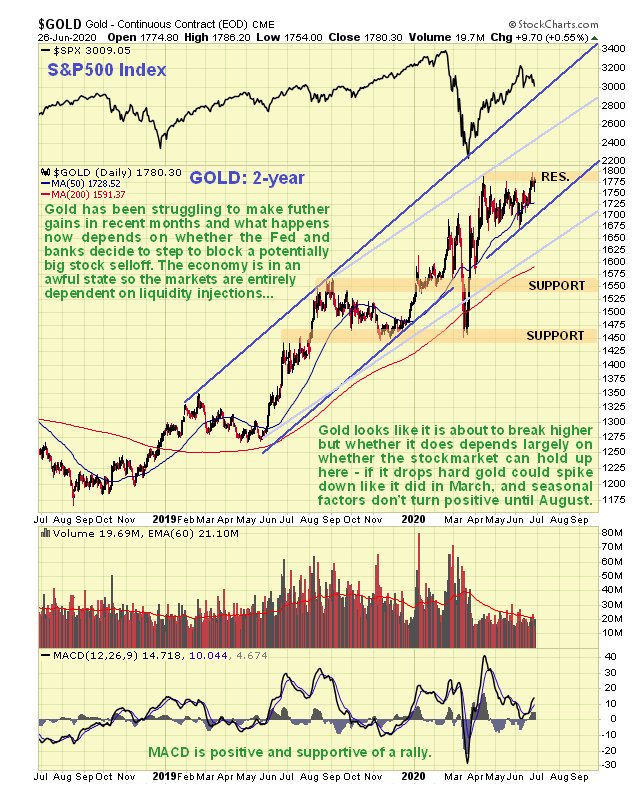
Gold, the stock market and the dollar are all at a critical juncture where they could break in either direction. What this usually means is that the markets are waiting on some fundamental development like, for example, whether the Fed is going to divvy up another trillion or two to throw at driving the stock market still higher, and maybe at the same time throw a bone to the 40+ million unemployed in the form of say $100 billion extra for checks to spend on flat screen TVs. On gold’s 2-year chart we can see that it has been struggling to make further progress within its uptrend over the past several months, and although in position to break higher, is vulnerable to a smackdown if the stock market should suddenly plunge. From a trading standpoint what would be ideal here would a short-term selloff that provides a buying opportunity ahead of the seasonally strong period in and August and September. If the stock market takes a hit it could do what it did in March.

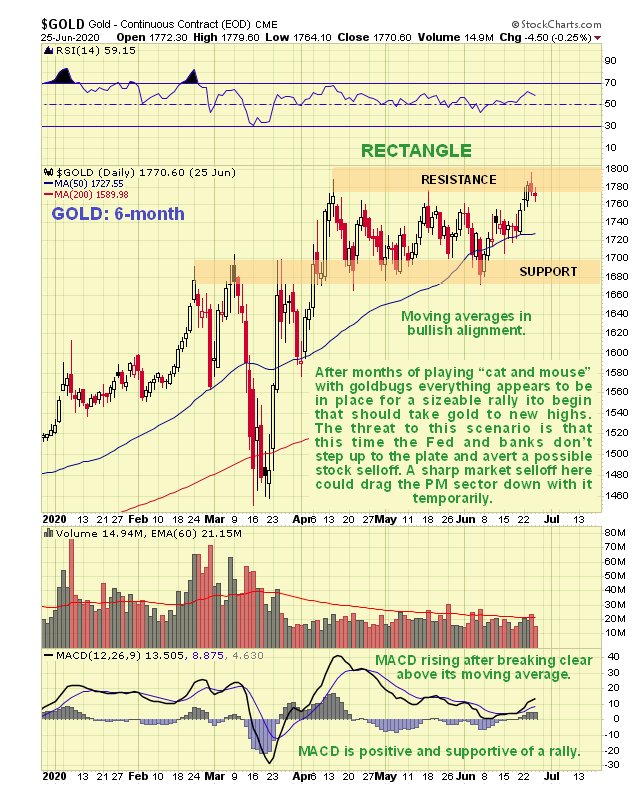
The 6-month chart looks positive, with the price well placed to break higher after a trading range from mid-April that has allowed time for its earlier oversold condition to unwind. Moving averages and the MACD are supportive of an advance from here. As mentioned above though, a stock market selloff could abort this scenario with a rude reversal and steep drop.

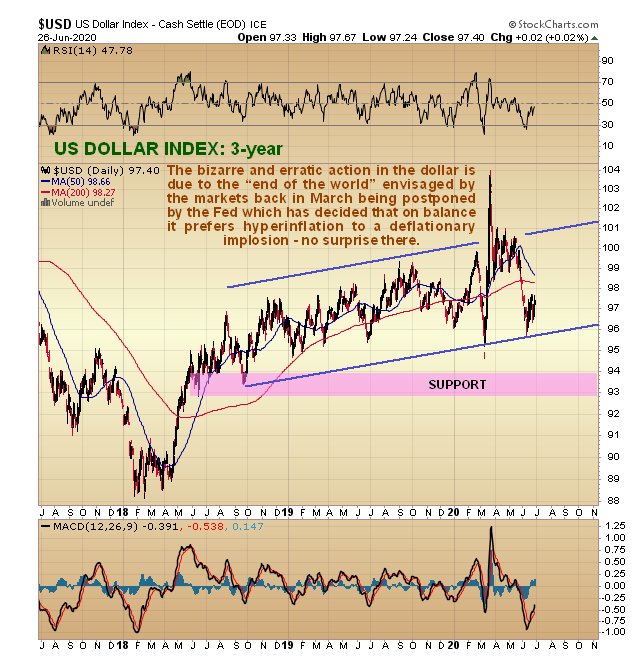
Turning now to the dollar, we see on the 3-year dollar index chart that it has made no net progress for almost two years, having been stuck within a shallow uptrend trading range. The spike in March was due to the specter of a deflationary implosion which was banished by the Fed boldly riding to the rescue with trillions of crisp new dollars. The recent drop caused by the Fed’s manic money creation, found support in the 95 area.

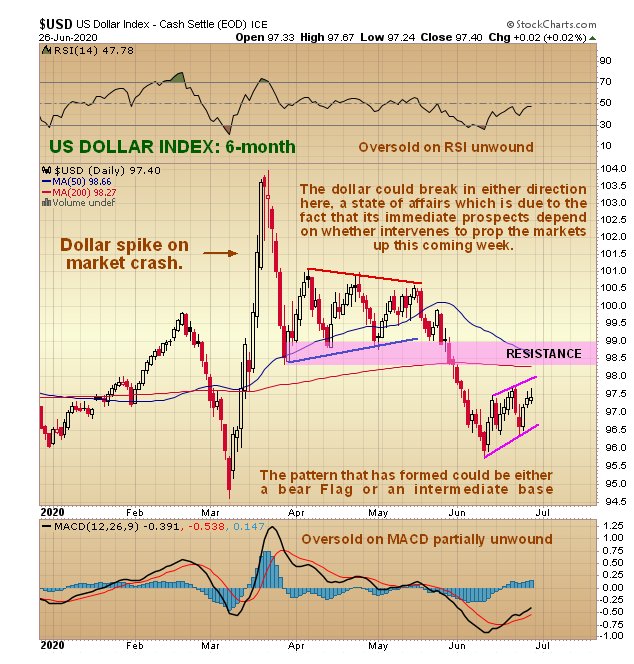
Like the stock market and gold, the dollar is evidently waiting on some development that could result in it breaking either way, depending on what happens. This is why the fairly tight range of the past two weeks or so shown on the 6-month chart could be either a bear Flag or some kind of intermediate base pattern.

The conclusion to all this is that gold is in a powerful bull market which is expected to accelerate. Near term, while it looks set to take off higher and should do if the stock market holds up, it is vulnerable to a potentially sharp correction if it doesn’t which would be viewed as a buying opportunity for the sector.

Finally, I want to take this opportunity to recommend that you do whatever you can you make sure that you have at least some physical gold and silver in your possession. Very bad times are headed our way and most Americans have no idea what’s coming down the pike. If you have to pay a premium then pay it, because the premiums are only going to get bigger with passing time, and eventually physical metal will be very hard to come by. I particularly like silver for two reasons—one is that it is still very undervalued relative to gold, and the other is that you are less likely to be hit over the head or shot when you try to trade it for goods. Silver coins of varied denomination are viewed as ideal. Gold buried in vaults thousands of miles away may sound like a great idea, but when things get really bad, you may not be able to get to it, or it to you. If you have sufficient resources it’s still a good idea, but you still want a quantity of physical in your possession that you can trade, and of course the means and willingness to defend your stash from marauders.

Here is an important and timely video by Jeremiah Babe entitled “US ECONOMY WALKING DEAD.” Although directed at Americans it is considered important viewing wherever you are, because when America goes down, the shockwaves will reverberate around the world.

Originally published on CliveMaund.com on June 28, 2020.

Clive Maund has been president of www.clivemaund.com, a successful resource sector website, since its inception in 2003. He has 30 years’ experience in technical analysis and has worked for banks, commodity brokers and stockbrokers in the City of London. He holds a Diploma in Technical Analysis from the UK Society of Technical Analysts.

Sign up for our FREE newsletter at: www.streetwisereports.com/get-news

Disclosure:
1) Statements and opinions expressed are the opinions of Clive Maund and not of Streetwise Reports or its officers. Clive Maund is wholly responsible for the validity of the statements. Streetwise Reports was not involved in any aspect of the article preparation. Clive Maund was not paid by Streetwise Reports LLC for this article. Streetwise Reports was not paid by the author to publish or syndicate this article.
2) This article does not constitute investment advice. Each reader is encouraged to consult with his or her individual financial professional and any action a reader takes as a result of information presented here is his or her own responsibility. By opening this page, each reader accepts and agrees to Streetwise Reports’ terms of use and full legal disclaimer. This article is not a solicitation for investment. Streetwise Reports does not render general or specific investment advice and the information on Streetwise Reports should not be considered a recommendation to buy or sell any security. Streetwise Reports does not endorse or recommend the business, products, services or securities of any company mentioned on Streetwise Reports.
3) From time to time, Streetwise Reports LLC and its directors, officers, employees or members of their families, as well as persons interviewed for articles and interviews on the site, may have a long or short position in securities mentioned. Directors, officers, employees or members of their immediate families are prohibited from making purchases and/or sales of those securities in the open market or otherwise from the time of the interview or the decision to write an article until three business days after the publication of the interview or article. The foregoing prohibition does not apply to articles that in substance only restate previously published company releases.

Charts provided by the author.

CliveMaund.com Disclosure:
The above represents the opinion and analysis of Mr Maund, based on data available to him, at the time of writing. Mr. Maund’s opinions are his own, and are not a recommendation or an offer to buy or sell securities. Mr. Maund is an independent analyst who receives no compensation of any kind from any groups, individuals or corporations mentioned in his reports. As trading and investing in any financial markets may involve serious risk of loss, Mr. Maund recommends that you consult with a qualified investment advisor, one licensed by appropriate regulatory agencies in your legal jurisdiction and do your own due diligence and research when making any kind of a transaction with financial ramifications. Although a qualified and experienced stock market analyst, Clive Maund is not a Registered Securities Advisor. Therefore Mr. Maund’s opinions on the market and stocks can only be construed as a solicitation to buy and sell securities when they are subject to the prior approval and endorsement of a Registered Securities Advisor operating in accordance with the appropriate regulations in your area of jurisdiction.

Categories
Gold

Citibank Joins Mainstream Gold Bulls Forecasting Record Prices

Citibank has joined other mainstream gold bulls calling for record gold prices. Citi raised its gold price forecast this week. It now projects a three-month price of $1,825 per ounce and for the yellow metal to head into record territory in 2021. Citi analysts expect gold to eclipse the $2,000 mark early next year. Citibank […]
Categories
Gold

If History Is Any Guide We Could See $4,000 Gold

If history is any guide, we could be heading toward $4,000 gold. This according to analysis by US Global CEO Frank Holmes. Holmes recently appeared on Kitco News and showed how the price of gold has historically correlated with the expansion of the Federal Reserve’s balance sheet. We’ve already seen the balance sheet balloon by […]
Categories
Gold

Not A Second Wave Of Coronavirus, A Second Wave Of TOTALITARIANISM!

The agenda is not LIBERTY. The agenda is OBEDIENCE. Should we accept totalitarianism as our “new normal”? by Daniel McAdams and Ron Paul of Ron Paul Liberty Report We cannot […]

The post Not A Second Wave Of Coronavirus, A Second Wave Of TOTALITARIANISM! appeared first on Silver Doctors.

Categories
Gold

The Coronavirus Strikes Back, But The Force is Strong With Gold

We all fear the second wave, but the U.S. hasn’t even controlled the first one! That’s bad news for Americans, but what does it mean for gold? by Arkadiusz Sieron […]

The post The Coronavirus Strikes Back, But The Force is Strong With Gold appeared first on Silver Doctors.

Categories
Gold

Beware Washington’s Latest Trillion-Dollar Infrastructure Scheme

Be prepared to be shackled by the chains of insolvency & incompetence. That’s what the Green New Deal/trillion-dollar infrastructure spending will achieve… by Andrew Moran via Mises The infrastructure zealots and the […]

The post Beware Washington’s Latest Trillion-Dollar Infrastructure Scheme appeared first on Silver Doctors.

Categories
Gold

Central Banks DRIVING GOLD: They Would Prefer To Ignore It, Yet They’re NET BUYERS

Central banks are signaling (by their actions) that they’re losing confidence in their own money and their money monopoly. They’re getting ready… (Silver Doctors Editors) Many readers of Silver Doctors […]

The post Central Banks DRIVING GOLD: They Would Prefer To Ignore It, Yet They’re NET BUYERS appeared first on Silver Doctors.

Categories
Gold

WE ARE AT WAR: America’s Bolshevik Revolution

War is being waged against the United States by the globalist cabal and its domestic terror allies. If it isn’t stopped in its tracks, it could… Wayne Jett interviewed by […]

The post WE ARE AT WAR: America’s Bolshevik Revolution appeared first on Silver Doctors.

Categories
Gold

Why gold will hit a record high in the second half of 2020

Zero Hedge/Eddie van der Walt/6-25-2020

graphic image of $2000 per oz“A mix of slow growth, easy money and black swans can propel gold to record highs in the second half of 2020. Lingering fears about lockdowns and scarring to the real economy should keep haven demand strong, but the metal could also rally in a risk-on environment, as the 2008 play book showed. Comfortably the best-performing major asset in the past year, gold soared by a quarter. That put it within levels that Markets Live foresaw at the end of 2019. With a global recession arriving sooner and cutting deeper than expected, $2,000/oz is the next target.”

USAGOLD note:  Van der Walt is a macro commentator at Bloomberg and one of a good many Wall Street analysts who see gold at the $2000 mark by the end of the year.