Categories
Gold

Gold & Silver Markets Energized by Broad & Expanding Risks

Welcome to this week’s Market Wrap Podcast, I’m Mike Gleason.

Coming up David Morgan of The Morgan Report joins me to discuss a range of topics including the recent disruptions in the paper-based precious metals futures markets that caused some major bullion banks to lose their shirts — and how it may be a telltale of a change in the pricing mechanisms for gold and silver.

David also shares why he believes we’re in the beginning stages of a massive financial system reset and why people need to be bracing for a lower standard of living in the days ahead as inflation heats up. So, don’t miss a jam-packed interview with our good friend David Morgan, coming up after this week’s market update.

Precious metals markets are finishing out a choppy week of trading that saw prices make little net progress through Thursday’s close.

As of this Friday morning recording, gold prices are up a slight 0.4% for the week to trade at $1,747 per ounce. Meanwhile, silver is showing a 1.0% weekly gain to come in at $17.84 an ounce.

Turning to the PGMs, platinum is now up 1.5% on the week to trade at $838. And finally, palladium prices are down 0.7% since last Friday’s close to bring spot prices to $1,984 per ounce.

Bullion premiums have been drifting lower in recent weeks after spiking earlier this spring. That in part reflects a waning of fear among investors… and a hope for markets and the economy returning to normal as we head into the summer.

But make no mistake, these are NOT normal times. Not with some parts of the economy still locked down. Not with the Federal Reserve embarking on an unlimited Quantitative Easing program that will dwarf all others that came before it. And not with the fabric of American society being ripped apart by radicals who are bent on erasing history and fomenting a race war.

Police officers in large cities across the country are bracing for a summer of continuing violence, property destruction, and unrest at the same time as many are looking for new jobs. Militant anti-cop hatred in the streets and a lack of support from mayors and prosecutors will leave many cities with hollowed out police departments that are unable to protect the public from crimes.

With these dangers simmering, volatility spikes could return to markets in the weeks ahead.

Summer – which officially begins on Saturday – is usually uneventful in the precious metals markets. Trading volumes tend to diminish, and demand for jewelry and bullion products tends to soften ahead of the seasonally stronger fall period.

But in a year that has been like no other in so many ways, we wouldn’t necessarily count on this summer being a typical one for gold and silver markets.

Investors will have to brace for a number of broad risks.

For one, the U.S. dollar could take a big hit as the government continues to add to an unprecedented budget deficit, the Fed piles on more trillions to its balance sheet, and the U.S. relationship with China turns increasingly adversarial.

Senior Chinese officials warned this week that the U.S. dollar’s privileged status as world’s reserve currency is in jeopardy. Although China has not yet acted to dump the bulk of its dollar holdings, it is continuing to forge various new trading partnerships with other countries that could gradually dethrone King Dollar.

Meanwhile, Jerome Powell and company at the Fed seem to be doing everything they can to undermine the purchasing power of the U.S. currency. They are openly calling for higher rates of inflation as they pump up the central bank’s balance sheet to $7 trillion and counting.

The Fed’s QE and repo market injections are likely to slow somewhat compared to the record pace seen earlier this spring. Since the stock market has been closely tracking the directional moves of the Fed’s balance sheet, central bankers may need to give it another boost if they want to keep Wall Street’s rally going.

They have already stretched and skirted the legal limits of their powers by purchasing corporate bonds and subsidizing small business loans. Perhaps they will soon begin buying up stocks, real estate, and other assets as well.

If the COVID-19 virus continues to spread and prevent the economy from firing on all cylinders, we can expect more stimulus programs from both the Fed and Congress. Heading into an election, politicians will be trying to buy as many votes as they can with handouts and promises of delivering even more handouts if they are elected.

Politicians today resent the historic role of gold and silver in the monetary system, which once served as a restraint on their ability to spend. But the more our currency moves away from the strict limits imposed by sound money, the more important it is for savers to move some of their wealth out of U.S. dollars and into precious metals.

Amid this dangerous social, economic, political, geopolitical, and monetary environment, physical gold and silver are likely to shine in the months ahead.

Well now, without further delay, let’s get right to this week’s exclusive interview with the man they call the Silver Guru.
David Morgan

Mike Gleason: It is my privilege now to welcome back our good friend David Morgan of The Morgan Report. David, we appreciate the time, great to have you on again and how are you?

David Morgan: Mike, I am well under the circumstances and actually, I’m feeling pretty good today. Thanks for having me on. It’s always fun to be with you.

Mike Gleason: Yeah, certainly great to have you back. Well David, let’s start with the big picture here and ask to hear your thoughts and get your take on what’s going on in the world today. Since we last spoke earlier this year, we’ve now got a full-fledged global pandemic, social unrest, massive unemployment and huge amounts of government stimulus and money printing to try to combat that, a movement now to defund police departments… a widely covered autonomous zone in your home state there, that has come about in response to this. Certainly lots going on in the world, to say the least. So comment on what you’re seeing and then where you see this all going, David. Let’s start there.

David Morgan: Well, you outlined it well and summarized just about everything. I’ll just add on that one, we really don’t know the ultimate outcome. Obviously, the trend change has taken place. It’s part of what I call the reset. Overused word, but the reset is a reset, not only in the financial system, but a reset of probably the pricing of almost everything… real estate, commercial real estate, food, communications, you name it down the line.

Obviously, the supply disruptions through this pandemic thing has been substantial and it will not come back to 100%. So, there’s going to be a general contraction in the economy. They’re still in debate whether or not it’s going to be pushed more toward globalization or global interaction versus the other, which is more localized… local food production, more localized government, et cetera. It’s that direction I’m almost certain, not that the globalist won’t push really hard for implementing their plan as much as they can. But I think the physical economy has broken up to such a level that they really can’t put it back together.

So, I don’t know how far I want to go further with that, Mike. I just think it’s a sad situation. It was inevitable without CV (COVID-19). We were already moving that direction. People probably already forgotten that the financial system was absolutely collapsing before our eyes with the repo market, where the federal reserve was putting in billions in the overnight loans because of a trust factor – these banks not trusting loans for 24 hours based on what the collateral was.

So, we were already there, this CV-19 was the needle that popped the bubble, but it isn’t the total cause. It was much, much deeper than that, a long time coming as I and many others have outlined and you’ve got many guests on your show explaining similar situations. I’d say, let me sum it up by saying that, be prepared for lowering standard of living pretty much across the board. That’s our new reality.

Mike Gleason: Yeah. And with all that said, in our view, there is literally never been a better fundamental case for buying gold and silver than there is right now. The Federal Reserve, which you alluded to and Congress are completely off the chain in terms of printing, borrowing, and spending.

The Fed is buying back junk bonds and ETFs. There’s no limits to what they’re willing to do. You talked about the repo markets and how they had to step in there to sustain that market. But somehow, the U.S. dollar seems to be holding up okay. The metals are performing fairly well, but there certainly are no fireworks, at least not yet. What do you make of this? And then, when do you think we’ll see these extraordinary fundamentals start mattering and showing up in the price of metals?

David Morgan: Well, reality dawns on people slowly and then all of a sudden. I mean, the general public is not familiar with the financial system and how it actually works, to sense that something’s wrong. They are, even in a casual way, pretty much aware that the Federal Reserve is pounding out fiat at a frequency that’s never been seen before.

If we just go back briefly and touch on 2008, look at what was produced. I think it was a roughly 4.3 trillion by the U.S., 5 trillion by the European Central Bank and 5 trillion by Japan. And that sort of, and I say sort of, got us through the 2008/2009 crisis, to the point where we are now and that amount of funny money that was put into the system to keep it going, pales in comparison to what’s going on now.

So we are facing probably an inflationary depression at some point, but I want to make the point that the dollar is actually one of the most trusted financial assets that you can have. And this goes right along with John Exter, Exter’s Pyramid, that you can look it up, where people seek safety.

And the safest thing most people know of isn’t gold because they don’t know it. They don’t understand it, they haven’t been educated about it. All they know is that it exists. And as far as they’re concerned, it’s nice to have a wedding ring made of gold and that’s about as much as they know.

Having said that, dollars are where they’re most comfortable. So, you’re going to see, as we are, a big push into the U.S. dollar as the money of last resort, except it isn’t. And it isn’t because if you studied history, monetarily, like I have, you have, most of the listeners have, we know that all fiat fails.

So, there’ll be a run in the dollar and probably see them both go up together for a while. Then there’ll be this bifurcation, meaning that the dollar price of gold will continue to accelerate, even as maybe gold is … excuse me, the dollar is doing better relative to all other currencies, but it will fail at some point.

So, we’re going to be in a very difficult stagflation where most the world, Americans included, are going to be struggling to get the currency de jour, the currency of their country to pay their bills and maintain their lifestyle. And at the same time, there’s this flood of printed money that’s going out everywhere, that dilutes what they’re able to obtain. And so it’s going to look really like a deflation at first. I am convinced of that. And the extra funding money will be going into the assets of probably the stock market, which it seems to be the main place right now.

I hope I’m not confusing anyone. It’s basically not that confusing. Just realize that we are going to see hard times ahead. And if we do, and I believe we will hit an inflationary depression, don’t think too much about the inflation part. Think more about the depression part because in an inflationary depression, the currency becomes worthless or near worthless. In a deflationary depression, the currency becomes more valuable. So, for a while, we’ll see it act that way, that the currency is more valuable because there’s so many people out of work or working part-time or not getting their job back that they once had.

So there’ll be a struggle there and it will look as if its deflationary depression, it is not. In the background, we have an inflationary depression. Once that mindset takes place in the marketplace, meaning basically the financial markets and everyday purchases. I mean, the people still have the power. If everybody decided to stop buying product-X, they’d be out of business literally overnight.

But back on point, you’ll see the inflation in the food sector almost immediately. I’m saying at least six months to a year out, you could see food prices double… maybe in a year, year and a half and that’s a huge increase. And Americans only spend 5% of their disposable income on food. But if you’re in the Philippines, 40% of your income goes to food. So, think outside of the U.S., how much food is a major factor in a normal person’s budget?

And this is almost irrefutable, the amount of destruction through the food supply chain has been astronomical and hasn’t caught up yet. We have reserves, there’s still stuff in the supply chain. And it probably won’t be all that apparent for a few more months, Mike. But once it becomes apparent, the general consensus of opinion will be, “Uh-oh, there’s inflation. Food prices keep going up and up and up.”

Mike Gleason: Yeah, well said. There’s been a theme with a lot of my guests here over the last several weeks, where we’re going to see periods of deflation. Then we’re going to see big periods of inflation and people need to be prepared to ride that wave because it will probably oscillate between one or the other.

We don’t need to spend a whole lot of time on this, but I did want to ask. We saw some trouble brewing in gold markets in March and April. There was a huge premium being paid in the COMEX futures for gold versus London spot markets. Some of the bullion banks lost huge amounts of money in March. They got caught short physical bars and had to pay up to get metal they needed to deliver.

Some of these banks, including Scotia, have decided since to close their metals trading operations. Now the bullion banks have had an extraordinary record when it comes to trading metals profitably. And in our view at least, that is in large part because the game has been rigged, but they got nailed hard this spring. Explain to our listeners how the banks got caught. And more importantly, give us your thoughts on what this might mean for paper gold and silver markets moving forward.

David Morgan: Well, I want to stay as factual as possible. So number one fact is they’re all over leveraged. I mean, they basically run a fractional reserve gold and silver system. It’s just like going back in history where the Goldsmiths held the gold and gave you a certificate for it. And they noticed that only about 10% of the population ever wanted the gold back. They’re very happy to take a certificate and trade that in the marketplace. So that gave them the ability to print more certificates than actual gold in existence.

Same story, just more sophisticated. So what happened was, there was a huge arbitrage opportunity because of the physical supply. And of course, this was told to be the inability to ship physical gold due to flight restrictions and that type of thing. There’s probably some truth to that because I am well-connected as you know, and I did talk to some of the refineries and there were flights that they could not get metal from the refinery into the United States.

So, the arbitrage took place, which usually will rectify the market at some point. And it has been since, but Mike, you’re right – and you might want to add onto it – but the fact is there was an arbitrage opportunity, existed for a long time. Physical metal finally did make it into New York. And basically, the two markets were back to “normal.”

Mike Gleason: Yeah, we have seen it return to normal, essentially in gold. Silver now does have a pretty big spread between London and U.S. futures. And we’re starting to see that a difficulty of getting commercial bars to satisfy the contracts here in the U.S.

Speaking of silver, what’s holding it back? And no one is more knowledgeable when it comes to silver than you are, so why hasn’t it been unleashed yet in terms of the price, do you think?

David Morgan: Well, at the risk of sounding like a broken record, primarily what holds it back is the inability to have a free market in silver. That’s one. Another one that isn’t talked about often enough is what is the real price of silver? And well, wait a minute, David, what do you mean? And here’s what I mean, the COMEX sets the price and that’s the real price. But really what it is, is a paper price for a contract to buy silver. Most of those contracts are never exercised.

But if you buy silver in the European continent, for the most part, there’s a 17% Value Added Tax. If you buy it almost anywhere outside of North America, there’s either a Value Added Tax or a premium that’s substantially larger than you get in the gold market. So, if silver were treated like gold, and there was a across the board, worldwide 3% markup between the bid/ask spread on silver, you would see a vast amount of physical silver investors moving into the market because the availability and the pricing mechanism would be normalized or not broken. It’s broken.

And so metals investors, primarily through the rest of the world, as I’m stating, look at their pocket book. And they say, well, geez, if I buy gold, I only have to overcome a 3% premium and I’m in the money and I’m ahead. Whereas with silver, it’s a 17% VAT on top of a premium that’s larger than the gold premium. And so I’ve got to see like a 25% move in silver just to be even, I don’t want to pay that big a premium.

So, there’s a huge detriment to buying physical silver outside of the North American continent, for the most part. And even in Mexico, where there’s a great deal of silver, spreads are more reasonable in South America and Mexico relative to the rest of the world. So, there’s going to be a day where with the algorithms that can be written, that there will be a world price of silver. That will be what the retail price or what I like to call the honest to God price, of silver really is when you factor in what the actual purchase would be in let’s say, Germany and France and the UK and Australia and Japan and India. And you could take all those and average them out on a weighted basis and find out what the real price is silver.

So, that’s one that isn’t talked about very often. And the last one is coming back to the paper price, fortunately or unfortunately, there has enough physical silver for most of the time, to satisfy the true physical demand. So, let me explain, in 2008, during the financial crisis, a lot of silver investors with some really big names. In fact, I just got a phone call from somebody. I digress, but he was at a level of a bank that you wouldn’t believe if I told you. And of course I’ll keep it anonymous, but when he bought silver, he bought at the bottom and he bought enough to be substantial.

Let me come back on point. There was a huge premium disparity for physical silver in the retail market. We’ve seen that again now. And Mike, you know as well as anybody, you might want to add on to my comment, where if you really want the metal you’re going to have to pay five, six bucks, maybe seven, eight. I mean, it’s varied. I know the premiums are falling back to more normal to get physical silver.

What’s interrupting this time, is that we didn’t see it in the 2008 crisis, you could buy, in fact I did buy three 1000 ounce bars, basically off the exchange. But this time, even the thousand ounce bars seem to have a bit of, I’ll call it a problem, for you to get them quickly. And that of course has got my eyebrows raised, but I don’t want to make too much of it. I like to see more data, but as you stated a moment ago, there’s this spread between the London market and the COMEX on commercial bars.

So, until that squeeze happens, where the physical market basically can’t keep up with the demand and we’re there, but I don’t want to project too far because the few times it’s happened, it has fallen back. Then this whole paper paradigm nonsense is going to go away and you’ll be pretty much in a cash market. Doesn’t mean that the COMEX closes down and quits putting out a price. They probably won’t, but it’ll be a joke. It will become a laughing matter because people will say, well, if you’re stupid enough to sell your silver at $17.50, when I have to buy it for $25, good luck. I’m not selling it until it hits $25 at the minimum. The only reason anyone would sell it back to anyone else would be because they absolutely were desperate, needed the money or something like that.

So, I think we’re getting to the end of their game of manipulating the market through this paper paradigm that has worked so well for them for so long, only there’s been enough physical of backup their nonsense. But I think that they are reckoning, that I’ve talked about and many others for so long, is approaching.

Mike Gleason: Yeah. Wouldn’t that be nice if we get true price discovery for once and no longer the ridiculousness of these paper derivatives setting the price for a physical commodity. And I think you’d probably see that coiled spring effect take place if it did finally unwind and we had the physical market setting the price, instead of the paper market setting the price.

Sticking with silver here, we’ve been reading about global mine production being severely disrupted due to government mandated suspensions of mining operations in response to COVID-19. Something like 66% of silver output has been taken offline as a result. Talk about this and what it may mean for the silver price down the road.

David Morgan: Yes. Well, as you know, Mike, I do a weekly perspective and that was one I did this a couple of weeks back. I continue to learn more about a lot of things. And of course, silver still fascinates me. And so I started looking into what was the effect of this shutdown on all the metals. And to my surprise, I didn’t realize that silver was the most. Silver was at 66%. I backed it up on the video I made a with the data showing on the screen. And uranium was 33%, so uranium being the second most hurt by the shutdown, was only half as bad as silver.

So, that will spill over. How much remains to be determined because even though supply has been curtailed, demand has been curtailed for the industrial side, but not necessarily investment side. The investment side is really quite robust. So, what will happen, as already stated, we’re going to see more and more investment demand come into both the metals and eventually move into the silver market because of so many factors. It’s more affordable. It’s undervalued, even relative to gold. And it may become more accessible through the Blockchain.

And I don’t want to be too one way on this because I am affiliated with a certain silver backed cryptocurrency, there are others but this will be a way for, going back to earlier in the conversation, where someone in India or Japan or the UK can buy real physical silver through the Blockchain system, without all this nonsense of VAT and all the rest of this stuff, which will be a huge boon to potential silver investors, that I do think there’s a pent up demand. I do believe again, I’ll repeat that if you had as much access to the silver market, as you do the gold market on a global basis, there would probably be a lot more silver investors out there than there are presently.

Mike Gleason: Yeah, well said. I couldn’t agree more on that. Well finally, before we let you go, give us any final thoughts you may have. Perhaps summarize the answer to the question, why metals and why now, because I know you have a lot more to say on that question and then anything else you care to comment on as we begin to close today?

David Morgan: Well, thank you for that. Yeah. In summary, I try to be a realist. I don’t want to be too big of a Debbie Downer, but the reality is we are going to have a lower lifestyle. We are going to have to adjust and you’re going to have to be mentally prepared for that. On top of that, the metals have shown throughout all of recorded history, that in times of uncertainty, it’s good to have some.

You don’t need to put your life savings in the metals. You don’t need to sell all your real estate holdings and buy gold. I’m not advocating that. But I am advocating, if you are awake and alive, you do need to have a hedge, which means you need precious metals. How much? Well that’s to be determined by you. But primarily, most people in the industry would recommend somewhere in the 10% range to be a sufficient amount for most people.

And that would take the gold and silver markets to heights that would be unimaginable because the whole financial system basis today, there’s less than really 1% in the gold market. So you would see, if it went to a 10%, a factor of 10, going into gold based assets. And silver represents like .02% of the whole financial system. I mean, it’s so minuscule that it’s almost not worth talking about. Of course, it’s important, it’s essential, it’s mandatory. It’s something that cannot be lived without it.

We couldn’t have modern technology without silver. You can live a pretty similar life to what we have without gold in the mix. But without silver, this lifestyle would be nonexistent. You wouldn’t be able to have the communications, the computers, the touch screens, flat screens. I mean, all this stuff that depends on the silver market.

So I think I’m so very bullish for a number of reasons, but you don’t have to be so bullish that you overdo it. Again, 10% is probably best for everybody to have, for most people. There are others that are over-weighted in metals, I’m one, it’s my specialty. And I do see an advantage to be over-weighted in the sector, but that’s me. For the general person, 10% is not very much as far as, you have 90% that could be in stocks or bonds or real estate or a partial owner of a business, or whole life or whatever, and still have enough that if something were to go awry, which it is happening as we speak, that precious metals position would actually rescue you financially from everything else going down substantially.

Mike Gleason: Yeah. You make a great point about how, if we go from say less than 1% ownership or approximately 1% ownership in precious metals to 10%, my gosh, what that would do to the demand and the supply-demand situation for physical metal. After all, they can’t print gold, they can’t print silver like they can with paper money.

Well, good stuff, David. It’s always a pleasure and we appreciate your insights, once again. Now, before we let you go, please tell people about the Morgan Reports and tell them how they can get on board with you and follow you more closely.

David Morgan: Sure, Mike. The easiest thing is go to the main landing page, which is TheMorganReport.com, all one word. You can sign up for our free newsletter. Interviews like this, I’ll send you in your email box. Also, I do a weekly perspective each week, which is a wrap up of the entire financial markets. And I usually do a video that shows you the screens. Some of the stuff is mainstream, Bloomberg Reuters, some of the mainstream type of press that they don’t really put in your face, but I do because this contraction, as I said, has been going on for a long time before the CV needle punctured the balloon.

Anyway, I try to be succinct. I try to make it like 10 to 15 minutes total. I always try to wrap up with something about the precious metals, one or the other or both. And also my main thesis has always been to get people to think critically on their own, so that’s available. You can look me up on Twitter. I have a YouTube channel.

If you go to the blog, which is TheMorganReport.com/blog, over on the upper right hand legend, you have all the icons for Twitter, YouTube, LinkedIn, everything I’m on. You can just click those from that page and it’ll take you right to the Twitter feed or right to the YouTube feed or right to the LinkedIn feed and be able to watch videos that I’ve posted to Twitter, as an example.

Sometimes you guys put stuff out that I think, everyone ought to read this article that’s in the precious metals market, so I’ll put it on my Twitter feed. And this is for people that want to go a bit deeper, but I do recommend, I do a lot of work for free, that if you want to stay in touch, go to the blog, I’d say two or three times a week. And if you’re lazy, just sign up for the newsletter, we’ll pretty much mail it to you every weekend.

Mike Gleason: Yeah. Well, thanks again, David. I’m an active follower of you on Twitter @silverguru22, for people who want to do that. You always put out excellent stuff and enjoy reading the things that you’re finding there, either original content that you’re putting out or great little news articles or videos that you’re finding and people should definitely do that.

Well, all the best to you. Appreciate the time, stay safe and healthy and have a great weekend, my friend. We’ll talk again soon.

David Morgan: All right, Mike, thanks for having me, same to you.

Mike Gleason: Well that will do it for this week. Thanks again to David Morgan, publisher of The Morgan Report. To follow David just visit TheMorganReport.com, you can also follow him on Twitter, it’s @silverguru22 and if you haven’t already, grab a copy of his book titled Second Chance: How to Make and Keep Big Money During the Coming Gold and Silver Shock Wave, which is available at MoneyMetals.com and other places where books are sold. Be sure to grab a copy of that.

And don’t forget to tune in here next Friday for next Weekly Market Wrap Podcast, until then this has been Mike Gleason with Money Metals Exchange, thanks for listening and have a great weekend everybody.

       
Categories
Gold

Lots Going On at Russian Silver-Copper Project

Source: Peter Epstein for Streetwise Reports   06/18/2020

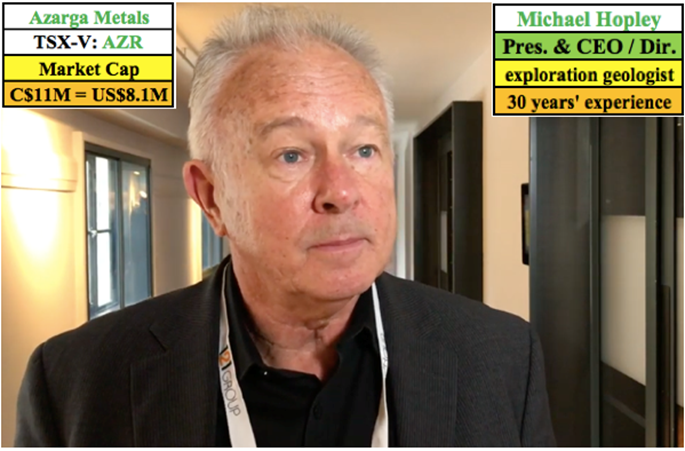
Azarga Metals CEO Michael Hopley speaks with Peter Epstein of Epstein Research about exploration at the company’s silver-copper project in Siberia and the resource estimate that will be released in the next few weeks.

WOW. What a three months it’s been. Things appear to be relatively better now, but I was very worried. At its worst, four major U.S. stock market indexes were down an average of 37.5% from all-time highs set in February. I feared stocks would keep falling and that copper might trade under US$1.50/lb for a long, long time. Luckily, that scenario did not play out.

I don’t know if we’re out of the woods yet, but copper is up nearly 20% from its March low. Perhaps analysts realizing that long-term demand for EVs has remained intact breathed some life back into Dr. Copper? Look no further than Tesla’s sky-high valuation (US$190 billion) for proof of concept!

Silver, although trailing behind gold, is up, so no worries there. I never claim to have any keen insights on commodity prices, but this time may be different. So much new debt and money printing, with no end in sight…. So much uncertainty from COVID-19…. Precious metals are in a bull market that could be epic and long-lasting. Silver frequently outperforms gold in bull markets, that means there’s a lot of catching up to do.

With this in mind, I revisited my favorite Russian copper-silver play Azarga Metals Corp. (AZR:TSX.V) by interviewing its President and CEO Michael Hopley. We had a wide-ranging conversation in which a key takeaway is that A LOT IS HAPPENING at the company!

Impressive drill results and favorable metallurgical testing data was released, and a new resource will be out in a few weeks. If the resource estimate is strong, management might commission an optimized PEA. Mr. Hopley could not tell me much regarding the parameters, but in a prior press release management stated that its mineralized strike length had increased from 3.4 to 6.5 km (+91%), and that the overall grade has not changed much.

The current resource is 62 million tonnes. Given a 91% strike extension, I would not be surprised to see 90 million or 100 million tonnes, which could result in an Indicated and Inferred resource approaching two billion copper equivalent pounds. Several near-term catalysts could be impactful and the company is well funded. Please continue reading to learn more about Azarga Metals and its investment thesis.

Peter Epstein: Michael, please tell us how you landed as CEO of Azarga Metals.

Michael Hopley: For almost 20 years I’ve been part of management or on the Board of predecessor companies to Azarga Metals. The company acquired its flagship Unkur property in 2016 and successfully explored it later that year and in 2017–18. However, due to perceived geopolitical risks, and a difficult funding environment, the project has not advanced as rapidly as we would have liked.

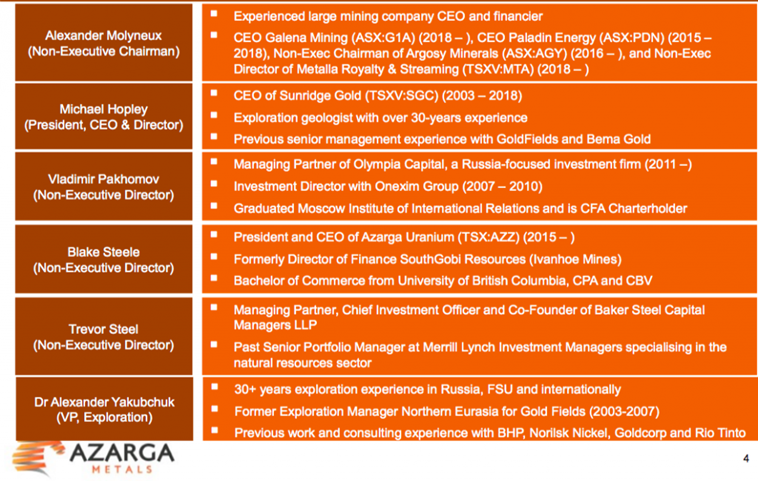
Since 2018, management has turned over; our new team {see team bios above} is very well suited for the specific tasks at hand. When we received a significant financing package from Baker Steel early last year, I was invited to come out of retirement to be president and CEO. As a director it was obvious to me that Unkur had serious potential to be a world-class copper-silver project, so I accepted.

Peter Epstein: Can you describe in greater detail Azarga’s 100%-owned Unkur Copper-Silver project?

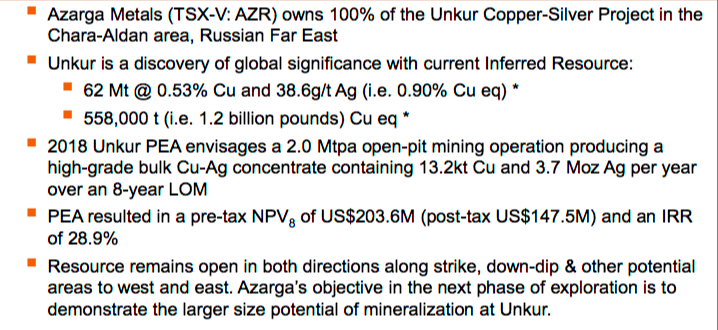
Michael Hopley: Yes, Unkur is located in eastern Russia (Siberia), ~400 km north of the Chinese border. China is by far the largest consumer of copper and silver. My team believes that Unkur hosts a discovery of global significance, with district-scale potential. It’s ~35 km from the giant Udokan copper project that reportedly contains >55 billion pounds of copper. The geological setting and possible scale of our project is similar to Udokan. Russian company Baikal Mining is building it and it’s scheduled to start production in 2022.

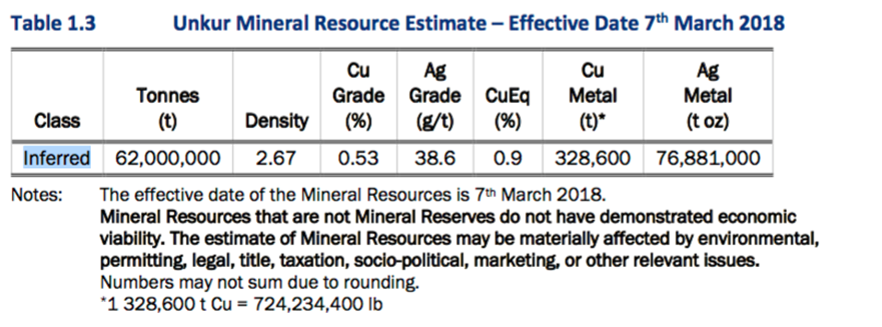
After completion of the first modern exploration in 2016–2018, we reported an NI 43-101 compliant Inferred resource of 62 million tonnes @ 0.53% Cu + 38.6g/t Ag, equivalent to 558,000 tonnes (1.2 billion pounds) copper equivalent (Cu Eq.) at an attractive grade of 0.90%. That’s ~US$52/t (~C$71/t) in-situ rock… that’s mineralized rock in the ground. The resource remains open in both directions along strike and at depth.

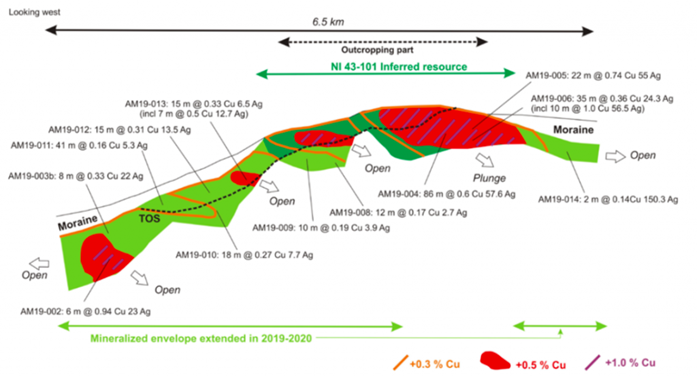
Peter Epstein: On April 9th, Azarga Metals announced drill results. Two assays stood out. The best had a 22-meter interval of 0.74% Cu and 55 g/t Ag. What do these results mean for the Unkur story?

Michael Hopley: This exciting result was from drill hole AM19-005, an in-fill hole drilled to test a higher-grade area north of our current resource. The intercept extended our high-grade envelope further north and deeper compared to the model we used to estimate our existing resource. Select recent drill results over a 6.5 km strike length {shown below}, are encouraging, especially as the project remains open in both directions along strike, and at depth.

As a frame of reference, the 22-meter interval you mentioned equates to ~US$74/t (C$100/t) in-situ value. And, that intercept included a shorter interval of 9m of 1.34% Cu + 99.4 g/t Ag, an in-situ value of C$181/t. To be clear, those two values are not indicative of the overall deposit. Still, if our metallurgy holds up, C$71/t rock (before recoveries) could be economic under the conditions, the right mine plan.

Peter Epstein: Speaking of metallurgy, please explain your latest results on that front.

Michael Hopley: Good question, this is important news. Previous metallurgical tests used only oxidized material from a surface outcrop. These new tests were on both oxidized & sulphide material taken from deeper parts of the Unkur deposit. Recoveries were up to 92% Cu and up to 88% Ag in our sulphide material, using conventional flotation.

The oxide results were as high as 96.4% Cu in an acid leach and up to 96.7% silver in a cyanide leach. Importantly, we think that a standard 30% Cu concentrate will be achievable, making it easy to sell to refiners. We believe this was a good outcome, especially for preliminary-stage testing. We think there’s a reasonable chance that we could use heap leaching to treat our oxide material.

Peter Epstein: Early last year, Azarga received a US$3M investment commitment from Baker Steel Resources Trust. How did that investment unfold?

Michael Hopley: Over the past several years it has been difficult for junior exploration companies to raise cash. Baker Steel took the view that among hundreds of risky companies destined for failure, there will always be some with projects of considerable merit. Azarga’s Unkur project stood out to them, a true vote of confidence.

Peter Epstein: Unkur’s resource estimate is 62 million tonnes @ 0.53% Cu, plus 38.6 g/t Ag. That’s a 0.90% Cu Eq. grade (~1.2 billion pounds Cu Eq.). How deep is the mineralization?

Michael Hopley: Mineralization at Unkur has been drilled to ~350 meters’ depth, but remains open at depth and in both directions along strike. A new resource estimate by SRK is coming out in two or three weeks. While I can’t say what that new resource might look like, I can reiterate what we said in a May 11th press release, namely that recent drilling had extended the mineralized strike length by 90% from 3.4 to 6.5 km.

Peter Epstein: Your 2018 PEA delivered promising financial metrics. Might Azarga be able to extend the 8-yr. mine life?

Michael Hopley: Yes, the existing PEA contemplates mining ~25% of our existing resource, or meaningfully less than 25% of our new resource estimate. We’re looking to announce a significant increase in the resource size in the next two or three weeks. If the resource expansion is strong, then we would look to extend the mine life.

Instead of an 8-year mine life with throughput of 2.0 millin tonnes/year, perhaps we could increase it to 3.0 million or 3.5 million tonnes/year and extend mine life by a few years. I’m not saying we can get there from our upcoming resource update alone; we have to study the new numbers. But, if we can increase annual production, and possibly extend mine life, without a major increase in cap-ex, the impact on NPV, IRR and payback period could be quite favorable.

Peter Epstein: What are the biggest risk factors of the Azarga story?

Michael Hopley: Aside from metals’ pricing, there are two primary concerns. Increased political tensions between Russia and the West, and the speed at which the world’s use/investment in copper and silver returns to normal after the impact of COVID-19.

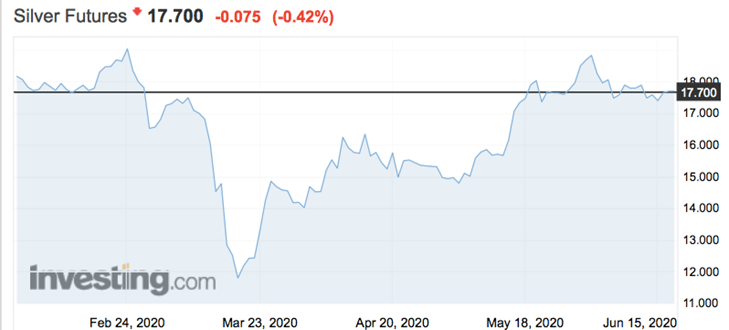
I find it encouraging that the Cu price fell to ~US$2.10/lb in mid-March, but has since recovered to ~US2.56/lb. Global automakers seem to have maintained fairly aggressive electric vehicle rollout plans, a promising sign for copper demand. Due to its industrial and investment / safe-haven attraction, silver futures touched US$11.80/oz, but have since rebounded to US$17.70/oz (+50%).

Peter Epstein: Why should readers consider buying Azarga Metals?

Michael Hopley: Azarga is one of the few juniors that’s well funded. We’re able to move the Unkur project forward with drill results, metallurgical testing, a new resource calculation in coming weeks and hopefully a new PEA in 6-9 months.

Our chairman, Alex Molyneux, is based in Asia and is well connected. He’s also highly experienced in investment finance/M&A. Russian investors, as well as global sovereign wealth funds, are looking to diversify away from oil, gas and coal. Silver, and especially copper, are critical, green energy, high-tech metals of the future.

Peter Epstein: Thank you, Michael, for this timely update. I can honestly report that few other metals and mining juniors are doing as much during this pandemic. I look forward to seeing your updated resource estimate in coming weeks.

Peter Epstein is the founder of Epstein Research. His background is in company and financial analysis. He holds an MBA degree in financial analysis from New York University’s Stern School of Business.

Sign up for our FREE newsletter at: www.streetwisereports.com/get-news

Disclosures: The content of this article is for information only. Readers fully understand and agree that nothing contained herein, written by Peter Epstein of Epstein Research [ER], (together, [ER]) about Azarga Metals, including but not limited to, commentary, opinions, views, assumptions, reported facts, calculations, etc. is not to be considered implicit or explicit investment advice. Nothing herein is a recommendation or solicitation to buy or sell any security. [ER] is not responsible under any circumstances for investment actions taken by the reader. [ER] has never been, and is not currently, a registered or licensed financial advisor or broker/dealer, investment advisor, stockbroker, trader, money manager, compliance or legal officer, and does not perform market making activities. [ER] is not directly employed by any company, group, organization, party or person. The shares of Azarga Metals are highly speculative, not suitable for all investors. Readers understand and agree that investments in small cap stocks can result in a 100% loss of invested funds. It is assumed and agreed upon by readers that they will consult with their own licensed or registered financial advisors before making any investment decisions.

At the time this article was posted, Azarga Metals was an advertiser on [ER] and Peter Epstein owned shares in the Company.

Readers understand and agree that they must conduct their own due diligence above and beyond reading this article. While the author believes he’s diligent in screening out companies that, for any reasons whatsoever, are unattractive investment opportunities, he cannot guarantee that his efforts will (or have been) successful. [ER] is not responsible for any perceived, or actual, errors including, but not limited to, commentary, opinions, views, assumptions, reported facts & financial calculations, or for the completeness of this article or future content. [ER] is not expected or required to subsequently follow or cover events & news, or write about any particular company or topic. [ER] is not an expert in any company, industry sector or investment topic.

Streetwise Reports Disclosure:
1) Peter Epstein’s disclosures are listed above.
2) The following companies mentioned in the article are billboard sponsors of Streetwise Reports: None. Click here for important disclosures about sponsor fees. The information provided above is for informational purposes only and is not a recommendation to buy or sell any security.
3) Statements and opinions expressed are the opinions of the author and not of Streetwise Reports or its officers. The author is wholly responsible for the validity of the statements. The author was not paid by Streetwise Reports for this article. Streetwise Reports was not paid by the author to publish or syndicate this article. Streetwise Reports requires contributing authors to disclose any shareholdings in, or economic relationships with, companies that they write about. Streetwise Reports relies upon the authors to accurately provide this information and Streetwise Reports has no means of verifying its accuracy.

4) The article does not constitute investment advice. Each reader is encouraged to consult with his or her individual financial professional and any action a reader takes as a result of information presented here is his or her own responsibility. By opening this page, each reader accepts and agrees to Streetwise Reports’ terms of use and full legal disclaimer. This article is not a solicitation for investment. Streetwise Reports does not render general or specific investment advice and the information on Streetwise Reports should not be considered a recommendation to buy or sell any security. Streetwise Reports does not endorse or recommend the business, products, services or securities of any company mentioned on Streetwise Reports.
5) From time to time, Streetwise Reports LLC and its directors, officers, employees or members of their families, as well as persons interviewed for articles and interviews on the site, may have a long or short position in securities mentioned. Directors, officers, employees or members of their immediate families are prohibited from making purchases and/or sales of those securities in the open market or otherwise from the time of the interview or the decision to write an article until three business days after the publication of the interview or article. The foregoing prohibition does not apply to articles that in substance only restate previously published company releases.

Graphics provided by the author.

( Companies Mentioned: AZR:TSX.V,
)

Categories
Gold

Blackrock Gets a Chance to Become a Hero

Source: Bob Moriarty for Streetwise Reports   06/18/2020

Bob Moriarty of 321gold awaits results from this explorer’s drill program.

The market was waiting for definitive news from Blackrock Gold Corp. (BRC:TSX.V; BKRRF:OTCMKTS) about their upcoming drill program at Tonopah West. On the 17th of June the market got it and liked it a lot. The shares were up 18% on the day and 50% over the past three weeks.

Investors have been waiting patiently for assay results coming out from Blackrock’s Silver Cloud project. Some were in for assay six weeks ago and have yet to be released.

Management tells me the next big news will be coming from their Tonopah West Silver project where the company plans 16 RC holes for a total of 7,285 meters of drilling. That drill program has started and since it is RC drilling results could come out as early as the 1st or 2nd week of July.

Between 1900 and 1950 the Tonopah district produced 174 million ounces of silver and 1.8 million ounces of gold at a grade equivalent of 2,125 g/t Ag with a value today of about $1160 USD for the rock. Blackrock is being pretty smart with their drill plan. They plan on punching down where the greatest grades and thickness were from historical reports. It’s all well and good to determine what the total tonnage and grade is for the deposit but investors buy shares for the sizzle, not the steak.

If they hit over 2 kilo silver equivalent over a few meters they will look like a hero. If they don’t. . .

Blackrock is an advertiser. I have participated in several private placements so naturally I am biased. Their website is pretty good and presentation excellent.

Blackrock Gold Corp.
BRC-V $0.31 (Jun 18, 2020)
BKRRF-OTCBB 91 million shares
Blackrock Gold website.

Bob Moriarty
President: 321gold
Archives
321gold

Bob Moriarty founded 321gold.com, with his late wife, Barbara Moriarty, more than 16 years ago. They later added 321energy.com to cover oil, natural gas, gasoline, coal, solar, wind and nuclear energy. Both sites feature articles, editorial opinions, pricing figures and updates on current events affecting both sectors. Previously, Moriarty was a Marine F-4B and O-1 pilot with more than 832 missions in Vietnam. He holds 14 international aviation records.

Sign up for our FREE newsletter at: www.streetwisereports.com/get-news

Disclosure:
1) Bob Moriarty: I, or members of my immediate household or family, own shares of the following companies mentioned in this article: Blackrock Gold. Blackrock Gold is an advertiser on 321 Gold. I determined which companies would be included in this article based on my research and understanding of the sector.
2) The following companies mentioned are billboard sponsors of Streetwise Reports: None. Click here for important disclosures about sponsor fees.
3) Statements and opinions expressed are the opinions of the author and not of Streetwise Reports or its officers. The author is wholly responsible for the validity of the statements. The author was not paid by Streetwise Reports for this article. Streetwise Reports was not paid by the author to publish or syndicate this article. The information provided above is for informational purposes only and is not a recommendation to buy or sell any security. Streetwise Reports requires contributing authors to disclose any shareholdings in, or economic relationships with, companies that they write about. Streetwise Reports relies upon the authors to accurately provide this information and Streetwise Reports has no means of verifying its accuracy.
4) The article does not constitute investment advice. Each reader is encouraged to consult with his or her individual financial professional and any action a reader takes as a result of information presented here is his or her own responsibility. By opening this page, each reader accepts and agrees to Streetwise Reports’ terms of use and full legal disclaimer. This article is not a solicitation for investment. Streetwise Reports does not render general or specific investment advice and the information on Streetwise Reports should not be considered a recommendation to buy or sell any security. Streetwise Reports does not endorse or recommend the business, products, services or securities of any company mentioned on Streetwise Reports.
5) From time to time, Streetwise Reports LLC and its directors, officers, employees or members of their families, as well as persons interviewed for articles and interviews on the site, may have a long or short position in securities mentioned. Directors, officers, employees or members of their immediate families are prohibited from making purchases and/or sales of those securities in the open market or otherwise from the time of the interview or the decision to write an article until three business days after the publication of the interview or article. The foregoing prohibition does not apply to articles that in substance only restate previously published company releases.

( Companies Mentioned: BRC:TSX.V; BKRRF:OTCMKTS,
)

Categories
Gold

Junior Royalty Company Wants to Be a Major

Source: Streetwise Reports   06/18/2020

Ely Gold aims to emulate the early years of today’s royalty majors.

Ely Gold Royalties Inc. (ELY:TSX.V; ELYGF:OTCQB; I4U:FSE) features a unique business model: in addition to purchasing royalties outright, it engages in royalty generation, which is acquiring properties mostly through staking, optioning them out and retaining a royalty when the sale is completed.

Ely Gold’s market cap, around CA$250 million, places it in the middle range of junior royalty companies—junior royalties are usually defined as having market caps between $100 million and $500 million. At $250 million, Ely Gold’s market cap is roughly in line with Metalla Royalty & Streaming and Abitibi Royalties.

“We think Ely Gold offers attractive growth potential.” – Mark Reichman, Noble Capital Markets

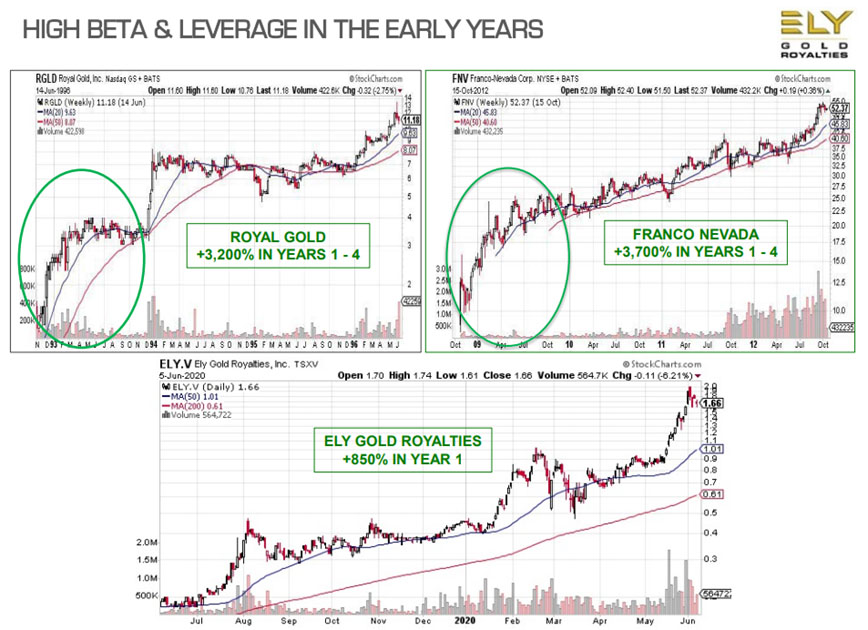
“While we are focused on becoming a mid-tier royalty company, we are really aspiring to be the next Royal Gold or Franco-Nevada by emulating what they did in their first four or five years,” Ely Gold’s President and CEO Trey Wasser told Streetwise Reports.

“Both Royal Gold and Franco-Nevada started with Nevada gold mining properties,” Wasser explained. “In their first four years in existence, they produced returns of 3,200% and 3,700%, respectively. Royal Gold, in the early 1990s, started with just one asset, the Cortez Pipeline royalty. They were a 30-cent stock that over the next few years became a $12 stock, and today they are a $135 stock. In the case of Franco-Nevada, they were a $2 stock that became a $55 stock in their first four years, fueled mostly by their Goldstrike royalties.”

Ely chart

“All that happened with a business plan very similar to Ely Gold’s: with projects located at some of Nevada’s larger gold mines,” Wasser said. “We’re picking up royalties on some of these same projects, so we believe that people are picking up on the comparisons to Ely Gold as the next Royal Gold or Franco Nevada. Is that aspiration too high? We have the potential, given the assets we are acquiring, and hope to generate those kinds of returns.”

Around 95% of Ely Gold’s assets are in Nevada, and the firm engages in royalty generation in addition to royalty purchases. The firm currently has an inventory of 34 properties for sale, which with royalty interests and properties being purchased brings the total number of properties to more than 100.

“That potentially makes us one of the largest property owners in Nevada, certainly by number of projects, that’s pretty compelling for a junior company and gives us a solid platform for growth,” Wasser stated.

Wasser differentiates his company from others by using three key metrics: business model, management execution and path to production.

Commenting on Ely Gold’s business model, “We differentiate ourselves from many of our peers in that we are generating royalties from property acquisition and sales that subsequently generate royalties,” Wasser said. “We never do joint ventures or earn-ins. We do straight 100% property sales. When a buyer has made all their options payments, we give them a mineral deed and they give us a royalty deed. If they don’t make all the payments, we get the property back 100%.”

The company is aggressively purchasing royalties. “The major and mid-tiers generally make royalty investments by being part of the financing package of new mine construction or mine expansion, where there’s a large capex requirement. The junior companies are mostly purchasing royalties, or in our case purchasing and organically generating royalties,” Wasser explained.

Management execution is the second metric in evaluating a royalty company. “Our focus is on adding net asset value to the portfolio. Net asset values are based on the cash flow that the royalties should generate in the future. The longer that revenue stream is from starting, the lower the net asset value on the asset. We are very active and have closed nine royalty transactions so far this year. Four of them are pretty significant royalties on three of Nevada’s largest gold mines,” Wasser said.

The third metric is the path to production. “First, you have to look at the project and determine if it can be developed at current gold prices emphasizing the ‘what and when’ of the potential cash flow,” Wasser stated. “But the second part is the operator of the project. Is it owned by a junior company that has never built or operated a mine before? Does the operator have the capital to build the mine or borrow to finance the construction, or is it going to take a corporate miracle for that to happen? Or, as is the case with our key assets, is the operator a seasoned operator, a mine builder, a well-financed major or mid-tier producer? That’s where our portfolio is being differentiated and it is really shaping up with our recent acquisitions.”

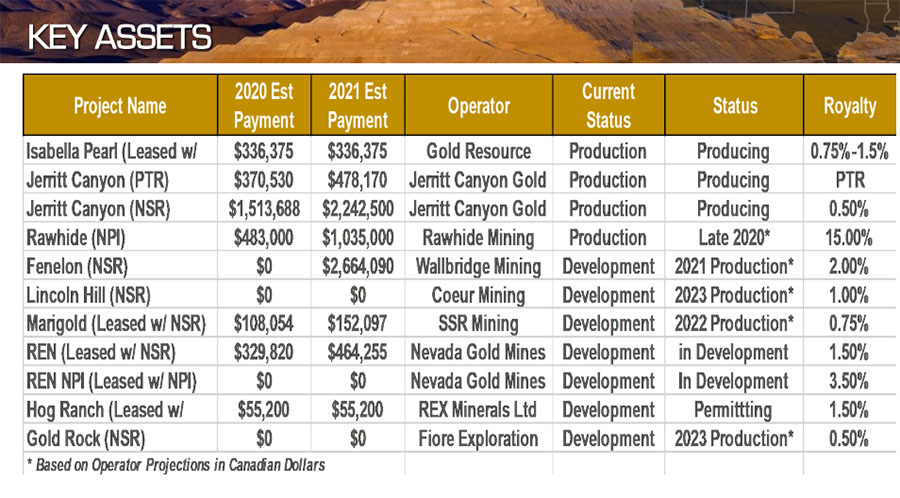
In February, Ely Gold announced the acquisition of VEK Associates, a privately held company. VEK’s portfolio holds a 50% interest on leases on five properties. Four are leased to Nevada Gold Mines, the Barrick-Newmont joint venture: REN, Lone Tree, Pinson and Carlin Trend. The other, Marigold, is leased to SSR Mining. “Two of the properties are near-term producing assets,” Wasser said. “SSR Mining is a standout mid-tier producer. There are two deposits on the acquired Marigold claims and lease that are in the current mine plan to start production in 2022. The Marigold Mine is an open pit, heap leach operation running at 200,000 tonnes per day and has over 3 million ounces in reserves.”

The other near-term producing asset is operated by Nevada Gold Mines, at its Goldstrike mine. “The REN property is the extension of the underground ore body,” Wasser stated. “Centerra outlined a mineralized resource of 2 million ounces on our REN claims between 2000 and 2010 in a JV with Barrick. In 2010, Barrick bought out Centerra’s interest and really hasn’t done any exploration on the property since. It now is looking at plans to bring the REN property into production and explore the entire property from underground. It is a very deep high-grade deposit and is already permitted for mining. In addition to the REN lease, ELY Gold purchased a 3.5% net profit interest royalty on REN.”

Wasser noted, “Goldstrike and Marigold were important assets for Franco-Nevada’s growth. Goldstrike has produced over 45 million ounces of gold, including over 12 million from the underground mine near REN. Marigold has produced over 3 million ounces of gold. Franco Nevada has multiple royalty interests on both assets. We are following in their footsteps.”

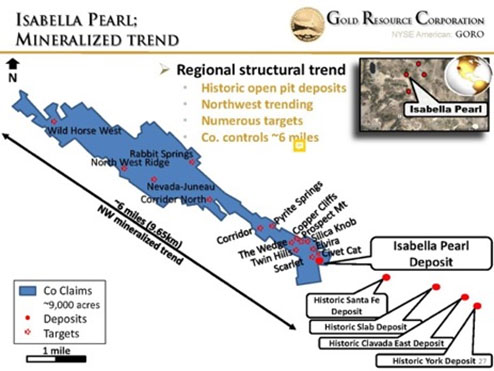
Ely Gold currently has three producing assets. At the privately operated Jerritt Canyon mine, Ely Gold holds a Per Ton Royalty Interest on all material that goes through the mill, and a 0.50% Net Smelter Return (NSR) royalty on production from the entire property package. The third asset is a 0.75% NSR royalty on the Isabella Pearl property, operated by Gold Resource Corp. Ely Gold also has a 2.5% royalty on 6 miles of expansion ground at Isabella Pearl that was generated from their property portfolio.

Isabella Pearl

Wasser is also excited about Wallbridge Mining’s Fenelon project, located in Quebec. “The project is growing quickly. This past year as Wallbridge has outlined a large underground ore body and it’s looking like it’s going to get much bigger.”

“Jerritt Canyon and the REN property both have mineralized resources of about 2 million ounces of gold and we believe they have the potential to become tier one mines, which means 5 million ounces or greater. Fenelon also has that potential. And all have a clear path to production. As mentioned, Jerritt Canyon is currently producing and the way we structured that purchase we’ll see nearly a full year of royalties in this year,” Wasser stated. “Two other key assets, the Gold Rock project of Fiore Gold and the Lincoln Hill project with Coeur Mining, are satellite mines and due to be in production sometime in 2023.”

Key assets

“When you talk about that path to production, we have some of the best properties, with the best operators in the best mining jurisdictions in the world. All, except Gold Rock and Hog Ranch, are current operations where the mine and processing plant does not need to be built,” Wasser said.

“We do not buy longer term exploration royalties with no real net asset value. We generate those as either development or exploration assets in our portfolio. All our 21 development assets are at or near producing mines and of our 33 exploration assets, eight of them are currently being drilled. Most were generated internally through property sales. This allows us to focus on purchasing royalties with a clear net asset value by buying royalties that are at or near production. You will rarely see us spending shareholder equity for anything that doesn’t add a clearly defined net asset value to our portfolio,” Wasser concluded.

On May 21, Ely Gold closed a brokered private placement for gross proceeds of CA$17.25 million, at CA$0.80 per unit, with one unit composed of one common share and one-half of a purchase warrant to acquire one common share at a CA$1.00 exercise price for three years. Ely Gold has about 157 million shares outstanding, and 197 million fully diluted. In May, the company up-listed to the OTCQB Market, and trades there under the symbol ELYGF. It trades on the TSX Venture Exchange under the symbol ELY.

Ely Gold has caught the attention of industry analysts. Noble Capital Markets analyst Mark Reichman awards Ely Gold an Outperform rating and wrote on June 16, “In 2020, the company has announced the purchase of 8 producing or near-term producing royalties and option/sale agreements on several properties, including Olympic and White Rock. We believe potential exists for the company to announce additional royalty purchases this year and also increase the company’s exposure to projects in which the company already holds royalty interests.

“In our view, Ely Gold offers shareholders leverage to gold prices through its growing portfolio of long-term gold royalties. …Ely has made several significant transactions in recent months that are expected to accelerate revenue and cash flow growth. …Based on the company’s successful record of growing its project portfolio coupled with a constructive gold price outlook, we think Ely Gold offers attractive growth potential,” Reichman concluded.

Analyst Jay Taylor wrote in Hotline on May 8, “I think there is a lot more upside for Ely Gold given their pipeline of near-term producing projects as well as a large number of attractive exploration projects located mostly in Nevada.”

Sign up for our FREE newsletter at: www.streetwisereports.com/get-news

Disclosure:
1) Patrice Fusillo compiled this article for Streetwise Reports LLC and provides services to Streetwise Reports as an employee. She or members of her household own securities of the following companies mentioned in the article: None. She or members of her household are paid by the following companies mentioned in this article: None.
2) The following companies mentioned in this article are billboard sponsors of Streetwise Reports: Ely Gold Royalties. Click here for important disclosures about sponsor fees.

3) Comments and opinions expressed are those of the specific experts and not of Streetwise Reports or its officers. The information provided above is for informational purposes only and is not a recommendation to buy or sell any security.
4) The article does not constitute investment advice. Each reader is encouraged to consult with his or her individual financial professional and any action a reader takes as a result of information presented here is his or her own responsibility. By opening this page, each reader accepts and agrees to Streetwise Reports’ terms of use and full legal disclaimer. This article is not a solicitation for investment. Streetwise Reports does not render general or specific investment advice and the information on Streetwise Reports should not be considered a recommendation to buy or sell any security. Streetwise Reports does not endorse or recommend the business, products, services or securities of any company mentioned on Streetwise Reports.
5) From time to time, Streetwise Reports LLC and its directors, officers, employees or members of their families, as well as persons interviewed for articles and interviews on the site, may have a long or short position in securities mentioned. Directors, officers, employees or members of their immediate families are prohibited from making purchases and/or sales of those securities in the open market or otherwise from the time of the interview or the decision to write an article until three business days after the publication of the interview or article. The foregoing prohibition does not apply to articles that in substance only restate previously published company releases. As of the date of this article, officers and/or employees of Streetwise Reports LLC (including members of their household) own securities of Ely Gold Royalties and Newmont, companies mentioned in this article.

Additional disclosures:

Disclosures for Noble Capital Markets, Ely Gold Royalties, June 16, 2020
Company Specific Disclosures
The following disclosures relate to relationships between Noble and the company (the “Company”) covered by the Noble Research Division and referred to in this research report.
The Company in this report is a participant in the Company Sponsored Research Program (“CSRP”); Noble receives compensation from the Company for such participation. No part of the CSRP compensation was, is, or will be directly or indirectly related to any specific recommendations or views expressed by the analyst in this research report.
The Company has attended Noble investor conference(s) in the last 12 months.
Noble intends to seek compensation for investment banking services and non-investment banking services (securities and non-securities related) within the next 3 months.
Noble is not a market maker in the Company.

ANALYST CREDENTIALS, PROFESSIONAL DESIGNATIONS, AND EXPERIENCE
Senior Equity Analyst focusing on Basic Materials & Mining. 20 years of experience in equity research. BA in Business Administration from Westminster College. MBA with a Finance concentration from the University of Missouri. MA in International Affairs from Washington University in St. Louis. Named WSJ ‘Best on the Street’ Analyst and Forbes/StarMine’s “Best Brokerage Analyst.” FINRA licenses 7, 24, 63, 87.

Disclosures from J Taylor’s Hotline, May 8, 2020
The opinions expressed in this message are those of Jay Taylor only and they do not necessarily represent the opinions of Taylor Hard Money Advisors, Inc., the publisher of J Taylor’s Gold, Energy & Tech Stocks. The management of THMA may, from time to time, buy and sell shares of the companies recommended in J Taylor’s Gold, Energy & Tech Stocks newsletter and in this Hotline message. No statement or expression of any opinion contained either in this Hotline or in J Taylor’s Gold, Energy & Tech Stocks newsletter constitutes an offer to buy or sell the securities mentioned herein.

Companies are selected for presentation in J Taylor’s Gold, Energy & Tech Stocks strictly on their merits as perceived by Taylor Hard Money Advisors, Inc. No fee is charged to the company for inclusion. The editor, his family and associates and THMA are not responsible for errors or omissions. They may from time to time have a position in the securities of the companies mentioned herein.

( Companies Mentioned: ELY:TSX.V; ELYGF:OTCQX; I4U:FSE,
)

Categories
Gold

Fun on Friday: Oops!

Confession: I am prone to lose things. I spend an inordinate amount of time looking for my glasses. I had to put a big lanyard on my keys to help me keep up with them. There’s even a running joke with one of my best friends about the frequency of losing my car in the […]
Categories
Gold

The Fed’s Thumb Is on the Scale: SchiffGold Friday Gold Wrap Podcast June 19

Jerome Powell ventured to Capitol Hill – virtually – to talk to Congress this week. Powell did what he does best – blew a lot of smoke. Meanwhile, the central bank upped its stimulus ante yet again. In this episode of the Friday Gold Wrap podcast, host Mike Maharry talks about the impact the Fed […]
Categories
Gold

One weird sign of trouble in the banking sector

Banks are NOT optimistic about economic conditions, and banks are NOT optimistic about their own conditions. Here’s how to tell… by Simon Black of Sovereign Man It was only a […]

The post One weird sign of trouble in the banking sector appeared first on Silver Doctors.

Categories
Gold

Don’t Resist Arrest, Global Reset Coming, No Real Recovery

If Trump gets to reset things, the globalists will not like how that plays out. The battle is really about who is going to shape the reset and how will […]

The post Don’t Resist Arrest, Global Reset Coming, No Real Recovery appeared first on Silver Doctors.

Categories
Gold

On Freedom: Until We All Truly Fight To Free Gold & Silver From The Market Riggers’ Chains And Shackles, We Are Only Tortured Slaves

Trump won’t free gold & silver, nor will anybody else in the cartel (the ESF, the Fed, and agents acting on behalf of one or both). There’s only one way… […]

The post On Freedom: Until We All Truly Fight To Free Gold & Silver From The Market Riggers’ Chains And Shackles, We Are Only Tortured Slaves appeared first on Silver Doctors.

Categories
Gold

Why Changing The Name “CHAZ” to “CHOP” Is Actually a Very Big Deal

It’s easy to look at this as just a scraggly, ragtag bunch of people just wandering around with this Utopian vision. But this small thing really shows a… by Toby […]

The post Why Changing The Name “CHAZ” to “CHOP” Is Actually a Very Big Deal appeared first on Silver Doctors.