Categories
Gold


How to buy gold coins and bullion
A step by step approach to help you start right
What you need to know before you buy your first ounce of gold
Some initial guidelines from one of America’s top gold experts
What you need to know before you launch your gold and silver IRA
Hedging economic uncertainty in your retirement plan

Interested in gold but struggling to find the right firm?
DISCOVER THE USAGOLD DIFFERENCE
ORDER DESK: 1-800-869-5115 x100/orderdesk@usagold.com

ONLINE ORDER DESK-24/7

Categories
Gold

Gold Has Just Started to Shine–Miners Should Glow in New Gold Rush – PRNewswire

Gold Has Just Started to Shine–Miners Should Glow in New Gold Rush  PRNewswire
Categories
Gold

Gold continues to be range bound after hitting the upper resistance trend line – Kitco NEWS

Gold continues to be range bound after hitting the upper resistance trend line  Kitco NEWS
Categories
Gold

Gold is going to $2,500 so buy the dips – Blue Line Futures | – Kitco NEWS

Gold is going to $2,500 so buy the dips – Blue Line Futures |  Kitco NEWS
Categories
Gold

Gold stocks vs gold: it’s rocket time – Kitco NEWS

Gold stocks vs gold: it’s rocket time  Kitco NEWS
Categories
Gold

Gold prices finish lower for a second session – MarketWatch

Gold prices finish lower for a second session  MarketWatch
Categories
Gold

Gold, silver and platinum taking a rest – Kitco NEWS

Gold, silver and platinum taking a rest  Kitco NEWS
Categories
Gold

Is America Headed for a Post-Apocalyptic Currency Collapse?

Just when it seemed as though America may be turning the corner after months of lockdown… just when it seemed as though we were on a path to reopening and gradually returning to normalcy… just when the prospects of panic-induced social unrest seemed to be behind us…

…America’s cities erupted into flames.

Rioting, Looting, Violence

Antifa and BLM-organized rioting, looting, violence, and mayhem have pushed cities across the country into pandemonium. Even if the insurrections are soon quelled – as President Donald Trump promised to do in a speech in front of the White House on Monday – the consequences won’t soon go away.

Some epidemiologists seized on the protests to predict a spike in the spread of the coronavirus due to the gathering of large crowds. They claim the “flattened” curve could begin to steepen all over again.

The “experts” may be wrong, as they have often been during this outbreak. The nationwide lockdowns and social distancing rules (beyond isolating the infected and protecting vulnerable populations such as those in nursing homes) may prove to have been “overkill.”

The response to pandemic fears, including and especially the economic consequences, certainly contributed to driving some people over the edge. Pent up stress, frustration, boredom, alienation, fear, and other symptoms of cabin fever created the potential for a social conflagration.

Jeremy Boreing of the Daily Wire suggests that social chaos erupted in an 8-step process:

  1. Instill fear
  2. Lock people in their houses
  3. Drive tens of millions out of work
  4. Remove the pressure valves: Sports, Concerts, Bars, Theaters, Lunch with Friends…
  5. Close the churches
  6. Dehumanize through masking the healthy
  7. Wait
  8. Strike match…

The “match” was the death of a suspect named George Floyd. He had fentanyl and other drugs in his system and may have been charged with a relatively minor crime. A police officer appeared to use excessive force in pinning him down. Clearly, Floyd’s death and the police actions that led to it deserved to be investigated.

But the establishment media decided, without evidence of racial bias by the officer – and in contradiction to evidence that shows black arrestees are actually less likely to be killed by white cops – to make Floyd’s death all about the incendiary issue of race. Time will tell if race played a role, but most agree the video evidence show the officer in the wrong.

And so the fire was lit.

The American Institute for Economic Research notes, “Many of the overly confident planners who hatched this disaster are hunkered down in hiding. People are unlikely ever to hold the mainstream media in high regard.”

Sowing the seeds of hatred and whipping up already anxious populations into a frenzy over a fabricated narrative (“racism”) of a single person’s death means many more lives that should have mattered will now be lost to senseless violence.

The article concludes pessimistically, “The best laid plans: inspired by myopic modelers, eschewing of expert opinions of dissident scientists, disregarding of essential rights, fueled by media fabrications and irresponsibility, imposed by governments at all levels. It’s a new chapter of The Road to Serfdom.”

Bailout

Some economists are predicting a death blow to small businesses that were already under unprecedented financial strain. If they weren’t ransacked, looted, and destroyed by hooligans, they will feel the macro effects of urban decline and flight, plummeting consumer confidence, falling property values, and worsening budgetary crises for state and local governments.

But don’t worry, Walmart, Amazon, Google, JPMorgan Chase, and all their close friends in Washington, D.C. will be just fine. In the event that any “too big to fail” entity runs into trouble, it will get bailed out by the Federal Reserve.

The demands for bailouts going forward will only accelerate. Lockdown relief is still being dispensed, and soon “riot relief” will come too.

The currency crisis will also come – perhaps later this year, perhaps further out in time.

Admittedly, most of us in the sound money camp have been surprised at how resilient the Federal Reserve Note has been for so long. But the world’s primary reserve currency has never had to weather a storm quite like the one we are in now.

No government can borrow into oblivion and no currency can be printed into oblivion without that currency losing credibility and purchasing power.

If you don’t own hard money (gold and silver) now, what are you waiting for? In the post-apocalyptic America that we seem to be heading toward, precious metals may be one of the only things you can count on.

Destroy the Dollar

Stock up on gold and silver, guns and ammunition, and non-perishable foods plus household essentials while you still can!

When the social fabric unravels, being self-reliant becomes absolutely essential. Calling 9-1-1 during an emergency may not do much good if the police, fire departments, and ambulances are all overwhelmed.

If you store you precious metals at home rather than a secure depository, a well-concealed fireproof safe to store precious metals will protect them in the event of a home invasion.

Most burglars look for obvious things to grab quickly and then take off to limit their risk of apprehension. A decoy safe with nothing of real value inside that placed out in the open can misdirect a thief’s time and efforts while your real safe is hidden from view (and ideally built into a strong structural element such as concrete).

The same supposed leaders in positions of power who are failing us now can be expected to continue failing. The elites who control the media and both political parties seem to be operating as if wrecking the country is their goal – a point Tucker Carlson powerfully drove home on his Fox News show Monday.

It’s time to get prepared both personally and financially if you’re not already.

       
Categories
Gold

Is Colombia the Latest Gold Exploration Hotspot? FenixOro Gold Thinks It Is

Source: Peter Epstein for Streetwise Reports   06/01/2020

Peter Epstein of Epstein Research profiles an explorer in Colombia with a project on the same prolific gold belt as Buriticá.

The importance of good community relations and avoiding serious outcomes from bad environmental stewardship is paramount. Moreover, in the age of COVID-19 and a 7-year high in the gold price, investors are increasingly interested in countries with abundant mineral resources, that are not among the top producers, countries like Colombia. At the same time, due to COVID-19, local communities will be in need of good, longer-term, high-paying jobs.
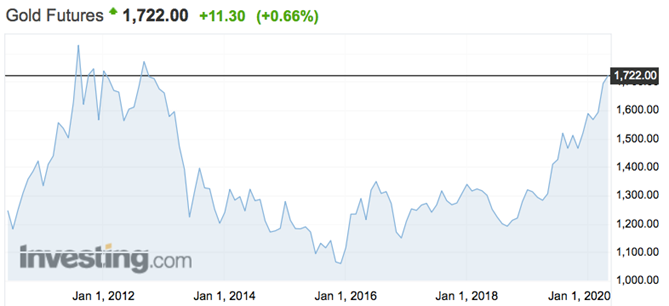
Although Colombia remains riskier than the U.S., Canada or Australia, most of the country is considerably less risky than at least three of the world’s top six gold producing countries—China, Russia and Indonesia. Colombia has a globally significant endowment of potentially mineable metals, yet has been woefully under-explored.

The ability of foreign firms to safely conduct mining activities in Colombia is improving. The newly elected federal government is pro-resource development as a means of accelerating government royalty revenue. For example, it is spearheading a national US$25 billion infrastructure program building roads, highways, bridges and tunnels to improve logistics throughout the Andes.

It doesn’t hurt that giant Zijin Mining recently acquired Canadian junior Continental Gold for US$1.05 billion = ~C$1.5 billion (at today’s C$ exchange rate) in cash (share price tripled in year leading up to takeout) outbidding Newmont Corp. for a truly world-class Colombian asset. Continental discovered and developed Buriticá, one of the highest grade, pre-production projects in the world.

Buriticá had 5.67 million Measured and Indicated ounces at ~11 g/t Au Eq, + 6.46 million Inferred ounces at ~9.2 g/t Au Eq. At US$1,200/oz gold, this project had an after-tax NPV(5%) of US$860 million and an internal rate of return (IRR) of 31.2%, and a whopping US$1.6 billion NPV & 48% IRR at today’s spot price of ~US$1,722/oz. An estimated All-In Sustainable Cost (AISC) of ~US$600/oz places it in the bottom decile of the global cost curve.

Newmont wanted Buriticá. AngloGold Ashanti is active in Colombia. B2Gold has an open pit JV with AngloGold that’s expected to deliver a BFS within nine months. Gran Colombia is the largest underground gold-silver producer in the country (until the Buriticá mine starts later this year). Gold-heavy juniors include; Caldas Gold, Royal Road Minerals, Outcrop Gold, Antioquia Gold, Cordoba Minerals and FenixOro.
FenixOro Gold Corp. (FENX:CSE) is a company that readers should take a closer look at. Shareholders believe it could be the next Continental Gold, that its Abriaqui project could be another Buriticá. Even if one considers this view an exaggeration (we need to see some drill results), many critical factors suggest the claim is within the realm of possibility.

Led by CEO John Carlesso, a 25-year veteran of the international business world and founder/director of a number of companies. John was VP Corporate Development for Desert Sun Mining when it was acquired by Yamana Gold for $750 million. Over the past 18 years, Mr. Carlesso has focused on LATAM deals.

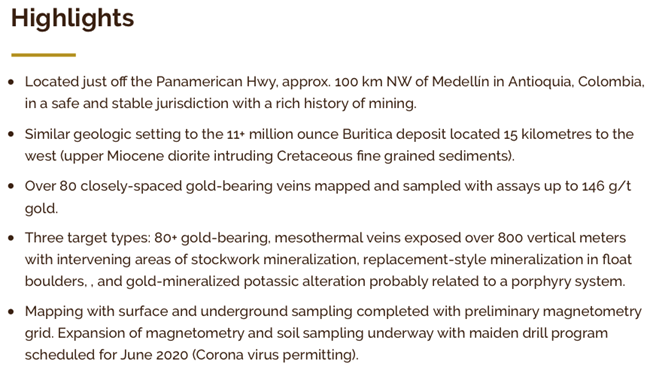
Since 2007, >80 million ounces of gold have been discovered on the 200 km long Middle Cauca gold belt (one of the most prolific in the world) hosting Buriticá and FenixOro’s Abriaqui projects. AngloGold Ashanti has two 20+ million ounce deposits in the belt. Notably, Abriaqui at ~550 hectares is packed into a much smaller footprint than Buriticá at 75,000+ hectares.

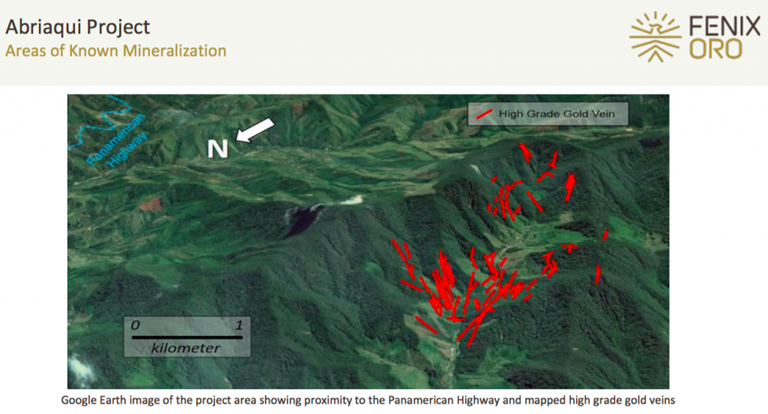
How is it possible that Abriaqui could potentially host a multi-million ounce deposit on just a 5 sq km surface footprint? For an answer, I asked newly appointed VP of Exploration (and a director) Stuart Moller (more on him later). He turned me to slide 8 of the May 2020 corporate presentation, explaining that the entirety of Buritica’s resource fits onto roughly one quarter (1/4) of the area of the Abriaqui project. Moller said,

“As shown in the inset of slide 8, the entire Buriticá resource is contained within the 100-hectare red box, shown at the same scale as the Abriaqui map in the figure. Comparing the outcrop area and dense spacing of the Abriaqui veins with Buriticá’s footprint, we believe we have plenty of room for a sizable orebody within our licenses.”

I invite readers to continue reading and to consider the risk-reward proposition here. FENX’s Enterprise Value (EV) [market cap – cash + debt] of ~C$14 million is less than 1/100 (< 1%) the size of Continental Gold’s takeout value. Although admittedly an apples to oranges comparison until/unless a significant discovery is made by FenixOro, investors should know in a matter of months, not years, if there’s something exciting that warrants further drilling.

The secret to the blue-sky potential at Abriaqui, and Buriticá’s existing 12M+ Au Eq resource, is the depth and continuity of mineralization across each company’s project areas. The technical team at FenixOro has already traced high-grade gold veins over ~900 meters of vertical extent, from gold outcrops at ~2,800 meters elevation, to workings at ~1,800 meters. Buriticá has greater than 1,200 meters of vertical extent and remains open at depth.

FenixOro’s Abriaqui project is directly on trend, and ~15 km west of Buriticá. Closeology is nice, but there’s a lot more to this story. First and foremost, there’s VP of Exploration/Director Stuart Moller. With 40 years’ experience in international mineral exploration, he held senior roles with Barrick and Pan American Silver.

As VP of Exploration at Continental Gold, Mr. Moller led the team that discovered Buriticá and was in charge of the first 270 drill holes. Few, if any, geologists on the planet are better suited to find the next Buriticá deposit than Mr. Moller. He and his technical team are anxious to conduct the very first meaningful, modern drill program on FenixOro’s property.

Armed with a great team, 40 years’ exploration under his belt and invaluable experience from drilling a giant discovery just 15 km away, Mr. Moller is understandably quite excited and optimistic. At the same time, he’s realistic. He told me that as bullish as he sounds over the phone, one never knows what a deposit holds until you drill it. The time has come to show the world what’s hidden below surface, not just talk about it.

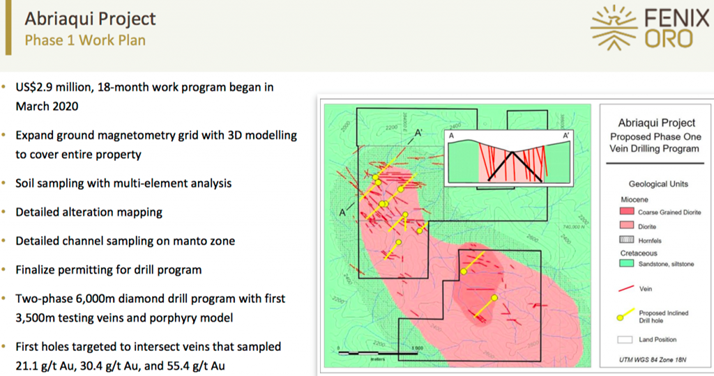
Second, a fully funded [6,000 meters, 18–20 holes] phase 1 drill program is expected to start in about two or three months. Unlike giant exploration properties where there can be hundreds of drill holes before a large discovery is made, management expects to identify a lot of mineralization in phase 1. Readers should note, FenixOro has already delineated >100 narrow, high-grade veins.

Readers should note, it’s not just narrow (~30–150 cm wide, tightly spaced, several meters apart) high-grade and possibly ultra-high-grade veins (>50 g/t). Equally important is the grade of mineralization between the veins. Investors will get a sense of this from phase 1 drill results starting in late summer or early fall.
Third, the gold price at US$1,722/oz is a spectacular development. Until recently, I never mentioned strength in the gold price as an investment merit. This year is different. I believe gold will stay strong at least through January 2021, due to the economic fallout from COVID-19, global debt-fueled stimulus programs/money printing and U.S. elections. If Trump loses, some fear his departure from office in January could be contentious.

Fourth, not only is Colombia well-endowed with minerals, it’s a low-cost jurisdiction to explore and develop. Fifth, as mentioned, the Colombian government is spending up to US$25 billion on infrastructure projects. A major 4-lane highway, complete with new power lines, from Medellín will come within 4 km of the Abriaqui project, cutting travel time in half to under two hours.

Despite not having drilled yet, a great deal is already known about the Abriaqui project. Over 300 chip or channel samples have been taken with assays of up to 146 g/t gold. More than 15% were >20 g/t gold. Hundreds of soil samples are in the lab awaiting assays. Greater than 100 high-grade veins have been mapped.

We can be reasonably sure that water, labor and power availability will not be a problem. Mr. Moller has lined up a well-known Canadian drill contractor, at very low cost. Community relations are strong. FenixOro has prudently partnered with a third generation local mining cooperative.

As mentioned, strong continuity and upwards of 1,000 meters of vertical extent support the possibility of a large or very large gold deposit. The gold is “free-milling,” as can be seen in the production from small water-driven gravity separation mills on the property.

FenixOro Gold Corp. (CSE: FENX) is fully funded well into next year. Therefore, evidence of something potentially worth much more than the company’s current EV of just C$14 million could come by the fall, well before the need to raise additional equity capital.
Peter Epstein is the founder of Epstein Research. His background is in company and financial analysis. He holds an MBA degree in financial analysis from New York University’s Stern School of Business.

Disclosures: The content of this article is for information only. Readers fully understand and agree that nothing contained herein, written by Peter Epstein of Epstein Research [ER], (together, [ER]) about FENIXORO GOLD., including but not limited to, commentary, opinions, views, assumptions, reported facts, calculations, etc. is not to be considered implicit or explicit investment advice. Nothing contained herein is a recommendation or solicitation to buy or sell any security. [ER] is not responsible under any circumstances for investment actions taken by the reader. [ER] has never been, and is not currently, a registered or licensed financial advisor or broker/dealer, investment advisor, stockbroker, trader, money manager, compliance or legal officer, and does not perform market making activities. [ER] is not directly employed by any company, group, organization, party or person. The shares of FENIXORO GOLD CORP. are highly speculative, not suitable for all investors. Readers understand and agree that investments in small cap stocks can result in a 100% loss of invested funds. It is assumed and agreed upon by readers that they will consult with their own licensed or registered financial advisors before making any investment decisions.

At the time this article was posted, FENIXORO GOLD CORP. was an advertiser on [ER] and Peter Epstein owned shares in the Company.

Readers understand and agree that they must conduct their own due diligence above and beyond reading this article. While the author believes he’s diligent in screening out companies that, for any reasons whatsoever, are unattractive investment opportunities, he cannot guarantee that his efforts will (or have been) successful. [ER] is not responsible for any perceived, or actual, errors including, but not limited to, commentary, opinions, views, assumptions, reported facts & financial calculations, or for the completeness of this article or future content. [ER] is not expected or required to subsequently follow or cover events & news, or write about any particular company or topic. [ER] is not an expert in any company, industry sector or investment topic.

Streetwise Reports Disclosure:
1) Peter Epstein’s disclosures are listed above.
2) The following companies mentioned in the article are billboard sponsors of Streetwise Reports: None. Click here for important disclosures about sponsor fees. The information provided above is for informational purposes only and is not a recommendation to buy or sell any security.
3) Statements and opinions expressed are the opinions of the author and not of Streetwise Reports or its officers. The author is wholly responsible for the validity of the statements. The author was not paid by Streetwise Reports for this article. Streetwise Reports was not paid by the author to publish or syndicate this article. Streetwise Reports requires contributing authors to disclose any shareholdings in, or economic relationships with, companies that they write about. Streetwise Reports relies upon the authors to accurately provide this information and Streetwise Reports has no means of verifying its accuracy.

4) The article does not constitute investment advice. Each reader is encouraged to consult with his or her individual financial professional and any action a reader takes as a result of information presented here is his or her own responsibility. By opening this page, each reader accepts and agrees to Streetwise Reports’ terms of use and full legal disclaimer. This article is not a solicitation for investment. Streetwise Reports does not render general or specific investment advice and the information on Streetwise Reports should not be considered a recommendation to buy or sell any security. Streetwise Reports does not endorse or recommend the business, products, services or securities of any company mentioned on Streetwise Reports.
5) From time to time, Streetwise Reports LLC and its directors, officers, employees or members of their families, as well as persons interviewed for articles and interviews on the site, may have a long or short position in securities mentioned. Directors, officers, employees or members of their immediate families are prohibited from making purchases and/or sales of those securities in the open market or otherwise from the time of the interview or the decision to write an article until three business days after the publication of the interview or article. The foregoing prohibition does not apply to articles that in substance only restate previously published company releases.

Graphics provided by the author.

( Companies Mentioned: FENX:CSE,
)

Categories
Gold

Central Bank Hypnosis

Source: Michael Ballanger for Streetwise Reports   06/01/2020

Sector expert Michael Ballanger bemoans the panic-inducing influence of politicians and the influx of “counterfeit currency” from central banks on the money and commodities markets.

One look at the chart of the U.S. financial markets against the backdrop of economic paralysis and suffering, and one is immediately filled with a myriad of emotions. Sympathy for those that have been afflicted by the most recent pandemic; fear for the families whose primary breadwinner is now unemployed; confusion toward the proper course of action going forward; and finally outrage at the abject timidity of our citizens in responding to the orders laid down by these insipid politicians in response to the crisis.

As the welfare of future generations hangs in the balance, its tentativeness the direct result of government ineptitude, I keep asking myself a critical question: “When did the backbone of our people turn to mush?” If someone holding political office had told my grandfather to stop ploughing his fields or tending to his livestock because a sickness was spreading throughout the community, that charlatan would have wound up with buckshot adorning his gluteus maximus. How dare any group of elected bureaucrats ordain the shutdown of an economy? Telling citizens to “stay home” and “avoid contact” was tantamount to telling my grandfather to cease and desist in providing for his family. That he should shutter the ploughs and the reapers and the milking stations, that his sons and daughters need not feed the chickens or slop the hogs because the government was going to “protect them” from harm? Well, not only would promises like that go unheeded by the generations that preceded us; they would be treated with the utmost of distrust and the vilest of response.

The reason that citizens of North America fled Europe and the British Isles to become settlers in the New World was because acceding to government orders and laws and rules and edicts had left them wallowing in a sewer of social and economic slavery while the elites inhabiting the privileged classes prospered. Sadly, over the last century or so, starting around 1934 with the creation of the first U.S. “central bank” (the Federal Reserve), citizens have been purposefully softened by the availability of social safety nets that started innocently and well intentioned in the 1930s, with programs like the Tennessee Valley Authority and later Freddie Mac and Fannie Mae.

But at every sniff of an economic downturn, political responses have grown progressively more rapid and more extreme. With the mainstream media (which is now social media more than print or TV/radio media) providing a wonderful symphony of accompaniment, the political grandstanders have been able to generate a cavalcade of panic, which has provided the perfect cover for clandestine enrichment of the corporate sector, once again, as in 2009, from the public purses on the pretense of economic Armageddon.

Fellow citizens, I ask you: How many times must you be subjected to this moral hazard rot before you arm yourselves with torches and pitchforks and enact change?

Back in late February, when the fear-mongering was just shifting into gear, I was ranting and raving about the REPO operations back in late September and asking why the Fed was bailing out the hedge funds. I was waving the red warning flag long before COVID-19 conveniently arrived on our doorsteps to present a “clear and present danger” to all aspects of Western civilization, to the extent that the U.S. central bank alone has authorized an injection of $10 trillion into the corporate pig trough. That is a pittance when one adds the Bank of Japan (BOJ), the Bank of China (BOC), the European Central Bank (ECB), the People’s Bank of China (PBOC), and all of the other purveyors of counterfeit currency to the mix.

Where was it ever written that an elected official has the right to impair the purchasing power of years of labor and prudence and savings of the average citizen? What gives any politician the right to debase my money, upon which I deserve to rely as I move into retirement?

You must forgive me for sounding like a bitter, disillusioned old man but the events of the New Millennium are growing more and more apocalyptic as the days wear on. Today I read that the CDC (Centers for Disease Control and Prevention) has agreed with the findings of scientists from Yale and John Hopkins, and has determined that the mortality rate for the current pandemic is no different than for any other strain of infectious virus.

In other words, whether or not these political wand wavers ordered work stoppages or not, the same rate of fatalities would have occurred. Whipped up into a media-frenzied print-fest, the Fed and the U.S. Treasury just trashed your savings, your pensions and your Social Security by assuming leadership of a crisis for which not one person was either qualified to assess nor capable of managing. The “clear and present danger” was not the pandemic; it was the politicians and the money changers inhabiting the temple.

Markets

What markets? There are no “markets” anymore. All I see when my quote terminal starts flashing these days is the New York Fed’s omnipotent computer programs whirling away, assigning their desired price objectives to literally everything. Yield curve moving back to inverted? Nope—buy all short-dated bonds until the two-year yield is down. Thirty-year yield moving lower? Nope—sell the hell out of the 30-year until we get that yield well above the two-year. Stocks looking a tad weepy? Nope—buy a 500-lot of the E-minis and trigger the algos to the buy side.

And gold! What the hell is it doing at $1,750/ounce? Offer three times annual global production $40 under cash, and we can easily fix that problem, too! Everywhere I look I see criminal interventions making it impossible for me to apply the skills I learned over 40 years to the practice of managing risk.

The near-term outlook for stocks is now locked within the walls of the Eccles Building in Washington; the models that have been constructed have no historical precedent upon which to rely. These economists all disagree on every point except one: credit creation. Since all they really understand is the process of debt application to solve all problems of a fiscal and monetary nature, the pandemic now provides an entirely new bogeyman to be vanquished through monetization. Adding a health crisis to the banking crisis of 2008 and the liquidity crisis of October 2019 (when the REPO ops began in earnest), their models completely and conveniently omitted the underlying systemic cause of disruptions—which, of course, is debt.

I learned long ago that after periods of sustained credit creation in any society, there comes a moment when the marginal benefit of one additional dollar of debt has zero impact on either gross domestic product (GDP) or money velocity, with the latter more important than the former. The world passed that threshold in 2008, and was beginning the violent and deflationary process of debt destruction when the international banking cartel, led by the Wall Street/Washington ringleaders, held out their hands. After using the MSM (mainstream media) to spread panic throughout the campaign headquarters of the political classes, they secured permission to reverse the debt elimination process through an unprecedented credit creation orgy that papered over the insolvency and illiquidity of the purging process.

Sure enough, the policymakers discovered the impossibility of reversing an exploding debt bubble, and that you can no more assuredly reverse a credit bubble’s popping than you can the direction of the St. Lawrence River. You can divert the flows temporarily, but you can never reverse them.

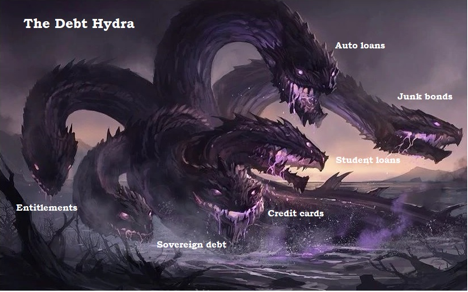
The first signs of the return of the credit reckoning came last autumn with the “not QE” REPO operations that were all centered around the growing illiquidity in the treasuries markets, which then began to bubble over into corporate high yield. As the size and scale of the REPO actions were escalating wildly as late as February, the debt destruction monster was starting to become an unpopular narrative that was threatening to overshadow the China trade war and talks of impeachment. In an election year, the last thing any Republican could handle was the re-emergence of this credit “hydra.”

Enter the Wuhan pandemic and what arrived in the nick of time was the perfect cover for yet another debt-fueled diversion of the credit reckoning—but this time, unlike 2009, the money-printing bazooka used by Hank Paulson has been replaced by a fifty-megaton nuclear weapon of mass distraction designed to keep the citizenry terrorized and under control.

ballanger2hydra

In past times, the layering of large swaths of counterfeit currency on top of systemic insolvency was done so delicately, and usually with little drama or fanfare. In the ’80s, when the savings and loan industry was buried in bad loans that threatened the big Wall Street counterparties, they deftly and surgically moved the problem “off balance sheet,” which is a polite way of saying that they lifted the corporate governance carpet and with the flick of the broom, swept the rotting remnants of corruption, bribery, and boardroom malfeasance under, never to be seen or spoken of again.

Fast forward to 2020. There are now daily press conferences with the thespian thought-managers front and center, all giving opinions and pronouncements on issues over which they have no control and about which they have no knowledge. To say that I am irked by the arrogance of the self-professed “experts” in espousing forecasts on everything from mortality rates to economic recovery rates is an understatement; these blowhards have zero understanding of, nor ability to predict, anything related to the pandemic. Therefore, they had zero authority to make decisions affecting millions of citizens in countries all over the world. Yet they did, and now we must live with their gambles on how we should live our lives.

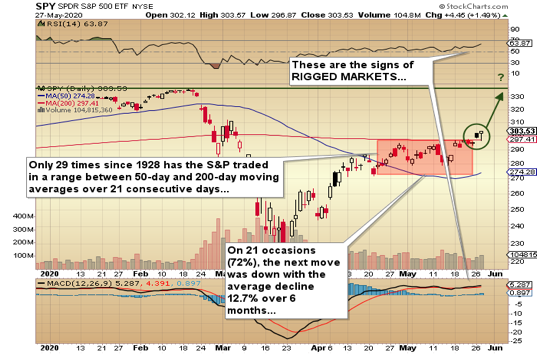
There is only one chart to show, and it is one that depicts the insanity of the day. Thanks to this coordinated orgy of preventative credit expansion, equity markets, led by the S&P 500, have roared back from the abyss. Debt-to-GDP at 140% and forward P/Es (price-to-earnings ratios) in the never-before-seen 24 ranges are today the “new normal,” and not to be feared but rather embraced, because at the end of the day, there can never ever again be bankruptcies of a corporate origin. These might impact the unemployment rate and, more importantly, stocks, and if stocks are in decline, people will be afraid to spend the money they no longer have, and that they lost while providing for their families after the government forced their employers to stop all operations.

ballanger2chart

I watch riots breaking out in Minneapolis, and now L.A., over yet another racially charged police action causing the death of a citizen, and firmly believe that this is going to become an accelerant to the outrage that is simmering on the back burners in households all across the globe. The SPY looks like it wants to probe higher, and quite possibly test the February pre-COVID highs, but from my perspective, valuations are absurd and joined by risks that are now even higher than I sensed in February, when I urged subscribers to short the SPY at 326.

Will I short the SPY again any time soon? Well, if I am in a Las Vegas casino and I see the pit boss whispering to a croupier about a player on a “roll,” I can promise you that I will not be joining that table any time soon. There are just too many big players who want to see stocks higher, and bonds and gold “controlled,” and until I have certainty that the trillions upon trillions of Fed credit bestowed upon the Wall Street crowd is not aimed at the stock market and Donald Trump’s reelection, I will be happy to keep the bulk of my investible cash exactly that—in cash—with an overweight position in gold and silver junior developers with ounces in the ground and fortunes to be made when the levee finally breaks and the oceans of toxic debt flood the fields.

The sooner, the better. . .

Originally published May 30, 2020.

Follow Michael Ballanger on Twitter @MiningJunkie.

Originally trained during the inflationary 1970s, Michael Ballanger is a graduate of Saint Louis University where he earned a Bachelor of Science in finance and a Bachelor of Art in marketing before completing post-graduate work at the Wharton School of Finance. With more than 30 years of experience as a junior mining and exploration specialist, as well as a solid background in corporate finance, Ballanger’s adherence to the concept of “Hard Assets” allows him to focus the practice on selecting opportunities in the global resource sector with emphasis on the precious metals exploration and development sector. Ballanger takes great pleasure in visiting mineral properties around the globe in the never-ending hunt for early-stage opportunities.

Sign up for our FREE newsletter at: www.streetwisereports.com/get-news

Disclosure:
1) Statements and opinions expressed are the opinions of Michael Ballanger and not of Streetwise Reports or its officers. Michael Ballanger is wholly responsible for the validity of the statements. Streetwise Reports was not involved in any aspect of the article preparation. Michael Ballanger was not paid by Streetwise Reports LLC for this article. Streetwise Reports was not paid by the author to publish or syndicate this article.
2) This article does not constitute investment advice. Each reader is encouraged to consult with his or her individual financial professional and any action a reader takes as a result of information presented here is his or her own responsibility. By opening this page, each reader accepts and agrees to Streetwise Reports’ terms of use and full legal disclaimer. This article is not a solicitation for investment. Streetwise Reports does not render general or specific investment advice and the information on Streetwise Reports should not be considered a recommendation to buy or sell any security. Streetwise Reports does not endorse or recommend the business, products, services or securities of any company mentioned on Streetwise Reports.
3) From time to time, Streetwise Reports LLC and its directors, officers, employees or members of their families, as well as persons interviewed for articles and interviews on the site, may have a long or short position in securities mentioned. Directors, officers, employees or members of their immediate families are prohibited from making purchases and/or sales of those securities in the open market or otherwise from the time of the interview or the decision to write an article until three business days after the publication of the interview or article. The foregoing prohibition does not apply to articles that in substance only restate previously published company releases.

Michael Ballanger Disclaimer:
This letter makes no guarantee or warranty on the accuracy or completeness of the data provided. Nothing contained herein is intended or shall be deemed to be investment advice, implied or otherwise. This letter represents my views and replicates trades that I am making but nothing more than that. Always consult your registered advisor to assist you with your investments. I accept no liability for any loss arising from the use of the data contained on this letter. Options and junior mining stocks contain a high level of risk that may result in the loss of part or all invested capital and therefore are suitable for experienced and professional investors and traders only. One should be familiar with the risks involved in junior mining and options trading and we recommend consulting a financial adviser if you feel you do not understand the risks involved.