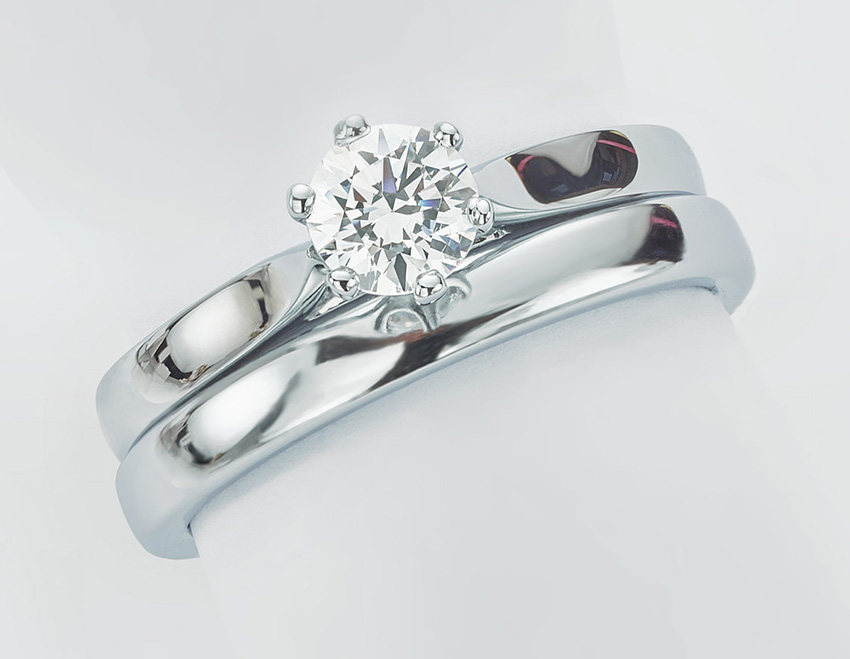
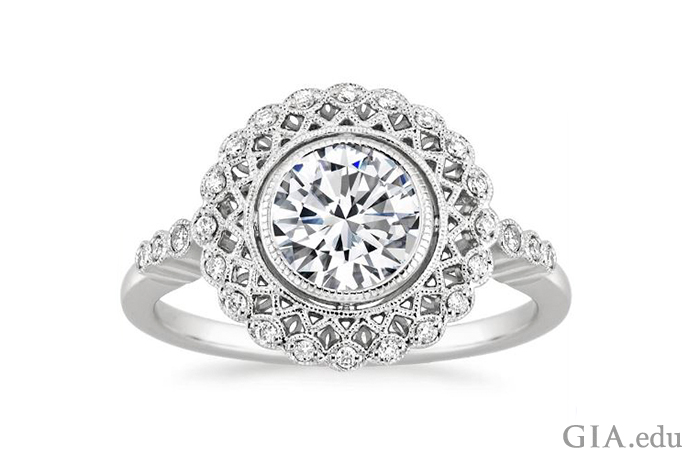
Our Ballerina wed fit engagement ring, with a matching profile wedding ring.
Matching wedding rings – ensuring both rings match.
One of the biggest concerns raised by brides is looking for a matching wedding ring.
Since there are so many styles and profiles for both the engagement ring and matching wedding ring, this can be an exhausting process, involving a great deal of conflicting advice, and head-scratching along the way. Factor in diamonds and many people will ask the question – “Where do I begin?”
We take much of the agony out of this process, by providing a very comprehensive service for matching wedding rings to an engagement ring. This requires a good working knowledge of both engagement rings and wedding rings, with the backing of jewellery making services adept in various styles.
Whether it be straight plain bands to more complex shaped wedding rings that will flow around the setting of an engagement ring.
The best metal for a matching wedding ring
We always recommend going for the same precious as your engagement ring. This it to ensure the metals are the same colour. But also, wearing two different precious metals against each other can cause them to wear.
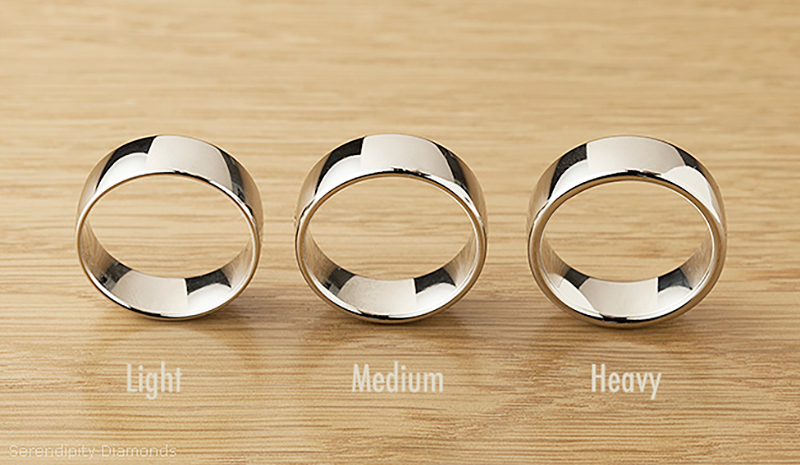
What is the best wedding ring width for me?
Think about what width will suit you. Some rings vary from behind the finger, to the top of the setting. Think about what will match best. Sometimes matching the ring width all of the way around works nicely. In certain circumstances, choosing an in-between width will match best. Some clients prefer a much wider ring to greatly differentiate the two types of wedding ring when worn together.
What is the best wedding ring depth?
The band of an engagement ring is often shallower under the finger than at the shoulders. Think about how deep you would like the wedding ring at each point.
A wedding ring created equal in depth to the engagement ring shoulders will potentially deepen more than necessary behind the finger, giving a stepped appearance between the rings.
For some rings, this difference is minimal, so less of a consideration. It is important to ensure that for the inclusion of diamonds within the matching wedding band, there is enough depth to accommodate the stones.
Do I want to mirror the diamonds to my matching wedding ring?
If you have diamonds set across the shoulders of your engagement ring consider adding a row of diamonds to your wedding ring, in the same style of setting, using the same shape of the diamond, and in the same diamond size.
We mirror the start of the diamonds to match your engagement ring. Small details such as this, usually have a dramatic effect in the final appearance of both rings.
Should my matching wedding ring be the same finger size as my engagement ring?
If your engagement ring is already tight on the finger, consider re-sizing this first. Once at a comfortable size, choose the same finger size for your matching wedding ring. In such circumstances (and especially with shaped wedding rings) arrange any re-size work at the same time, with both the wedding and engagement ring being matched in finger size.
Do I need a shaped ring?
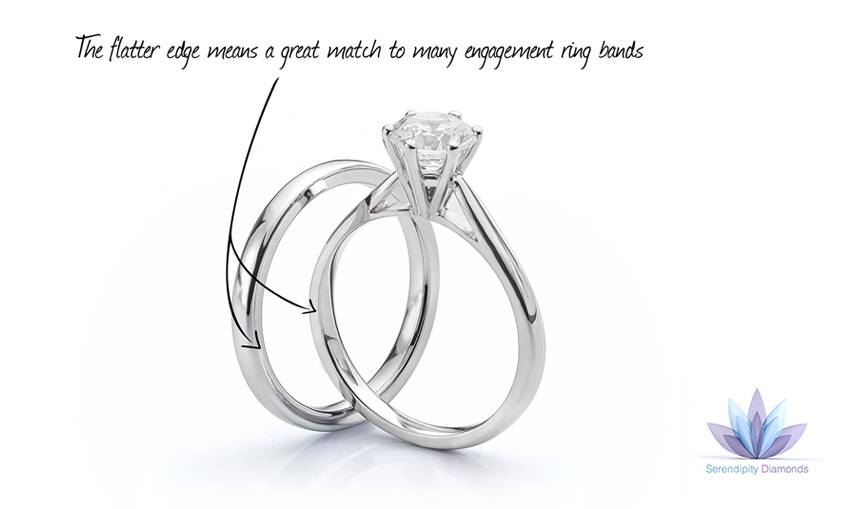
Some engagement ring settings are unsuitable for a straight matching wedding band. You will easily see this by placing a straight band alongside, with gaps being clearly visible. The straight ring may even rock, connecting only with the setting of the ring.
There are two ways for a matching wedding band to sit with an engagement ring setting. Either a shaped matching wedding ring can be created to flow around the design (this can be angular or sweeping depending on preference and style) contoured on both sides, or alternatively, a wider band can be contoured, or recessed on just one side.
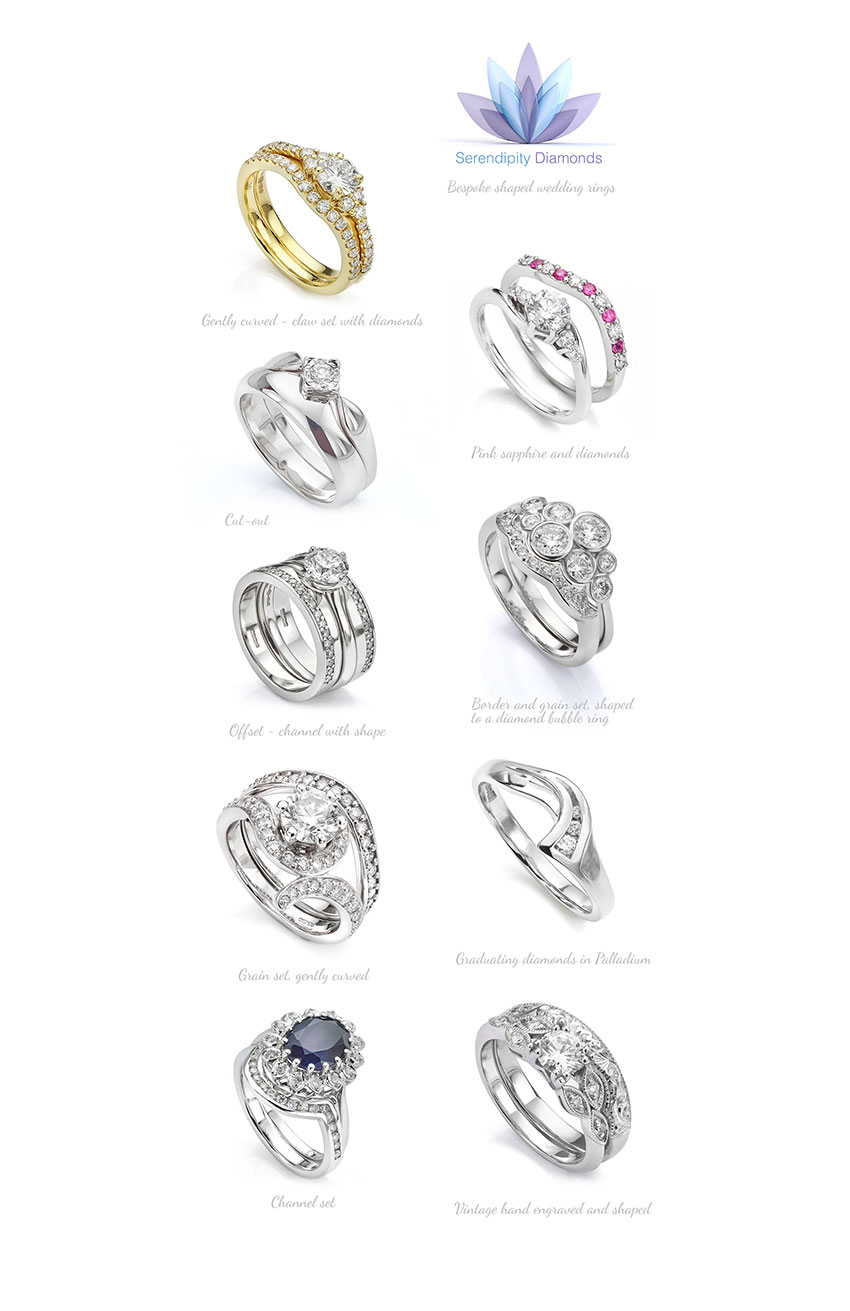
Examples of wedding rings matched to engagement rings
Look at the chart below and view some of the matching wedding rings we have created to match engagement rings. Click on the chart below to find out the approximate cost of each design.
Need more wedding ring advice?
If you’re a little stuck, or even in need of some guidance, we’re happy to talk you about matching wedding bands. Since we cost jewellery based on material costs and labour, with no hefty “designer” price tags, you can rest assured we do our very best on not only the item produced but also on the cost. contact us for more information.
The post How to Match a Wedding Ring to an Engagement Ring appeared first on Serendipity Diamonds Blog.
The process of diamond cutting transforms a diamond from its original form. From an insignificant crystal in the ground, the true beauty of a diamond comes from the expertise of the diamond cutter.
The diamond cutting process reveals the true hidden beauty of a diamond. From the rough crystal to the final faceted gemstone, the final result changes the passage of light passing through the diamond. At the same time, light reflects from the stone.
A significant part of a diamond’s value results from the cutting process. The cut and proportions of a diamond can influence value by as much as 40 per cent. For this reason, great time and effort go into cutting a diamond to release not only beauty but its value at the same time.
Most people refer to fire, brilliance and scintillation. But few people understand the difference between each of these terms.
In the following video, a round brilliant cut diamond sparkles with fire, brilliance and scintillation in a tension setting of our Unity ring design.
Light refraction and reflection in diamonds
The passage of light through a diamond slows as it passes through the matrix of carbon crystal.
Light bends as it passes from one medium to another—an effect referred to as refraction.
As this light travels through the diamond, it strikes another surface within the stone, causing part of the light to be reflected back.
The proportions of a diamond change the way light passes through a diamond. A well-proportioned diamond reflects most light back internally. Light passes back to the eye through the table facet. The result we refer to as brilliance. Conversely, a poorly proportioned diamond leaks light. As a result, poorly cut diamonds appear far less brilliant by comparison. Diamonds sparkle owing to the effect of brilliance with additional factors.
What is diamond fire?
Light passing through a diamond bends. As light passes through a diamond it splits into different colours. We see the same effect in water droplets when a rainbow forms. Also, when light passes through a prism.
This means that a beam of white light going into a diamond comes out as a spectrum of different colours. When we see the colours of the spectrum in a diamond, we call this fire.
Some diamond cuts exhibit greater fire than others. For example, Emerald-cut diamonds give greater fire but less brilliance. In contrast, brilliant-cut diamonds demonstrate greater brilliance and less fire.
A diamond splits white light into colours of the spectrum, referred to as ‘fire.’
What is scintillation?
The effect of light and movement creates scintillation. Scintillation is the play of white and coloured flashes of light seen when the diamond is viewed in motion. Viewable with the naked eye, scintillation is the life of the diamond.
We divide scintillation into flash scintillation and fire scintillation. Flash scintillation comes from bright flashes of light dancing across the polished facets of a diamond. When this effect throws flashes of colour, we refer to this as fire scintillation.
The quality of a diamond’s polish results adds or subtracts from the scintillation. An excellent polish assists in the reflection of light from each facet of the diamond.
The effect of fire, brilliance and scintillation on a diamond
The combined effect of fire, brilliance and scintillation gives a diamond life.
Together, the beauty of a diamond comes from the “across-the-room-sparkle.”
Few gemstones have this overall effect. We should remember that without light, diamonds have no brilliance, fire or scintillation. Light brings a diamond to life with an effect that few gemstones achieve.
How to keep the sparkle of your diamond
The attraction of grease and dirt to a diamond causes the loss of diamond sparkle. The build-up of hand creams and oils on the back of a diamond ring causes significant loss of sparkle. Remember to clean your diamond regularly using the Dazzlestik to restore sparkle.
The post Why Do Diamonds Sparkle? Diamond Brilliance, Fire and Scintillation appeared first on Serendipity Diamonds Blog.
South African diamonds gave birth to the modern diamond industry. Two teenagers — Erasmus Jacobs and Cecil Rhodes — helped make this happen. Learn how Jacobs found the first South African diamond and how Rhodes built up a diamond empire. In this blog, we’ll cover:
Erasmus Jacobs’ Surprise Discovery Cecil Rhodes’ Diamond Empire How South African Diamonds Changed Diamond History Famous South African Diamonds Diamonds Do Good Are South African Diamonds Ethical Diamonds?
Erasmus Jacobs’ surprise discovery
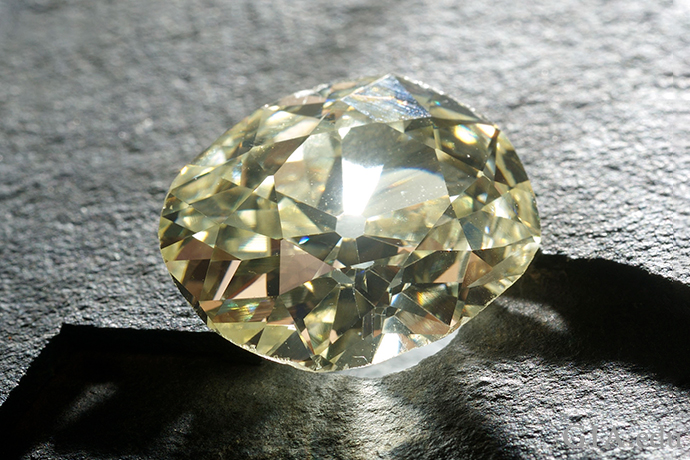
Teenagers, farmers, a shepherd — these were the first to discover diamonds in Northern Cape Province, South Africa, and by doing so, give birth to the modern diamond industry. The first significant South African diamond was found in 1866 by Erasmus Jacobs, a farmer’s son, who collected ‘pretty stones’ with his friends near the banks of the Orange River. A neighbor, Schalk Van Niekerk, intrigued by a particularly shiny pebble in the collection, offered to buy it from the boy’s mother, who then gave the pebble to Niekerk for free. The stone passed through several hands before an amateur geologist identified it as a diamond weighing 21.25 carats (cts). This enormous South African diamond was named Eureka, meaning “I have found it.”
Found by 15-year-old Erasmus Jacobs, the 21.25 ct Eureka diamond was the first significant diamond discovered in South Africa. It is on display at the Kimberley Mine Museum. Photo: Courtesy of De Beers Group.
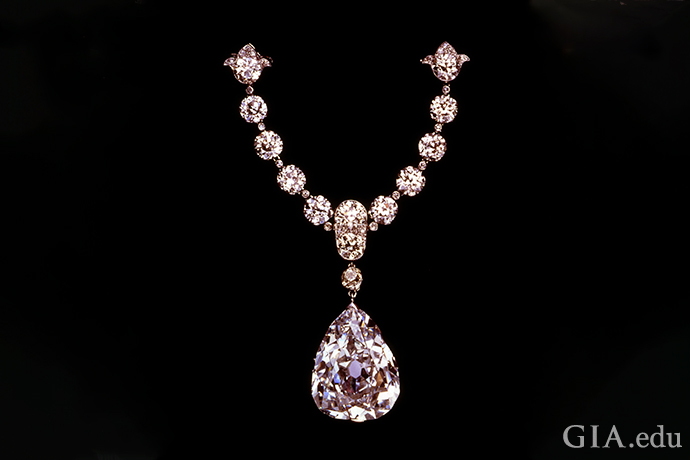
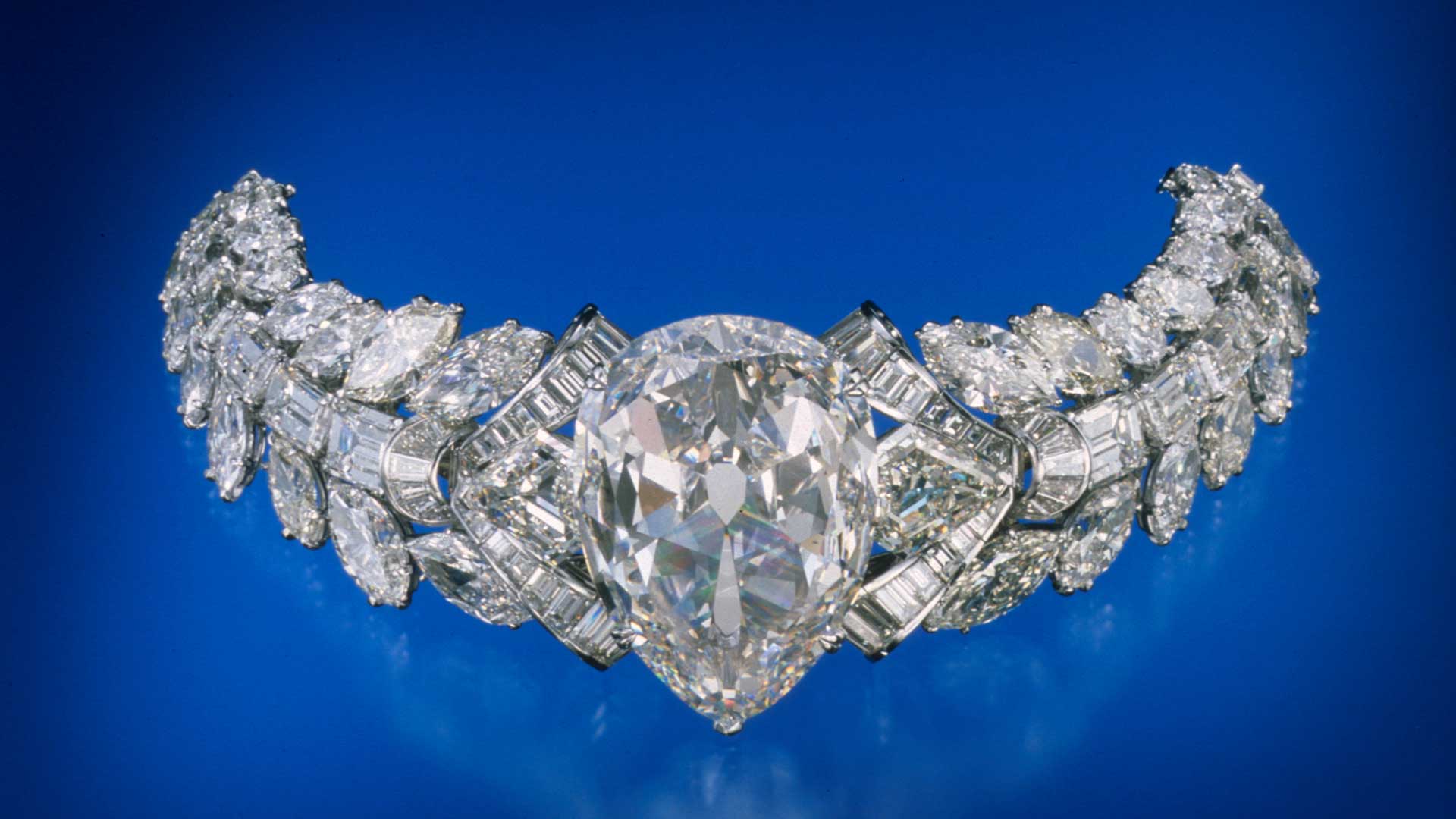
This discovery was treated with disbelief by most, and interest was lukewarm until 1869 when a shepherd found an enormous pebble. He first tried to trade the pebble for a place to sleep and then for breakfast. Everyone turned him down. Eventually, he made his way to the same man who first noticed Erasmus Jacobs’ shiny rock—Schalk Van Niekerk. In exchange for the pebble, Niekerk gave the shepherd a horse, 10 oxen and 500 sheep, nearly all of his earthly goods. His gamble paid off. The pebble turned out to be a South African diamond weighing 83.50 cts, and Niekerk sold it for £11,200 (equivalent to US$56,000 at the time), almost 100 times the value of what he gave Jacobs. This stone, named the Star of South Africa, made its way to England where it was cut into a 47.69 ct pear-shaped stone and purchased by the Earl of Dudley.
The pear-shaped, 47.69 ct Star of South Africa makes up the pendant in this diamond necklace. This fabulous diamond was found by a shepherd in 1869. Courtesy of De Beers Group
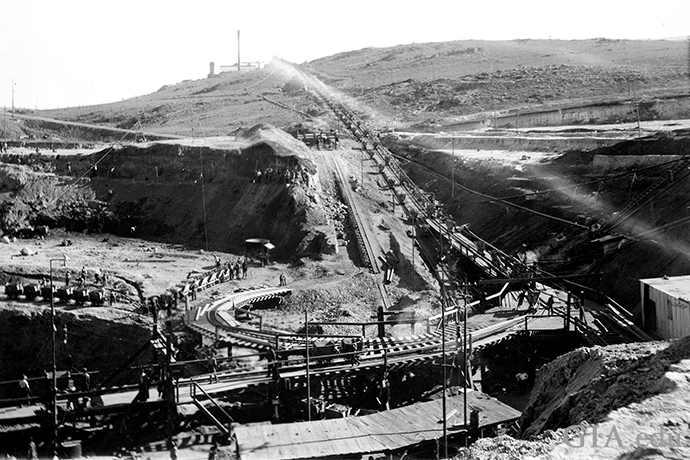
The discovery of this South African diamond sparked a diamond rush in the area where it was found. As more diamonds were discovered on local farms, including on the De Beer brothers’ farm in 1871, this hot and barren place quickly transformed into a town named Kimberley with a population of 50,000.
South Africa’s Premier Diamond Mine was an open-pit mine that opened in 1902 and operated for several decades.
Cecil Rhodes’ diamond empire
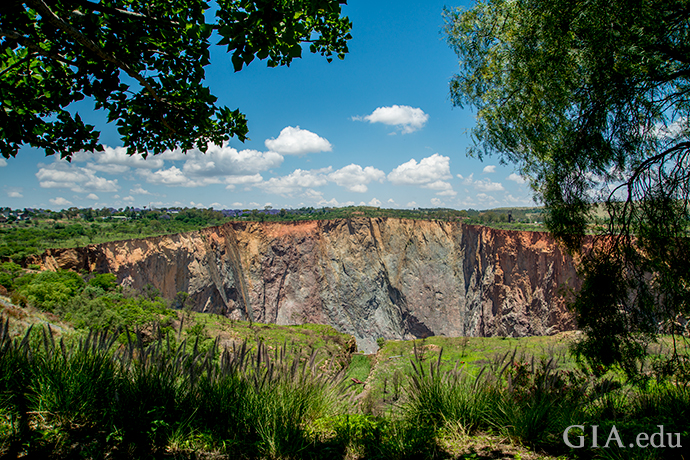
Another boy — an enterprising seventeen-year-old Englishman named Cecil Rhodes — launched what many consider as the modern diamond industry. Rhodes embarked for South Africa to try his hand at cotton farming. When farming failed, he traveled to the diamond fields of Kimberley where he made a living by pumping water from the diggings. By the age of eighteen, he had enough funds to start buying mining claims. Miners sold out to businessmen like Rhodes because, as they dug deeper, the ground became harder, and this harder ground made mining too risky and costly for individual miners. Rhodes, with the help of the Rothschilds, soon owned all of the De Beers’ claims. By 1888, he had also bought out all of the Kimberley diamond mines. Combining his holdings, Rhodes formed De Beers Consolidated Mines Ltd., a company that would grow to become a worldwide diamond monopoly.
The Kimberley Mine in South Africa, known as The Big Hole, is an example of an open-pit mine. Open-pit mining involves removing diamond-bearing kimberlite rock and processing it to extract diamonds. Photo: Robert Weldon/GIA.
How South African diamonds changed diamond history
The South African diamond rush changed two things: 1. The world’s supply of diamonds 2. How diamonds are found. Within a decade after diamonds were found in South Africa, the world’s production of diamonds increased tenfold. Before the South African diamond discoveries, the world’s diamond supply was limited. India had been the world’s primary supplier throughout history until Brazil emerged onto the world’s diamond stage as a primary producer in the 1700s. Diamonds from these countries were alluvial diamonds, however, that had been carried downstream from their host rock by rivers. These diamonds were rare and hard to find and therefore reserved for monarchs and royalty.
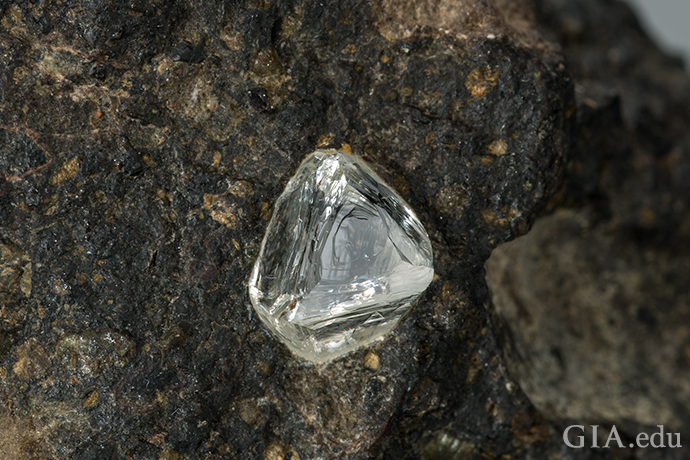
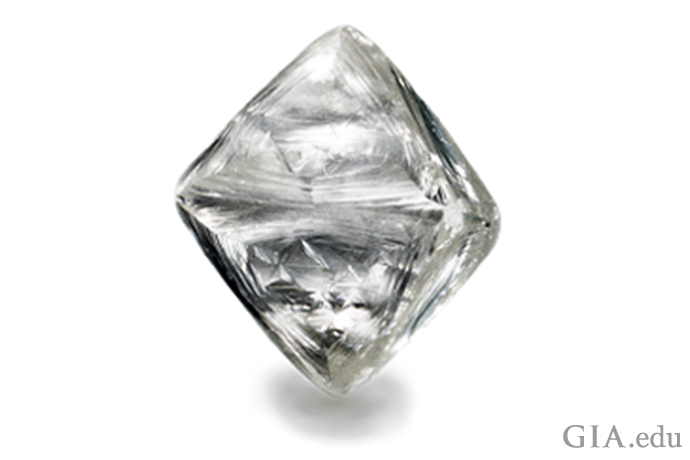
Octahedral diamond crystal in kimberlite matrix from South Africa. Photo: Robert Weldon/GIA.
The earliest diamonds in South Africa were also alluvial, but later diamonds were found in their host rock, kimberlite. Finding the host rock meant that diamonds could be mined in higher concentrations and greater quantities than before. This made large-scale open-pit mining worthwhile, transforming how diamonds are unearthed.
More diamonds were uncovered during the South African diamond rush than had been found in India in 2,000 years. Diamonds became affordable for the wealthy middle class for the first time. Fast forward to more than a century later, diamonds are now a popular and fairly accessible gem, and South Africa — currently the world’s 6th largest producer of diamonds by volume — continues to be a dominant player on the world’s diamond stage.
Famous South African diamonds
Diamond octahedron from South Africa. Photo: Robert Weldon/GIA
Diamonds do good
Diamonds, along with other mineral resources, have been the lifeblood of South Africa’s economy since their discovery. South African mines produced roughly ten million carats of diamonds, worth over US$1.2 billion, in 2018. The diamond industry creates jobs for tens of thousands of South Africans — diamond mining alone employed over 16,000 people in 2018 — and taxes on diamond companies help build roads, schools and hospitals. As a result, a greater number of children in mining towns attend schools than in non-mining areas.
Students participate in the Junior Gemology program conducted by GIA at a rural primary school in Limpopo Province, South Africa. Photo: Crystall Nel/GIA.
In addition, many diamond companies give back to their mining communities. Forevermark, an offshoot of De Beers, builds schools and hospitals near its mines and partners with UN Women to support women who are in business or in the Science, Technology, Engineering and Mathematics (STEM) fields. De Beers also created the Venetia Limpopo Nature Reserve, which is home to lions, elephants, leopards, African wild dogs and more. Anglo American funds the Zimele program, which helps small or medium-sized business owners grow their businesses, which ultimately results in more jobs.
Impala photographed at the Kruger National Park, Lower Sabie Region, South Africa. Courtesy: Robert Weldon.
Elephant photographed at the Kruger National Park, Lower Sabie Region, South Africa. Courtesy: Robert Weldon.
Are South African diamonds ethical diamonds?
Consumers searching for ethically sourced diamonds should consider diamonds from South Africa. South African diamond mines are world class in terms of their safety and environmental standards, and wages in the industry are high. South Africa is also a participant in the Kimberley Process, a global process set up by the UN to prevent ‘conflict’ diamonds from entering the mainstream diamond market. The process, named after Kimberley, South Africa, helps ensure that 99.8% of the world’s diamond production does not contain conflict diamonds.
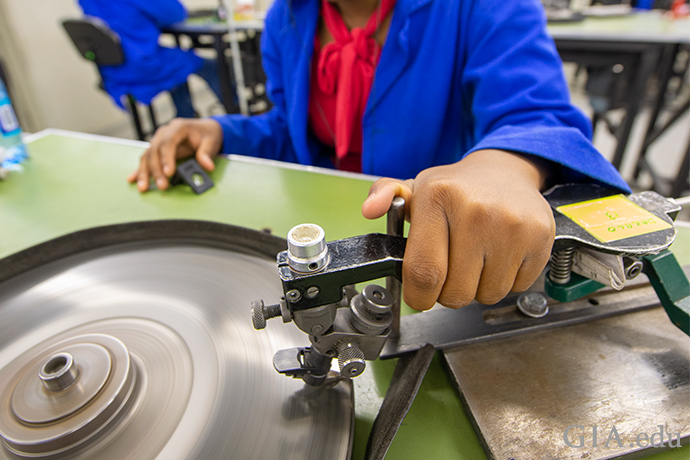
A diamond cutter polishing a diamond at the Harry Oppenheimer Diamond Training School in Johannesburg, South Africa. Courtesy: Robert Weldon
GIA, to help consumers know where their diamonds come from, is collaborating with diamond mining companies in South Africa as well as Canada, Botswana, Russia, Namibia and Lesotho to confirm the origin of diamonds from these places. This helps consumers wear their diamonds with peace-of-mind, knowing that their diamonds supported the miners in the country where they were mined.
How does GIA determine a diamond’s country of origin?
Select mining companies send rough diamonds to GIA in documented, sealed and untampered parcels. GIA then collects data and images of the rough for analysis. The rough is sent on to be cut and polished and then sent back to GIA. GIA then uses the markers and data identified during rough analysis to scientifically match each polished diamond to its original rough, thereby confirming the diamond’s country of origin.
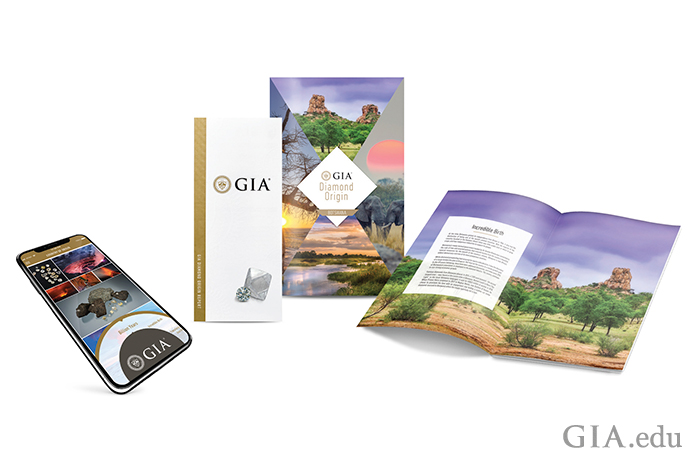
Learn where your diamond is from with the GIA Diamond Origin Report, Diamond Origin brochures and the Diamond Origin app.
The diamond’s origin is then stated on the GIA Diamond Origin Report, which contains a full and unbiased assessment of the diamond’s 4Cs quality (Color, Clarity, Cut, and Carat Weight) as well as a plotted diagram of the diamond’s inclusions. For added security, the diamond is laser inscribed with its unique report number. For consumers curious about their diamond’s journey and the impact their purchase has on local communities, the Diamond Origin app provides full-color images of the diamond in both its rough and polished states, as well as rich content about the diamond’s country of origin.
Rings like this Alvadora engagement ring from Brilliant Earth can be set with Russian, Botswanan or Canadian diamonds with GIA Diamond Origin Reports. Courtesy: Brilliant Earth.
A diamond’s journey is every bit as breathtaking as its sparkle. A GIA Diamond Origin Report helps tell a dazzling story — of a diamond’s journey from the depths of the earth to your jewelry box, and of the people in the country who helped make it happen.
The post Where are Diamonds Found? Spotlight on South African Diamonds appeared first on GIA 4Cs.
Silver 1 OZ 999 NY (XAG=X) Prices are Rallying, Where Should Investors Look to Take Profits? Live Trading News
The post Silver 1 OZ 999 NY (XAG=X) Prices are Rallying, Where Should Investors Look to Take Profits? – Live Trading News appeared first on WorldSilverNews.
(Kitco News) – The 10-year Treasury yield dropping below 1% for the first time means that the market thinks the Federal Reserve might not be done easing after an emergency 50 basis point cut, according to analysts.
The post 10-year Treasury yield below 1% means Fed ‘hasn’t gone far enough’ – analysts appeared first on WorldSilverNews.
(Kitco News) – The CBOE Volatility Index (VIX), a popular gauge of market fear, has returned to nine-year highs after falling briefly after Monday’s stock market rebound.
The post Fed failed to calm markets; VIX returns to highest level since 2011 and extreme fear is back appeared first on WorldSilverNews.
The Merits of Government Minted Coins Versus Privately Minted Coins Contributed Opinion Streetwise Reports
The post The Merits of Government Minted Coins Versus Privately Minted Coins Contributed Opinion – Streetwise Reports appeared first on WorldSilverNews.
If we had to guess, we would not expect silver stackers to panic and sell their metal at this point. Those who own the metal today likely hold it for reasons other than false certainty of endless gains (which did occur at certain times in the past). However, if economic hardship hits them, they may be forced to unload silver to put food on the table. This may seem premature in the US, but we will write about our observations in Asia. Here is one picture Keith took in the virtually empty Jewell Mall attached to Chiangi Airport in Singapore.
“Given that international gold price discovery takes place on derivatives markets which have little or no connection to the physical gold market and that the prices are merely blips on a screen (screen gold), we can therefore say that the gold price plunge last Friday was driven by trading in these markets, led by the COMEX, and also that the gold price fall last Friday was unconnected to the physical gold market.
While the mainstream financial press will never question gold price discovery or the difference between screen gold and physical gold, they do predictably try to come up with reasons to explain price movements. Unfortunately, most of these reasons are often not based on anything other than off-the-cuff the remarks of stockbrokers, trading desks, and buy side investment bank analysts. Unfortunately also, by not explicitly distinguishing between prices derived in an electronic casino and the real physical safe haven asset of tangible gold, the reasons provided by these reporters will fall into the trap of jumbling up two different things.”
USAGOLD note 1: The tail wags the dog and quite often, as the cartoon above suggests, to the surprise of the dog or, better put, to the surprise of the dog’s owners. In this piece, Manyly makes a distinction between the price “taker” (physical gold) and the price “maker” (the paper gold markets). That dichotomy has been the centerpiece discussion in the gold market for the past quarter-century. Though a source of great frustration to speculators in the short run, big price drops like the one we had this past Friday create opportunities for knowledgeable, strong-handed buyers to accumulate physical metal. Asia comes to mind. So do American professional money managers who have joined them in loading up on the dips.
USAGOLD note 2: Sooner or later, demand for the physical metal translates to the paper markets, even if cause and effect do not always match-up precisely on the timeline. If that were not the case, the price of gold would still be at $35 per ounce and physical supplies would have disappeared from the face of the earth long ago.