Categories
Gold

Ray Dalio Says “Cash Is Trash” and Americans Must Own Gold

Welcome to this week’s Market Wrap Podcast, I’m Mike Gleason.

Coming up Michael Pento joins me for a tremendous interview on a range of topics. Michael goes through his checklist of data points and the events that, once taken place, will fuel the next big rally in precious metals. He also talks about the key warning sign that we can be looking for that will indicate when the economic bubble to end all bubbles is about to burst. So don’t miss another fantastic interview with Michael Pento of Pento Portfolio Strategies, coming up after this week’s market update.

Gold and silver markets are once again getting overshadowed by wild price moves in lesser known metals – in particular, palladium and rhodium. Both are used mainly in emissions control devices for automobiles. And both are in extremely short supply.

A liquidity crunch over the past few days has driven an explosive spike in rhodium to nearly $10,000 per ounce. That’s nearly $4,000 higher than where it started the year and ten times higher than where it traded just a few years ago.

The rhodium, palladium, and platinum markets are heavily dependent on South African mines for supply. But recurring power outages and other dysfunctions in the country are crimping mining output.

Palladium prices shot up to $2,500 an ounce mid week in volatile trading and currently come in at $2,425 – up 5.2% since last Friday’s close and up nearly 25% so far in the early going of 2020.

As palladium continues to set records, so does its rising premium over its sister metal platinum. Palladium now sells for nearly 2.4 times the price of platinum. The opportunity for it to narrow in favor of platinum appears good given that one can often be substituted for the other in catalytic converters. When that starts to happen in a big way is another question.

But the trade has become so lopsided that a powerful squeeze on the platinum market could be triggered at any time. As of this Friday, platinum trades at $1,011 per ounce and shows a weekly decline of 1.5%.

Gold is up now by 1.0% for week to trade at $1,574. And finally, silver is unchanged for the week at $18.11 as of this Friday morning recording.

So can gold and silver investors look forward to a massive price spike in the near future like the one playing out in palladium and rhodium? Very likely, their day will come.

As central bankers continue to monetize ever-growing sums of debt and pursue negative real interest rates, the value of paper currency will go down versus hard money.

It’s a point reiterated this week by billionaire asset manager Ray Dalio. In an interview with CNBC from Davos, Dalio declared that cash is not where he wants to be.

Ray Dalio: What do you jump into when you jump off the train? And the issue is you can’t jump into cash. Cash is trash, because they’re going to print money. What do you do? You get out.

CNBC Interviewer #1: So what do you do?

Ray Dalio: So what you have to do is you have to have a well diversified portfolio. I think that you have to have a certain amount of gold in your portfolio, or you have to have something that’s hard. I know I’m going to come out of here (and everyone will be) like “Ray Dalio’s wild on gold.”

CNBC Interviewer #2: I’m going to say “cash is trash” is your headline.

Ray Dalio: But cash is trash.

There is no doubt that cash will depreciate over time. What is less certain is which assets Federal Reserve notes will depreciate against the most.

In recent years, the stock market has fared well while most commodities have not. However, even as food and energy costs have been held down, healthcare, education, insurance, housing, and other costs of living continue to move relentlessly higher.

We can only imagine what things would be like for consumers if crude oil and grain prices were going parabolic like palladium is. Since palladium only represents a small portion of the total cost of an automobile, most consumers feel no direct impact.

But they would be wise to pay attention to what’s happening in the palladium market – because it may be a precursor to what will happen in other markets in the years ahead. Declining oil rig counts and chronic under-investment in copper mines, for example, could lead to supply crunches that put enormous upward price pressure on all manufactured goods.

A reemergence of inflation fears would, in turn, drive safe-haven investment for gold and silver. As we’ve said before, it will take more than a geopolitical scare to drive a major trend.

The big scare this week: the deadly Coronavirus in China. It has the potential to spread rapidly and perhaps even drag down the global economy if it is not contained. There is currently no vaccine for the virus. As investors weighed the risks of a possible global pandemic, the stock market experienced some gyrations.

Whether the Coronavirus remains a front page story in the weeks ahead remains to be seen. But long-term precious metals investors can benefit from focusing on the underlying drivers for gold and silver that the mainstream media isn’t yet covering.

Well now, for more on what the mainstream financial media isn’t covering because they’ve blackballed guests like the man I talked to this week, let’s get right to the week’s exclusive interview.
Michael Pento

Mike Gleason: It is my privilege now to welcome back Michael Pento, President and founder of Pento Portfolio Strategies. Michael’s a well-known money manager, market commentator and author of the book, The Coming Bond Market Collapse: How to Survive the Demise of the U.S. Debt Market. He’s been a regular guest with us over the years and we always love getting his fantastic insights.

Michael, thanks for the time again today, and welcome back.

Michael Pento: It’s always a pleasure to be on with you. Thank you for inviting me back on the program.

Mike Gleason: Well, we’re having a hard time seeing a big move higher in metals prices until one of two things happen. We’ll start here. The first would be a pickup and safe haven demand. In our view there is too much investor complacency given the circumstances as has been the case for a while now, equity market valuations are sky high. Now we’ve got an election coming up, and there is at least some chance our next president will be an avowed socialist. This does not seem like the time for investors to be all in on risk trades, but we suppose the only thing that really matters is the Fed. They are going to do whatever it takes to keep the party in the stock markets going.

But what are your thoughts? Are we likely to see the markets get a wakeup call anytime soon or is the Fed likely to maintain complete control for the foreseeable future? Let’s start there.

Michael Pento: What a great question. Geez, you hit me over the head with a, a big anvil. That’s the $20 trillion question. I mean, can the market continue to defy gravity – and it is defying gravity, make no mistake about it. If you look at the total market cap to GDP, I look at the Wilshire 5000, that doesn’t have 5,000 stocks anymore. I think it’s like 3,500 but it’s the widest measurement of stocks, their market cap, to the underlying economy. That ratio is now 155%. Outside of March of 2000 when it was 145 or 148 around there, it’s never been near this. The average ratio is 0.8%… 80% or 0.8 in the ratio. So 155%, 1.55% above where the underlying supporting economy is. I mean it’s never been anywhere near this outside of that epic bubble in the NASDAQ debacle where the NASDAQ lost 80% of its value.

So that is where we are. We have S&P 500, year-over-year earnings are going to be negative. Margins are shrinking. Four quarters in a row of negative earnings per share growth, and profit margins are shrinking. You have the most overvalued market on the planet, that the planet has ever seen, and yet you wonder how much longer can it go? Well, think about it. The Fed said they were going to raise rates in December of 2018. Do you remember Jerome Powell said, “Hey, we raise rates and we’re going to 3.5% on the Fed funds rate, and we’re going to continue to drain our balance sheet. We’re going to continue quantitative tightening.” How long did that last, Mike?

They did a panic about face, took rates down to 1.5% on the overnight borrowing costs for banks, and they went back into QE. They’re doing $60 billion worth of money printing every month, and they have a repo facility on top of that. Hundreds of billions of dollars trying to keep the money markets liquid. So the Fed’s balance sheet was going to be drained back to normal, it went from 400 trillion from 800 billion. It was supposed to go back down to 800 billion or around there, but guess what? It’s now increased by a half a trillion dollars since mid-September.

So why is the market in a bubble? Why is the bubble getting bigger? Is because the Federal Reserve, and the ECB, and the Bank of Japan, and the Bank of India, and the People’s Bank of China, they’re all in a frantic to keep this artificial bubble alive. The only question I have is, you asked me, when is it going to end?

I’ll tell you when it’s going to end. I can’t tell you the date but I have a model that lets me know when to short the market, and believe me when I tell you, this crash is going to be something like we’ve never seen before. It could even dwarf the NASDAQ debacle of 2000, from 2000 to 2002.

I’m looking for a bust in junk bond yields. When junk bond yields implode, because that’s the nucleus of the crisis, that is when you’ll see me go net short the market in my portfolio, in the inflation/deflation and economic cycle model. And when will the junk bond market implode? Whenever the U.S. enters a recession and/or, because it could be both, and/or inflation begins to run intractable. That is when the market will implode. That is when we’ll have our reality check. That is when hopefully we make a lot of money for our investors while the chaos runs rampant around the world.

Mike Gleason: Sticking with the stock market theme here, you just published a note talking about Zombie Companies. What we’re seeing in the stock markets is truly amazing. You talk about defying gravity. That’s a great way of explaining it. You observed, in this piece, that stocks are at an all-time record highs, but at the same time we have 40%, nearly half of listed companies losing money. And 97% of CFOs in a survey published by Deloitte say a slowdown is either already started or will start this year. Talk a bit about the total and complete disconnect between stock prices and reality.

Michael Pento: Well, as you mentioned, there’s a record number of IPOs that don’t make any money. So, if you look at the trailing 12-month earnings, 40% of listed U.S. shares don’t make any money. And if you go back, it’s not just 12 months, if you go back three years, 30% of all listed companies haven’t made a nickel in the last three years and nobody seems to care.

This is the truth… Central Banks on a global basis have the global economy and global markets in the ICU unit, and they are on the life support system of money printing. I’ll give you an example. So, let’s look at the global debt scenario. Global debt is now $255 trillion, Mike, that’s up 50% since 2008. Government debt is up 80%, nearly 80% since 2008, the great credit crisis. But you ask yourself, what is the Portuguese, for example? The Portuguese 10-year note yields in this tsunami of new debt that’s been issued?

You know, back in 2000 as well, the PIGS, remember the PIG countries, their debt, Greek debt, the yield was 40%, Portugal and they were up at double digits. Italy, Greece, Ireland, Spain. The Portuguese 10-year note yield is 0.4%. Now on what planet does that make any sense at all? I mean, let’s just do a thought experiment for a second, Mike. Let’s just say that you knew that tomorrow the ECB, the Bank of Japan, and the Fed were going to make announcement. The announcement is that we will be ending QE and we will not buy when the assets mature… we will not roll over any more of that debt, corporate debt, sovereign debt, all that will be rolled off. What do you think would happen to the stock market? I think that it would be lock limit down.

Circuit breakers would be hit for many consecutive days, shutting down the exchange eventually. That’s what will happen. That’s the truth. So central banks have no choice, they’re trapped. They have no choice because, the world was ending in 2008, instead of taking our medicine then and allowing for a deflationary depression to wipe out all the imbalances, we levered up on everything. We increased debt on the government side by 80%, as I mentioned, $255 trillion, 330% of global GDP, total debt. We’ve created a massive corporate bond bubble, which I’d love to touch on in a second, unprecedented in the history of the planet. And interest rates, instead of being at five and a quarter percent like they were in the start of the crisis in 2008, they’ve gone to zero around the world, and in some cases negative, and have stayed there for a decade or more. And, of course, the consequences of that are massive intractable asset bubbles.

So, they’re trapped, there’s nothing they can do. They’re going to keep on printing money because they have no choice until the market decides that fiat currencies no longer deserve our trust, that inflation will run intractable, and then the junk bond market will implode.

And when that happens, what are you going to say to the central bank? You’ve reached your asinine 2% inflation target, even though we’re already there, that’s not good enough for them. The way they measure it, they want it at three or four, then they’ll be happy. Of course, by that time inflation will be running their double digits, and then they’re going to say, okay, we have intractable inflation and bond yields they’re starting to go crazy. They’re spiking uncontrollably. And the central banks are going to do what about that, exactly?

Are they going to print more money to combat an inflation problem? Are they going to then purchase every single fixed income asset in the globe? Corporate debt, municipal bonds, all sovereign debt. It doesn’t make any sense. That’s where we’re headed.

So, the problem here is you have to be on the vanguard, very vigilant for a recession in the United States, or for inflation to run intractable, that is when this thing will end. And it will end, it will go supernova. It’s not going to end in a quiet whimper.

Mike Gleason: Obviously the bigger the bubbles get the worse the bursting of that bubble if and when that does come, and it’s probably more a matter of when, not if at this point.

How about metals? Michael gold had nearly a 20% gain last year. Silver lagged a bit but still was up about 15%. Do you envision 2020 being better or worse or what compared to 2019 in the metals?

Michael Pento: Well, you had a big rise in the dollar, about two years ago starting. And then we see it had a nice run in 2019, but it is starting to top out and rollover. When I look at gold, I look at three factors. I want to see rising debt as a percentage of GDP. Check. I want to see a dollar that is rolling over, or at least topping out. Check, you’re getting that. And then, of course the most important thing is falling real interest rates. And usually these things are all part and parcel with a U.S. economy that is faltering. Right now I have 10% of the portfolio in physical gold doing very well, I’m happy with that. But you want to add miners to that when you see all those three things I just mentioned taking place.

So, the missing piece for me to get really heavy into miners, and even increase my position into physical gold, is I want to see the U.S. economy really take a dive to the South. So I’m going to need to see not only the manufacturing ISM, which is already plunging, I want to see the service sector ISM catch up with that.

I’d like to see that the initial unemployment claims spike above the 200,000 level where they’ve been for a long time. And that is when I’ll know… and I have eight more components to my economic cycle model… but those type of things will let me know when it’s time to not only get net short the stock market in the portfolio, but also to increase my exposure to gold and the miners.

Mike Gleason: Well, as we begin to wrap up here, Michael, any final comments? Some other things that you’re looking for that you think investors ought to be thinking about and watching for? Let’s hear some of that before we close.

Michael Pento: Well, I mean I just want to mention, the middle-class continues to be eviscerated. I don’t think the central banks of the world quite are on their side. They’re on the side of (JPMorgan chairman and CEO) Jamie Dimon, et al. So if you look at the combined assets and liabilities of the bottom, 50% of Americans, for example, it’s now become negative. 80% of Americans now live paycheck to paycheck because they spend so much of their income on food, clothing, shelter, energy. But the richest among us get to enjoy multiple homes and big stock portfolios. So that’s a trench in gap is getting wider and wider.

And I just want to say a couple of things about corporate debt. I mean, business debt surged by 60% since 2008. Triple B, the tranche of investment grade debt that’s on the lowest rung, comprises 50% of all investment grade. That yield is just above 3%. It’s never been this low in history. The construction of corporate debt, the record net debt as a percentage of EBITDA, so it’s the worst composition of corporate debt. The amount has surged, the levels of debt has surged, and the yields have never been lower. So, that’s the nucleus of next crisis.

Please keep in mind, if you’re not with me as an investor… also, you know, you can become a podcast subscriber, so I’ll let you know about a lot of this stuff on a higher level…. but please keep a close eye on the investment grade and junk bond corporate debt market, not only here in the United States but around the world. That is what you should be myopically focused upon, that’ll be your warning sign. That’ll be the canary in the coal mine to let you know when it’s time to sprint for the very narrow emergency exit.

Mike Gleason: Well, we’ll leave it there for today. Thanks so much again, Michael. We certainly appreciate the time and look forward to following these markets with you as we go through the year here in 2020. Now before we let you go, please tell people a little bit more about Pento Portfolio Strategies, where they can get the podcast, for instance, and follow you more closely.

Michael Pento: Sure. The podcast and my website is Michael Pento:. On that website you’ll be able to avail yourself of a free trial, five-week trial of my podcast called the Mid-Week Reality Check. I give you a whole bunch of data that Wall Street isn’t very proud of so they don’t tell you about it. But it’s all real, it’s all there.

I give you some high-level functionality on that analysis so you can understand when you should be long stocks, and when you should be out of the market. And of course, if you have a $100,000 or around that, you can join me in my firm and I’ll take care of your money personally. And my goal here is to participate in the bubble while it lasts, but most importantly to protect and profit.

I will personally make sure, and do the best I can, to make sure you’re not only protected when this crisis comes, but you actually make money when the reality check comes. And believe me, for this great nation, the sooner this occurs, the better off it will be for all involved.

Mike Gleason: Yeah, very well put. Michael’s obviously got a fantastic handle on these markets and he’s not one of these cheerleaders for the mainstream financial media. That’s, I guess, the reason why they’ve blackballed him on places like CNBC, but we’re very happy to have him on our podcast here on a regular basis.

Michael Pento: Mike, you probably have more viewers and listeners so, I’m happy to be with you.

Mike Gleason: Well we appreciate it. All the best to you in the new year, Michael, and thanks again. Have a great weekend, my friend.

Michael Pento: Thank you.

Mike Gleason: Well, that will wrap it up for this week. Thanks again to Michael Pento of Pento Portfolio Strategies. For more info please visit Michael Pento:. You can sign up for his free email list, get a free trial of his weekly podcast, and get his fantastic market commentaries on a regular basis. Again just go to Michael Pento:.

Well, I hope you enjoyed the replay of that interview with Guy Christopher as much as I did. It was always a real joy to speak with Guy and he will be truly missed, but his wisdom lives on.

And don’t forget to tune in here next Friday for next Weekly Market Wrap Podcast, until then this has been Mike Gleason with Money Metals Exchange, thanks for listening and have a great weekend everybody.

       
Categories
Gold

Golden Arrow Resources Renegotiates Indiana Project Deal; Ready for Drilling and a Potential New Precious Metals Bull Market

Source: The Critical Investor for Streetwise Reports   01/23/2020

The Critical Investor provides an update on this explorer’s Indiana project in Chile.

Golden Arrow Resources Corp. (GRG:TSX.V; GARWF:OTCQB; G6A:FSE) recently came out with some pretty interesting news on its Indiana gold project in Chile. The company managed to amend the definitive agreement with the property owner, Mineria Activa (MSA), a Chilean private equity investment management firm focused on exploration to production-stage assets in mining. Golden Arrow now has the right to earn 100% of Indiana over a 74-month period, expiring in December 2024, and the total cost of US$15.1 million has not changed.

However, the payment of US$1 million due to the end of 2019 was reduced to US$150,000, and the subsequent payment of US$2 million due in one year is reduced to US$200,000. Another great advantage is moving US$7 million of the total US$15 million payment obligation for the 25% MSA interest during production after a production decision, meaning that MSA will be bearing execution risk now. This is obviously a great advantage to have as hard dollar commitments have been scaled back significantly this way, and that money can be spent at exploration.

I was interested in the fact that this agreement could be adjusted so considerably after a relatively short period of time, during what seems to be the first innings of a new precious bull market. After asking VP Exploration and Development Brian McEwen a number of questions about this, he had the following insights to share:

“Indiana is a narrow vein project with very good potential for expansion of resources, and when you include the possibility of adding ounces from surrounding prospects of very interesting targets. The difficulty in projects like this the cost of proving up resources. It is very expensive to drill it off to the required spacing to meet 43-101 standards. Given this point we went back to Mineria Activa (the vendor) and said we are willing to honor our total commitment to pay $15 million for the project, but with a different strategy of initially drilling off enough to prove up a feasible operation and then making the payments out of cash flow.

“At first they were not interested in this option as it means they need to accept some of the mining risk, which before they did not. We presented a staged plan with the possibility of obtaining a mining partner and said we would start right away with mobilizing a drill this month. Mineria Activa are reasonable partners and accepted the proposal. This is all very good for GRG as we now have two years to prove up a workable plan requiring minimal vendor payments. We also now earn 100% of the project, where before Mineria Activa had the option to maintain a 25% interest.”

On my follow up question of what really changed, as the needed dense grid spacing was probably apparent from the start, both for GRG and the vendor, Brian answered:

“We went back to square one with the drill hole data and questioned some of the interpretations, mostly this had to do with the size and extent of the high-grade ore shoots. This needs to be tested. At the same time, we had the idea that if we can delineate high-grade ore shoots with enough certainty, why not start to mine them and create cash flow. If we can do this, we can pay the vendor without having to raise money in the market. At the same time, we can be expanding our resources in the area. This idea of mining first, pay second was presented to Mineria Activa and after a period of negotiations, we came up with a new deal.”

So, it probably boiled down to the fact that geologists can only do so much due diligence for an agreement, and when an exploration program is being set up, they go much deeper into the available data, and can run into unexpected conclusions. After this I asked Brian if he has a good idea of staging in their new plan for Indiana now. He stated:

“Staging now is:

  1. Define high grade tonnage in ore shoots through initial 2,500m program for approximately 160K ouncesTest resource potential to support a 400tpd operation for an extended period
  2. Complete engineering studies to show feasibility of plan
  3. Find a local partner, with proven mining experience (talking to several groups now)
  4. Construction
  5. Mining
  6. Pay vendor out of cash flow
  7. Continue to grow resource/reserve”

This fits in nicely with the company’s originally stated plans: a minimum 2,500 meter drill program in 2020 and a further minimum 2,500 meter drill program and commencement of preliminary engineering studies before the end of 2021. The company will commence a 2,500 meter drill program in the first quarter of this year to confirm and further delineate high-grade mineralization prior to planning additional drilling and commencing engineering studies. First results are expected sometime early in Q2.

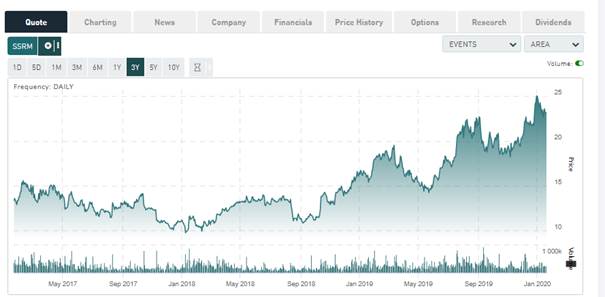
The company still has 1.045 million shares of SSR Mining (SSRM.TO), worth C$24.22 million at the moment (January 20, 2020), after having sold 200,000 shares of the original 1,245,580 shares received from SSR Mining as part compensation for the sale of the 25% interest in the Puna operation. The four-month hold period for the SSR shares ended at January 18, 2020, so the company probably sold the 200k shares as soon as possible. The sale netted the company C$4.5 million, which means Golden Arrow has about C$5 million in the treasury at the moment, and is fully funded for their 2020 exploration programs. According to management, the company has sufficient cash and cash equivalents to be able to take the Indiana project to PFS stage, and a market financing would only be considered if Golden Arrow shares were trading considerably higher.

When looking at the chart of SSR Mining, it can be seen why these shares are a great and liquid asset to have, as the company is performing very well and is profiting perfectly of the increasing precious metals prices for the last six months:

grg 1.png
Share price SSRM.TO; 3 year time frame (Source tmxmoney.com)

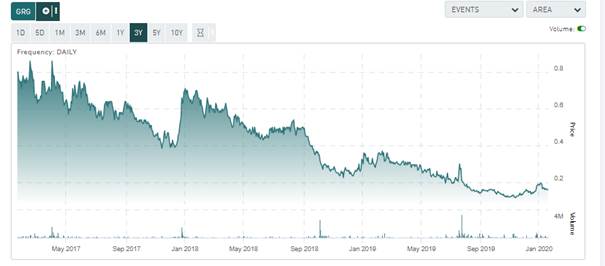
Golden Arrow has been trading the other way around, as its hands were tied most of 2019 and the timing of the much discussed, forced sale of Puna couldn’t have been more unfortunate, but this is all behind us now, and Golden Arrow seems to have bottomed now:

grg 2.png
Share price GRG.V; 3 year time frame (Source tmxmoney.com)

The company has, of course, more projects than just the Indiana project, and I was wondering if more information has become available at this moment. Not so much, according to management, regarding the Tierra Dorada project; the upcoming drill program is slated to start in Q2.

The Flecha de Oro project in Argentina has surface mapping and sampling underway and will be followed by detailed mapping and trenching in Q1/Q2. Further results will be announced in Q1.

Conclusion

I view the renegotiation of the Indiana Project deal as a very important one, as upcoming obligations in the first two years are limited to a minimum, but on the other hand the company gets a realistic opportunity to retain a 100% ownership of a very interesting project going into production. As the company is fully funded and still has about C$24 million in SSR Mining shares, which is a very good operator in my view and has exceptional leverage to rising precious metal prices, they don’t have to worry about cash now for a very long time. Together with its other exploration programs going on in Paraguay and Chile, Golden Arrow seems to be fully recovered and ready to profit from a potential new precious metals bull market.

Afbeelding met buiten, lucht, berg, veld

Automatisch gegenereerde beschrijving

I hope you will find this article interesting and useful, and will have further interest in my upcoming articles on mining. To never miss a thing, please subscribe to my free newsletter on my website, http://www.criticalinvestor.eu in order to get an email notice of my new articles soon after they are published.

The Critical Investor is a newsletter and comprehensive junior mining platform, providing analysis, blog and newsfeed and all sorts of information about junior mining. The editor is an avid and critical junior mining stock investor from The Netherlands, with an MSc background in construction/project management. Number cruncher at project economics, looking for high quality companies, mostly growth/turnaround/catalyst-driven to avoid too much dependence/influence of long-term commodity pricing/market sentiments, and often looking for long-term deep value. Getting burned in the past himself at junior mining investments by following overly positive sources that more often than not avoided to mention (hidden) risks or critical flaws, The Critical Investor learned his lesson well, and goes a few steps further ever since, providing a fresh, more in-depth, and critical vision on things, hence the name.

Sign up for our FREE newsletter at: www.streetwisereports.com/get-news

Disclaimer:
The author is not a registered investment advisor, currently has a long position in this stock, and Golden Arrow Resources is a sponsoring company. All facts are to be checked by the reader. For more information go to www.goldenarrowresources.com and read the company’s profile and official documents on www.sedar.com, also for important risk disclosures. This article is provided for information purposes only, and is not intended to be investment advice of any kind, and all readers are encouraged to do their own due diligence, and talk to their own licensed investment advisors prior to making any investment decisions.

Streetwise Reports Disclosure:
1) The Critical Investor’s disclosures are listed above.
2) The following companies mentioned in the article are sponsors of Streetwise Reports: None. Click here for important disclosures about sponsor fees. The information provided above is for informational purposes only and is not a recommendation to buy or sell any security.
3) Statements and opinions expressed are the opinions of the author and not of Streetwise Reports or its officers. The author is wholly responsible for the validity of the statements. The author was not paid by Streetwise Reports for this article. Streetwise Reports was not paid by the author to publish or syndicate this article. Streetwise Reports requires contributing authors to disclose any shareholdings in, or economic relationships with, companies that they write about. Streetwise Reports relies upon the authors to accurately provide this information and Streetwise Reports has no means of verifying its accuracy.

4) The article does not constitute investment advice. Each reader is encouraged to consult with his or her individual financial professional and any action a reader takes as a result of information presented here is his or her own responsibility. By opening this page, each reader accepts and agrees to Streetwise Reports’ terms of use and full legal disclaimer. This article is not a solicitation for investment. Streetwise Reports does not render general or specific investment advice and the information on Streetwise Reports should not be considered a recommendation to buy or sell any security. Streetwise Reports does not endorse or recommend the business, products, services or securities of any company mentioned on Streetwise Reports.
5) From time to time, Streetwise Reports LLC and its directors, officers, employees or members of their families, as well as persons interviewed for articles and interviews on the site, may have a long or short position in securities mentioned. Directors, officers, employees or members of their immediate families are prohibited from making purchases and/or sales of those securities in the open market or otherwise from the time of the interview or the decision to write an article until three business days after the publication of the interview or article. The foregoing prohibition does not apply to articles that in substance only restate previously published company releases. As of the date of this article, officers and/or employees of Streetwise Reports LLC (including members of their household) own shares of Golden Arrow Resources, a company mentioned in this article.

Charts and graphics provided by the author.

( Companies Mentioned: GRG:TSX.V; GARWF:OTCQB; G6A:FSE,
)

Categories
Gold

Experts See Opportunity in Ratios of Gold to Silver and Platinum

Source: Maurice Jackson for Streetwise Reports   01/23/2020

Andy Schectman of Miles Franklin Precious Metals Investments and Maurice Jackson of Proven and Probable discuss investment strategies centered on precious metals ratios.

Maurice Jackson: Joining us for a conversation is Andy Schectman, the president of Miles Franklin Precious Metals Investments.

Always a pleasure to have you on the program to discuss the value proposition before us in precious metals. Today we will identify three exciting value propositions for your precious metals portfolio that are currently selling at a deep, deep discount.

Mr. Schectman, you have a proven pedigree of success in the precious metals space. I want to discuss a methodology that has made you and the clients of Miles Franklin very handsome returns over the years, and that is your use of ratios. Sir, please explain why it is paramount for precious metals investors to have a thorough understanding on precious metals ratios.

Andy Schectman: When we last spoke I shared that legendary investor Rick Rule is fond of saying, “the deal’s in rhetoric,” and he deals in arithmetic. I like to look at the world the exact same way, from the standpoint of arithmetic, and at least in terms of any precious metals investor, ratios are very, very, very important in mathematics. They are another way of saying the law of averages. As we look at ratios that fall out of historical average, they represent opportunities—in fact, distinct opportunities. I guess the easy way of saying that is the farther away you get from long-term established averages, the greater the magnetism that pulls you back to the average.

I’m here in Minneapolis, where the high today may be 20–25 degrees. If I woke up this morning and it was 85 degrees in the middle of the winter, I wouldn’t rush to pull out my lawn furniture and assume that spring has come early. It’s an aberration, it’s an anomaly. When I look back at what has made me successful over the years, in many respects the ability to identify and exploit price anomalies or averages or ratios has really been at the very forefront of my success. It’s something that I’m keenly aware of and like to share as often as possible.

Maurice Jackson: Speaking of opportunities and anomalies, let’s discuss our first value proposition, and that is gold. Andy, please introduce the Dow-Gold ratio.

Andy Schectman: Historically, when the Dow can be bought for five ounces of gold, we buy stocks and sell gold. When it takes over 15 ounces to buy the Dow, you sell stocks and buy gold. Bill Bonner, who’s a very smart man, has a chart [and] he’s been tracking this for the last hundred years. Had you followed that pattern over the last hundred years, there would have been six possible trades that you could have made and you would have won on every single one of them. I guess as a rule of thumb, 15 or higher you sell the Dow, you buy gold. Five or lower, you do the opposite.

I would argue, however, that due to the manipulation of the price of gold and the easy currency by the Federal Reserve that has found its way into inflation of asset prices, that these ratios are even more skewed than they should be. They are artificially positioned, and so like the rubber band being stretched or a spring being stretched, when it pops it will pop significantly more because both prices have been artificially positioned, that of gold and arguably of the Dow, [which is] at all-time highs based upon every single metric.

At this point right now with the ratio much higher than 15:1—closer to 19:1—the idea would be to sell the Dow and to buy gold, absolutely. I could make the strong argument that the Dow is strongly overvalued based upon metrics. It still may go higher, but based upon historical metrics, the Dow is overvalued, and based upon historical metrics, you could argue that gold is significantly undervalued, making this a no-brainer trade, actually.

Maurice Jackson: Now that we understand the virtues of knowing the Dow-Gold ratio, let’s look at another value proposition, and that is silver. Andy, please introduce the gold-silver ratio.

Andy Schectman: Geologically, the silver-gold ratio is 15.5:1, meaning geologically, what comes out of the ground is 15.5 times silver, more abundant than gold. For the last hundred-plus years, that ratio has been about 42:1 on average. If you listen to some people in the industry who are at the forefront of it, like Keith Neumeyer, the CEO of First Majestic Silver Corp. (FR:TSX; AG:NYSE; FMV:FSE), he’s publicly said that what they see coming out of the ground is closer to 9:1.

In the respect that silver is found in nature in what is called epithermal [deposits, which] means that it is very close to the surface, most of the big deposits of silver have been found long, long ago, and 65% of what is mined today in silver comes from byproduct mining of other metals. It’s a situation where you could argue that what’s coming out of the ground right now is far less than what has historically been expected to come out of the ground. In other words, 9:1 might even be more than what we see coming out of the ground. In any case, a ratio right now of 86:1 or thereabouts is an anomaly. It’s only happened a few times in the last 150 years.

The last time we saw it was in 2010. We saw a ratio of 80:1. Within one year in 2011, you had gold at nearly $2,000 and silver at $50. That’s 40:1. The historical average going back literally over 150 years is 42:1, so at this point right now, at 86:1, a strong, strong argument could be made for temporarily trading your gold into silver. What I mean by temporarily is we sell the gold and buy silver. When the ratio normalizes, you trade back into gold and you double the amount of gold you started with without spending a penny. Here again, a ratio of 86:1 is like waking up in Minneapolis in January to find 85-degree weather. It just doesn’t happen, and if it does it’s an anomaly.

Maurice Jackson: Let’s discuss value proposition number three, and it’s probably my favorite, and that is platinum. Andy, please introduce the gold-platinum ratio.

Andy Schectman: When I think of platinum, first of all, platinum is about 30 more times rare than gold. I don’t know exactly how many more times more rare, but it’s significantly more rare than gold, and forever, platinum is traded at a higher price than gold. In fact, I can remember—I think it was around 2008, with gold around $800 and platinum north of $2,000—it was three times the price of gold. But [for] the first 20-plus years of my career, 25 years—going back 50 years [from] that—platinum always traded at a premium to gold, sometimes a hundred bucks, sometimes double, sometimes triple, but always a premium.

The fact that it’s trading at a discount to gold right now is another anomaly, just as the platinum-palladium ratio is an anomaly.

I think at this point the argument would be to sell gold and buy platinum, obviously, because it is so far out of whack. There are reasons, [and] a lot of it has to do with Dieselgate—the fact that. . .typically, unleaded catalytic converters are made of palladium, and for diesel, of platinum. With the push to get diesel fuel vehicles off the road due to emissions, platinum has suffered. That is the easy answer.

I don’t know if it’s deeper than that or not, but simply. . .the ratio is way out of whack, and [for] the 30 years I’ve done this, 28 and a half or 29 of those years it would have cost you more money to buy platinum than it would to buy gold.

The fact that we have that ratio upside down right now—a 1:6 ratio—it’s an anomaly. It’s 85 degrees in the middle of January in Minneapolis. These are true value propositions, true anomalies when referenced with historical averages.

Maurice Jackson: Now, Andy, we didn’t reference palladium or rhodium, and that was, again, because of the ratios. Is that correct?

Andy Schectman: That’s exactly correct. Yes, absolutely.

Maurice Jackson: Now, if somebody wants to take advantage of the buying opportunities in gold, silver and platinum, what’s the process?

Andy Schectman: Sure. It’s as simple as giving either Miles Franklin a call, giving Maurice a call, myself a call. Any of us here at Miles Franklin are happy to assist, and we start by answering questions. We prefer to do things the old-fashioned way. With the threat of identity theft and cyber threats, we have decided to really take this offline, do things the old-fashioned way, answer questions and give personal service to any of our clients, starting with answering questions first. If we do a good job at answering your questions, then hopefully we get to the point of transacting business.

As far as placing an order is concerned, it couldn’t be easier. We decide what you want, we lock in the order on a verbal handshake. An invoice is then e-mailed to the client; overnighted if they prefer by Federal Express. Once the invoice is paid for, I wire a check. Everything is sent by UPS, insured overnight or three-day. If it’s silver, typically for free. It’s pretty much that simple.

Maurice Jackson: That is registered mail, is that correct?

Andy Schectman: Yes, sir, that is correct, or UPS insured. Either one.

Maurice Jackson: Mr. Schectman, for someone listening that wants to get more information regarding Miles Franklin, please share the contact details.

Andy Schectman: The website is Miles Franklin Precious Metals Investments, where they can sign up for our free daily newsletter. I can be reached at andy@milesfranklin.com, and my number is 1 (800) 255-1129. Our main number is 1 (800) 822-8080.

Maurice Jackson: As a reminder, I’m a proud licensed representative for Miles Franklin Precious Metals Investments, where we provide a number of options to expand your precious metals portfolio, from physical delivery, offshore depositories, precious metal IRAs, and private blockchain-distributed ledger technology. Call me directly at (855) 505-1900, or you may e-mail maurice@milesfranklin.com.

Finally, we invite you to subscribe to www.provenandprobable.com, where we provide mining insights and bullion sales.

Mr. Schectman, thank you for joining us today on Proven and Probable.

Maurice Jackson is the founder of Proven and Probable, a site that aims to enrich its subscribers through education in precious metals and junior mining companies that will enrich the world.

Sign up for our FREE newsletter at: www.streetwisereports.com/get-news

Disclosure:
1) Statements and opinions expressed are the opinions of Maurice Jackson and not of Streetwise Reports or its officers. Maurice Jackson is wholly responsible for the validity of the statements. Streetwise Reports was not involved in the content preparation. Maurice Jackson was not paid by Streetwise Reports LLC for this article. Streetwise Reports was not paid by the author to publish or syndicate this article.
2) This article does not constitute investment advice. Each reader is encouraged to consult with his or her individual financial professional and any action a reader takes as a result of information presented here is his or her own responsibility. By opening this page, each reader accepts and agrees to Streetwise Reports’ terms of use and full legal disclaimer. This article is not a solicitation for investment. Streetwise Reports does not render general or specific investment advice and the information on Streetwise Reports should not be considered a recommendation to buy or sell any security. Streetwise Reports does not endorse or recommend the business, products, services or securities of any company mentioned on Streetwise Reports.
3) From time to time, Streetwise Reports LLC and its directors, officers, employees or members of their families, as well as persons interviewed for articles and interviews on the site, may have a long or short position in securities mentioned. Directors, officers, employees or members of their immediate families are prohibited from making purchases and/or sales of those securities in the open market or otherwise from the time of the interview or the decision to write an article until three business days after the publication of the interview or article. The foregoing prohibition does not apply to articles that in substance only restate previously published company releases.

Proven and Probable LLC receives financial compensation from its sponsors. The compensation is used is to fund both sponsor-specific activities and general report activities, website, and general and administrative costs. Sponsor-specific activities may include aggregating content and publishing that content on the Proven and Probable website, creating and maintaining company landing pages, interviewing key management, posting a banner/billboard, and/or issuing press releases. The fees also cover the costs for Proven and Probable to publish sector-specific information on our site, and also to create content by interviewing experts in the sector. Monthly sponsorship fees range from $1,000 to $4,000 per month. Proven and Probable LLC does accept stock for payment of sponsorship fees. Sponsor pages may be considered advertising for the purposes of 18 U.S.C. 1734.

The Information presented in Proven and Probable is provided for educational and informational purposes only, without any express or implied warranty of any kind, including warranties of accuracy, completeness, or fitness for any particular purpose. The Information contained in or provided from or through this forum is not intended to be and does not constitute financial advice, investment advice, trading advice or any other advice. The Information on this forum and provided from or through this forum is general in nature and is not specific to you the User or anyone else. You should not make any decision, financial, investments, trading or otherwise, based on any of the information presented on this forum without undertaking independent due diligence and consultation with a professional broker or competent financial advisor. You understand that you are using any and all Information available on or through this forum at your own risk.

Categories
Gold

Fun on Friday: Plastic Gold

My stepdad used to grump about everything being made out of plastic. This was a thing with him even way back when I was a little kid. “All these plastic toys… back in my day toys were wood and metal.” It really got under his skin when they started using plastic in tools. He called […]

The post Fun on Friday: Plastic Gold appeared first on SchiffGold.com.

Categories
Gold

Zombie Economy: SchiffGold Friday Gold Wrap Jan. 24, 2020

While impeachment proceedings kicked off at home President Trump was in Davos, Switzerland, talking up the US economy. He called it the best economy in American history. Is it though? In this episode of the Friday Gold Wrap podcast, host Mike Maharrey talks about the economy, what’s really driving it, and why this might be […]

The post Zombie Economy: SchiffGold Friday Gold Wrap Jan. 24, 2020 appeared first on SchiffGold.com.

Categories
Gold

An Army For Hire: Trump Wants To Make Money By Renting Out American Soldiers

To stay that there has been some strange stuff coming out of the White House lately would be an understatement… by Philip Giraldi via Strategic Culture To stay that there […]

The post An Army For Hire: Trump Wants To Make Money By Renting Out American Soldiers appeared first on Silver Doctors.

Categories
Gold

Greg Hunter: Sham Impeachment Dud, Dem 2020 Election Panic And Economic Warning Signs

Why are the Democrats pushing this sham impeachment that is basically a fraud on the Constitution? Greg Hunter gives The Weekly News Wrap-Up for Friday, January 24th, 2020 Why the […]

The post Greg Hunter: Sham Impeachment Dud, Dem 2020 Election Panic And Economic Warning Signs appeared first on Silver Doctors.

Categories
Gold

Gold & Silver: Prevention Only Works Before US, China Or Global Economy Gets Flu (Wuhan Virus)

SD Friday Wrap: Gold & silver catch a bid as the “markets” begin to price-in the effects of a global pandemic… Edit: These charts were set-up around approximately 1:30 p.m. […]

The post Gold & Silver: Prevention Only Works Before US, China Or Global Economy Gets Flu (Wuhan Virus) appeared first on Silver Doctors.

Categories
Gold

Ron Paul: The Truth Comes Out – New Evidence Syria Gas Attack Evidence Falsified

Were the documents falsified under pressure from the US government, and why is the MSM silent on this? by Ron Paul of Ron Paul Liberty Report Former OPCW inspector Ian […]

The post Ron Paul: The Truth Comes Out – New Evidence Syria Gas Attack Evidence Falsified appeared first on Silver Doctors.

Categories
Gold

John Rubino: Why A Flu Outbreak In China Can Spook The Markets

Financial markets understand that should a contagious, fatal virus start to spread between countries, the immediate response will be… by John Rubino of Dollar Collapse When people talk about empires of the […]

The post John Rubino: Why A Flu Outbreak In China Can Spook The Markets appeared first on Silver Doctors.