
Click here to get this article in PDF
As gold reaches record highs, the value of the United States’ gold reserves has far exceeded $1 trillion. Yet, the Federal Reserve still operates under a dollar-linked conversion rate set in 1973.
In this week’s The Gold Spot, Scottsdale Bullion & Coin’s Precious Metals Advisors Joe Elkjer and Todd Graf uncover the massive gulf between the market and book value of America’s gold reserves, the current legislation that may correct this discrepancy, and how this simple switch could help take pressure off the staggering national debt.
America’s Trillion-Dollar Gold Discrepancy
The U.S. holds the largest official gold reserves in the world, a status that’s been maintained for decades. Currently, the Department of the Treasury maintains an estimated 261,499,926 troy ounces, which works out to roughly 8,133.5 metric tons. For reference, the second-closest central bank only holds 3,384.2 tons of gold, less than half that of the U.S.
With gold prices sitting around $5,000/oz, the federal government’s gold reserves would be worth an estimated $1.2 trillion. However, the Federal Reserve lists the country’s physical gold holdings at only $11 billion, a mere fraction of their fair market value. What appears to be a colossal accounting error actually stems from historical gold evaluations.
Why Does the U.S. Value Its Gold at $42 an Ounce?
Throughout the gold standard era, the United States defined the dollar in terms of gold, allowing paper currency to be converted into physical metal and anchoring confidence in the monetary system. That fixed relationship evolved through legislation, beginning near $19.39/oz in 1792 and rising to $42.22/oz in 1973 after the breakdown of the Bretton Woods Agreement.
For the past five decades, the U.S. government has continued using the $42.22/oz price for accounting purposes, even though the spot price of gold has been allowed to float freely. The Treasury states clearly that this is “the book value is not the market value, but instead represents the total number of troy ounces multiplied by a value established by law…set in 1973.”
Gold Steps Back Into the Policy Spotlight
No administration in recent memory has generated more policy chatter surrounding the nation’s gold reserves than the current one. In the early days of Trump 2.0, Elon Musk floated the idea of auditing Fort Knox — the primary storage site for much of the U.S. bullion. The plan seems to have faded away with the broader DOGE efforts.
Of particular note was Treasury Secretary Scott Bessent’s brief mention of “the asset side of the U.S. balance sheet for the American people.” This was widely interpreted as a potential gold revaluation. Although Bessent was quick to shoot down these inferences at the time, current legislation suggests a revival of the idea.
A Bitcoin Proposal’s Hidden Repricing Trigger

The Bitcoin Act of 2025, currently under committee consideration, proposes establishing a strategic Bitcoin reserve. The goal of the legislation, according to supporters, is to diversify the country’s assets. On its face, this seems like another cryptocurrency law, right in line with the stablecoin bills this crypto-friendly administration has explored.
Hidden deep within the bill’s legalese, however, is a proposal to update the official gold valuation as a potential accounting mechanism to recognize existing asset value. Effectively, this would act as an official revaluation of gold from the decades-old $42.22/oz price, allowing the Fed to recognize the true value of its monstrous reserves.
Would a Gold Price Revaluation Solve the Debt Problem?
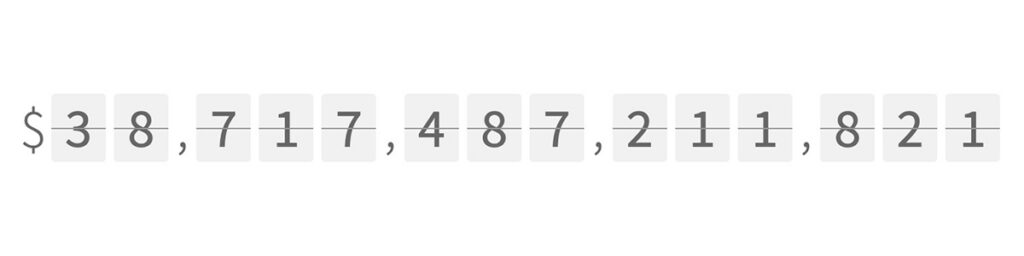
With a simple accounting decision standing in between the U.S. government and an asset boost of more than $1 trillion, budget-weary investors are wondering how this revaluation could impact the national debt. Currently, the U.S. is running a $38.7 trillion debt, so even a full realization of the country’s reserve value would fail to make a meaningful dent.
Besides, recalibrating the Fed’s gold holdings would enhance its balance sheet, not reduce its debt directly. However, more assets could improve America’s fiscal flexibility and financial reputation, making it easier to handle the colossal debt burden.
Recent Fed Analysis Shows Fiscal Impact of Gold Revaluation
In August 2025, the Fed’s Board of Governors quietly released a report examining how governments have used valuation gains on gold reserves in the past. The report found that such proceeds have typically been used to offset central bank losses, manage public debt, or strengthen balance sheets. In the U.S. case, the Fed estimated that revaluing gold reserves could generate proceeds equal to roughly 3% of the gross national product (GDP).
Notably, that estimate was based on gold trading near $3,300/oz at the time of the study. With gold around $5,000/oz today, the potential impact rises accordingly. With the economy roughly at $31 trillion and gold prices near all-time highs, the revaluation would now represent about 4.5% of the GDP.
How Markets Might Respond

If gold were formally revalued or its monetary role reasserted, analysts agree the price response would not occur in a vacuum. Markets would immediately begin repricing gold to reflect its renewed balance sheet significance and its role in global reserves.
Some analysts argue that $10,000/oz to $20,000/oz is not unrealistic in a post-revaluation environment, particularly if global central banks respond by increasing gold holdings or if confidence in fiat currencies weakens. Although estimates vary widely, the projections align with optimistic 2026 gold price forecasts.
Don’t Wait to Buy Gold, Buy Gold and Wait
While there is no guarantee this particular bill will pass or trigger a revaluation of U.S. gold reserves, the legislative push reflects a growing call for gold to take a more central role in domestic fiscal policy. On the global stage, central banks are accumulating gold at record levels, and the metal has been recognized as a Tier 1 asset within the international financial system.
As the saying goes in the market, it is better to buy gold and wait than to wait to buy gold. The momentum behind gold reemerging as a core economic asset has rarely been stronger. Now may be an opportune time to consider greater exposure.
If you would like to learn more about how physical gold can help protect your portfolio while avoiding common pitfalls, grab a FREE copy of our Rookie Mistakes Guide.
Question or Comments?
If you have any questions about today’s topics or want to see us discuss something specific in a future The Gold Spot episode, please add them here.
CommentPowered by WPeMatico
Questions or Comments?
“*” indicates required fields