
Click here to get this article in PDF
With a historic shakeup coming to Congress this November and the national debt entering territory the government’s own budget office calls “unsustainable,” many investors are wondering what corrective measures their leaders are willing to take…if any.
In this week’s The Gold Spot, Scottsdale Bullion & Coin Founder Eric Sepanek and Precious Metals Advisor John Karow discuss the political impact of the upcoming midterms, how incoming lawmakers may approach the growing debt challenge, the fiscal cliff facing major social welfare programs, and what investors can do to help protect their wealth.
Will the Midterm Shakeup Change Anything?
This November, Congress is facing a historic overhaul with a volatile combination of retirements and open seats. About 10% of House representatives have announced their intention not to run again, the second-highest number of retirements in decades. In total, that’s 26 Republicans and 21 Democrats, suggesting that this widespread defection is bipartisan. On top of that, 11 Senators are vacating their positions, adding to the upcoming revamp of the legislative branch, according to a PBS report.
With some of the most established and senior members leaving Congress, the American people are eagerly awaiting the fiscal impact of this influx of new members. If history reveals anything, the fresh faces in the House and Senate are unlikely to ruffle any fiscal feathers, preferring to go along to get along. Most likely, they’ll continue passing the buck down to the next seat, as several generations of reps have for decades.
Even those members with the desire to rein in the U.S. national debt, implement spending caps, and control the debt are almost guaranteed to fail in their endeavor. The pace of spending in Washington has decades of momentum behind it, and newcomers will struggle to keep up.
“These are all beginners. Washington will continue, will not slow down, will continue with doing what it’s always done. And they don’t have a chance of catching up.”
John Karow
Precious Metals Advisor

The Government Calls the National Debt “Unsustainable”
Last month, the Congressional Budget Office (CBO) — a nonpartisan federal financial group that compiles reports on the country’s fiscal and economic trajectory — released The Budget and Economic Outlook: 2026 to 2036. Upon the release of this sobering report, the government referred to the national debt as “unsustainable,” projecting it could reach $50 trillion by 2030.
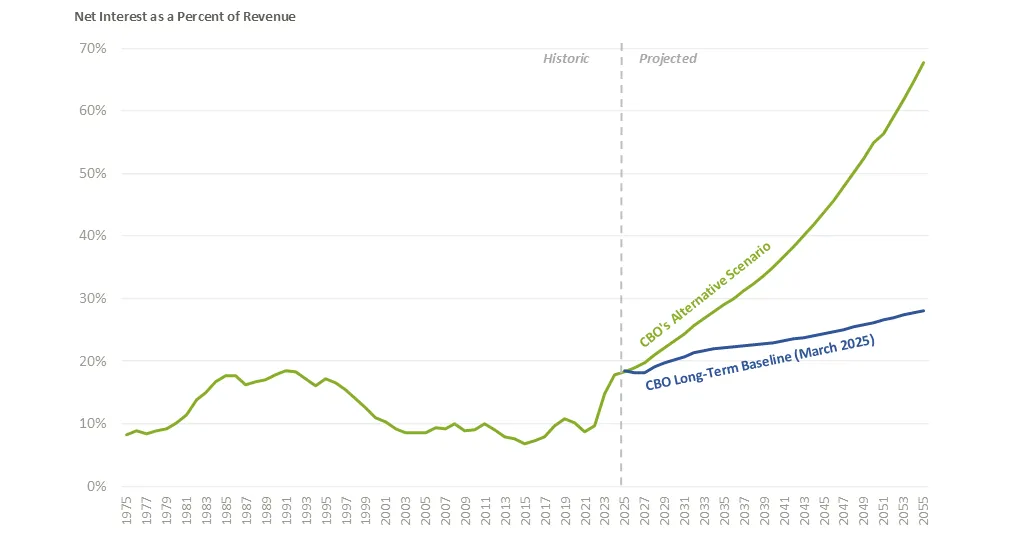
While the report reveals several troubling figures, net interest costs stand out as both a serious threat to the national budget and a stark reflection of how far the situation has spiraled. In a special episode of The Gold Spot, Congressman David Schweikert called these figures “dark numbers.”
Three of the most glaring stats include:
Net interest payments have now surpassed $1 trillion, even eclipsing the defense budget.

The CBO projects those payments could double to nearly $2 trillion by 2035.

By 2055, interest costs are expected to consume more than 30% of all federal revenue.
The Fast-Approaching Social Security & Medicare Cliff
While rising interest payments are the blaring alarm signaling the nation’s growing debt, and an increasingly large share of federal spending, the primary driver of debt accumulation, and of its accelerating pace, is mandatory spending.
Consider that Social Security and Medicare, the two largest federal programs in the country by budget, account for over one-third of the annual federal budget.

The main funding arm of Social Security is expected to run dry in 2034, triggering automatic cuts of between 20% and 25%. This would have disastrous and immediate consequences for the nearly 40% of seniors who rely exclusively on Social Security for retirement income. For context, over 70 million people receive these benefits annually. The funding limit for Medicare follows a similar trajectory.
Recent developments, such as the war with Iran, certainly affect the budget, but they’re a drop in the bucket compared to these recurring, guaranteed expenses.
“Forget about a $40 trillion debt, a $50 trillion debt, a $60 trillion debt. I see us pushing this to infinity and beyond when it comes to the debt. The question is, how long is that sustainable?”

Eric Sepanek
SBC Founder
Politicians Take the Easy Way Out
In an economy dominated by Modern Monetary Theory (MMT), which treats debt as an asset and spending as a cure-all solution, the response to this budget catastrophe is unlikely to solve the problem.
While tough decisions and austerity measures are the likely true solution, elected officials are most likely going to flip on the money printer to keep these programs funded. However, this quick fix will only compound the fallout from the debt bubble in the long run.
“If you want to get reelected or elected, you don’t want to give people scary news because there are two things that people fear more than anything in the world. That’s poverty and death. Those are the two things that you really want to kind of not talk about if you’re running to try to win.”
Eric Sepanek
SBC Founder
Although many hope the influx of fresh faces in Congress will mark a turning point toward greater fiscal responsibility, history suggests the opposite is more probable. As previously discussed, green representatives are at a disadvantage due to a lack of procedural knowledge and a lack of willingness to take risks.
Investors Start Questioning the Pyramid Scheme

With the bicentennial of the United States approaching, the federal government can seem faultless. Yet the Congressional Budget Office’s own fiscal outlook suggests otherwise.
If the federal government were a company, its balance sheet would likely give investors pause. Few would willingly put their capital into an organization that continues to take on large amounts of debt while committing a significant share of its budget to mandatory spending.
Foreign governments often assess the U.S. fiscal position through the same financially-focused lens, which helps explain why some countries have been gradually reducing their holdings of U.S. Treasuries and exploring alternatives to the greenback amid the de-dollarization trend sweeping the globe.
The equation is somewhat different for Americans, but a growing number of savvy investors are diversifying their portfolios with physical gold and silver and reducing their exposure to the dollar to protect their wealth.
“In uncertain times, the only certain thing is gold.”
John Karow
Precious Metals Advisor
To avoid costly missteps when investing in precious metals, claim a FREE copy of our Rookie Mistakes Guide. For a deeper dive into the policies shaping today’s debt-driven economy, get our Modern Monetary Theory Report.

Modern Monetary Theory, the Catalyst to the Next Financial Crisis?
Get Report – It’s Free!
Question or Comments?
If you have any questions about today’s topics or want to see us discuss something specific in a future The Gold Spot episode, please add them here.
CommentPowered by WPeMatico
Questions or Comments?
“*” indicates required fields