Click here to get this article in PDF
A sudden plunge, a swift rebound, and new questions about the gold and silver market’s foundation have investors paying close attention.
In this week’s The Gold Spot, Scottsdale Bullion & Coin Founder Eric Sepanek and Sr. Precious Metals Advisor Damian White explore why precious metals fell so fast, why some experts warn about a market-wide physical silver default, and what these developments say about the direction of gold and silver prices.
“Historic” Losses Don’t Deter Metals Rally
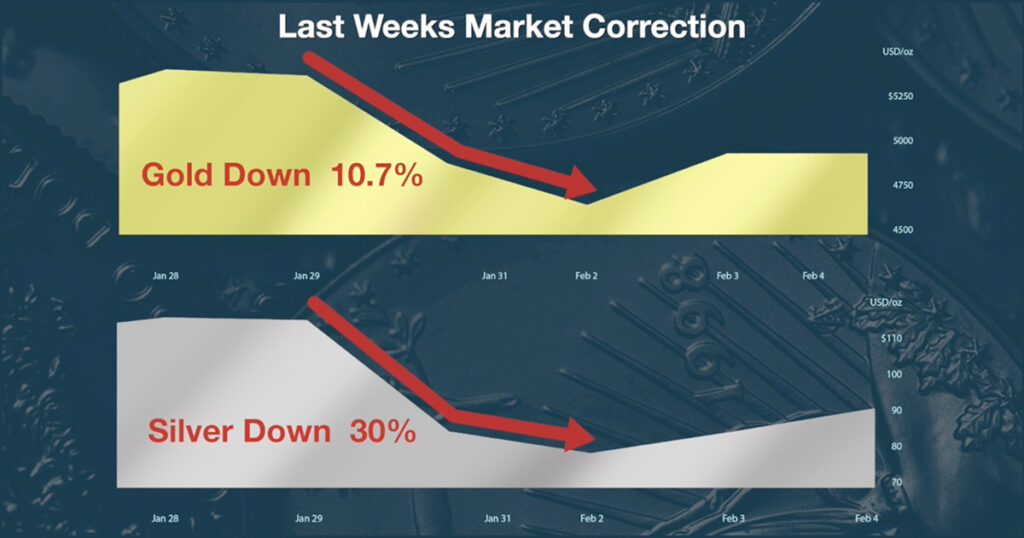
Following years of largely steady upward momentum, the precious metals markets suffered a severe bout of volatility earlier in the month. Between January 29th and February 2nd, gold and silver prices tumbled by 10% and 30%, respectively, paring back some of the meteoric gains seen from the beginning of the year.

These sudden, unexpected losses have left many investors questioning the rally’s structural integrity and the future direction of gold and silver prices. While these precipitous drops are alarming in isolation, the broader context remains indicative of a robust upward trend. Factoring in these recent drops, gold prices are still up ~70% over the past year.

Even more impressive, silver prices maintain an annual gain of about 140%.

Only days following their plunging performance, both precious metals have started to reclaim some of their losses — suggesting the tremor was more of a correction than a trend reversal. That’s a remarkable recovery for both metals, considering that gold’s fall was the largest decline since 2013, and silver hasn’t seen a worse performance since 1980.
The Perfect Storm Behind Gold and Silver’s Slide
The more immediate causes of the collective, drawdown in precious metals were an impactful cocktail of shifting macroeconomic conditions, political developments, and monetary policy decisions. Within the few days gold and silver slipped, the following happened in quick succession, compounding the shock:
- Hawkish Fed Pick: Trump’s nomination of hawkish Kevin Warsh as the next Federal Reserve Chairman relieved concerns about the central bank’s independence and buoyed U.S. dollar prices.
- Record Prices: Gold prices shot up to a record of $5,600/oz within a few weeks of the new year, and silver prices were setting their own records, heating up an already booming trend.
- Elevated Margin Requirements: The CME Group, which runs the COMEX, increased margins across the market. Gold margins were boosted from 6% to 8%, and silver margins spiked from 11% to 15%, putting more pressure on traders.
- Improved Economic Outlook: Record stock market highs and increased investor confidence created a permission structure for dollars to shift away from the in-demand metals market to equities and other more mainstream instruments.
Physical Silver Market Strain
Another less visible but potentially more structural factor behind the recent turbulence was the calendar itself. February 27, 2026, marked First Notice Day for March silver contracts — the point when holders of futures must either settle in cash or stand for physical delivery.
That timing matters because a growing number of traders are choosing the latter. Veteran market analyst Bill Holter has warned that COMEX could struggle to meet delivery obligations if requests for physical silver bullion continue to outpace registered inventories, raising the specter of a delivery default at the nation’s primary bullion exchange.
Any meaningful shortfall in settlements would shake confidence in today’s paper-driven pricing system. If contracts promising physical silver cannot be honored on demand, the credibility of current price discovery mechanisms would be called into question, potentially forcing a fundamental reset in how the precious metal is valued.
January Demand Spike Raises March Madness Concerns
January is typically a sleepy month for physical silver delivery. Yet in 2026, demand ran 20 to 40 times above normal levels. Most years see 1 to 2 million ounces, occasionally as much as 20 million, change hands in the first month. This January, however, roughly 40 million ounces stood for delivery.
That unforeseen spike has turned attention toward March, when 70 to 80 million ounces are expected to be delivered. The imbalance is striking: the COMEX shows around $500 million worth of contracts outstanding, while only about 110 to 120 million ounces are currently on hand.
Evidence of Strain in the Silver Pipeline
On-the-ground data underscores that the pressure is more than theoretical. In a period of just seven days, 33.45 million ounces were withdrawn from COMEX warehouses — roughly 26% of registered inventory. At the same time, silver lease rates climbed to 8%, a level rarely seen outside periods of acute tightness, while dealers began charging extra premiums for early delivery to secure metal ahead of schedule.
Against this backdrop, the paper-to-physical silver ratio remains above 500:1, highlighting how many more claims on silver exist than immediately deliverable silver bars. This structural imbalance has traders questioning how smoothly March settlements can proceed.
What This Means for Silver Prices
Although investors may have feared the precious metals tumble would lead to downward price revisions, the opposite has happened. Many prominent experts have reaffirmed or increased their outlooks, especially for silver, in the wake of last week’s rapid retracement and the physical market weakness it mirrored.
In the event of a market-wide delivery default, the price movement could go parabolic, reaching levels considered improbable not long ago. A complete COMEX settlement shortfall would effectively blow the lid off price expectations, rendering even a $600/oz silver price call “ridiculously underestimated,” according to Bill Holter. Peter Krauth believes silver could hit $300/oz easily in what he describes as a “frenzy phase.”
Across various technical and price analyses, experts seem to agree that $50/oz has been firmly established as silver’s new floor, meaning silver prices are unlikely to fall below this threshold again. The outlook is just as shiny for the yellow metal, with many experts already revising their 2026 gold price predictions only a month into the year.
 SUGGESTED READING
Silver Price Forecasts 2026
READ NOW
The Bigger Shift Behind Silver’s Strength
The structural market tightness in the physical silver market is another symptom of a broader economic shift. Official and institutional investors are shedding USD and dollar-linked assets in favor of physical assets. The current conditions of the precious metals markets are struggling to keep up with unprecedented demand, creating short-term dips yet a foundation of upward pressures.
Silver is experiencing increased consumption from both industrial and investment applications. Meanwhile, gold demand is smashing records across the board.
If you’re eager to get ahead of this seismic economic shift toward hard assets and structure your portfolio for success, read our FREE Gold Rush 2.0 report today.

Question or Comments?
If you have any questions about today’s topics or want to see us discuss something specific in a future The Gold Spot episode, please add them here.
Comment
Questions or Comments?
“*” indicates required fields